Feeds:
Posts
Comments

Posts Tagged ‘Mike Flanagan’

Tom Hiddleston

“THE LIFE OF CHUCK” My rating: A-(Various PPV platforms)

111 minutes | MPAA rating: R

Mike Flanagan’s “The Life of Chuck” provides the 10 most joyful minutes of cinema I’ve seen in all of 2025.

Which is not bad for a movie that starts out depicting the end of the world.

“…Chuck” is a departure for writer/director Flanagan, possibly our best dispenser of supernatural horror (“The Haunting of Hill House,” “Midnight Mass,” both Netflix miniseries); but then it is based on what is probably the most atypical story ever penned by Stephen King.

I mean, we’re talking a weirdly-structured but deeply moving meditation on the meaning of life.

You know somebody’s tinkering with the time/space continuum when the opening titles tell us that the yarn begins with Chapter III.

Here we meet Marty Anderson (Chiwetel Ejiofor), a middle school teacher struggling (as is everybody else) with the rapid collapse of civilization.  First the Internet went down.  Now cell phones aren’t working.  TV stations are going off the air one by one, but not before announcing that most of Northern California has fallen into the Pacific.

There’s still electricity, but nobody knows how long the juice will keep flowing.

With classes cancelled, Marty wanders the streets of his town, now cluttered with abandoned cars.  He has a conversation with a funeral director (Carl Lumbly) about a blitz of billboards, banners and TV/radio commercials that have appeared overnight.  These declare “Charles Krantz. 39 Great Years! Thanks, Chuck!” and feature a photo of Chuck (Tom Hiddleston), a pleasant-looking guy wearing a business suit and spectacles.  Maybe Chuck is retiring from his job, though he doesn’t look nearly old enough.

And anyway, the world is ending.

A big chunk of Chapter III centers on Marty’s efforts to reconnect with his ex, Felicia (Karen Gillan), a nurse now jobless since all the high-tech medical machines in her hospital stopped working. Reunited, Marty and Felicia sit in her back yard watching the stars blink out one by one.

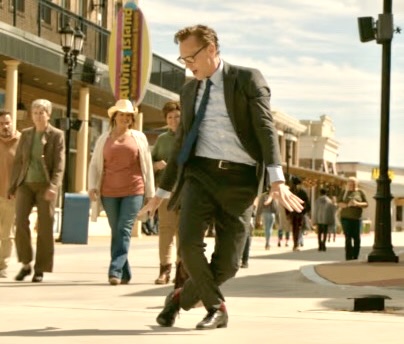
Next up is Chapter II. We find Chuck (Hiddleston) attending a conference for accountants. On a stroll through the city center he is confronted by a busking street drummer (Taylor Gordon). Listening to the percussive symphony she generates, the buttoned-down Chuck begins swaying tot he music.  

Then he starts doing a few dance steps.  Before long he’s grabbed the hand of a passer-by (Annalise Basso) and together they put on an impromptu display of big band terpsichorean razzamatazz that draws a cheering crowd.

It’s a heart-in-your-throat “Singin’ in the Rain” kind of moment. Pure movie magic. (Much love to Mandy Moore’s spectacular choreography).
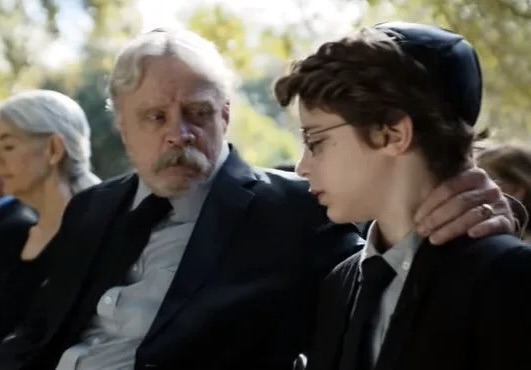
Mark Hamill, Benjamin Pajak

Then it’s on to Chapter I, which depicts Chuck’s childhood (as you’ve gathered by now, “The Life of Chuck” unfolds in reverse order). Orphaned by a car accident, young Chuck (he’s depicted as a middle schooler by the excellent Benjamin Pajak) is being raised by his grandparents (Mark Hamill and Mia Sara).

(Uh, wait a minute.  Mia Sara.  Wasn’t she Ferris Bueller’s squeeze only a couple of years back? Surely she can’t be anybody’s grandma.)

Anyway, this segment examines Chuck’s relationship with his loving grandparents, and his discovery of dance in an after-school club.  The kid’s a whiz…before long he’s the talk of the prom for cutting a rug with a girl two years his senior.  

Once again, the dance sequence is magic.  But what kind of career is dance for a red-blooded American boy? No, Chuck will grow up to study something more practical, like accounting.  But he’ll never forget the thrill of his body moving effortlessly to the music.

“…Chuck” bites off a big chew by attempting (in reverse) to depict one man’s life. What we come to realize is that Chapter III is actually unfolding in the head of a dying man.  Chapters I and II tell us how he got there, while introducing figures (Marty, Felicia, the funeral director) who will appear in his end-of-life reverie.

The film has been so deftly directed and acted (even from the unseen Nick Offerman, whose narration provides just the right taste of detached observation) that more than a few veiwers will find themselves in tears.  

| Robert W. Butler
Read Full Post »

Tom Hiddleston

“THE LIFE OF CHUCK” My rating: A-(Various PPV platforms)

111 minutes | MPAA rating: R

Mike Flanagan’s “The Life of Chuck” provides the 10 most joyful minutes of cinema I’ve seen in all of 2025.

Which is not bad for a movie that starts out depicting the end of the world.

“…Chuck” is a departure for writer/director Flanagan, possibly our best dispenser of supernatural horror (“The Haunting of Hill House,” “Midnight Mass,” both Netflix miniseries); but then it is based on what is probably the most atypical story ever penned by Stephen King.

I mean, we’re talking a weirdly-structured but deeply moving meditation on the meaning of life.

You know somebody’s tinkering with the time/space continuum when the opening titles tell us that the yarn begins with Chapter III.

Here we meet Marty Anderson (Chiwetel Ejiofor), a middle school teacher struggling (as is everybody else) with the rapid collapse of civilization.  First the Internet went down.  Now cell phones aren’t working.  TV stations are going off the air one by one, but not before announcing that most of Northern California has fallen into the Pacific.

There’s still electricity, but nobody knows how long the juice will keep flowing.

With classes cancelled, Marty wanders the streets of his town, now cluttered with abandoned cars.  He has a conversation with a funeral director (Carl Lumbly) about a blitz of billboards, banners and TV/radio commercials that have appeared overnight.  These declare “Charles Krantz. 39 Great Years! Thanks, Chuck!” and feature a photo of Chuck (Tom Hiddleston), a pleasant-looking guy wearing a business suit and spectacles.  Maybe Chuck is retiring from his job, though he doesn’t look nearly old enough.

And anyway, the world is ending.

A big chunk of Chapter III centers on Marty’s efforts to reconnect with his ex, Felicia (Karen Gillan), a nurse now jobless since all the high-tech medical machines in her hospital stopped working. Reunited, Marty and Felicia sit in her back yard watching the stars blink out one by one.

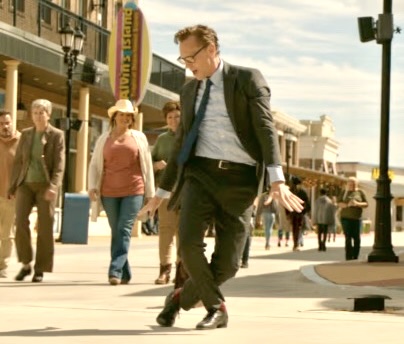
Next up is Chapter II. We find Chuck (Hiddleston) attending a conference for accountants. On a stroll through the city center he is confronted by a busking street drummer (Taylor Gordon). Listening to the percussive symphony she generates, the buttoned-down Chuck begins swaying tot he music.  

Then he starts doing a few dance steps.  Before long he’s grabbed the hand of a passer-by (Annalise Basso) and together they put on an impromptu display of big band terpsichorean razzamatazz that draws a cheering crowd.

It’s a heart-in-your-throat “Singin’ in the Rain” kind of moment. Pure movie magic. (Much love to Mandy Moore’s spectacular choreography).

Mark Hamill, Benjamin Pajak

Then it’s on to Chapter I, which depicts Chuck’s childhood (as you’ve gathered by now, “The Life of Chuck” unfolds in reverse order). Orphaned by a car accident, young Chuck (he’s depicted as a middle schooler by the excellent Benjamin Pajak) is being raised by his grandparents (Mark Hamill and Mia Sara).

(Uh, wait a minute.  Mia Sara.  Wasn’t she Ferris Bueller’s squeeze only a couple of years back? Surely she can’t be anybody’s grandma.)

Anyway, this segment examines Chuck’s relationship with his loving grandparents, and his discovery of dance in an after-school club.  The kid’s a whiz…before long he’s the talk of the prom for cutting a rug with a girl two years his senior.  

Once again, the dance sequence is magic.  But what kind of career is dance for a red-blooded American boy? No, Chuck will grow up to study something more practical, like accounting.  But he’ll never forget the thrill of his body moving effortlessly to the music.

“…Chuck” bites off a big chew by attempting (in reverse) to depict one man’s life. What we come to realize is that Chapter III is actually unfolding in the head of a dying man.  Chapters I and II tell us how he got there, while introducing figures (Marty, Felicia, the funeral director) who will appear in his end-of-life reverie.

The film has been so deftly directed and acted (even from the unseen Nick Offerman, whose narration provides just the right taste of detached observation) that more than a few veiwers will find themselves in tears.  

| Robert W. Butler

Read Full Post »

“BODIES”  (Netflix)

A good time travel yarn can really mess you up. 

Remember how dislocated and awed you felt after seeing the original “Terminator”?

How you started asking yourself questions about the immutability of time, about the possibility of changing the past or, even freakier, our own present?

That same sort of brow-furrowing mind massage is at work in the  deep-diving Brit series “Bodies.” 

Episode One sets up the tantalizing premise.  In present-day London the corpse of a naked man is found in an all-but-abandoned alleyway.  A police detective (Amaka Okafor) is stumped as to how he got there.

The scene then jumps to 1890s London where — WTF? — the same body is found in the same alley by a bearded and bowler-hatted police inspector (Kyle Soller).

But there’s more.  In 1941, with German bombers paying nightly visits, yet another copper (Jacob Fortune-Lloyd) stumbles into the same scenario.

And then, just when you think you’re getting a handle on it, the episode wraps up with the revelation that 30 years into the future another officer (Shira Haas) is dealing with the same body in the same crumbling alleyway.

Series creator Paul Tomalin (adapting Si  Spencer’s graphic novel) takes his time setting up his reveals…before any big answers are dangled he explores societal conflicts like contemporary racism, anti-Semitism during the Blitz or the Victorian-era inspector’s desperately closeted homosexuality.

Along the way there are all sorts of tantalizing hints at a monstrously massive conspiracy, members of which invariably sign off with the superficially comforting/existentially disturbing line: “Remember, you are loved.”

Eventually the film focuses on Mannix (Stephen Graham), who exists in all of these time frames, though not always as an adult (in our present he’s a troubled adolescent). Basically he’s playing God with time…and thus with everyone on Earth.

There are several big holes here.  The methodology of time travel isn’t explored..there’s this machine, but good luck figuring out how it got made and tested. And in one possible past/future the city of London is hit by a nuclear blast…it levels everything except that darned red-brick alleyway where the bodies keep dropping. Unlikely.

But the series’ slow-build momentum is such that you don’t dwell on these shortcomings, preferring to take in the big picture.

And that big picture will leave you juggling a score of metaphysical conundrums.

“THE FALL OF THE HOUSE OF USHER” (Netflix)

With “Midnight Mass” and “The Haunting of Hill House” writer/directorMike Flanagan shot to the top of the horror world, delivering slowly-unfolding creepfests that served as anguished meditations on the human condition while delivering multiple opportunities for great acting.

His latest, the 8-part “The Fall of the House of Usher,” is a step back, in part because just about everyone on screen is a truly horrible individual. Good luck looking for someone to empathize with.

Also, horror is much less scary when those threatened are evil bastards to begin with.

That said, the series is wildly successful in cannibalizing the Poe oeuvre, not just …Usher but most of his famous poems and short stories. No doubt as you read this some grad student is working on a thesis picking apart the series’ plethora of Edgar Allan Easter eggs.

The Usher family has become fabulously wealthy after developing an opiate pain killer that has addicted a good chunk of the population. (Yeah, they’re a thinly-disguised version of the Sacklers.)

At the top is Roderick Usher (Bruce Greenwood), now in his early 70s and, thanks to several marriages, the father of six very spoiled, desperately corrupted offspring.

The series is so jammed with flashbacks, subplots and digressions that a flow chart might come in handy. Basically, in just a month’s time all of Usher’s despicable heirs will die in bizarre ways. The common thread is a mysterious woman (Carla Gugino) who serves as a sort of Angel of Death (if you gotta go, doing so at Gugino’s hands seems preferable).

The whole thing is a huge flashback, as the doomed Roderick relates his clan’s twisted history to the prosecutor (Carl Lumbly) who has been trying for years to bring down the Usher empire.

The “Dynasty”-sized cast is filled with familiar faces from the Flanagan repertory company, as well as newcomers like Mary McDonnell as Usher’s scheming sister and Mark Hamill as the Ushers’ creepy legal fixer.

Unlike “…Hill House” and “…Mass,” I never experienced fright watching “The Fall of the House of Usher,” and that lack of emotional connection percolates throughout the enterprise. There’s a certain intellectual attraction in observing how Flanagan structures his story and, as previously stated, you can spend the whole thing picking out Poe references.

But genuine terror? Nope.

| Robert W. Butler

Read Full Post »