Feeds:
Posts
Comments

Posts Tagged ‘Tom Hiddleston’

Hugh Jackman

“THE DEATH OF ROBIN HOOD” My rating: B- (HBO Max)

122 minutes | MPAA rating: R

You can’t get much more revisionist than “The Death of Robin Hood,” a dour medieval psychodrama that suggests we’ve gotten it all wrong.

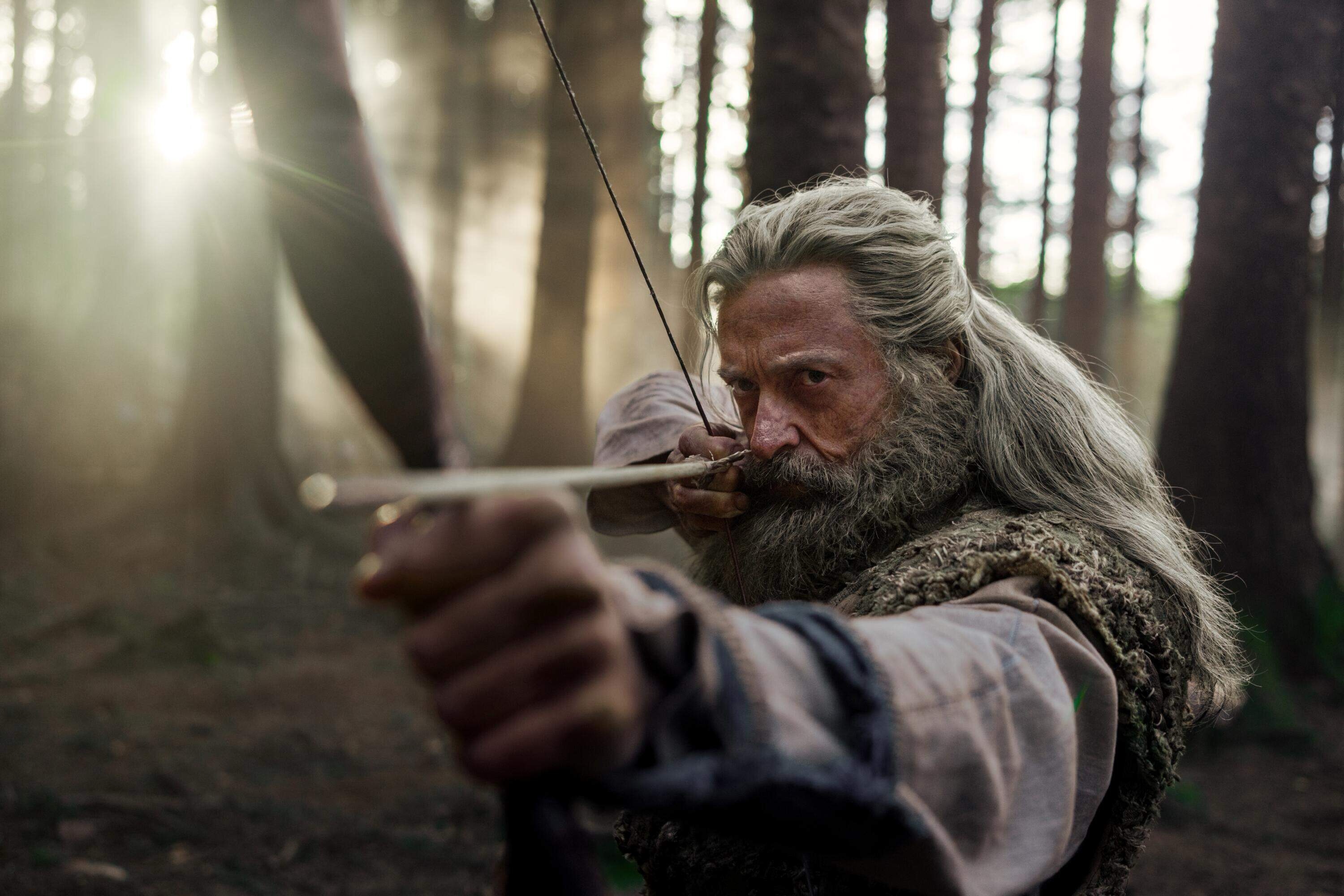
The Robin Hood portrayed by Hugh Jackman in writer/director Michael Sarnoski’s grimy, almost colorless period piece is a sociopath who has robbed and killed mostly for the fun of it.  Now in late middle age he’s a solitary wanderer, always on the lookout for revenge-minded kin of his countless victims.

In an early conversation with a boy he encounters in the wilderness, the unsmiling outlaw  deflates the fanciful myths that follow him everywhere.  Steal from the rich and give to the poor?  Fat chance.

Sarnoski’s screenplay kicks off with a reunion with Little John (Bill Skarsgard, virtually unrecognizable), who has spent the last few years laying low as a farmer, husband and father. But John has  been evicted by his landlord and his wife and child held prisoner. Now he wants Robin to help him get back what’s his.

The result is a bloodbath that leaves Robin so badly injured that John takes him to an island priory where the abbess, Sister Brigid  (Jodie Comer), has built a reputation for healing.

“The Death of Robin Hood” is nothing if not ambitious.  First presenting us with Robin as a conscienceless killer, the yarn’s second half is virtually violence free as the incapacitated bowman slowly regains his strength and is forced to contemplate just where his life has brought him.

Sister Brigid, it turns out, was widowed years before by Robin.  Will she remain a healer or become his executioner? Among the priory’s residents is a leper (Murray Bartlett) wrapped head to toe like a mummy but eager to delve into the outlaw’s psyche. A teen (Noah Jupe) being treated for the loss of an eye may be an assassin.

And then there’s Little John’s orphaned daughter (Katie Green),  who latches onto the grizzled bad man as her new Papa. Can a child’s love soften a hardened heart?

“The Death of Robin Hood” feels historically accurate in its recreation of a time and place, and the early violence is jarringly effective.

But the real reason to see it is Jackman’s eerie transformation into a graying, bearded lump of malevolent indifference.  When he’s on the screen you don’t want to look at anything else. Even when the film slows to a glacial, contemplative pace in the latter scenes, Jackman keeps our attention.
Genden Phuntsok, Tom Hiddleston

“TENZING” My rating: B+ (Apple+)

125 minutes | MPAA rating: PG

Visually ravishing and unexpectedly inspiring, “Tenzing” is a hugely effective recreation of a seminal moment in human history: the conquest of Mt. Everest.

But it’s also the  fiercely personal story of one man, the Nepalese mountaineer Tenzing Norgay who along with New Zealander Edmund Hillary first reached the summit of the world’s highest point in 1953.

Director Jennifer Peedom (her track record includes numerous documentaries about mountaineering) and co-writers Luke Davies and Ed Douglas center their piece on Everest, but provide a detailed backstory of Tenzing’s boyhood, marriage and gradual rise in the world of mountaineering.

Tenzing was born into a family of herdsmen who regarded the mountain that towered over them as the goddess Chomolungma (“Mother of the World”); in fact the boy Tenzing (Samdrup Dorje Lama) at one point met British climber George Mallory, who in the early 1920s led three failed attempts on Everest.

Incapacitated by an injury, young Tensing was left by his nomadic parents at the home of a well-to-do herdsman; he never saw them again. Instead he worked as a hired hand, often ridiculed because the dominant Sherpas regarded his tribe as inferior and provincial.

Nevertheless, as a young man (Tenzin Dalha) he wooed and won his boss’s daughter Kinzorn (Lhakpa Tsanchoe), moving with her to a more populated area where he hoped to become a laborer on climbing expeditions.

Tenzing and Kinzorn’s love story is both uplifting and shattering…while their two daughters were still adolescents she died, making his prolonged absences from home that much more painful.

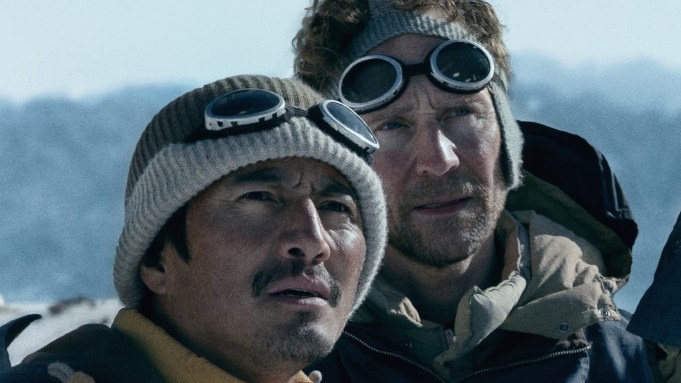
Tenzing (performed as an adult by the marvelously understated Genden Phuntsok) became a skilled climber, so much so that when British explorer John Hunt (Willem Dafoe) assembled a team to tackle Everest he put Tenzing in charge of the Sherpa crew that would lug tons of equipment up the mountain.

In that position Tenzing had to negotiate not only the incipient racism of his European bosses but also the resentment of his Sherpas, who regarded him as an outsider and fomented a rebellion that almost stalled the entire effort.

The film does a terrific job of laying out the physical dangers of Everest  (the cinematography of Stefan Duscio spectacularly captures the Himalayan vistas); you can practically feel the weariness through which the climbers fought and the frigid air that surrounded them.

With just a day to go before the monsoon season made any attempt impossible, Hurt gave the final ascent assignment to Tenzing and Hillary (Tom Hiuddleston), who among his European colleagues seems to have been the most eager to regard the Nepalese native as an equal.

The rest, as they say, is history.

| Robert W. Butler
Read Full Post »

Tom Hiddleston

“THE LIFE OF CHUCK” My rating: A-(Various PPV platforms)

111 minutes | MPAA rating: R

Mike Flanagan’s “The Life of Chuck” provides the 10 most joyful minutes of cinema I’ve seen in all of 2025.

Which is not bad for a movie that starts out depicting the end of the world.

“…Chuck” is a departure for writer/director Flanagan, possibly our best dispenser of supernatural horror (“The Haunting of Hill House,” “Midnight Mass,” both Netflix miniseries); but then it is based on what is probably the most atypical story ever penned by Stephen King.

I mean, we’re talking a weirdly-structured but deeply moving meditation on the meaning of life.

You know somebody’s tinkering with the time/space continuum when the opening titles tell us that the yarn begins with Chapter III.

Here we meet Marty Anderson (Chiwetel Ejiofor), a middle school teacher struggling (as is everybody else) with the rapid collapse of civilization.  First the Internet went down.  Now cell phones aren’t working.  TV stations are going off the air one by one, but not before announcing that most of Northern California has fallen into the Pacific.

There’s still electricity, but nobody knows how long the juice will keep flowing.

With classes cancelled, Marty wanders the streets of his town, now cluttered with abandoned cars.  He has a conversation with a funeral director (Carl Lumbly) about a blitz of billboards, banners and TV/radio commercials that have appeared overnight.  These declare “Charles Krantz. 39 Great Years! Thanks, Chuck!” and feature a photo of Chuck (Tom Hiddleston), a pleasant-looking guy wearing a business suit and spectacles.  Maybe Chuck is retiring from his job, though he doesn’t look nearly old enough.

And anyway, the world is ending.

A big chunk of Chapter III centers on Marty’s efforts to reconnect with his ex, Felicia (Karen Gillan), a nurse now jobless since all the high-tech medical machines in her hospital stopped working. Reunited, Marty and Felicia sit in her back yard watching the stars blink out one by one.

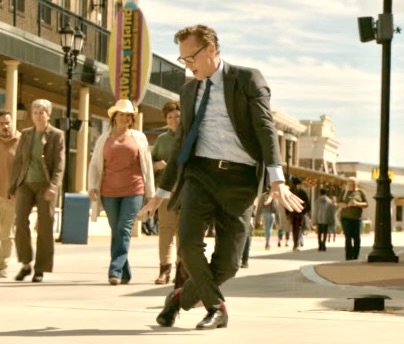
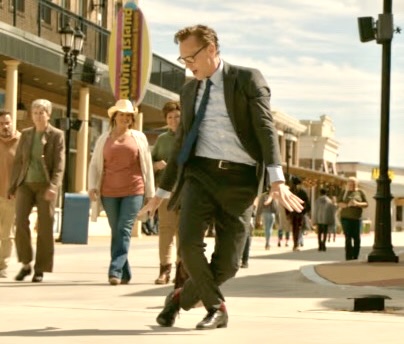
Next up is Chapter II. We find Chuck (Hiddleston) attending a conference for accountants. On a stroll through the city center he is confronted by a busking street drummer (Taylor Gordon). Listening to the percussive symphony she generates, the buttoned-down Chuck begins swaying tot he music.  

Then he starts doing a few dance steps.  Before long he’s grabbed the hand of a passer-by (Annalise Basso) and together they put on an impromptu display of big band terpsichorean razzamatazz that draws a cheering crowd.

It’s a heart-in-your-throat “Singin’ in the Rain” kind of moment. Pure movie magic. (Much love to Mandy Moore’s spectacular choreography).

Mark Hamill, Benjamin Pajak

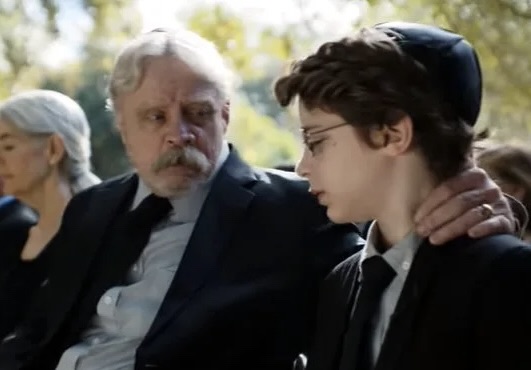
Then it’s on to Chapter I, which depicts Chuck’s childhood (as you’ve gathered by now, “The Life of Chuck” unfolds in reverse order). Orphaned by a car accident, young Chuck (he’s depicted as a middle schooler by the excellent Benjamin Pajak) is being raised by his grandparents (Mark Hamill and Mia Sara).

(Uh, wait a minute.  Mia Sara.  Wasn’t she Ferris Bueller’s squeeze only a couple of years back? Surely she can’t be anybody’s grandma.)

Anyway, this segment examines Chuck’s relationship with his loving grandparents, and his discovery of dance in an after-school club.  The kid’s a whiz…before long he’s the talk of the prom for cutting a rug with a girl two years his senior.  

Once again, the dance sequence is magic.  But what kind of career is dance for a red-blooded American boy? No, Chuck will grow up to study something more practical, like accounting.  But he’ll never forget the thrill of his body moving effortlessly to the music.

“…Chuck” bites off a big chew by attempting (in reverse) to depict one man’s life. What we come to realize is that Chapter III is actually unfolding in the head of a dying man.  Chapters I and II tell us how he got there, while introducing figures (Marty, Felicia, the funeral director) who will appear in his end-of-life reverie.

The film has been so deftly directed and acted (even from the unseen Nick Offerman, whose narration provides just the right taste of detached observation) that more than a few veiwers will find themselves in tears.  

| Robert W. Butler

Read Full Post »

Tom Hiddleston

Tom Hiddleston

“HIGH-RISE” My rating: C+

119 minutes | MPAA rating: R

Duration is the enemy of allegory.

At 50 minutes Ben Wheatley’s “High-Rise” would have been a stunning achievement — a vicious, snarling, breathless satire of class warfare and social apocalypse.

At two hours, though, it’s a slog, one that very nearly wears out its welcome and ends up repeating itself like a 33-record with a track-skipping scratch.

Screenwriter Amy Jump’s adaptation of the 1975 novel by J.G. Ballard (Crash) bears more than a few  similarities to William Golding’s Lord of the Flies and especially to the the recent cult hit “Snowpiercer.”  Just replace the hermetically sealed high-speed train with an equally isolated high-rise apartment complex.

We are introduced to this modern Tower of Babel through the new tenant, Liang (Tom Hiddleston, who seems to be everywhere nowadays: “I Saw the Light,” TV’s “The Night Manager,” Marvel movies).  An unmarried M.D. with more money than he knows what to do with, Liang takes an apartment about halfway up the 30-plus story edifice.

The tower has all the amenities of a decent-sized town: health spa, swimming pool, school, a traditional English garden on the rooftop complete with livestock. There’s even a grocery store that sells only generic products (“Thank you for shopping on floor 15”). Alas, the place is chilly and sterile, all poured concrete and glass. Which is fine with Liang, who has no furniture and never gets around to unpacking his boxes.

It quickly dawns on the newcomer that the building has a social pecking order.  Towering over everyone else in his penthouse is the symbolically named Royal (Jeremy Irons), the architect who designed the building and is forever tinkering with improvements meant to validate his experiment in social engineering.

Just below Royal are the wealthy aristocrats embodied by the sneering, pompous Pangbourne (James Purfoy).

Then come the mid-level residents like Liang and Charlotte (Sienna Miller), the salacious single mom whose bright young son (Louis Suc) is building what looks like a homemade bomb.

Below Liang are residents like Wilder (“The Hobbit’s” Luke Evans), an aggressive and rabble-rousing documentary film maker, and his ever-pregnant wife Helen (Elisabeth Moss). (more…)

Read Full Post »

Tom Hiddleston as Hank Williams

Tom Hiddleston as Hank Williams

“I SAW THE LIGHT” My rating: C-

123 minutes | MPAA rating: R

The Hank Williams songbook runs deep and rich, which makes the shallow ineffectiveness of “I Saw the Light” all that much more dispiriting.

Williams, of course, was the country/western genius who in the late ’40s and early ’50s produced some of popular music’s most lasting tunes (“I’m So Lonesome I Could Cry,” “Cold Cold Heart,” “Hey Good Lookin’,” “Lovesick Blues,” “Jambalaya,” “I Can’t Help It,” “Move It On Over,” Kaw-Liga”) then succumbed to drugs and alcohol, dying at age 29 in the back seat of a limousine on New Year’s Day 1953.

The story has been told cinematically once before, in “Your Cheatin’ Heart,” with Coppertone poster boy George Hamilton in the lead role. That 1964 release remains the best screen treatment of Williams’ life and music.

Going in, my hopes were high for “I Saw the Light.”

I was looking forward to seeing what Brit actor Tom Hiddleston (a scene stealer as the evil Loki in the “Thor”/Marvel franchises) could bring to the role of  an iconic American country artist.

And there was hope behind the camera as well, inasmuch as writer/director Marc Abraham had helmed the solid 2008 biopic “Flash of Genius” (about the inventor of the variable-speed windshield wiper, who sued the Detroit carmakers over patent infringement) and produced films ranging from “The Commitments” to “Dawn of the Dead” and “Children of Men.”

Well, “I Saw the Light” gets the music right, though there’s not near as much of it as there could have been.

But as drama this one is dead in the water.

The major issue here is Abraham’s lack of a coherent vision. What story is he telling here? He throws around a lot of ideas but never settles on one that can carry the weight of a two-hour-plus feature film. (more…)

Read Full Post »