Feeds:
Posts
Comments

Posts Tagged ‘Paul Mescal’

Jessie Buckley

“HAMNET” My rating: B (In theaters)

125 minutes | MPAA rating: PG-13

For a good three quarters of Chloe Zhao’s “Hamnet” I found myself diverted — fine photography, good acting — but nowhere near the emotional catharsis that has many critics calling it a masterpiece.

But just wait.

“Hamnet” only comes fully to life in the last 20 minutes, but it does so with devastating intensity.

Well, better to peak late than early, and in that regard the film will leave viewers well wrung out as they head for the exits.

This is the story of how the death of Shakespeare’s young son, Hamnet, inspired the playwright to create perhaps his most enduring and overwhelming drama, “Hamlet.”

Zhao’s screenplay abandons the jumbled timeline of Maggie’ O’Farrell’s best-selling novel for a straightforward chronological narrative. At the same time it keeps a  couple of the book’s twistier aspects by leaving  nameless the Shakespeare character (we know he’s the Bard, but none of his contemporaries do) and by identifying his wife as Agnes when history tells us that Shakespeare’s wife actually was named Anne.

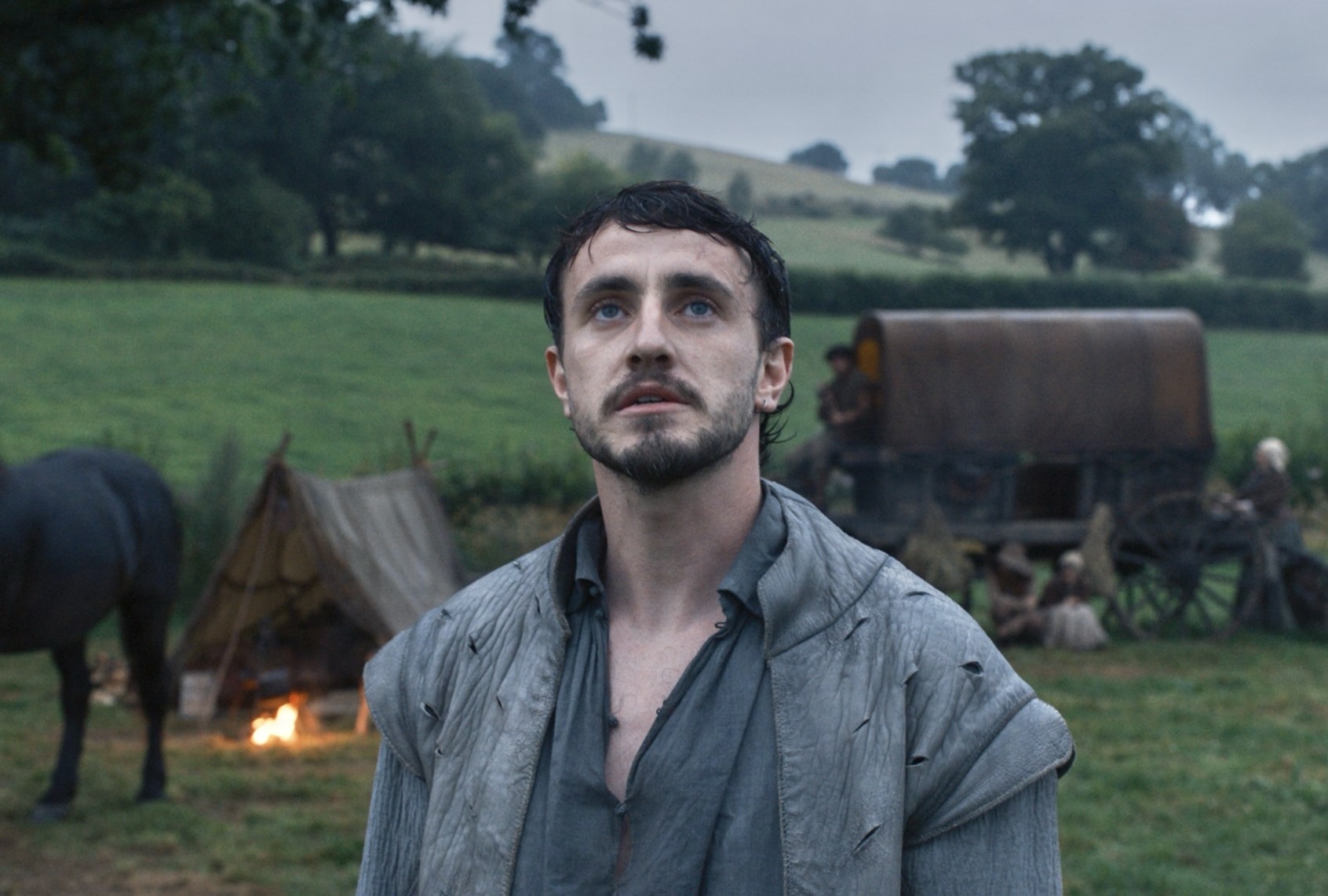
The film begins with the courtship of a small-town Latin tutor (Paul Mescal) and an odd young woman (Jessie Buckley) who spends much time in the woods, has a pet hawk and is rumored to be the daughter of a witch.

Their respective families (Emily Watson plays the tutor’s mother) disapprove, but young love (or lust) will have its way.  With Agnes pregnant, marriage is the next step.
Paul Mescal

The bulk of “Hamnet” is devoted to domestic life in Stratford.  The young husband begins spending time away in London (writing plays, we presume) while Agnes holds down the fort back home.  Their reunions are happy ones, and the couple have three children.

The only boy is Hamnet, so charmingly played by young Jacobi Jupe that we nave no trouble imagining the fierce love his parents have for him. 

At age 9 Hamnet succumbs to the plague in a horrendous death scene that leaves his mother a screaming wraith of pain.  Father arrives too late to see his boy alive.

Tragedy can bring families together or tear them apart. It appears that this family will never recover from Hamnet’s death.

When Agnes learns that her spouse’s latest play references their dead son, she makes the long trip to London to confront her now-estranged husband, arriving just in time to witness one of the first performances of “Hamlet.”

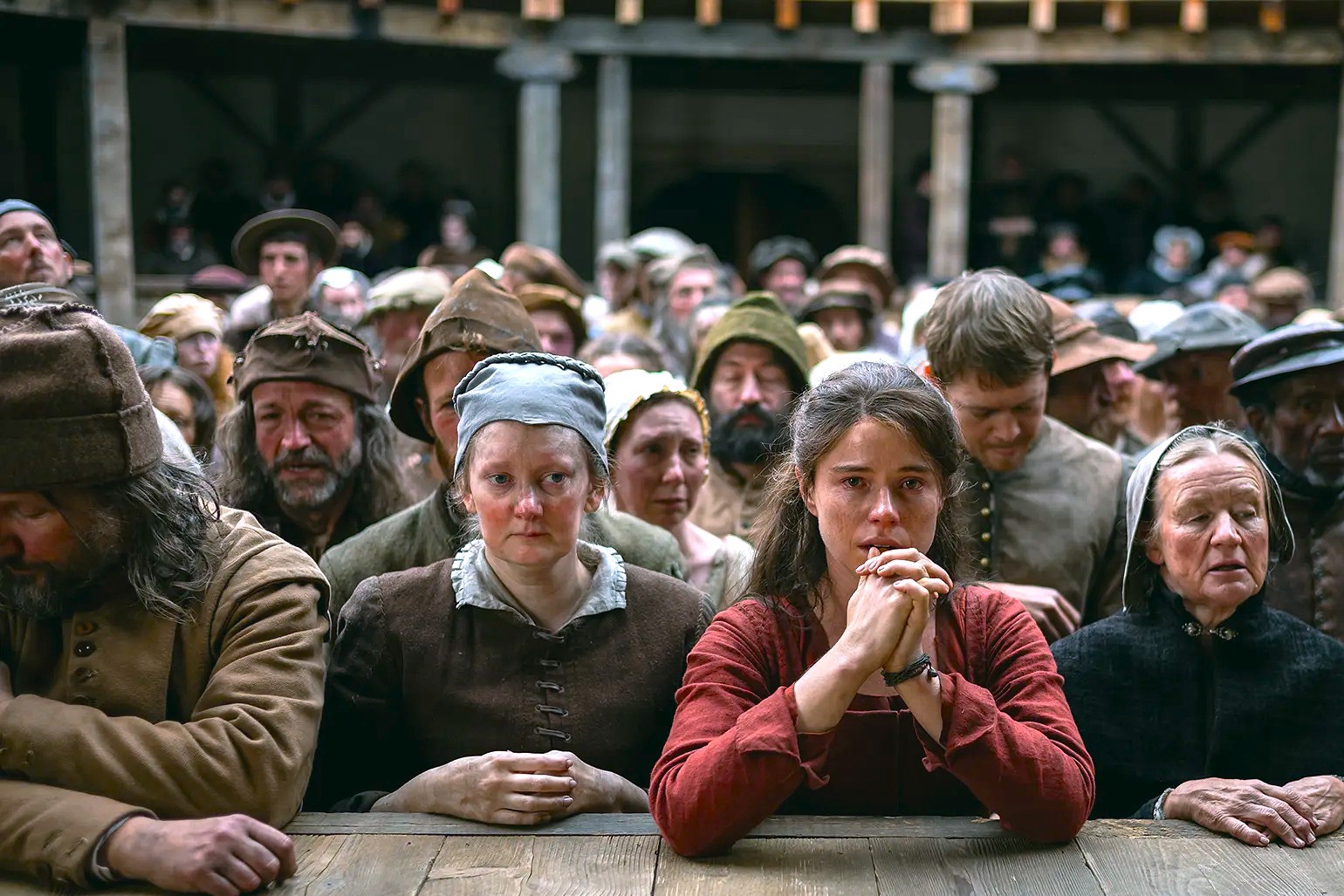
It’s at this point that “Hamnet” becomes something extraordinary. Agnes enters the open-air Globe with dozens of other playgoers, pushes her way to the front of the crowd and leans on the stage, ready to hurl objections and insults at this entertainment that capitalizes on her grief.

Except that during the performance she finds herself engrossed by the extraordinary storytelling and language. Like her fellow playgoers, she is transported to Elsinore Castle and caught up in the tale of loss, revenge and existential paradox. Abandoning her initial objections, Agnes ultimately recognizes that her husband has come to grips with their loss by using the theater to resurrect their dead child.

Art as therapy.

Zhao’s recreation of an Elizabethan production is extraordinarily captivating, not the least because Noah Jupe (older brother of the actor who played Hamnet) is so spectacularly good as the actor portraying Hamlet on stage.  

Watching this tragedy unfold is a transforming experience.  We recognize the awe and investment of the London audience in this new play; the sheer aesthetic pleasure that transcends the tragedy.

Mescal and Buckley give fine performances, but in the end it is the eternal genius of William Shakespeare that sticks in the memory.

George Clooney

“JAY KELLY”  My rating: C(Netflix)

132 minutes | MPAA rating: R

I’m a fan of George Clooney’s work. his persona and his politics.  But “Jay Kelly” left me cold.

Noah Baumbach’s latest film is a character study…sort of…of a man who apparently has no character.

Jay Kelly (Clooney) is a famous movie star.  Millions know him from his many screen appearances, but apparently nobody knows him, really.

His family, his friends, his co-workers…about all they get from him is suave charm, self-deprecating wit and good looks.  If there’s a real human being in the attractive package, it’s yet  to assert itself.

The screenplay by Baumbach and actress Emily Mortimer (who takes a small role) finds Jay on a trip to Italy to receive some sort of award.  Usually he flies in a private jet, but for this trip he has decided to take the train with all the other tourists and proles.  He says he doesn’t like being noticed, but he sure spends a lot of time being noticed.

If anyone is close to knowing Jay it’s his long-suffering manager Ron (Adam Sandler), who likes to think of himself as a friend.  Except as Jay points out, friends don’t usually take 15 percent.

“Jay Kelly” has an astoundingly deep cast — Greta Gerwig, Billy Crudup, Laura Dern, Patrick Wilson, Stacy Keach, Isla Fisher, Jim Broadbent, Riley Keough, Josh Hamilton (for starters) — though many have only a few seconds of screen time.

The film is stranded somewhere between satirizing Hollywood and its denizens and empathizing with Jay’s late-in-life realization that as a human he’s pretty much blown it.  But it’s neither funny enough or tragic enough to warrant a bloated running time (more than two hours).

Moreover, since Jay is a handsome cipher, our only real  human connection is Sandler’s Ron, who must ride herd on a mercurial star while trying to hold together his own private life.  It’s the film’s best performance.

“Jay Kelly” ends with Jay and an audience watching a compilation of scenes from his film and television work (actually they’re clips from George Clooney’s career, making for a sort of head-smacking meta moment).  To the extent that the segment stirs pleasurable memories it gives Jay’s life an emotional arc missing from the rest of the film.

But it’s a contrived moment in a film that already feels contrived.

| Robert W. Butler

Read Full Post »

“GLADIATOR II” My rating: C+ (In theaters)

148 minutes | MPAA rating: R

“Gladiator II” is pretentious twaddle.

At least it’s brilliantly-produced twaddle.

Director Ridley Scott’s followup to his 2000 Oscar winner (what were they thinking?) is less a sequel than a loose remake.  It’s forever repeating beats from the original.

You see that right in the opening credits, which unfold over a montage of moments from the original “Gladiator,” albeit this time rendered in painterly animation.

Once again we get color-desaturated dream sequences and flashbacks.

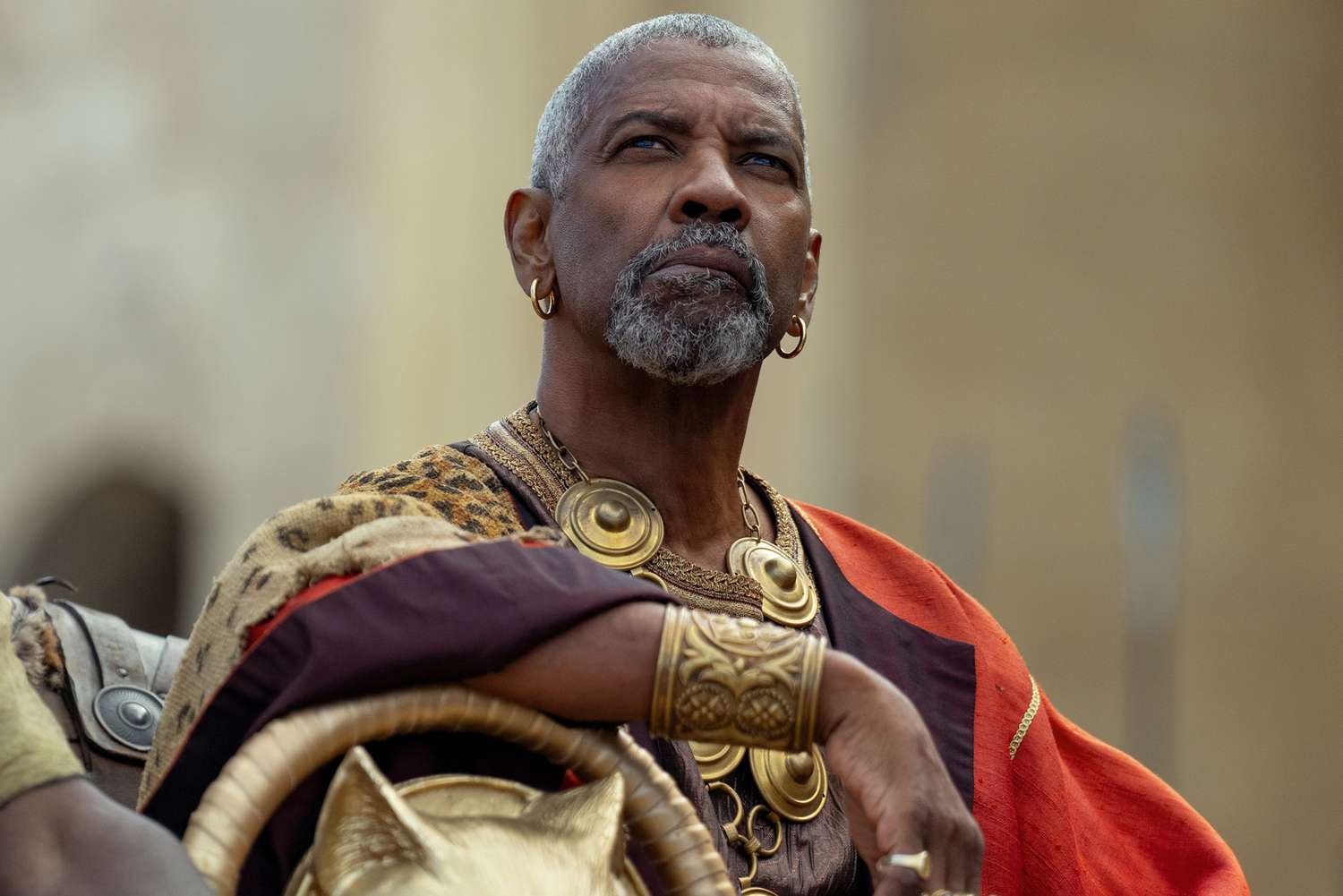
Then there’s the plot, which begins with a massive battle, then becomes the story of an honest man reduced to slavery and a life of fighting in the arena. (Remember the gladiator owner played by Oliver Reed the first time around? This time those duties are fulfilled by Denzel Washington.)

The first film had a crazy emperor.  This one has two crazy emperors.

And again there’s an iffy subplot about Roman political machinations with lots of uplifting/dubious oratory espousing democratic ideals that sound more like Thomas Jefferson than Marcus Aurelius. (At one point we even get an “I am Spartacus” moment.)

But here’s the thing: “Gladiator II” is bigger, noisier, faster.  Special effects that looked phony in the original are now so sophisticated that one cannot tell a real rampaging rhino from a digitally created one. The city-scapes are awe-inspiring.

The whole thing pulses with visceral/sensory overload.

And it needs to, because dramatically “Glad II” feels like amateur hour. (The screenplay is by David Scarpa, Peter Craig and David Franzoni.)

Our hero (I never caught his name…I now see that this was deliberate) is played by Paul Mescal. I’ll call him Hero.

Paul Mescal

Hero comes to Rome in chains after a Roman fleet destroyed his city on the coast of North African. Having lost his home and his wife in the battle, Hero carries a chip on his shoulder.  All he wants before dying is revenge on the general who ruined his life.

That would be Marcus Acacius (Pedro Pascal), who is now married to the princess Lucilla (Connie Nielsen, reprising her role from the first film).  Together they are plotting to overthrow the sibling emperors Geta and Caracalla (Joseph Quinn, Fred Hchinger), a debauched pair of painted syphilitic psychos. 

Before it’s all over, Hero’s path will cross those of Marcus and Lucilla in an unexpected (and wildly unlikely) plot reveal. 

But then there’s the spectacle.  Scott and his production designers have outdone themselves in creating the Colosseum in beautiful downtown Rome. 

The first big brawl finds humans battling a troop of killer baboons.  Then we move on to that armored rhinoceros, which is about the size of a Sherman tank.  Most awe inspiring of all is a naval battle staged in the flooded arena. Those Romans thought of everything, including introducing  huge sharks which swim around the galleys to snatch anyone who falls overboard.

The acting?  It’s okay.  Just okay.

Which is disappointing because Mescal has in recent roles (“Aftersun,” “All of Us Strangers,” “Normal People”) displayed a subtly seductive approach.  He’s one of the few actors who can find interesting things to do with “nice” characters.

Ironic, then, that as our vengeful protagonist he’s kind of a one-note creation.  Barely suppressed rage gets tiresome after a while.

Washington has been getting some awards-season buildup for his work as the gladiator master and Machiavellian power broker  Macrinus. I don’t see it.  The character has a few moments of gloating triumph as he turns the tables on Rome’s blue-blooded politicians, but I yearned for Washington to exhibit some wickedly comic impulses. Nope.

Denzel Washington

Everyone else delivers their lines with the sort of bloviating declamatory dialogue that wouldn’t be out of place in an old Hollywood epic from the 1950s.

Here’s the thing:  “Gladiator” is all surface and no substance.  There are no interesting ideas beneath the grandeur and violence, no emotional engagement.

Like Scott’s last film, the curiously untethered “Napoleon,” “Gladiator II” is a display of elephantine emptiness.  No wonder it feels about 45 minutes too long.

| Robert W. Butler

Read Full Post »

Paul Mescal, Andrew Scott

“ALL OF US STRANGERS” My rating: B+ (Hulu)

105 minutes | MPAA rating: R

It’s just about impossible to describe Andrew Haigh’s deeply moving “All of Us Strangers” without either giving away the film’s big reveal or making it sound like a half-baked dive into armchair psychology.

Yet “…Strangers” got under my skin unlike any other film of 2023. It’s a downer…but we walk away from its all-consuming sadness with filled with hope for our capacity for love.

Andrew Scott, the “hot priest” of “Fleabag,” stars as Adam, a lonely writer living in a London high-rise so recently opened that there’s hardly anyone else in the building.

One fellow resident who does catch his eye is Harry (Paul Mescal); they spot each other during a fire drill and Harry almost  immediately shows up at Adam’s door with a bottle and a too-eager desire to be let in.

Nothing immediately comes of Harry’s advances (both men are gay), but over the course of the next week the two strike up a relationship that moves quickly from the physical to the romantic.

Meanwhile the screenplay by Haigh (adapting Taichi Yamada’s novel Strangers) tosses a head scratcher into the mix. 

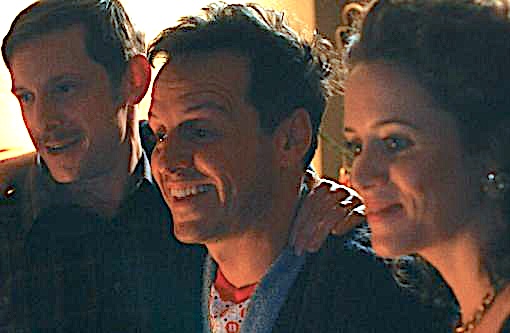
One day Adam boards a train and gets off in a suburb where he is reunited with his parents (Jamie Bell and Claire Foy)…an impossibility since (a) Mom and Dad appear to be the same age as their son and (b) we have already learned from Adam’s conversations with Harry that his parents died in a car crash when he was a young teen.

Jamie Bell, Andrew Scott, Claire Foy

What’s happening?  Well, apparently Adam has constructed a fantasy world in which he can receive the parental love denied him in reality. In this world he can touch and be touched. He can reveal to his parents his homosexuality (Dad is cool with it; Mom is  a bit slower to get on board).  He can take comfort in the warmth of his boyhood home.

Obviously Mom and Dad don’t exist anywhere but in Adam’s head. Yet so spectacularly convincing is Scott, so quietly desperate is his need for affection, that we end up buying into his delusion. And as delusions go, this one is pretty damn seductive.

At the same time the Adam/Harry relationship is deepening…at one point Adam takes his new boyfriend out to meet the folks, only to be confronted with an unoccupied house. Harry quite naturally gets a little creeped out.

“All of Us Strangers” is forever whiplashing us between the real and the imagined. It probably shouldn’t work, but the players are so astoundingly convincing that we find ourselves believing despite the craziness.

And is it really craziness?  “Strangers…” isn’t into psychoanalyzing Adam; that sort of real-world attitude is at odds with the film’s near-poetic approach.

The moral here: We humans need love. Even if we have to invent it. There’s madness there, but a kind of nobility, too.

| Robert W. Butler

Read Full Post »

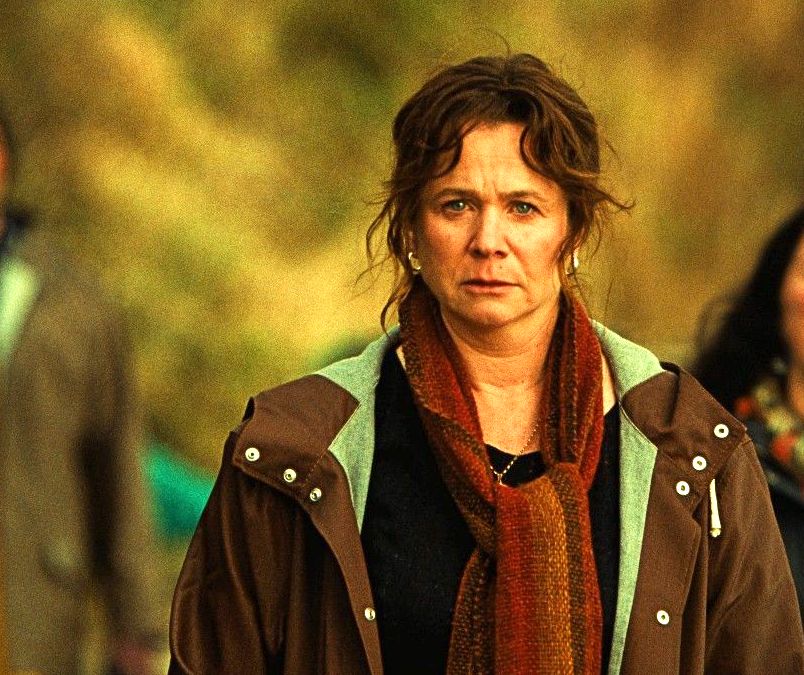
Emily Watson

“GOD’S CREATURES” My rating: B (At the Glenwood Arts, VOD)

100 minutes | MPAA rating: R

A blanket of Celtic fatalism drapes over “God’s Creatures,” rendering even a sunny day wan and gray.

Set in an economically-challenged Irish fishing village, this entry from co-directors Sale Davis and Anna Rose Holmer (“The Fits”) centers on a middle-aged wife and mother who out of love makes a seriously bad decision.

Aileen O’Hara (Emily Watson, sinking her teeth into her meatiest role in ages) is a crew chief at a seafood processing plant. She and her husband Con (Declan Conion) seem to more or less share the same space, brought together mostly by their first grandchild, born to their daughter.

Then, quite unexpectedly, Aileen’s son Brian (Paul Mescal) appears after spending seven uncommunicative years in Australia.  Aileen is overjoyed to have her boy back in the fold. Her husband less so…it’s all he can do to shake Brian’s hand. What’s that about?

At first glance Brian is a handsome charmer.  But his behavior raises questions  He left home suddenly (why?) and rarely communicated with his family during his long absence.  Now he’s back (again, why?) ready to take over the long-unattended oyster beds owned by his uncle.

Aileen is too thrilled having her firstborn back under her wing to dwell on such business. But within weeks of his return Brian is accused of sexually assaulting his old girlfriend Sarah (Aisling Franciosi of “The Nightingale”), one of Aileen’s co-workers.

Interviewed by the police, Aileen lies, providing Brian with an alibi. She does so automatically, almost without thinking.

But in the aftermath her conscience begins gnawing.  She senses something disquieting beneath her boy’s outward magnetism.  Worse, Sarah sticks to her accusation and becomes a pariah in their tiny community.

Viewers who demand that everything be spelled out for them will find little solace in “God’s Creatures.”  The film’s narrative approach is elliptical; there’s all sorts of suggestion but little solid information.

Uncertainty seeps through Fodhia Cronin O’Reilly and Shane Crowley’s screenplay and is reflected in the carefully contained performances.  Watson suggests Aileen’s torn loyalties not with bit speeches but through her eyes.  Similarly, Mescal — who made a big splash as the overwhelmingly decent leading man of Hulu’s “Normal People” — cannily uses his good-guy image to disguise Brian’s true nature.

No doubt many will find the film’s understated approach too remote. And the denouement of Brian’s story arc is borderline ridiculous, a deus ex machina  moment comes out of left field.

On the plus side, the film works extremely well as a study of working class life, with its economic uncertainties and demeaning situations.

| Robert W. Butler

Read Full Post »

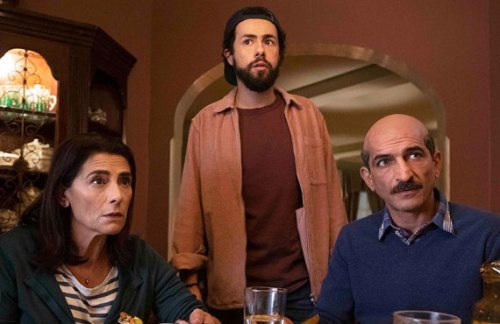
Hiam Abbass, Ramy Youssef, Amr Waked

Like most boomers, I grew up on half-hour TV dramas. They once roamed the airwaves like herds of bison.

Maybe back then the entertainment industry didn’t think the fledgling television public had sufficient attention spans to endure a full hour of heavy dramatic lifting. Perhaps the studios were still trying to find the right balance between production costs and on-air quality, and a half-hour show minimized risk.

Whatever.  My generation came of age watching Westerns in which characters were introduced, a situation established and resolved (usually through gunplay) in a terse 25 minutes. (Plus five minutes for commercials.)

Not just Westerns.  Legal dramas and crime shows as well.

By the early ’60s the half-hour drama had given way to 60-minute productions which provided creators a chance to stretch a bit, dabble in nuance without the need to get in and out in record time.

Which is why I was surprised to discover that two of my new favorites — the Hulu series “Ramy” and “Normal People” — are half-hour dramas.

Yeah, yeah, technically “Ramy” is a comedy — this year its creator and star, Ramy Youssef, won the Golden Globe for best actor TV musical or comedy   — but as will soon be explained, the new second season of “Ramy” is essentially dramatic.

And as for “Ordinary Humans,” you don’t get much more intense than this tale of two Irish kids whose sexual/romantic relationship is followed over several years.

Okay, first “Ramy.”

Youssef stars (basically he’s playing  himself, or at least the self he presents in his standup routines) as Ramy, twenty something son of Egyptian immigrants who wants to be a good Muslim but also wants to be a normal American millennial.  He manages to avoid alcohol, but sex is his Achilles heel…he loves the ladies and whacking off to porn.

Season One sets up Ramy’s world and its inhabitants. His father Farouk (Amr Waked) is some kind of white-collar drone; mom Maysa (the sublime Hiam Abbass) is a homemaker and busybody with endless advice for Ramy (get a job, marry a nice Muslim girl) and his rebellious but still virginal sister Dena (May Calamawy).

Ramy’s running buddies are Mo ,(Mohammed Amer), who operates a diner and is always encouraging Ramy’s libidinous behavior (married, Mo lives vicariously through his friend), and the physician Ahmed (Dave Merheje), a nerd forever attempting to steer his pal along paths of righteousness.  Basically Ahmed and Mo are a good angel and a bad angel, each perched on one of Ramy’s shoulders and delivering hilariously contradictory advice.

A third pal is Steve (Youssef’s real-life best friend Steve Way), who has muscular dystrophy and is confined to a wheelchair from which he hurls world-class insults.

Another important character — and one who generates huge laughs in Season One — is Uncle Naseem (Laoth Nakli), who is also Ramy’s boss at a Manhattan jewelry store (the family lives in New Jersey). Broad, hairy, proudly chauvinistic and fiercely opinionated, Nasseem is an Arab version of a redneck who apparently agrees with Trump on everything except Muslim policy. Archie Bunker seems benign by comparison.

The debut season finds Ramy in various romantic entanglements (including an affair with a Jewish girl), but huge chunks of the season are devoted to exploring his world. This includes the daily schedule of Muslim prayer (Ramy is less than diligent), dietary and cleanliness laws (Ramy is reluctant to pray if he has recently farted) and prejudices within the Muslim community (Arabs aren’t so sure about their black American brethren).

In Season Two, which just debuted, things get considerably darker.

For starters, Ramy often takes a back seat as entire episodes are devoted to one character.  Maysa has been augmenting the family income as a Lyft driver; when she is suspended over a bad customer comment, she is sure the complainer is a trans woman, a recent fare.  She boneheadedly (but without malice) begins stalking the rider in an attempt to set things right.

Sister Dena, who at one point almost gives it up to a charming young man she meets on campus, finds herself in a deep depression when her glorious head of hair (no wraps for this girl) starts falling out in clumps.

Most of all there’s the episode devoted to the Uncle Naseem, whose bullish exterior hides a heart-breaking inner life.

These segments are essentially dramatic…there may be a chuckle or two, but they’re aiming at targets bigger than laughs.

The season is anchored by the great Mahershala Ali as Ramy’s new spiritual leader, a Sufi who cuts through all the chatter in Ramy’s head with his deep faith and psychological awareness.  This leads to Ramy’s romance with the Sheik’s daughter; the season ends with a betrayal by Ramy that makes us wonder if he’s really the nice goof we’ve always thought or simply too dense and selfish to warrant our affection.

Throughout the 30-minute format provides enough time to get the story told without lollygagging…”Ramy” will jump from one scene to the next almost before you can get the laugh out. Yet it rarely seems hurried.
(more…)

Read Full Post »