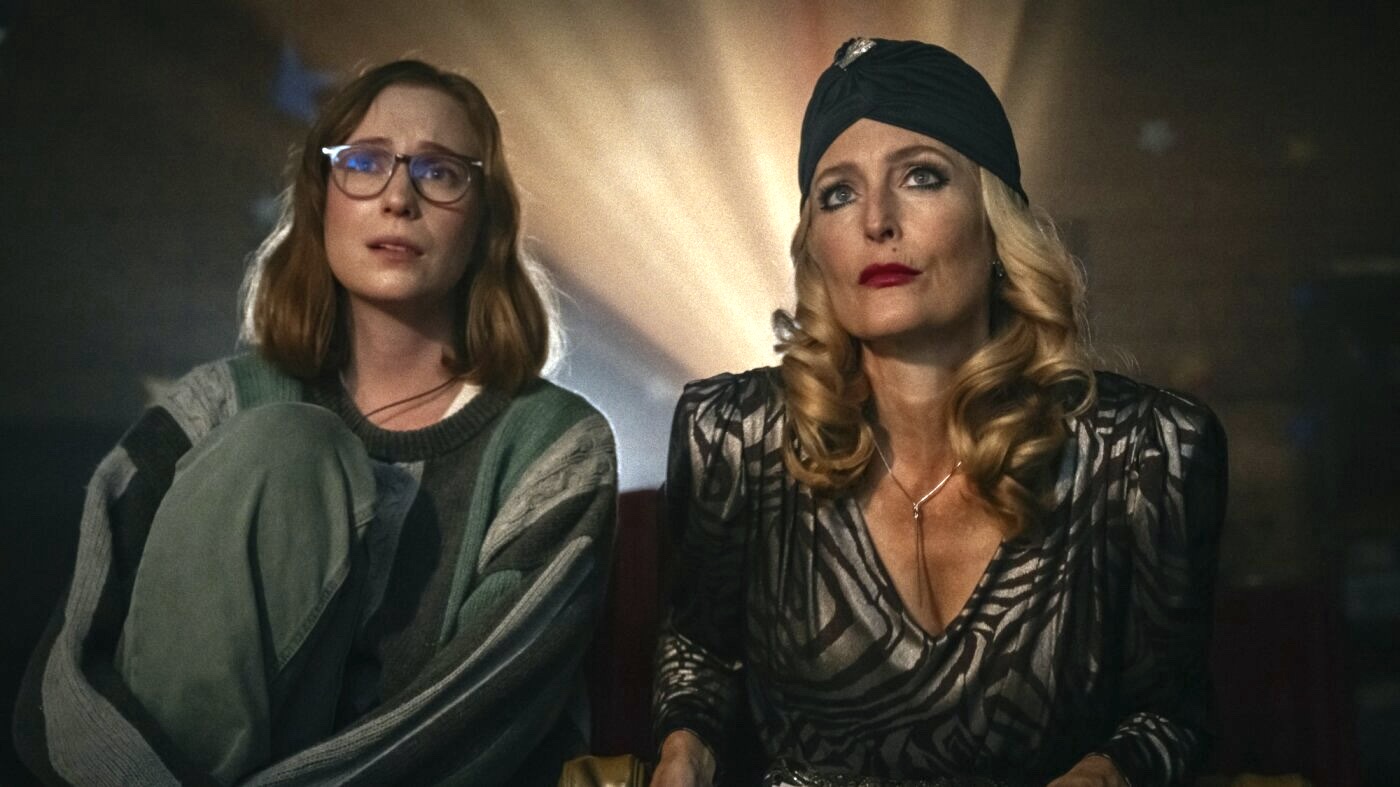
Hannah Einbinder, Gillian Anderson
“TEENAGE SEX AND DEATH AT CAMP MIASMA” My rating: B (In theaters on Aug. 21)
112 minutes | MPAA rating: R
There’s so much to unpack in Jane Schoenbrun’s “Teenage Sex and Death at Camp Miasma” that you practically need a flow chart to keep on top of all its ideas.
As the name implies, it’s a parody of those teen slasher films in which horny adolescents are carved up by a mysterious masked individual.
But it’s also a tale of sexual liberation. And a visual tour de force. And a sly look at the process of artistic creation.
And, believe it or not, a showcase for two of the year’s best performances.
That said, it ain’t for everyone.
Schoenbrun’s previous film, 2024’s “I Saw the TV Glow,” centered on outsider teens obsessed with a cheesy ’80’s TV horror/fantasy. It was a somber affair, sad even, but it got under my skin even if I wasn’t quite sure of just what was going on.
“Teenage Sex…,” on the other hand, is a goofy lark, albeit one that draws heavily on Schoenbrun’s own childhood and career.
Just so you know where we’re coming from here: Schoenbrun is transgender (their early films were made under the name Dan Schoenbrun) and while in the fifth grade they devoted a month to watching every “Nightmare on Elm Street” film. All that is in evidence in this latest effort.
The setup: Lesbian filmmaker Kris (Hannah Einbinder) has come to the Pacific Northwest to visit the summer camp that was the setting for her favorite series of horror flicks. She’s planning a reboot of the “Camp Miasma” franchise, and her goal is to track down the female star of the original film.
That would be Billy (Gillian Anderson), who dropped off the map after her screen debut and for 30 years has been living as a recluse in a cabin at the long-abandoned summer camp.
Einbinder and Anderson dominate what is essentially a two-character film. As she showed in her Emmy-winning work in “Hacks,” Einbinder is a comic engine. Here she lacks the killer one-liners that fueled “Hacks,” but makes up for it in dorky earnestness and her fan-boy mania. Kris is a post-modern intellectual, but when it comes to her unfulfilled sexual and emotional needs she’s comically childlike.
Anderson’s Billy, on the other hand, comes off a bit like a turbaned Gloria Swanson in “Sunset Boulevard,” albeit with a molasses-tinged southern accent. Sexy but weird.
Schoenbrun’s screenplay has Kris staying at the snowbound camp so as to coax Billy into signing up for her new movie. Along the way they watch the original “Camp Miasma,” which introduced Little Death, a killer in a white hazmat suit and a head-covering mask that looks like an air duct vent.
So basically we’ve got two movies here. The one about Kris and Billy, and then the one they’re watching on an old 16mm film projector. “Teenage Sex…” is forever shifting between the two.
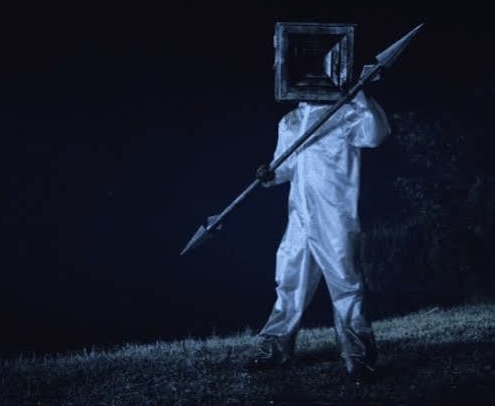
Little Death
All this comes to a head when Little Death rises from the lake bottom where he/she/it has been hibernating and gets to work slashing. Simultaneously the uptight Kris at last finds sexual liberation in Billy’s arms.
The name “Little Death” (the character is portrayed by trans actor Jack Haven, who starred in “I Saw the TV Glow” under the name Brigette Lundy-Pain) is an English translation of the French term le petite mort, a reference to post-orgasmic bliss.
So the threat posed by Little Death drives Kris to sexual fulfillment.
Or maybe not. Perhaps all this is just happening in Kris’ fevered mind.
While some of “Teenage Sex…” has been shot in a real summer camp, other scenes play out against stagey backdrops done in such a way that you have to look twice to be sure whether it’s a real forest or just painted canvas. I think it’s Shoenbrun’s way of telling us not to trust everything we see — especially when it comes to the over-the-top gore of Little Death’s killing spree.
The film is also a sort of cautionary comedy about artistic struggle. There’s a marvelous scene which has Kris dealing with three of her producers on a Zoom call…Dylan Baker is spot on as a crass philistine who hasn’t time for Kris’ intellectual navel-gazing. He’s the kind of guy who just wants a movie with tits and blood. A demand, by the way, that Shoenbrun slyly satisfies.
Not everything here works. The movie-within-a-movie sequences, for example, so accurately mimic those old slasher flicks that, like the originals, they’re boring between bloodbaths. Is bad acting bad acting, even if it’s a parody of bad acting?
And Schoenbrun’s fragmented narrative style is bound to alienate literal-minded audiences. What can I say? Dreams and nightmares don’t always make sense. But the weirder they get the more we remember them. And it’ll be hard to forget “Teenage Sex and Death at Camp Miasma.”
| Robert W. Butler


Leave a Reply