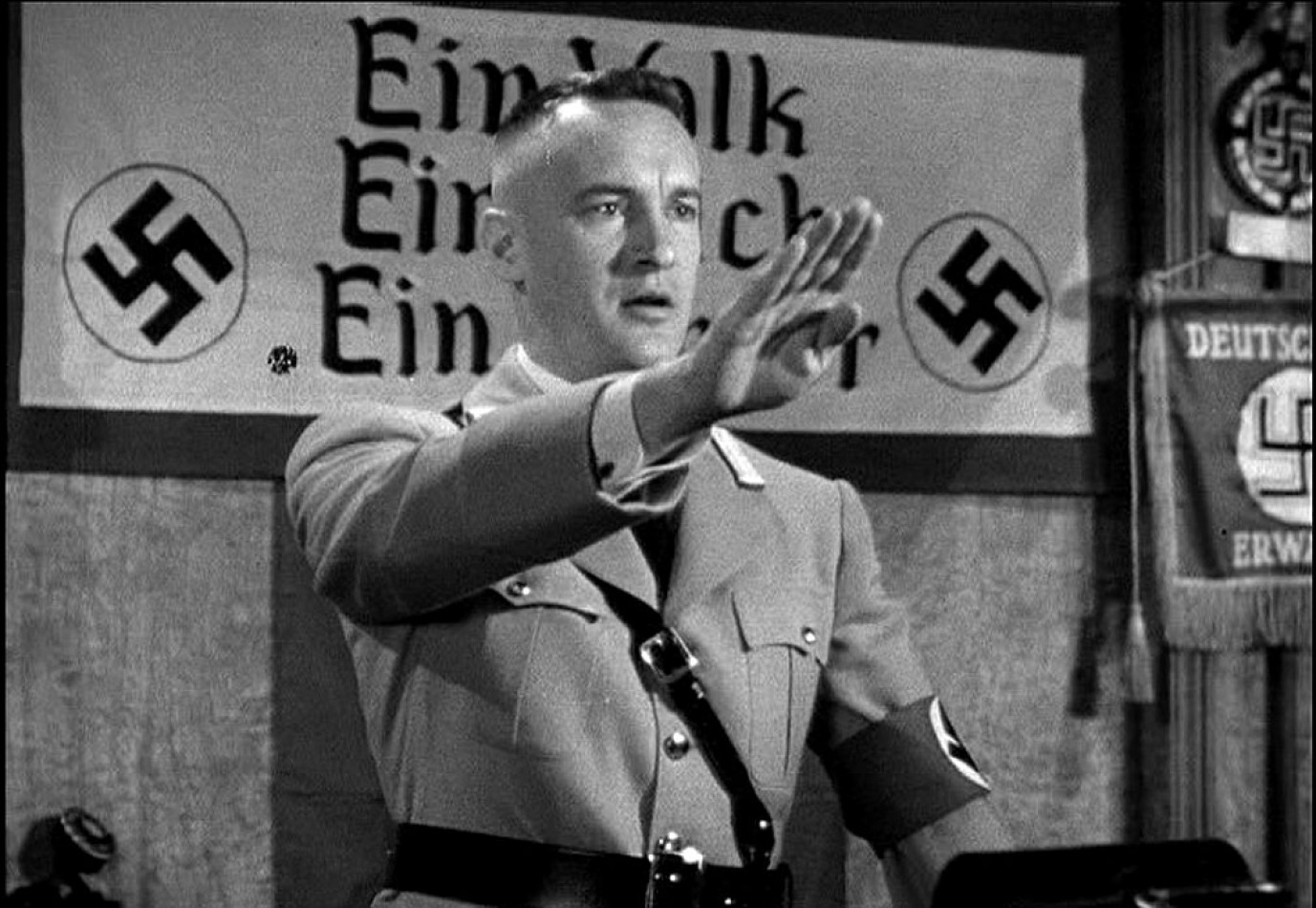
George Sanders rallies American fascists in “Confessions of a Nazi Spy”
“Confessions of a Nazi Spy” screens at 1:30 p.m. Saturday, July 19, 2014 in the Durwood Film Vault of the Kansas City Central Library, 14W. 10th St. Admission is free. It’s part of the year-long film series Hollywood’s Greatest Year, featuring movies released in 1939.
Whatever its merits as entertainment, 1939’s “Confessions of a Nazi Spy” is a social and historical landmark, the first time a major Hollywood studio pulled out all the stops in attacking the rise of Adolf Hitler and Nazism.
The film begins at a rally of an American/German friendship organization. The speaker (Paul Lukas) is haranguing an audience of men in Nazi uniforms: “Those who fight us must perish socially as well as economically because of our determination to destroy our enemies completely and without any consideration…Germans must save America from the chaos that breeds in democracy and racial equality. We Germans must make the United States our America!”
The scene is shocking…in large part because most Americans have forgotten that throughout the 1930s, groups like the German American Bund sought to build support in this country for the German state while encouraging American isolationism. The Bund regularly drew 20,000 Seig Heil-ing supporters to swastika-draped Madison Square Garden. On at least one occasion this spawned rioting in Midtown Manhattan as Nazi supporters, their leftist opponents, and police clashed.
While their newsreel subsidiaries covered the rise of Nazism, in their feature films the Hollywood studios made a point of ignoring what was happening in Europe. Germany was a big consumer of American movies, and the suits didn’t want to alienate such a lucrative market.
In fact, among American studios, only Warner Brothers had the will and the guts to take on Hitler. Jack Warner and his brothers were the sons of a Polish Jew who fled the pogroms and came to American in the 1880s, and they looked upon Hitler and his minions with alarm and dismay. Refusing to work with the Nazis, they closed the studio’s Berlin office in 1934. The other studios – MGM, Fox, Paramount – would not do so until war broke out in 1939.
When in 1939 former FBI agent Leon Turrou published a best-seller about how he infiltrated and broke up a Nazi spy ring in the U.S., Jack Warner found a story that could express his own feelings of alarm, outrage, and defiance. He snapped up the film rights and put director Anatole Litvak – himself a Jew from Kiev and a devoted anti-fascist – to work bringing it to the screen.
The first obstacle was getting the screenplay approved by the Production Code Administration, the industry’s de facto censors. PCA head Joseph Breen was a vocal anti-Semite and worked to shut down production of films that attacked or mocked foreign governments. In fact, the German Consul General in L.A. called on Breen to reject the screenplay, threatening to ban from German cinemas any film featuring an actor who appeared in “Confessions of a Nazi Spy.”




 Butler's Cinema Scene