Feeds:
Posts
Comments

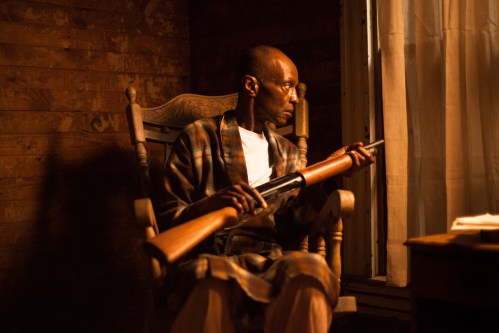
Robert Forster, John Hawkes

“SMALL TOWN CRIME”  My rating: C+ 

91 minutes | MPAA rating: R

Ex-cop Mike Kendall is a “shit heel” according to one of the other characters in “Small Town Crime.” It’s hard to disagree with that assessment.

Mike is an alcoholic who’s usually wasted by noon. He drives his souped-up car like an irresponsible teen; one morning he awakens to find his ride parked in the front yard amongst the wreckage of a picket fence.

Mike has been jobless since the unfortunate incident that led to the death of a fellow patrolman. To keep getting unemployment benefits he goes through the motions of applying for jobs, but should a prospective employer actually show an interest, Mike scotches the deal by confessing to being a hopeless drunk.

The good news is that Mike, as played by the great John Hawkes, isn’t a mean drunk. He loved being a cop and has a hopeless dream of once again wearing a badge. And despite his maddeningly childlike behavior, he’s just charming enough that you can’t hate him.

This noir drama from siblings Echo and Ian Nelms finds Mike thrust back into the game when he discovers a young woman dying in a roadside ditch. His cop instincts kick in, and despite warnings from his old colleagues on the force, Mike starts poking around into her death.

Posing as a private detective, he contacts the girl’s rich grandfather (Robert Forster), who is infuriated by the cops’ sloppy handling of the case (“To them she’s just another toe tag”). Despite his granddaughter’s self-destructive history of drug addiction and prostitution, he’s ready to spend big bucks to find out how and why she died.

Mike’s dogged digging eventually reveals a murderous conspiracy.  Before it’s over, other young prostitutes are being murdered and Mike is himself a target.  Not to mention his “sister” (Octavia Spencer), with whom he grew up in foster care, and her husband (Anthony Anderson) and their kids.


Continue Reading »

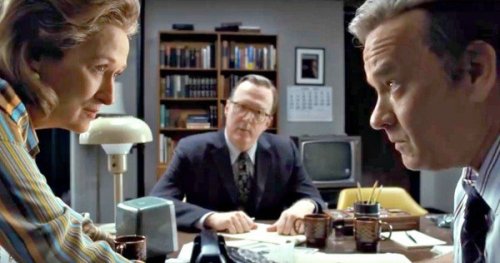
Meryl Streep, Tracy Letts, Tom Hanks

“THE POST” My rating: B+ 

115 minutes | MPAA rating: PG-13

Steven Spielberg’s powers as a storyteller are so secure that not even the miscasting of one of “The Post’s” two leads can do much damage to the narrative.

This sprawling effort — it begins with a firefight in Vietnam and winds down with a firestorm over the Second Amendment — hits the ground running and rarely slows down for a breath. It’s like a Spielberg master class in taking a complicated story and telling it cleanly and efficiently.

And like other major movies about real-world journalism — “All the President’s Men” and “Spotlight” especially — “The Post” could hardly be more timely.  With a president who shows every indication that he’d love to roll back freedom of the press, this film is so relevant it hurts.

The subject, of course, is the 1971 scandal over the Pentagon Papers.  That massive study, commissioned by LBJ’s Secretary of Defense Robert McNamara, looked at American involvement in Vietnam going back to the Truman administration. It revealed that the experts had always known a land war in Vietnam was unwinnable — but had plowed ahead anyway, sacrificing billions of dollars and countless lives on what amounted to political face-saving.

The papers showed that the Johnson administration had systematically lied to the public and to Congress so as to continue the war.

McNamara suppressed the study; the public only learned of its existence when one of its authors, Rand Corporation analyst Daniel Ellsberg (Matthew Rhys), made an illegal copy of the top secret document and passed it on to The New York Times.

Today  The Washington Post sits at or near the top of American newspapers (thanks to its reporting on the Watergate Scandal in 1972-’73).  But in 1971 The Post was at best a regional paper…and not a very good one.

Its new editor, Ben Bradlee (Tom Hanks), was pushing it toward greatness, but still felt himself outclassed by the journalistic aces at The Times. He was particularly concerned about rumors that The Times was about to scoop The Post (and every other news outlet) with a major story.

That big story was the Pentagon Papers. No sooner had the first in a series of articles been published than a federal judge — at the behest of the Nixon administration — enjoined The Times from printing additional material.

Bradley’s Post, however, was under no gag order. Working back channels Bradley got his hands on another copy of the papers and prepared to publish even more revelations on the pages of The Post.

Continue Reading »

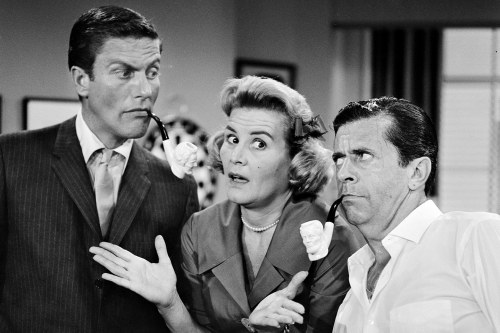
Dick Van Dyke, Rose Marie, Morey Amsterdam

“WAIT FOR YOUR LAUGH” My rating: B+

85 minutes | No MPAA rating

Most of us remember Rose Marie, who died last week at the age of 94, as the wise-cracking comedy writer Sally Rogers on TV’s “The Dick Van Dyke Show.”

But that was only one stage in a show-biz career that lasted nine decades and was crammed with dozens of firsts.

“Wait for Your Laugh,” Christina Tucker and Jason Wise’s loving documentary, covers Rose Marie’s remarkable life, in the process delivering a pretty comprehensive look at the evolution of entertainment in the 20th century.

Based on a series of filmed interviews with the still-sharp-as-a-tack Rose Marie — as well as with colleagues and friends like Van Dyke, Carl Reiner, Tim Conway and Peter Marshall — the film reveals a remarkable life.

Rose Marie Mazzetta became a child star at age 4, winning a talent contest by belting out songs in the style of Sophie Tucker.  This led to radio appearances as Baby Rose Marie. When listeners refused to believe that a child could sing like that, she hit the vaudeville circuit in its final days. Audiences couldn’t deny their eyes and ears.

Al Capone and other gangsters (“the boys”) treated little Rose Marie as an adopted daughter, offering protection. They could’t protect her from her father/manager, who siphoned off millions before she was old enough to declare her emancipation. (The old man was arrested 128 times for violation of child labor laws.) Continue Reading »

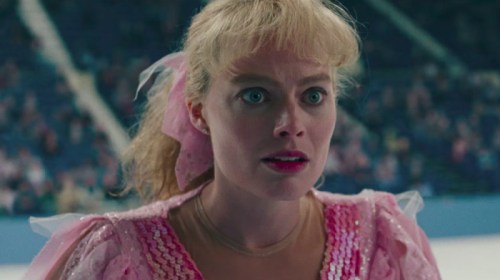
Margot Robbie as Tonya Harding

“I, TONYA” My rating: A-

120 minutes | MPAA rating: R

Everybody knows that spunky figure skater Tonya Harding was behind the plot to smash the knee of  her teammate and strongest competitor, Nancy Kerrigan. Right?

Well, maybe not. The astounding “I, Tonya” suggests that Harding  may not deserve her rap as the poster girl for unsportsmanlike conduct.

“Based on irony free, widely contradictory, totally true interviews” with the major participants (under the closing credits we see some of the actual news and police interview footage), this savage and breathtakingly entertaining black comedy from Craig Gillespie (“Lars and the Real Girl”) is also a powerful dramatic and emotional experience, one that forces a total reassessment of the Harding/Kerrigan affair.

By the time it’s over you don’t know whether to laugh or weep.

Along the way it gives Aussie glamor girl Margot Robbie the opportunity to display world-class acting chops as Tonya, while cementing Allison Janney’s reputation as the cinema’s greatest bad mother (we’re talking a perf that leaves “Mommie Dearest” in the dust).

Steven Rogers’ screenplay (a huge step up from his usual stuff…”Hope Floats,” “Stepmom,” “Love the Coopers”) centers on a series of recreated interviews with the main characters, illustrating their memories with flashbacks.

The tone is set early on with Janney’s appearance as LaVona, the stage mother from hell. She’s like a human skull beneath a Beatles wig with an ever-smoldering cigarillo. In the present-day interview scenes she always has a parakeet on her shoulder.

LaVona is a foul-mouthed waitress and (mostly) single mother who motivated her little athlete with psychological and occasional physical abuse. (“She skated better when enraged.”) She practically crows at the memory of  Tonya wading out onto the rink for the first time and blowing away the privileged little girls who had been at it for years. (“Those bitches didn’t know what hit them.”)

Continue Reading »

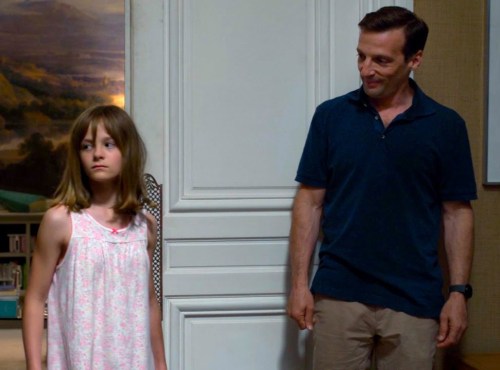
Kristen Wiig, Matt Damon

“DOWNSIZING” My rating: C+ 

135 minutes | MPAA rating:

There’s a work of genius lurking inside “Downsizing,” one that struggles to make itself heard and ultimately loses steam and dribbles away.

Bottom line: The first half of Alexander Payne’s sci-fi/fantasy satire/end-of-the-world warning is pretty wonderful. After that, things get iffy.

In the film’s first moments we’re introduced to the concept of “downsizing” — not corporate layoffs but rather the shrinking of human beings to the size of Barbie Dolls.

Downsizing could be the answer to, well, everything.  An ear of corn could feed a dozen people for a week.  Tiny homes require almost no power to heat and cool efficiently.  Moving around is easy — downsized citizens ride in shoebox-sized containers that can fit easily in a bus or airplane’s overhead rack.

Omaha residents Paul and Audrey Safranek (Matt Damon, Kristen Wiig) are initially bemused by this new technology.  But after a decade of hand-to-mouth living they come to the conclusion that downsizing is the key to a prosperous future — especially when it is explained to them that after downsizing their modest savings will translate into millions of dollars.

So they contract to live in a downsized community (a glass dome offers protection from predatory birds). This mini-metropolis takes up only a couple of acres of real-world real estate but, in shrunken form, is the size of greater New York City. Their built-to-order mansion awaits.

The actual process of downsizing is cleverly laid out in Payne and Jim Taylor’s screenplay…and it’s a techno-nerdish wonder. Once sedated, the client’s dental fillings are removed (only organic tissue can be shrunk…a ceramic filling could cause the client’s head to explode).  All body hair is shaved (again, hair follicles are not alive…only the roots).

Once downsized, the comatose clients are moved about on spatulas, like burgers on a short-order grill.

It’s all very amusing, yet weirdly plausible.

Just one problem. Upon awakening Paul learns that Audrey got cold feet at the last minute. She now wants a divorce from her tiny husband and most of  their savings.

Continue Reading »

P.T. Barnum (Hugh Jackman) and his band of oddities

“THE GREATEST SHOWMAN” My rating: B-

105 minutes | MPAA rating: PG

The most memorable utterance attributed to P.T. Barnum — “There’s a sucker born every minute”  — appears nowhere in the original film musical “The Great Showman.”

This is understandable. The quote is thick with contempt/condescension for the everyday idiot.  Michael Gracey’s film, on the other hand, is all about openness and a childlike sense of wonder.

Ostensibly a biography of the 19th-century con man and entertainment entrepreneur, “The Greatest Showman” is a passion project from Aussie actor Hugh Jackman, who has long wanted to tackle the role. (Aside from subject matter, the film is in no way related to the fine 1980 Broadway musical “Barnum.”)

The real Barnum was a wart of a fellow and a self-proclaimed “humbugger,'” certainly not the dashing charmer we get in this production. But then “The Greatest Showman” has been conceived and executed not as history or actual biography but as a colorful commentary on dreaming big and embracing diversity.

The characters are paper thin and the historic details iffy (there appear to be electric lights in a house in the 1850s, the women’s costumes are all over the place).

But it is undeniably entertaining, especially in several of the musical numbers and in a garish presentational approach that reminds of Baz Luhrmann’s work on “Moulin Rouge,” with maybe a touch of Bob Fosse-inspired choreography thrown in for good measure.

Zendaya

We follow the rise of Jackman’s Barnum from struggling shipping company clerk to national prominence. He woos and wins a wealthy young woman (Michelle Williams), in the process alienating her family, who find his work very low class.

He buys a run-down museum in NYC and goes on a world-wide hunt to stock it with human and animal oddities. Before long Barnum can claim among his attractions the world’s smallest man, Tom Thumb, a bearded lady (Keala Settle), Siamese twins, the Dog Boy, the Tattooed Man and  a fellow with three legs.

Far from presenting Barnum as an exploiter of these unfortunates, the film depicts him as a father figure who creates an outcast clan whose members band together for mutual support in defiance of a cruel world.

Continue Reading »

Sally Hawkins, Doug Jones

“THE SHAPE OF WATER” My rating: B+

122 minutes | MPAA rating: R

Blend the whimsey of “Amelie” with the sci-fi fantasy of “Creature from the Black Lagoon,” wrap it all up in Cold War paranoia, and you’ve got Guillermo del Toro’s “The Shape of Water,” an interspecies love story that will leave you swooning.

Horror and beauty are never far apart in del Toro’s cinema; what’s noteworthy about this picture is that the horror is generated not by the fantastic creature at its heart but by human fear and loathing. This time around we’re the monsters.

Set in early ’60s Baltimore, where it’s always raining and everything is tinted bottom-of-the-sea green, “The Shape of Water” opens with Elisa ( Sally Hawkins) awakening from a watery dream and getting ready for work. Elisa is mute and communicates through sign language (we get subtitles); she works the night shift mopping floors at a top-secret government research station that looks and feels like a giant concrete mausoleum.

Michael Shannon

The scientific staff is all agog over their new acquisition, an amphibious creature captured in a river in South American, where the natives worshipped him as a god. The current condition of this beautiful/disquieting creation (that’s frequent del Toro collaborator Doug Jones under the spectacular prosthetics developed by Legacy Effects) is anything but god-like; he’s in chains and is the subject of the sadistic cattle-prod attentions of Strickland (Michael Shannon), a malevolent CIA type who can’t wait to vivisect this new species.

Using her passkey to gain entrance to the creature’s prison, the empathetic Elisa brings hard-boiled eggs and a portable phonograph player with a collection of jazz LPs. This frog/man may not be able to speak, but he digs eggs and music.

Elisa soon discovers that the captive is not a mindless beast; before long they’re conversing in sign language. And and as her affections for this scaly  newcomer deepen, Elisa hatches a plan to spirit the amphibian man out of the lab before he can be vivisected. He can live in her claw-footed bathtub.

She is abetted in this quest by her co-worker, the mop-swinging Zelda (Octavia Spencer),  by her neighbor Giles (Richard Jenkins), a mild-mannered commercial artist, and by one of the scientific eggheads, Hoffstetler (Michael Stuhlbarg), who wants to preserve this great discovery at any cost. Continue Reading »

Gary Oldman as Winston Churchill

“DARKEST HOUR”  My rating: B

A confession.

I’ve often found Gary Oldman  a shameless scenery chewer. Villainous roles were especially problematic; you could actually see Oldman twirling his mustache, metaphorically speaking.

2011’s “Tinker Tailor Soldier Spy” gave us a more settled, thoughtful Goldman, who portrayed John LeCarre’s good gray spookmaster George Smiley with an admirable degree of restraint.

Now, in  “Darkest Hour,” Goldman tackles the iconic role of Winston Churchill, and it’s a match made in heaven.  Sir Winston was, after all, no slouch at scenery chewing; yet Oldman’s performance here is subtle and balanced, a deft blend of  bombast and inner activity.

It’s a performance of such insight and power — abetted by David Malinowski’s spectacularly effective makeup design — that it immediately propels Goldman into the front ranks of this year’s Oscar contenders.

Joe Wright’s film centers on one month, May of 1940, when the long-out-of-favor Churchill was elected Prime Minister after the collapse of Neville Chamberlain’s ineffectual government.

The P.M. is faced with seemingly insurmountable problems. The Nazis have taken over much of Europe and are pounding the British army at Dunkirk. If those 300,000 or so soldiers are captured or killed, it will leave Great Britain defenseless.

Voices within his own party are urging Churchill to sue Hitler for peace. It’s the only way to escape a bloodbath and an armed invasion.

Churchill doubts that Der Fuhrer is in any mood to grant concessions. If only he can save the troops waiting on the French coast, galvanize public opinion, and overnight turn his country’s prevailing ethos from dovish to hawkish. Continue Reading »

Kate Winslet

“WONDER WHEEL” My rating: C-

101 minutes | MPAA rating: PG-13

“Spare me the bad drama,” cheating housewife Ginny (Kate Winslet) moans to her complaining boyfriend late in Woody Allen’s “Wonder Wheel.”

Funny, but those are exactly the sentiments of the audience watching the film.

Visually splendid but dramatically inert, “Wonder Wheel” plays like an idea plucked from Allen’s reject pile. About all it’s got going for it is a sense of time and place.

Set in Coney Island’s famed amusement park in the 1950s — and filmed by Vittorio Storaro with a near-Technicolor glow — this tale of an unfulfilled woman’s last chance at romance is a self-pity party of the first order. It’s one of Allen’s periodic attempts at straight drama…and as is usually the case when he blows off any semblance of humor, it’s a hard slog.

Winslet’s Ginny is a 39-year-old former actress (apparently she was limited to one-line roles) now married to Humpty (Jim Belushi), the big-bellied, balding operator of the Coney Island carousel.  They live in an apartment over a shooting gallery; their marvelous view of the nearby Wonder Wheel is undermined by the constant din of gunshots.

Early in Allen’s script the couple are visited by Humpty’s estranged daughter, Carolina (Juno Temple), who married a mobster, divorced him, sang to the feds and is now on the run from her ex’s murderous associates. She begs for Humpty to take her in.

Carolina’s arrival coincides with Ginny’s affair with a much younger lifeguard, Mickey (Justin Timberlake).  Mickey is one of Allen’s more impossible creations, an aspiring playwright who talks like a college freshman in the first throes of intellectual pretentiousness. And boy, does Mickey talk.  He’s the movie’s narrator, telling us what’s going on even as we’re watching what’s going on. Timberlake can do nothing with the character.

“Wonder Wheel” focuses on Ginny’s emotional and moral disintegration after learning that Mickey and Carolina are canoodling on the side. Her shrilly-expressed angst and jealousy are so altogether off-putting that not even Winslet can make her anything but irritating.

Allen is here clearly inspired by the Fifties New York dramas of Arthur Miller and William Inge (“Come Back, Little Sheba” especially), but those plays transcended their protagonists’ moral and intellectual shortcomings.

“Wonder Wheel” doesn’t come close.

| Robert W. Butler

Daisy Ridley, Mark Hamill

“STAR WARS: THE LAST JEDI” My rating: C

152 minutes |MPAA rating: PG-13

Over the last 40 years “Star Wars” films have thrilled and delighted (the original “A New Hope”) and occasionally pissed off and dismayed (the George Lucas-directed prequels).

But until now I’ve never been bored.

We’re talking I-don’t-know-if-I-can-keep-my-eyes-open bored.

It’s not that “Star Wars: The Last Jedi” is terrible. It’s just that writer/director Rian Johnson is so handcuffed by the franchise’s mythology that there’s no hope of actually delivering anything new and unusual.

A “Star Wars” movie is now like a giant hamster wheel. We keep loping along but the scenery never changes. The same narratives, motifs and tropes play out over and over again. The filmmakers may tinker with small details, but there’s no way they can give this series the swift kick in the narrative ass it needs.

Actually, Johnson (“Loopers,” “Brick,”  “The Brothers Bloom”) delivers a flash of hope early in “Last Jedi” when the pompous General Hux (Domhnail Gleeson) delivers one of those vituperative “rebel swine” declamatory speeches, only to be phone pranked by rebel pilot Poe Dameron who cuts in on the imperial cruiser’s radio frequency.

It’s a refreshingly gonzo sequence, one that not only re-establishes Dameron as the new Han Solo but  acknowledges the cardboard villainy that has always been the hallmark of “Star Wars” baddies.

Alas, that moment passes, never to be repeated. Yeah, there are a couple of mildly amusing flashes still on tap.

“If they move, stun ’em” one of our heroes says of captives, a clear nod to “The Wild Bunch’s” “If they move, kill ’em.” And we get a throwaway glimpse of an imperial dreadnaught’s laundry room where all those fascist uniforms are being starched.

But for the most part “Last Jedi” takes itself very, very seriously. It needs a lot more finger-in-the-eye subversiveness.

Continue Reading »