Feeds:
Posts
Comments

Posts Tagged ‘Annette Bening’

Colin Farrell

“SUGAR”(Apple+):

The year’s biggest gotcha!!! moment arrives at the end of Episode 6 of “Sugar,” and it’ll leave you reeling.

And that’s all I’ll say about that.

But there’s plenty of other stuff to relish in creator Mark Protosevich’s smart, stylish and thought-provoking re-examination of classic private eye tropes.

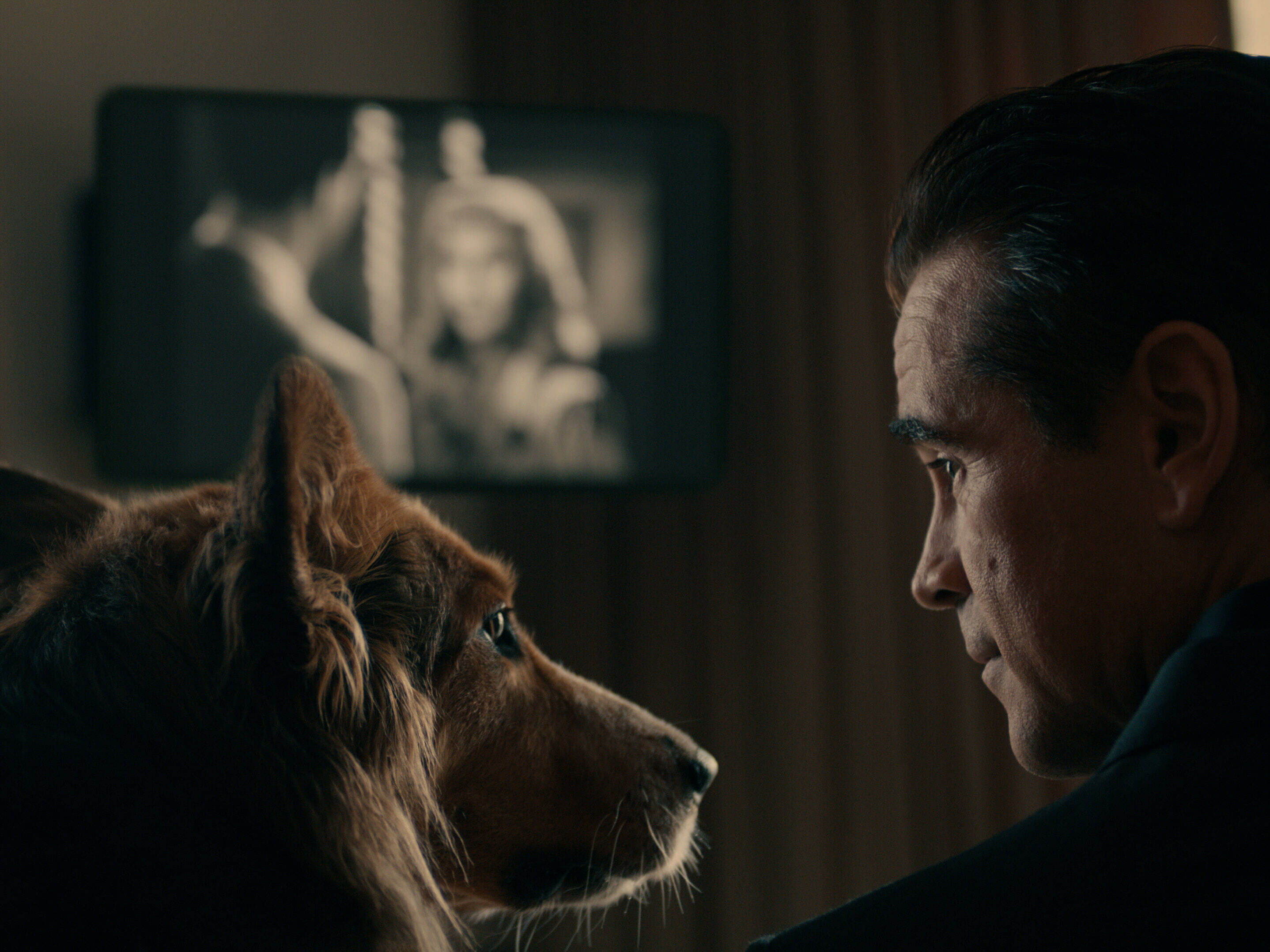
Colin Farrell is at his absolute best as John Sugar, a private investigator specializing in missing person cases.  

Noir usually requires a protagonist who is essentially honest but bummed out and bitter, a guy sickened by the corruption of the big city but driven to discover the truth.

Sugar, though, loves L.A.  For him it’s like a trip to Disneyland.  For one thing, he tools around town in a vintage Corvette convertible while sporting immaculately tailored suits. Even when facing down despicables he’s gentlemanly, more curious than judgmental.

Moreover, he loves working in the motion picture capital of the world. One  of the show’s cleverest conceits is that he’s always encountering characters and situations that remind him of classic films…and brief clips from those films are scattered reverentially throughout the series.

It’s been said that everything we need to know we learned in kindergarten.  John Sugar learned  it watching movies.

Sugar’s current case involves the disappearance of a young woman bred of Hollywood royalty.  Her grandfather (James Cromwell) is a financial titan; her father (Dennis Boutsikaris) is a ruthless producer, and her half-brother (Matt Corddry) is a former child star now wallowing in a drug-infused career burnout.

Sugar appears to have no close friends (an abandoned dog becomes his main bud), though he has a sort of Girl Friday (Kirby) who assigns cases to him and is always warning against getting too involved with the clients.

And in the course of the investigation Sugar finds himself spending time with the missing girl’s one-time stepmother (Amy Ryan), an actress and recovering alcoholic who finds herself attracted to this cooly empathetic white knight.  (Aside from the missing persons case, the series’ biggest mystery is whether these two will ever make a romantic connection.)

Now all this sounds intriguing enough, but it’s only a prelude to the mind-blowing reveal that comes halfway through.

“Sugar” is so good it’s worth subscribing to Apple+ just for this one series.
Ewan McGregor, Alexa Goodall

“A GENTLEMAN IN MOSCOW” (Paramount +):

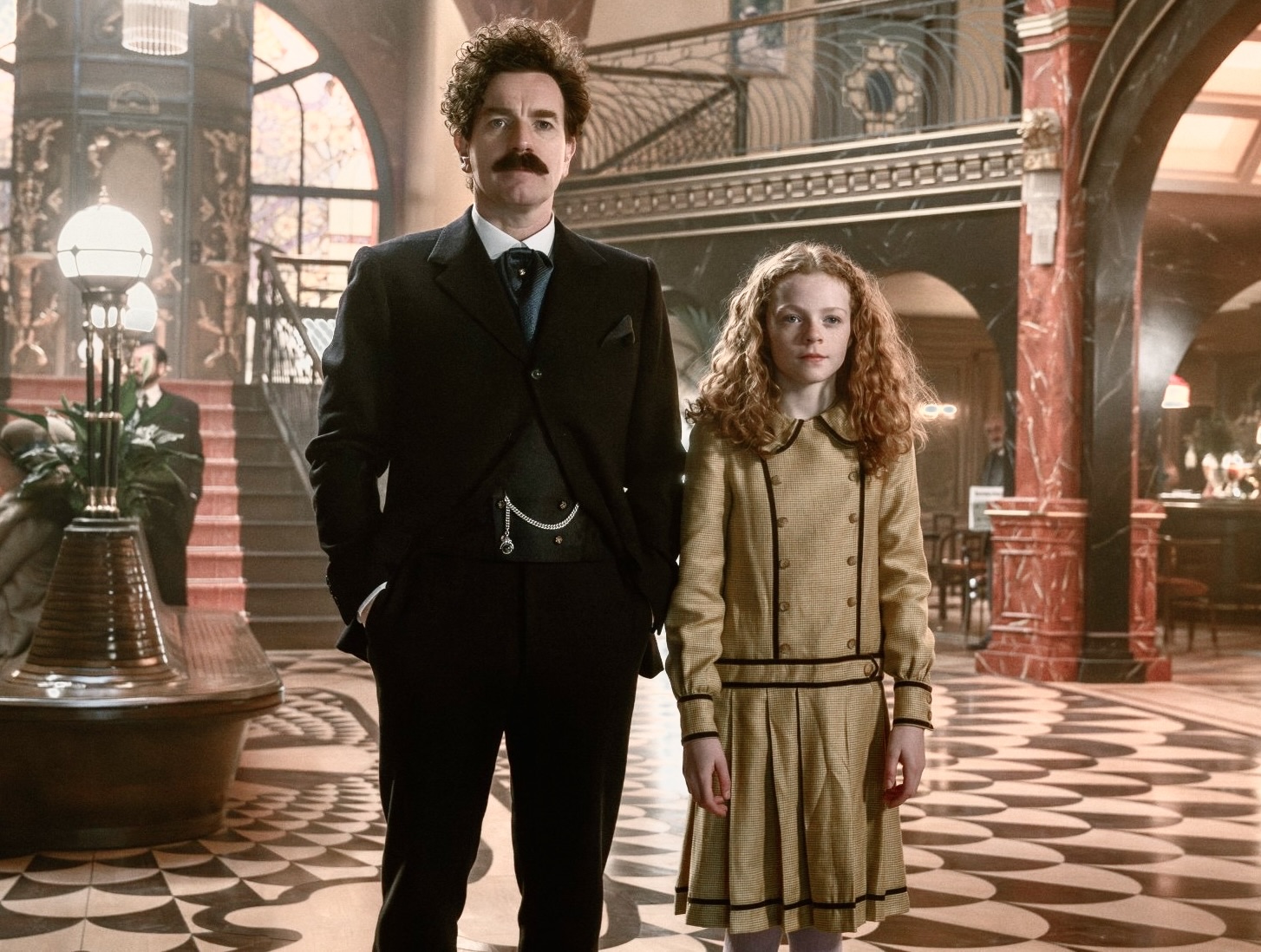
Ewan McGregor gives what may be a career-high performance in “A Gentleman in Moscow.” 

He’s so good that one is willing to overlook some of the production’s flaws just to luxuriate in his presence.

Based on Amor Towles’ best-selling novel, “Gentleman…” over eight episodes follows the life of Alexander Rostov, a Russian count caught up in the Revolution.  

Being rich, cultured, erudite and well-educated, Alexander seems destined for a firing squad.  He’s saved when he is credited (erroneously) with composing a popular pro-Communist poem; instead of death he is sentenced to spend the rest of his life in Moscow’s Metropol Hotel.

Which is ironic, since the Metropol, an art nouveau masterpiece, is a last bastion of Western decadence in the economically devastated USSR. The Communist Party uses it as a showplace so foreign visitors can experience posh accommodations while the rest of the country starves.

 Alexander may be an impoverished prisoner sleeping in a frigid attic room, but he’s free to move about the building, to hobnob with guests and staff.  He becomes a waiter…and the in-house wine expert. And he even creates his own secret salon, a sort of throwback to his former life of luxury, this time furnished with pilfered items.

The heart of McGregor’s interpretation lies in Alexander’s mix of fatalism (the old world order is gone and isn’t coming back) and his innate humanism, which allows him to see the good in all people (though in the case of certain Party die-hards, it’s a rough go). And despite his view of himself as a loner, he becomes a father — twice.

There are four basic plot threads interwoven here.

Initially there is  Alexander’s relationship with Nina (Alexa Goodall), the daughter of a hotel guest who becomes his best friend and guide to the wonders of the hotel (the child  has somehow gotten her hands on a master key.) Years later, after the grown Nina and her husband become victims of a Stalinist purge, Alexander will care for their daughter Sofia (Billie Garson), who becomes a brilliant pianist.

Throughout his 30-year stay in the Metropol Alexander will carry on an affair with Anna Urbanova (Mary Elizabeth Winstead), a star of Soviet cinema who enjoys her decadent pastimes and especially the Count’s old-world charm. This is one of the series’ big flaws: I didn’t buy Winstead (in real life she is Mrs. Ewan McGregor) as a jaded European; there’s too much all-American girl about her. Sometimes it feels she’s playing dress-up in Mom’s closet.

Finally there’s Osip (Johnny Harris), Alexander’s bald, brutal KGB overseer. Osip is Red down to his toenails; he hates the nobility and is looking for any excuse to condemn Alexander.  But over the decades theirs becomes the series’ most intriguing relationship.  Initially Osip demands that Alexander spy on the hotel’s guests; eventually the thug finds himself relying on Alexander’s cultured past and obvious “people” skills to navigate the dark twists and turns of a Stalinist society. Weirdly enough, they almost become friends.

The physical production is sumptuous, with the Metropol Hotel presented as a sort of funhouse  wonderland.  We explore this castle from the cellar furnace room to the rooftop (as close as Alexander can get to the great outdoors), luxuriating now and then in the posh dining room and bar, and the luxurious suites…not to mention the back stairways, kitchens and offices.

Finally, there’s one aspect of the series that bugged me. Usually I’m all for non-traditional casting, but the makers of “Gentleman…” have taken it to extremes. Black actors here take roles that for historic accuracy should be portrayed by…well, people who look Russian. The Russian minister of arts is black, an American diplomat (in the 1940s and ‘50s) is black; even Alexander’s boyhood best friend (Fehinti Balogun) is black (and with braided dreadlocks, even). 

These instances took me out of the show and temporarily derailed my attention and enjoyment. 

But then I come back to McGregor’s display of unassuming decency.
Left to right: Alison Brie, Sam Neill, Annette Bening, Conor Kerrigan Turner, Essie Randles, Jake Lacey

“APPLES NEVER FALL” (Peacock):

First-rate players never get the payoff they deserve in “Apples Never Fall,” a murder mystery (sort of) about a hugely dysfunctional family that hints at becoming something dark and revealing before turning all soft and squishy.

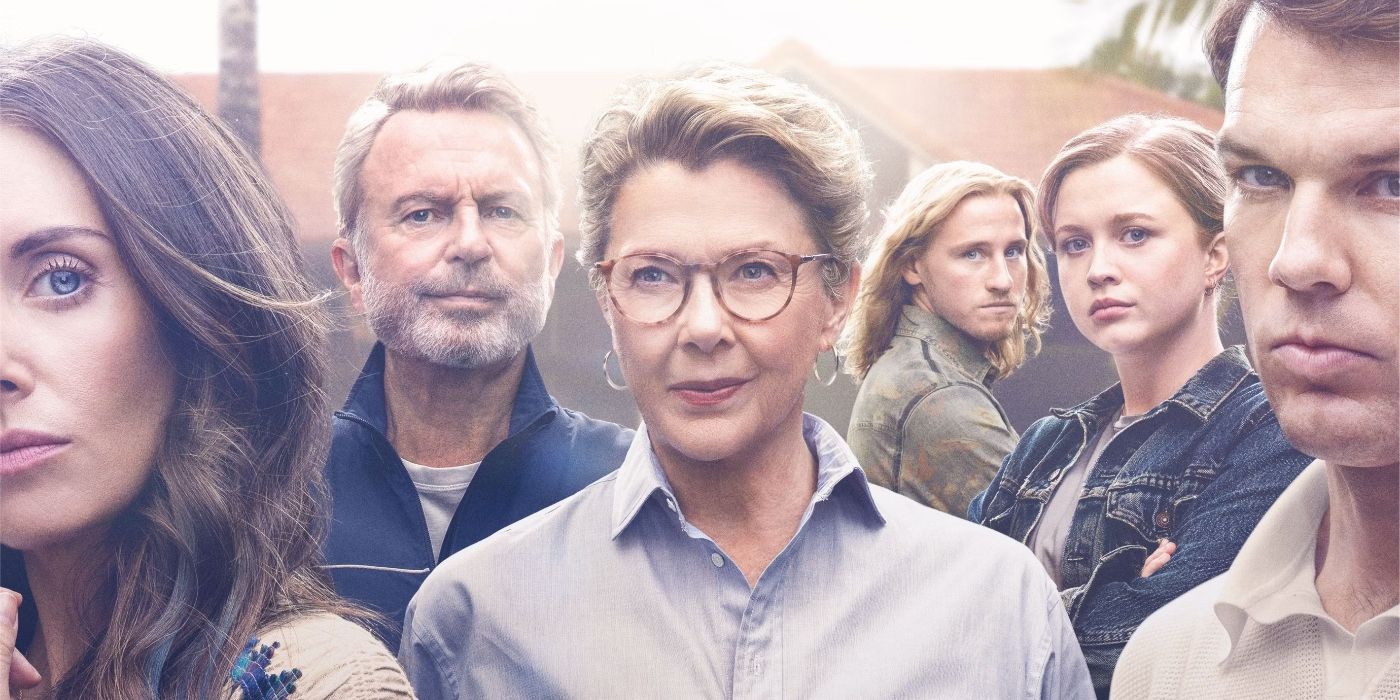
The Delaney family of Palm Beach are local legends by virtue of running a tennis academy that has turned out the current world champion.

Mom Joy and dad Stan (Annette Bening, Sam Neill) are currently enjoying an uneasy retirement…he’s a bit of a boor who radiates possible violence, she’s a bored matron.

They’ve got four grown kids — played by Jake Lacy, Alison Brie, Conor Kerrigan Turner and Essie Randles — all of whom seem lost, professionally and/or personally.

Creator Melanie March mixes two genres here.  First there’s the arrival of Savannah (Georgia Flood), an abused woman (or so she claims) who washes up on Joy and Stan’s doorstep, is taken in my them, and slowly makes herself indispensable in ways their actual children won’t. Is Savannah a con artist? Dangerous?

Then there’s Joy’s disappearance, Stan’s stubborn refusal to cooperate with the cops, and lots of bloody evidence suggests she has been the victim of foul play.

“Apples Never Fall” dishes a ton of armchair psychology, a mess of subplots that do little more than pad the proceedings, and a jumbled time frame that makes it hard to figure out exactly where we are in the 7-episode story.

Finally, there’s a payoff that is more “meh” than “damn!”

| Robert W. Butler

Read Full Post »

Olivia Wilde, Oscar Isaac

“LIFE ITSELF” My rating: C-

118 minutes | MPAA rating: R

Having conquered the world of episodic television with the emotion-wringing family drama “This is Us,”  writer/director Dan Fogelman turns to the big screen with “Life Itself.”

Things don’t go well.

As the title suggests, Fogelman is here attempting nothing less than a God’s-eye view of human lives, all of them entangled — though at first that’s not obvious.  While “This is Us” appeals directly to big laughs and big tears, “Life Itself” is curiously muted, as if we’re observing the characters across vast distances.  Those looking for a good cry will probably leave looking for something to punch.

The film is perversely curious, for Fogelman has given us nothing less than a humanistic, non-violent parody/homage of Quentin Tarantino’s “Pulp Fiction.” Like that film, “Life Itself” is broken into specific chapters and employs a time-leaping narrative (something with which Fogelman is familiar…see “This is Us”). At one point characters attend a party dressed like John Travolta and Uma Thurman in “Pulp Fiction’s”  famous dance contest; at least twice in “Life Itself” the movie slows down so that characters can deliver long Tarantino-esque monologues. Tarantino regular Samuel L. Jackson even pops up in an extended cameo so weird it defies description.

So what’s the movie about?  Well, let’s break it down by  chapters.

  • In the opening sequence the bearded, unkempt Will (Oscar Isaac) is getting therapy from a shrink (Annette Bening). We gradually learn that his beloved wife Abby has left him (in flashbacks she’s played by Olivia Wilde).  We see their romantic meeting, their growing love, their relationship with Will’s parents (Mandy Patinkin, Jean Smart), their anticipation of the birth of their child. We discover that Will’s therapy was court-mandated after a suicide attempt and a few months in a mental ward. Eventually we discover what happened to Abby.
  • The next segment follows the childhood of Will and Abby’s daughter, Dylan (Olivia Cooke), who is raised by her widowed grandpa and grows up to be a smart/rebellious punk rocker, though tormented by the loss of the parents she never met. (more…)

Read Full Post »

Annette Bening

“THE SEAGULL” My rating:B-

98 minutes | MPAA rating: PG-13

There’s nothing particularly wrong with the new movie version of Anton Chekhov’s “The Seagull”…save that it is a movie.

Call me old-fashioned, but I believe Chekhov was meant to be seen on the stage, where the only thing between the audience and the storytellers is air.  By its very technological nature, film has a way of distancing us from the immediacy of Chekhov’s characters.

That said, this “Seagull,” directed by Michael Mayer and featuring an impressively strong cast, will serve as an introduction — a  limited introduction that hints at the greatness revealed when one views this play in the flesh.

Set on a wooded Russian estate at the turn of the last century, Chekhov’s tale studies a handful of individuals engaged in a round robin of romantic frustration.

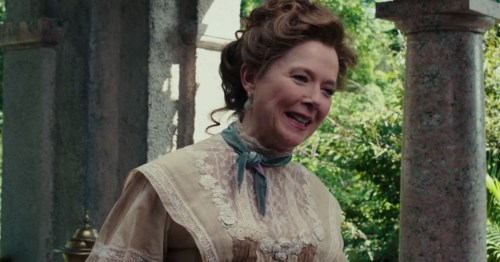
Irina (Annette Bening) is a famous stage actress whose current lover, Boris, is a rising literary star a couple of decades her junior.  Vain, pompous and absolutely terrified of aging, Irina is nearly undone by Boris’ obvious attraction to Nina (Saoirse Ronan), the fresh-faced daughter of a nearby landowner who has her own thespian ambitions.

Nina, meanwhile, is loved by Irina’s neurotic son Konstantin (Billy Howle), an aspiring playwright and short story writer so sensitive that he appears to be in a constant state of depression or anger.

Konstantin is worshipped from afar by Masha (Elisabeth Moss), who wears black because “I’m in mourning for my life” (she’s a real barrel of monkeys) and nips steadily from a tiny flask.

Masha is loved by Mikhail (Michael Zegen), an impoverished local school teacher.

Then there’s the good-hearted Doctor Dorn (John Tenney), who has long carried a torch for Irina; he’s the unattainable love object of the housekeeper Polina (Mare Winningham).

In other words, just about everyone in sight is in love with someone who doesn’t return the sentiment.

There are other characters blessedly free of the these romantic entanglements, especially Irina’s aging bachelor brother Sorin (Brian Dennehy) and the chatty estate foreman Shamrayev (Glenn Flesher). (more…)

Read Full Post »

Greta Gerwig, Annette Bening, Elle Fanning

Lucas Jade Zumann, Greta Gerwig, Annette Bening, Elle Fanning

“20th CENTURY WOMEN” My rating: B

118 minutes | MPAA rating: R

In his 2011 film “Beginners,” writer/director Mike Mills presented a fictionalized portrait of his father, who at age 75 announced that he had cancer and, by the way, was gay, too.

With “20th Century Women” he does a similar service for his mother, delivering a funny and emotionally substantive look at an unconventional household of feminists in the mid-20th century.

Much as Christopher Plummer won a supporting actor Oscar as the father in “Beginners,” Annette Bening is gaining awards buzz as the divorced matriarch in “20th Century Women.”

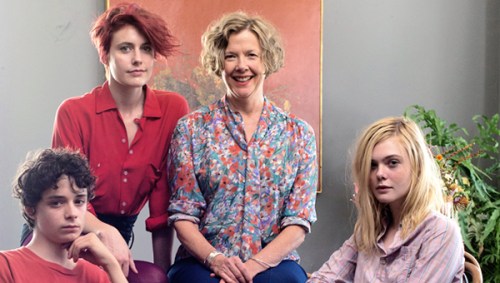
Set in the ’70s, the film centers on 55-year-old Dorothea (Bening) and her 15-year-old son, Jamie (Lucas Jade Zumann).

Dorothea is a curious case, a chain-smoking, mildly eccentric traditionalist in her personal life but a low-key crusader when it comes to social issues. (That conflict is reflected in the musical soundtrack, which pits the likable Talking Heads against the snarling punk of the Germs and Suicide.)

Dorothea lives in a big crumbling house undergoing perennial restoration. She’s got a hunky, laid-back boarder, William (Billy Crudup), who serves as carpenter, mason and auto mechanic.

There’s another renter, the henna-headed Abbie (Greta Gerwig), a blend of punk and hippie sensibilities who is undergoing a cancer scare.

And then there’s the young beauty Julie (Elle Fanning). Two years older than Jamie, she uses his bedroom as her refuge from an unhappy home life and a series of apparently joyless sexual couplings. At night she often enters through his second story window, scrambling up the construction scaffolding that surrounds the house.

Jamie is desperately in love with Julie (so are those of us watching the movie), but she keeps it platonic. She needs a friend and sounding board, not another young dude who wants to paw her. (“It was so much easier before you got so horny,” she sighs.) (more…)

Read Full Post »

Warren Beatty

Alden Ehrenreich, Warren Beatty

“RULES DON’T APPLY”  My rating: C

126 minutes | MPAA rating: PG-13

If “Rules Don’t Apply” is a comedy, why aren’t we laughing?

If it’s a romance, why don’t we feel something?

If it’s a tragedy, why don’t we care?

Warren Beatty’s latest feature as writer/director (his fifth, and the first since “Bullworth” in 1998) might be charitably described as a highly polished question mark.

It’s good looking,  competently acted and mildly affable. Basically it’s two hours of narrative  noodling that never scores an emotional or intellectual point.

Ostensibly the film provides an opportunity for Beatty to tackle the character of real-life  billionaire Howard Hughes — though Beatty doesn’t make an appearance as the nutjob recluse until nearly 40 minutes into the movie.

“Rules…” is, at its most basic level, a love triangle involving Hughes and two of his employees.

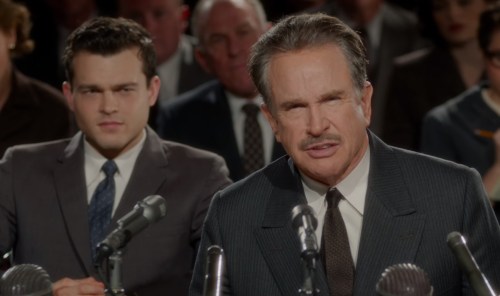
Marla (Lily Collins), a virginal Virginia beauty queen, has come to late-‘50s Los Angeles  after being signed to an acting contract by the mysterious Mr. Hughes.  (In addition to his oil and aviation interests, Hughes is a Hollywood producer.)

Lily is but one of two dozen aspiring actresses stashed by Hughes in posh digs all over LaLa Land. These stars of tomorrow — or harem members , if you will — are given a weekly stipend, acting and dance classes, and are ferried around town by a small army of limousine drivers whose behavior is strictly proscribed (no canoodling with the girls, no talking about Mr. Hughes’ business, etc.).

Marla and her driver, Frank (Alden Ehrenreich), have enough in common — including a shared religiosity — that Marla’s hovering mom (Annette Bening, aka Mrs. Warren Beatty) warns her daughter against any attraction to the handsome young chauffeur.  (more…)

Read Full Post »

Ed Harris, Annette Bening

Ed Harris, Annette Bening

“THE FACE OF LOVE” My rating: B- (Opening March 28 at the Rio)

92 minutes | MPAA rating: PG-13

Great performances can trump great pretentiousness.

That’s the story on “The Face of Love,” an eye-rollingly improbable yarn that, thanks to some very fine acting and terrific dialogue, rises above its contrivances and gets under your skin.

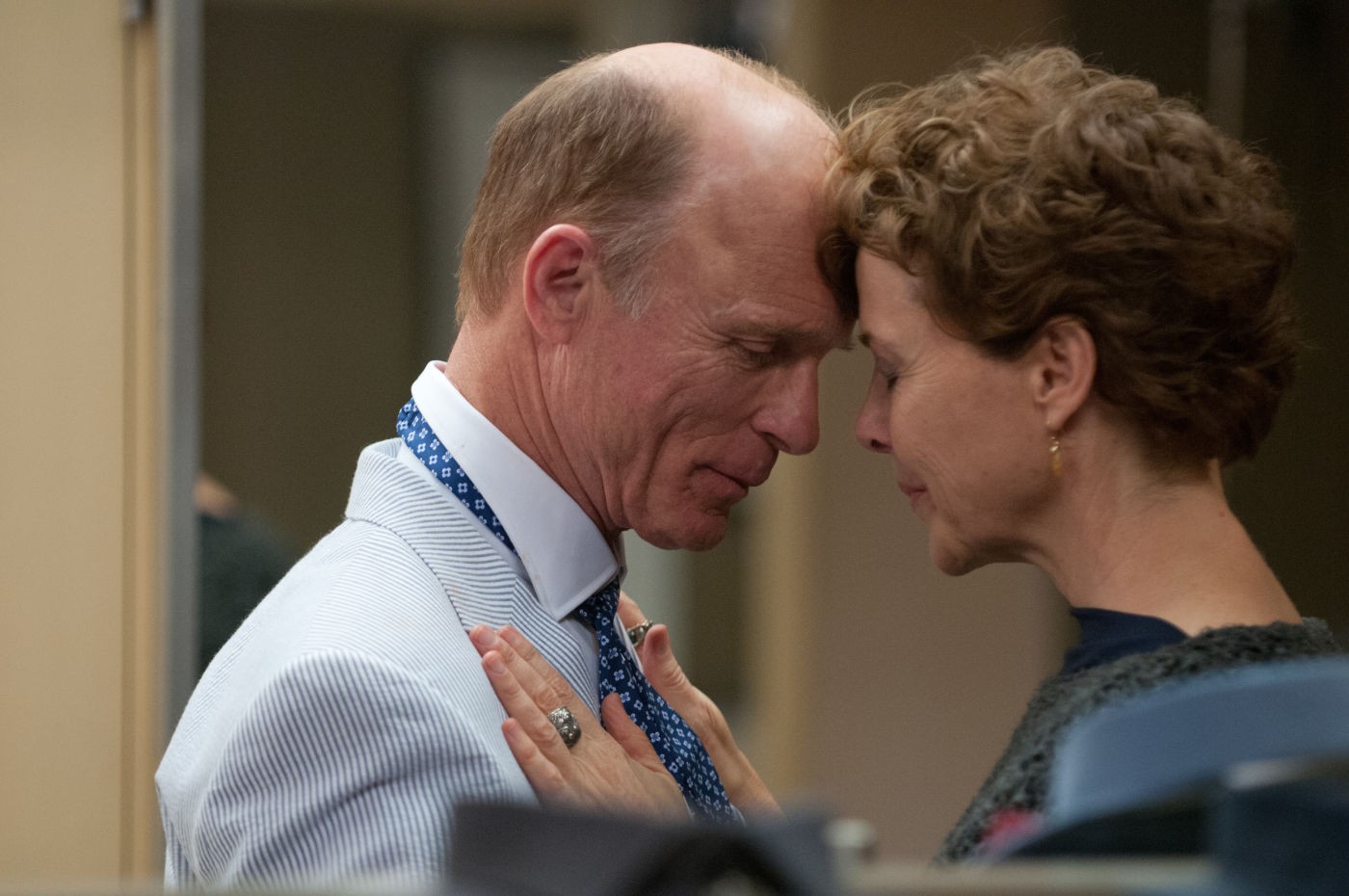
In the opening moments of Arie Posin’s film we get scenes from the life of married couple Nikki (Annette Bening) and Garrett (Ed Harris). Theirs appears to be a perfect relationship…although we may be getting an overly rosy view.

Because before too long Garrett drowns while vacationing at a Mexican resort and Nikki is left to rebuild her life. Those flashbacks may represent her idealized view of her marriage.

Five years later Nikki is visiting an L.A. art musuem when she spots a man who looks exactly like Garrett (Harris again). At first she’s stunned, then curious.

She returns to the museum hoping to see him again, then begins stalking him. Discovering that the man — his name is Tom — teaches art at a local college, she approaches him about taking some private art lessons. One thing leads to another and soon they’re dating — although Nikki never lets Tom know that he’s her late husband’s doppelganger.

(more…)

Read Full Post »