Feeds:
Posts
Comments

Posts Tagged ‘film’

Naomi Ackie, Eva Victor

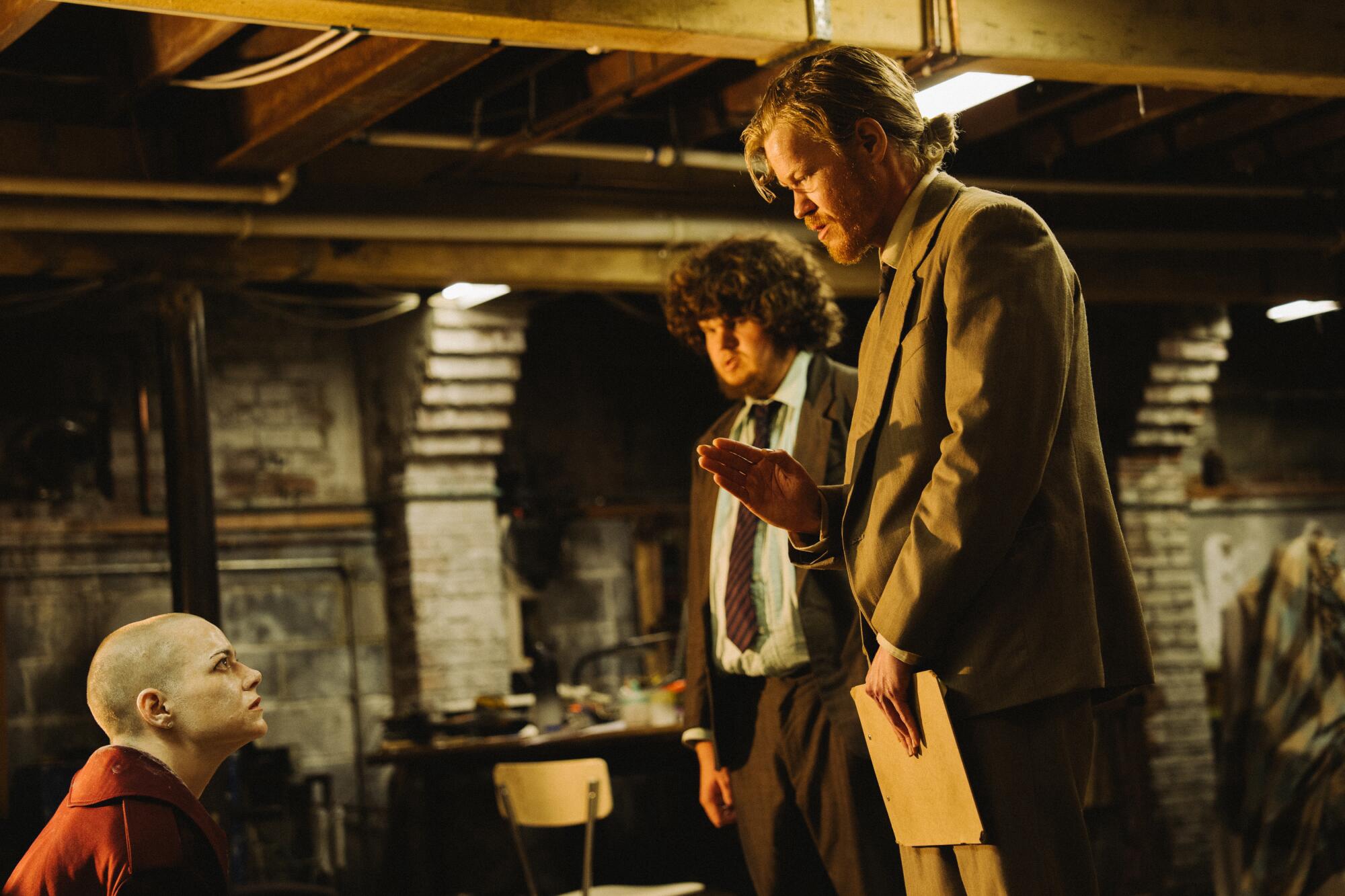
“SORRY, BABY”  My rating: A- (HBO Max)

103 minutes | MPAA rating: R

Every once in a while you encounter a film so achingly on target that you instinctively realize that it had to be torn from someone’s personal experience.

So it is with “Sorry, Baby,” Eva Victor’s hauntingly beautiful film about the aftermath of a sexual assault.

The words “sexual assault” will be enough to scare off many viewers.  But while Victor’s semi-autobiographical film (she wrote, directed and stars in it) addresses trauma, it’s more about the healing aftermath.

It starts unremarkably enough with our protagonist, Agnes (Victor), being visited by her old college roommate, Lydia (Naomi Ackie).  They’re several years out of school, but while Lydia has moved to the big city and settled down (she’s gay,  not that it’s a big deal) Agnes has hung around their New England college town.  In fact, she’s now a bigwig in the English Department.

These opening scenes radiate the easy familiarity of old friends reconnecting. But soon the talk drifts back to their senior year and an unpleasant incident. In a flashback we view Agnes’ interaction with Decker (Louis Cancelmi), one of her professors.  He seems like a standup guy…until he isn’t.

Victor wisely refrains from showing the assault.  Instead we get a long shot of the teacher’s home, where the two are meeting to discuss her thesis. Agnes goes inside, and the unmoving camera records the home’s facade as the sun dims, night falls, and lights go on inside. Apparently several hours have passed before Agnes stumbles out, walks to her car and drives away in a fog of humiliation and disbelief.

In a balancing act for the ages, Victor seasons this traumatic incident with satiric flashes.  When she meets with school officials to discuss the incident, she’s told that it’s not their problem.  Decker turned in his resignation just before the assault.  This news is delivered by a couple of women administrators whose clumsy efforts at sympathy are undermined by their panicked sense of institutional preservation.

“Sorry, Baby” rises and falls with Victor’s performance.  Her Agnes is tall, gawky and unremarkable (though, weirdly enough, by film’s end I saw her as beautiful).  She’s intellectually solid but emotionally tentative.  She often masks her feelings with oddball comments and an ironic aura.

Not that she doesn’t get some solid help from the other players.  Ackie is the best friend everyone wishes they had.  Lucas Hedges shines as the vaguely nerdy neighbor with whom the post-assault Agnes has a sweetly goofy love affair.  And veteran actor John Carroll Lynch nearly steals the film as a  sandwich shop operator who takes a grieving Agnes (whom he has never met before) under his caring wing.

The world can be cruel.  But simple decency  goes a long way.

Bob Odenkirk

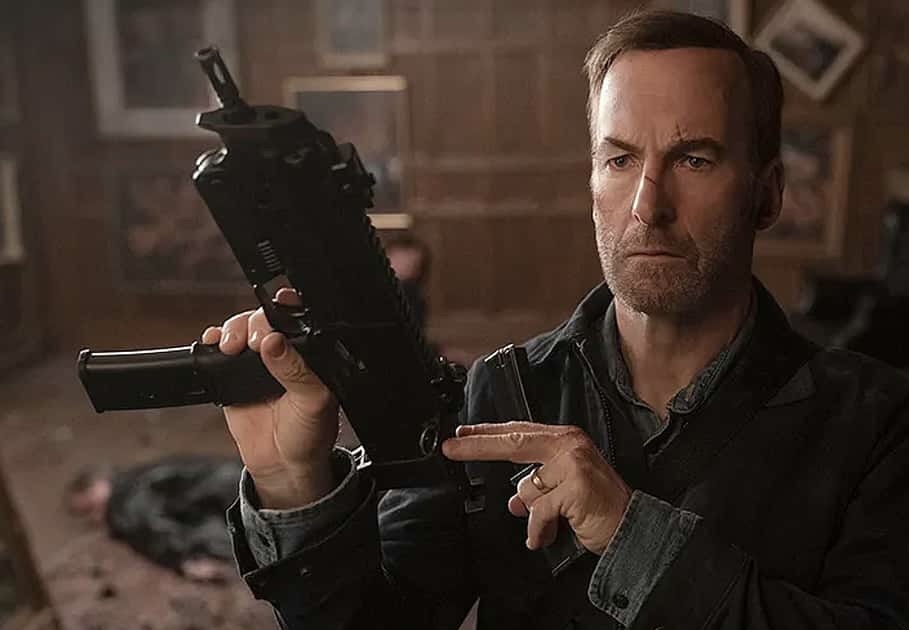
“NOBODY 2” My rating: C+(Peacock)

89 minutes | MPAA rating: R

“Nobody” (2021) was an unexpected sleeper, a hyperviolent, darkly funny yarn about a nondescript family man (Bob Odenkirk) whose secret job is that of assassin.

Now we’ve got a second installment and it’s pretty much the same thing all over again…minus the sense of discovery that made the first film so enjoyable.

Imagine “National Lampoon’s Vacation” mated with “Pulp Fiction.”  Odenkirk’s Hutch Mansell takes the family (Connie Nielsen is the Missus) to the cheesy amusement park he enjoyed as a boy.  

Except he finds the place now is a front for a drug operation run by a sociopathic grand dame (Sharon Stone) and administered by a corrupt local sheriff (John Ortiz).

Much mayhem ensues.  

Except this time the brew of comedy and over-the-top violence falls to the law of diminishing returns.  (Although I did enjoy the addition of Christopher Lloyd as Hutch’s father, himself a retired black ops type.)

Colin Farrell

“BALLAD OF A SMALL PLAYER” My rating: B (Netflix)

101 minutes | MPAA rating 

“The Banshees of Inisherin.” “Sugar.” “The Penguin.”

Yeah, Colin Farrell has been on a roll. And it continues  (sort of) with “Ballad of a Small Player,” which works a bit too hard to breathe new life into the gambler-at-the-end-of-his-luck yarn.

Farrell is Lord Doyle, a polished gent who floats through the casinos of neon-lit Macau as if he owns the joints. He sophisticated, generous, impeccably dressed.

It’s all a sham.  In truth he’s a common hustler who’s developed an impressive fictional character. Lord Doyle (he’s not a lord and Doyle is not his actual name) is so good at role playing that he has credit at all the tables.

That is, until his losses get so big that they can no longer be ignored. 

Scripted by Rowan Joffe and Lawrence Osborne and directed by Edward Berger (“All Quiet on the Western Front,” “Conclave”), “Ballad…” attempts to make up for a lack of originality (really, it’s just another movie about a desperate gambling addict searching for a big score) with a heightened visual sense and an almost operatic sense of melodrama.

But it’s worth sticking with to watch Farrell navigate Lord Doyle’s existential dilemma. Toss in Tilda Swinton as a comically stuffy investigator hot on his trail and Fala Chen as the casino hostess who provides  a love interest, and you’ve got a good-looking if not terribly deep outing.

| Robert W. Butler

Read Full Post »

Rose Byrne

“IF I HAD LEGS I’D KICK YOU” My rating: B (PPV on various services)

113 minutes | MPAA rating: R

The first thing you see in Mary Bronstein’s “If I Had Legs I’d Kick You” is a looming closeup of Rose Byrne’s face.  Her character, Linda, is being mom shamed by an unseen woman — some sort of physician — about her handing of her young daughter’s medical situation.

Just a few seconds of staring into Linda’s eyes betrays an ever-changing wash of emotions.  Defiance, aquiescence, guilt, cajoling, panic…Linda’s on a feeling-fueled roller coaster.  She’s trying to hold it together, but her desperation is everywhere creeping through.

Things just go downhill from there.

“If I Had Legs…” features a great performance from Byrne. It is also a thoroughly unpleasant experience.  

Unpleasant because Linda is circling the drain and hasn’t the strength to pull herself out.

Here’s her situation: Her daughter (voiced by Delaney Quinn, who is never fully seen) has an eating disorder so dangerous that she’s being fed through a tube inserted into her abdomen.

Linda must try to get the kid to eat real food while hooking her up nightly to a feeding machine.  She’s got no help in dealing with her whining, manipulative offspring because her husband is away for several weeks on business (Christian Slater provides his voice in mansplaining phone conversations).

Linda and the child move to a transient motel after a leaky pipe causes the ceiling of the family’s apartment to cave in. The crew hired to remediate the black mold and make repairs are doing a lousy job— when they bother to show up at all.

Things are no better on the work front.  Linda is a psychoanalyst (talk about a case of “physician, heal thyself”!). Her clients include a postpartum-plagued  young mother (Danielle Macdonald) who abandons her baby, expecting Linda to care for it,  and a demanding young man (Daniel Zolghadri) who has the hots for his shrink.

Linda is herself undergoing therapy from a colleague (Conan O’Brien, solid) who is clearly bored with sessions that have become a repetitive emotional merry-go-round.

In fact, Linda has taken the plunge from merely  miserable to self-destructive.  She’s hitting the bottle and often abandons her sleeping child to engage in misadventures with a fellow resident of the motel (A$AP Rocky).

To emphasize Linda’s isolation, writer/director Bronstein rarely lets Byrne share the frame with a fellow actor. 

And then there’s the question of how much of what we see is actually happening and how much is the product of Linda’s overworked nervous system.  For instance, what’s with the eerie dots of light that swarm like fireflies in the black hole of her ceiling? 

Bottom line: I’m in awe of Byrne’s work here.  It’s Oscar-level and then some.

But the film itself is tough going.

Zoey Deutch, Guillaume Marbeck
“NOUVELLE VAGUE” My rating: B (Netflix)

106 minutes } MPAA rating: R

I thoroughly  enjoyed Richard Linklater’s “Nouvelle Vague,” his recreation of the 1959 making of  “Breathless,” the French independent film that introduced a whole new  cinematic vocabulary and launched the directing career of Jean-Luc Godard. 

But I wonder… will anyone who is not already a hard-core film geek, who had not seen “Breathless” repeatedly, who is unaware of Godard’s influence…will anyone else understand or appreciate it?

Well, screw ‘em. “Breathless” is a film fanatic’s wet dream, a story of an outsider who makes an end run around movie conventions and created one of the seminal works of the 20th century. 

Linklater’s approach is both reverent and impish…he understands what made “Breathless” work and tries to apply the same ethos to “Nouvelle Vague,” even to the point of using the same film frame ratio and grainy  black-and-white  palette that Godard emplioyed.

Guillaume Marbeck is absolutely spot on as Godard, the cryptic film critic who wants to make his own movies.  Godard is plenty weird (he wears sunglasses 24/7 and appears to live in his own world) but he somehow manages to inspire a company of young moviemakers to break all the rules to create a masterpiece on a starvation budget.

Aubry Dullin plays Jean-Paul Belmondo, the young Gallic boxer/actor who would become an international star as a result of ”Breathless.” He doesn’t look all that much like Belmondo (whose nose was one of a kind) but he nails the body language and languid/sexy humor.

Zoey Deutch, on the other hand, is a dead ringer for American actress Jean Seberg, who was highjacked into doing the film and, despite numerous attempts to bail from the production, gave a career-defining performance.

Of the supporting perfs I was taken with Matthieu Penchant’s Raoul Coutard, the cinematographer who shot scenes on the streets of Paris while hidden in a handcart, and Bruno Dreyfurst as Georges de Beauregard, the exasperated producer who nevertheless stuck with Godard to make history.

“Nouvelle Vague” (the title translates as “New Wave” and refers to the generation of young French filmmakers that  included giants like Truffaut, Chabrol, Rivette and Rohmer)  oozes  youthful exuberance and intellectual precocity.  It’s both lighthearted romp and a serious appreciation of an important moment in cinema history.

In other words, it’s a lot of fun.

| Robert W. Butler
Read Full Post »

Jessie Buckley

“HAMNET” My rating: B (In theaters)

125 minutes | MPAA rating: PG-13

For a good three quarters of Chloe Zhao’s “Hamnet” I found myself diverted — fine photography, good acting — but nowhere near the emotional catharsis that has many critics calling it a masterpiece.

But just wait.

“Hamnet” only comes fully to life in the last 20 minutes, but it does so with devastating intensity.

Well, better to peak late than early, and in that regard the film will leave viewers well wrung out as they head for the exits.

This is the story of how the death of Shakespeare’s young son, Hamnet, inspired the playwright to create perhaps his most enduring and overwhelming drama, “Hamlet.”

Zhao’s screenplay abandons the jumbled timeline of Maggie’ O’Farrell’s best-selling novel for a straightforward chronological narrative. At the same time it keeps a  couple of the book’s twistier aspects by leaving  nameless the Shakespeare character (we know he’s the Bard, but none of his contemporaries do) and by identifying his wife as Agnes when history tells us that Shakespeare’s wife actually was named Anne.

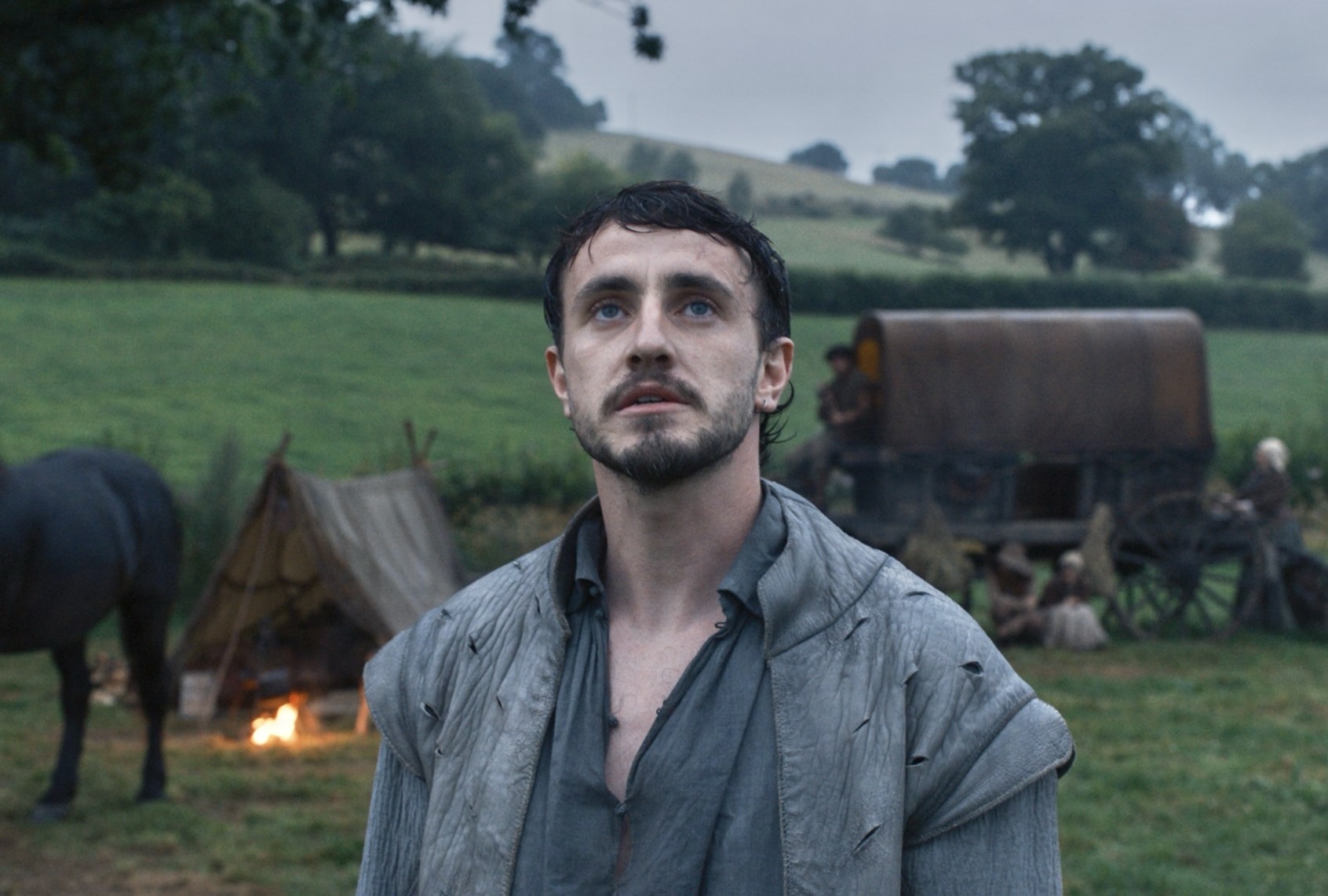
The film begins with the courtship of a small-town Latin tutor (Paul Mescal) and an odd young woman (Jessie Buckley) who spends much time in the woods, has a pet hawk and is rumored to be the daughter of a witch.

Their respective families (Emily Watson plays the tutor’s mother) disapprove, but young love (or lust) will have its way.  With Agnes pregnant, marriage is the next step.

Paul Mescal

The bulk of “Hamnet” is devoted to domestic life in Stratford.  The young husband begins spending time away in London (writing plays, we presume) while Agnes holds down the fort back home.  Their reunions are happy ones, and the couple have three children.

The only boy is Hamnet, so charmingly played by young Jacobi Jupe that we nave no trouble imagining the fierce love his parents have for him. 

At age 9 Hamnet succumbs to the plague in a horrendous death scene that leaves his mother a screaming wraith of pain.  Father arrives too late to see his boy alive.

Tragedy can bring families together or tear them apart. It appears that this family will never recover from Hamnet’s death.

When Agnes learns that her spouse’s latest play references their dead son, she makes the long trip to London to confront her now-estranged husband, arriving just in time to witness one of the first performances of “Hamlet.”

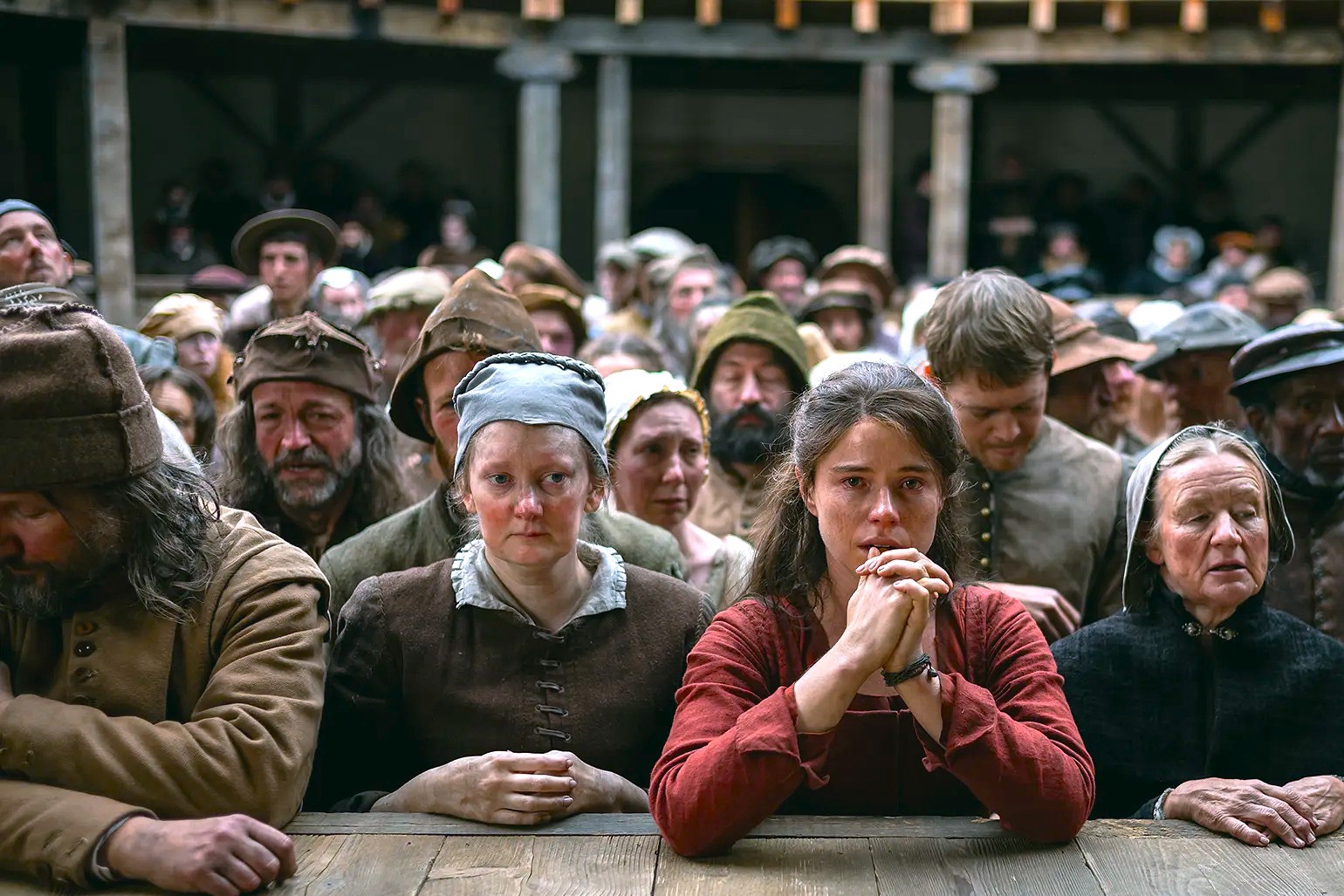
It’s at this point that “Hamnet” becomes something extraordinary. Agnes enters the open-air Globe with dozens of other playgoers, pushes her way to the front of the crowd and leans on the stage, ready to hurl objections and insults at this entertainment that capitalizes on her grief.

Except that during the performance she finds herself engrossed by the extraordinary storytelling and language. Like her fellow playgoers, she is transported to Elsinore Castle and caught up in the tale of loss, revenge and existential paradox. Abandoning her initial objections, Agnes ultimately recognizes that her husband has come to grips with their loss by using the theater to resurrect their dead child.

Art as therapy.

Zhao’s recreation of an Elizabethan production is extraordinarily captivating, not the least because Noah Jupe (older brother of the actor who played Hamnet) is so spectacularly good as the actor portraying Hamlet on stage.  

Watching this tragedy unfold is a transforming experience.  We recognize the awe and investment of the London audience in this new play; the sheer aesthetic pleasure that transcends the tragedy.

Mescal and Buckley give fine performances, but in the end it is the eternal genius of William Shakespeare that sticks in the memory.

George Clooney

“JAY KELLY”  My rating: C(Netflix)

132 minutes | MPAA rating: R

I’m a fan of George Clooney’s work. his persona and his politics.  But “Jay Kelly” left me cold.

Noah Baumbach’s latest film is a character study…sort of…of a man who apparently has no character.

Jay Kelly (Clooney) is a famous movie star.  Millions know him from his many screen appearances, but apparently nobody knows him, really.

His family, his friends, his co-workers…about all they get from him is suave charm, self-deprecating wit and good looks.  If there’s a real human being in the attractive package, it’s yet  to assert itself.

The screenplay by Baumbach and actress Emily Mortimer (who takes a small role) finds Jay on a trip to Italy to receive some sort of award.  Usually he flies in a private jet, but for this trip he has decided to take the train with all the other tourists and proles.  He says he doesn’t like being noticed, but he sure spends a lot of time being noticed.

If anyone is close to knowing Jay it’s his long-suffering manager Ron (Adam Sandler), who likes to think of himself as a friend.  Except as Jay points out, friends don’t usually take 15 percent.

“Jay Kelly” has an astoundingly deep cast — Greta Gerwig, Billy Crudup, Laura Dern, Patrick Wilson, Stacy Keach, Isla Fisher, Jim Broadbent, Riley Keough, Josh Hamilton (for starters) — though many have only a few seconds of screen time.

The film is stranded somewhere between satirizing Hollywood and its denizens and empathizing with Jay’s late-in-life realization that as a human he’s pretty much blown it.  But it’s neither funny enough or tragic enough to warrant a bloated running time (more than two hours).

Moreover, since Jay is a handsome cipher, our only real  human connection is Sandler’s Ron, who must ride herd on a mercurial star while trying to hold together his own private life.  It’s the film’s best performance.

“Jay Kelly” ends with Jay and an audience watching a compilation of scenes from his film and television work (actually they’re clips from George Clooney’s career, making for a sort of head-smacking meta moment).  To the extent that the segment stirs pleasurable memories it gives Jay’s life an emotional arc missing from the rest of the film.

But it’s a contrived moment in a film that already feels contrived.

| Robert W. Butler

Read Full Post »

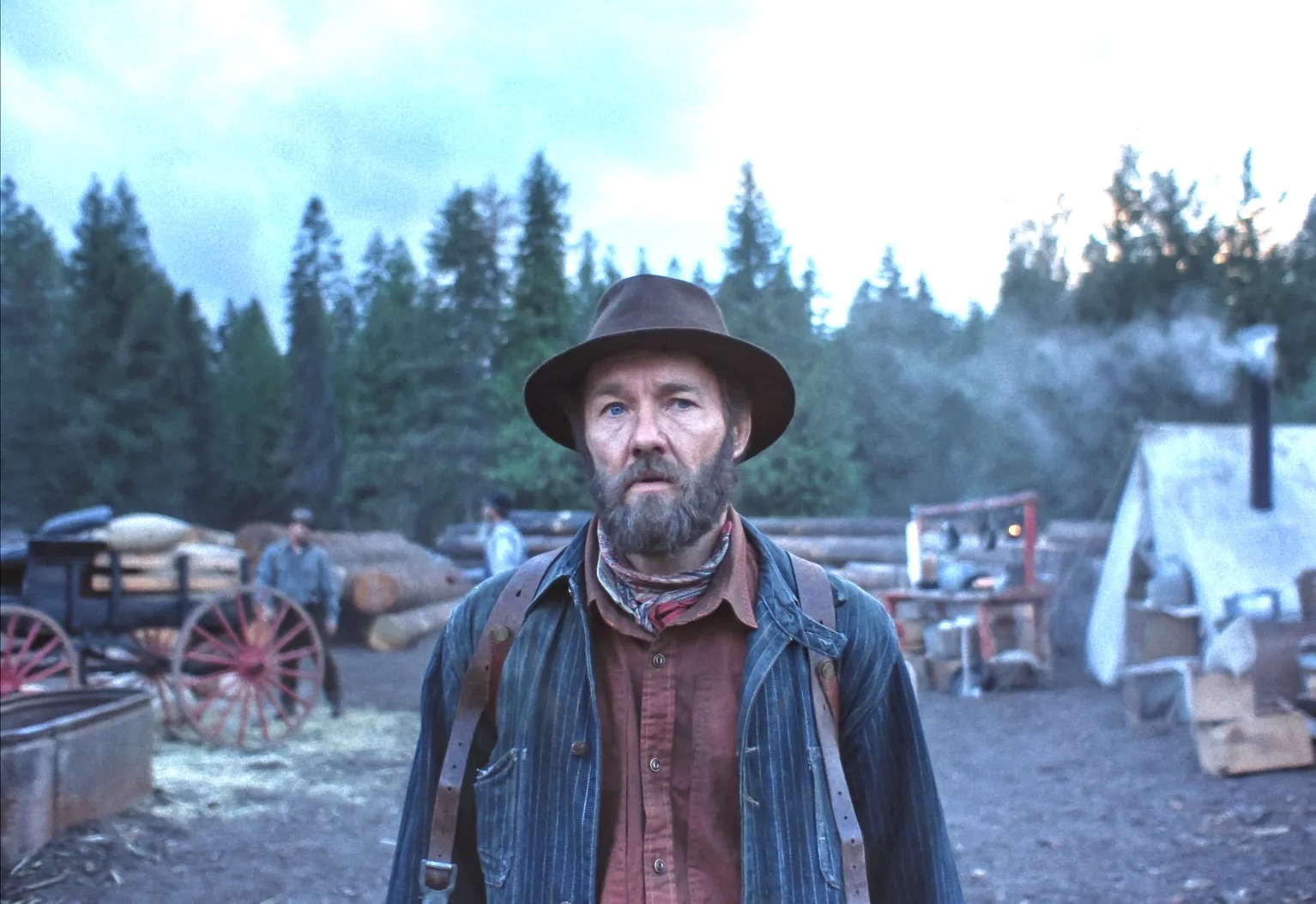
Joel Edgerton

TRAIN DREAMS” My rating: A- (Netflix)

102 minutes | MPAA rating: PG-13

If Terrence Malick and Kelly Reichart had a baby it would be “Train Dreams,” a visually ravishing examination of one human life.

This is only the second directing credit from Clint Bentley (he wrote the Oscar-nominated screenplay for “Sing Sing”), but it displays an astounding depth of  maturity and sensitivity. 

In adapting Denis Johnson’s novella (he co-wrote the piece with Greg Kwedar) Bentley has approached this sprawling tale as a sort of  visual folk song. There’s only limited dialogue, but since his leading player is the breathtakingly empathetic Joel Edgerton, little is required.

Will Patton’s voiceover narration (a device I generally despise;  here it is delivered like a poetry reading) tells us of the origins of Robert Grainier, a foundling who grows up in a small burg in the Pacific Northwest.  He comes to maturity in the early 1900s, when the mechanized modern world has not yet intruded on the wilderness.

Poorly educated, Robert excels at manual labor.  He helps build a wooden railroad bridge across a forested gulch, and witnesses the murder of a co-worker,  a Chinese man (Alfred Hsing) whose ghostly visage will haunt him throughout his long life.

Mostly Robert works for logging crews; his huge axe is practically an extension of his own arm.

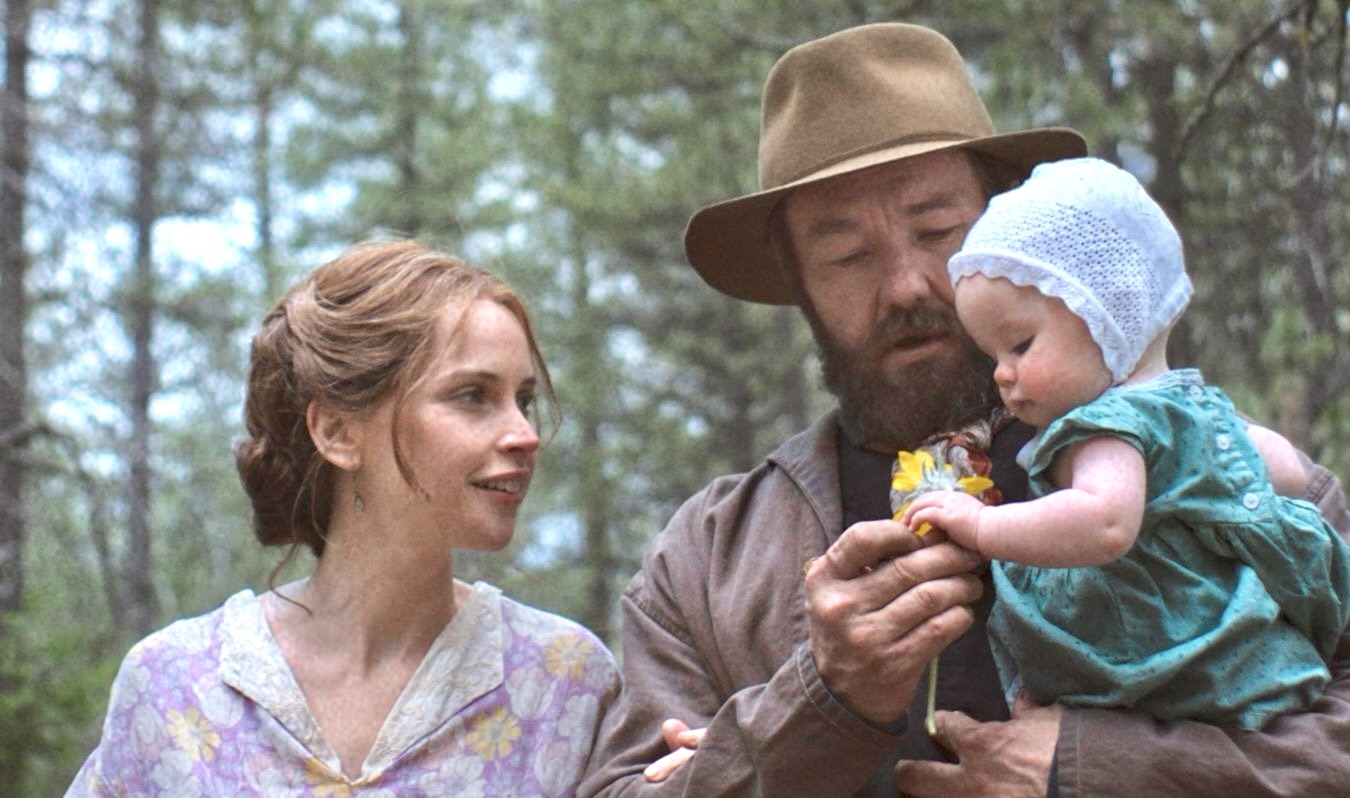
He meets and falls for Gladys (Felicity Jones) and together they build a cabin and have a daughter, though Robert’s work requires him to be away for months at a time.

The loggers are a hard-working bunch, a collection of loners who can go all day without saying a word.  There is one exception.  William H. Macy is terrific as Arn Peeples, a grizzled old codger whose main job seems to be serenading his fellows with nonstop running commentary on anything that comes into his head.

There are on-the-job accidents, some fatal.  Robert soldiers on.  His goal is to make money, return to his beloved wife and child, and start the process all over again.

Felicity Jones, Joel Edgerton

The scenes of the Grainier’s domestic life are so achingly beautiful that one is tempted to give up on civilization and take up residence in the woods. Adolpho Veloso’s camera seems to caress its subjects; frequently we’re distracted by the waving tufted tips of wild grass, or the grain of a tree trunk. Man and nature in harmony.

These scenes arebolstered by the presence of the uncredited young child who plays Robert and Gladys’ daughter.  The kid steals every scene without even trying. We’re as delighted in her as are her parents.

Then cruel fate intervenes. Robert is away on a job when tragedy strikes back home. His cabin lies in ashes; the fate of his wife and daughter unknown.

Ever faithful, Robert is determined to rebuild on his smoldering acreage so that when his family returns, he’ll be ready.

Edgerton is devastatingly effective as the stoic yet forlorn Robert. The sadness in his eyes, the gentleness in his movements, the way his posture changes over more than 60 years of physical labor…all these add up to an unforgettable portrait of a man who, by most standards, is unremarkable.

But then that’s the whole point. “Train Dreams” finds the unexpected nobility in everyday humanity.

| Robert W. Butler

Read Full Post »

Joan in Phoenix, Pedro Pascal

“EDDINGTON” My rating: C+ (HBO MAX)

148 minutes | MPAA rating: R

“Eddington” is a mess, but at least it’s an ambitious mess.

For his followup to “Hereditary” and “Midsommar” filmmaker Ari Aster has come up with a different sort of horror film in which the threat comes not from the supernatural but from within ourselves.

Unfolding in the sun-baked burg of Eddington, N.M.,  this drama attempts nothing less than to summarize all the roiling currents of contemporary America.  Which is a nice idea, but it devolves into a credulity-crushing melodrama populated less by characters than by various poltical/social points of view.

The time is the early months of the Covid pandemic, and Sheriff Joe Cross (Joaquin Phoenix) has his hands full on just about every front.  At home there’s his childlike and sickly wife Louise (Emma Stone) and her conspiracy-crazed mother Dawn (Deirdre O’Connell).

On his patrols of the town Joe finds himself refereeing standoffs between pandemic-panicked citizens in government-mandated face masks and those individuals who refuse to muffle up, whether because it’s physically uncomfortable or because they smell the nefarious efforts of Big Brother to smother individual identity.

It’s also election season in Eddington, with mayor Ted Garcia (Pedro Pascal) running for another term.  Ted’s campaign centers on bringing in a high-tech outfit to erect a data farm, or a bitcoin mine, or some other damn electicity-gobbling enterprise.  The whole thing smacks of an insider deal.

There are the kids, the teenagers who aren’t content just to smoke grass behind the grocery store.  No, they’ve all climbed on a high horse to protest everything they don’t like — which is just about everything from Native America rights to old folks who can’t be bothered with personal pronouns. They’re putty in the hand of the charismatic Vernon (Austin Butler), a rabble rouser who may be a good guy…or maybe a Charles Manson.

And finally there’s Lodge (Clifton Collins Jr.), a hirsute desert rat who wanders through town babbling angrily at demons real and imagined.

Pushed way past exasperation, Joe decides to take matters into his own hands. He’ll run for mayor, too.  Except that the key to his campaign is assassinating the opposition.

Once the crime’s been committed “Eddington” becomes a sort of Jim Thompson thriller with Joe working overtime to cover up his crime and blame it on somebody else.  Except that there are a couple of armed vigilantes (identified in the credits as Antifa Terrrorists 1 and 2) who begin stalking him in a beautifully staged nighttime action sequence.

By the time “Eddington” wraps up after nearly 2 1/2 hours the patience of most viewers will be worn thin. As a schematic of our current state of affairs the film offers some good nasty fun, but there’s not a character on screen we can actually like.

Tessa Thompson

“HEDDA” My rating: B-(Prime Video)

107 minutes | MPAA rating: R

Hendrick Ibsen’s “Hedda Gabler” gets a heavy-duty makeover in “Hedda,” in which writer/director Nia DaCosta makes actress Tessa Thompson the scene-stealing centerpiece.

Ibsen’s original was set in the 1890s Norway;  DaCosta moves the action to post-war Britain.

The story is pretty much the same with some radical casting changes…new bride Hedda (Thompson) is miserable with her stuffy academic hubby George (Tom Bateman) and uses a big cocktail party attended by his colleagues to do mischief.  She’s supposed to be boosting George’s profile for a much sought-after collegiate gig, but Hedda’s personal demons are going strong.

George’s main competition is Eileen Lovborg (Nina Hoss), an openly gay female academic working on what will surely be a best-selling book.  Eileen is a recovering alcoholic; she’s also a former lover of Hedda, though she now cohabits with the mousy Thea (Imogen Poots).

In the course of the evening Hedda will sabotage Eileen’s relationship, her husband’s career, and her own life.

“Hedda” has been very well acted, and the updatings made to the original text are intriguing and evocative.

But here’s the thing…when I think of Britain in the 1950s I’m thinking of the rather stiff world of PBS’s “Granchester,” a time when the old social mores were only slowly changing and gasoline was still being rationed.

What we get here, though, is a Bacchanal right out of the 1920s, with stuffy college professors getting blotto and dancing the boogie woogie.  The film’s frantic ambience felt forced and overstated. 

If you can get past the anachronistic elements, “Hedda” offers some terrific acting.  If.

| Robert W. Butler

Read Full Post »

Jeremy Allen White

“SPRINGSTEEN:  DELIVER ME FROM NOWHERE” My rating: B+ (In theaters)

120 minutes | MPAA rating: PG-13

Less rock concert than chamber piece, “Springsteen: Deliver Me From Nowhere” is an intimate drama about a guy losing his mind at the same time he’s becoming one of the most famous entertainers on the planet.

As a longtime fan of the Boss, I found Scott Cooper’s film unexpectedly moving, and not just because of the brilliance of Bruce Springsteen’s songwriting.

The film is about the creative process, sure, but it’s also about  family dysfunction, personal demons, and the lifelong struggle to discover one’s true essence even when the rest of the world is all too eager to dictate what it expects you to be.

Unfolding over a year in the early 1980s, “Deliver Me…” finds Springsteen (Jeremy Allen White, stupendous) riding high from his just-completed “River” tour…or is he?  Bruce finds little satisfaction with his new star status (first new car, lakeside rental in rural Jersey, guest gigs at the Stony Pony in Asbury Park).  Something’s missing.

The screenplay by Cooper (adapting Warren Zanes’ book) follows Bruce’s retreat to his hideaway in the country where he lays low and begins writing the material that will become his album “Nebraska.” It’s less a pleasurable vacation than a furious quest. The man has ideas — dark ones at that — circling around in his head that demand expression in song.

Periodically the film delivers black-and-white flashbacks to Bruce’s childhood with a protective mother (Gaby Hoffmann) and a struggling working class father (Steven Graham) who all too often takes out his frustrations on his loved ones.

These digressions are integral to understanding the singer and his songs. Childhood trauma finds its way into the music…but, then, so do little moments of grace (dancing with Mom, being driven into the country by Dad for a romp in the cornfields).  In some cases you can draw a direct line from Bruce’s boyhood to individual songs (“My Father’s House,” “Used Cars”).

Perhaps the most problematical element of “Deliver Me…” is the brief romance between Bruce and a young waitress/mother named Faye (Odessa Young). Faye is a composite character, an amalgam of women Springsteen dated during this period. Young is solid in the role but it’s something of a thankless task…Bruce is simply so at sea with his own mental and emotional health that romantic commitment to another human being is out of the question.

Professional relationships are a bit easier to navigate.  Jeremy Strong is hugely effective as manager Jon Landau, who runs interference for his famous client and appears to care more for Bruce’s well-being than for the moneymaking machine he could soon become. When Bruce decides to release the rough demos of his “Nebraska” songs — acoustic mono, no backup musicians, no fancy mastering, no portrait on the album cover, no tour, no press — it is Landau who stands up to record company bigwigs who dismiss Springsteen’s “folk record” as a disaster in the making.

Jeremy Strong

Late in the film we see Bruce in his first session with a psychiatrist, but throughout “Deliver Me From Nowhere” we see our man making small incremental steps toward healing. The first of these is recognizing that something’s wrong.

The performances are terrific throughout, but White’s Bruce is so good that he becomes his own person.  It’s not an imitation — although White’s vocals and stage movements are uncannily accurate — but rather a reinterpretation.  There were moments when I forgot this was a film specifically about Springsteen and regarded it as a much bigger examination of the artistic imperative.  Which is saying something.

I fully expect an Oscar nomination for White…and another for Graham, whose Springsteen pere is a sad nightmare of blue-collar disappointment and emotional turmoil.  This British actor has only a few moments of screen time, but the impression he makes on the viewer gives the film a thematic backbone that keeps everything moving.

Will “Deliver Me From Nowhere” appeal to those merely on the fringes of Springsteeniana? It’s a tough call. I found the process of creating “Nebraska” and tracing the LP’s roots back to boyhood incredibly involving…but then I know these songs by heart.

But even a viewer who has never heard of Bruce Springsteen should respond to the very human conflicts depicted here. 

Fathers and sons. Failed love. Lifelong friendship. These are universal stepping stones in human life, and “Deliver Me From Nowhere” finds both the beauty and the dread.

| Robert W. Butler

Read Full Post »

Anthony Ramos, Rebecca Ferguson

“A HOUSE OF DYNAMITE” My rating: B+ (Netflix)

112 minutes | MPAA rating: R

This Halloween season’s scariest movie has nothing to do with ghosts and ghoulies.  It will nonetheless induce nighmares.

Kathryn Bigelow’s  latest directorial effort takes the same 20-minute time frame  and retells it repeatedly from different perspectives. 

 It begins with American military personnel in Alaska detecting an incoming ICBM and ends with the President faced with an impossible decision that could determine the fate of mankind.

Noah Oppenheimer’s screenplay — created with the assistance of former military types who know their stuff — exudes an aura of helplessness that not all our high-tech weaponry can dispel.

The incoming missile was launched from the Pacific, but we don’t know from where, exactly.  Without knowing who fired it, our military cannot know against whom to retaliate.  The Russians? The North Koreans?

Also. how could it be launched undetected by our surveillance capabilities?  Maybe someone inside our defense system is a saboteur?

Two of our missiles are sent to stop the intruder.  One breaks down in flight.  The other hits its target, but without effect.  The missile just keeps coming.  The most likely target is Chicago.

With each iteration of the story things get more dire, more tense. How will it end?  

“A House or Dynamite” has been crammed with familiar faces (Idris Elba. Rebecca Ferguson, Jared Harris, Tracy Letts, Anthony Ramos, Jason Clarke, Greta Lee, Renee Elise Goldsberry, Kaitlyn Dever), many of whom are on screen for only a minute or two.

They’re all solid, but I found myself being drawn to many of the background characters, soldiers and White House staffers caught in the awful realization that the horrors they trained for have now come to pass. Some maintain their by-the-book demeanor. Others come close to panicking.  Many call their families and friends with dire warnings to evacuate or simply to say “I love you.”

Bigelow cannily employs handheld cameras to capture a documentary feel; as the film progresses the tension reaches near unbearable levels.

Maybe don’t watch this one before going to bed.

“JOHN CANDY: I LIKE ME” My rating: B (Prime)

113 minutes | MPAA rating: PG-13

The late John Candy was a very funny man, but the overwhelming feeling percolating through this documentary is one of profound loss.

Director Colin Hanks (yes, Tom’s son) seems to have interviewed virtually everyone who moved in Candy’s orbit.  Among the famous talking heads represented here are Bill Murray, Dan Aykroyd, Dave Thomas, Martin Short, Eugene Levy, Andrea Martin, Catherine O’Hara, Steve Martin, Conan O’Brien, Mel Brooks and Macaulay Culkin.

Not to mention Candy’s widow, children and siblings. 

To an individual they describe a prince of a guy  — warm, empathic, considerate.  Bill Murray struggles mightily to find something negative to say (conflict is vital to drama, right?) but in the end can’t deliver.

But we learn a lot about Candy here.  His father died of a heart attack when he was just a boy…ironically Candy would die of a heart attack at age 43.

He wasn’t comfortable with his image as a jolly fat man; interviewers back in the day subjected Candy to a not-terribly-subtle form of fat shaming that would get them fired today.  He never struck out at them…just smiled thinly and carried on.

There are, of course, a ton of clips from his stint with “SCTV” and from his many feature films, including “Planes, Trains & Automobiles,” in which Candy delivered a performance of such humor and humanity that in retrospect you’ve got to wonder what the Academy folk were thinking in not giving him a nomination.

All in all this is a warm tribute to a very good man.

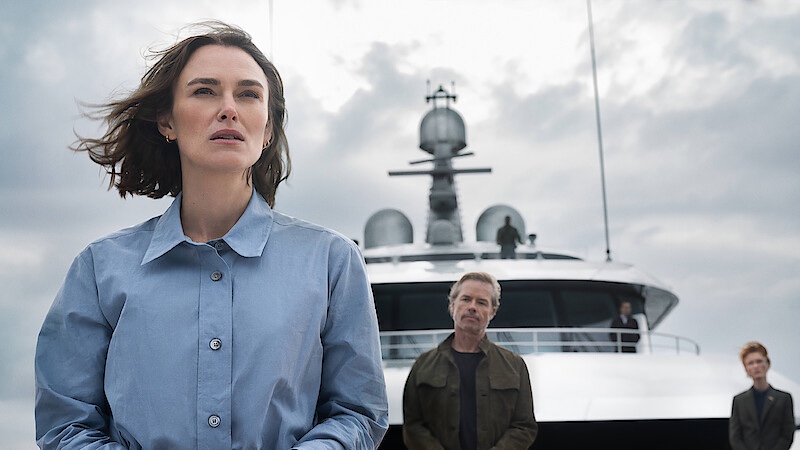
Keira Knightley, Guy Pearce

“THE WOMAN IN CABIN 10” My rating: C (Netflix)

93 minutes | MPAA rating: R

Reporter Laura Blacklock (Keira Knightley) is invited to cover the maiden voyage of a super yacht whose owners — a dying billionairess and her husband (Guy Pearce) — want to draw attention to their new charity.

The proletarian Laura feels painfully out of place among these rich creeps (Hannah Waddingham, David Morrissey, etc.), and when she reports that the woman in the cabin next to hers has fallen (or was thrown) overboard, she becomes the object of suspicion and ridicule.

Apparently Cabin 10 was never occupied.

I was kinda bored by the  first third of Simon Stone’s thriller (the screenplay is by Stone, Joe Shrapnel and Anna Waterhouse).  The middle section, in which Laura hides on the boat from unseen killers, has a sort of “Die Hard” tension going on.

It’s all wrapped up with a posh gala on a Norwegian fiord that deteriorates into a sort of soggy Velveeta pizza.  Didn’t believe a word of it.

| Robert W. Butler

Read Full Post »

Jorma Tommila

“SISU” My rating: B (Peacock)

91 minutes | MPAA rating: R

The Finnish actioner “Sisu” feels like a Road Runner cartoon directed by Quentin Tarantino.

Not that it’s funny, exactly.  Jamari Helander’s film is crammed with gloriously gruesome mayhem meted out by a silent fellow who, like the beep-beeping star of those old Chuck Jones cartoons, survives every attempt on his life, absorbing punishment after punishment.  

The violence is utterly outlandish, but presented with such a straight face (and with so much stage blood) that we get caught up in the whole silly premise.

It also helps that the Wile E. Coyote of the piece is a platoon of goonish Nazis.  Nature’s perfect bad guys.

We first see Astami (Jorma Tommila) in the vast treeless plains of Lapland.  Accompanied only by his dog, this heavily scarred fellow with a white beard is prospecting.  One day he finds a vein of gold so rich that he soon has a couple of backpacks crammed with fist-sized nuggets.

Up to this point we don’t really know whether this is taking place in the present or the distant past.  Then we’re introduced to a unit of retreating Germans. Okay…so World War II.

Basically this is an elaborate chase.  The Nazi commander (Aksel Hennie) takes Astami’s gold and leaves him for dead. Figuring the war is lost, the German plans on using the treasure to build a new life.

But it turns out that Astami is a Finnish national hero, a sniper/survivalist who before leaving the war behind racked up hundreds of kills. 

Now he wants his gold back. He goes after the Germans like some sort of Scandinavian Terminator.

Along the way he will be shot, nearly blown apart, set on fire, hanged and drowned. He’ll even survive a plane crash.

 You can’t keep a good Finn down.

Oh…and with the Germans is a truckload of Finnish women being used as sex slaves.  Astami makes sure that before it’s all over the ladies will be well armed and ready for vengeance.

Among the film’s “huh?” elements is the dialogue, which drifts unexpectedly between English, German and Finnish for no obvious reason.

Then there are the many virtues of “Sisu” (a Finnish word that roughly translates as “unstoppable”):  drop-dead gorgeous cinematography, spectacular fight coordination and especially the slow-burn performance of Tommila, who doesn’t say a word until the final scene but commands the screen every time a camera (or gun) is pointed at him.

Cate Blanchett, Michael Fassbender

“BLACK BAG” My rating: B+ (Peacock)

93 minutes | MPAA rating: R

About the highest praise I can give Steven Soderbergh’s “Black Bag” is that it is of John le Carre quality, a spy thriller less about violence than about the toll the business of espionage takes on the human soul.

Michael Fassbender (who seems to be in every movie) is George Woodhouse, a Brit intelligence agent who after a legendary field career is now holding down a desk. His specialty is rooting out double agents.

David Koepp’s script is set in motion when George is given a list of five fellow agents suspected of selling secrets to Britain’s enemies.  

Just one problem: One of the suspects is George’s wife Kathryn (Cate Blanchett). The big question: If it turns out that Kathryn is a turncoat, will George serve  his country or his heart?

After much preliminary sleuthing, George decides to hold a dinner for the potential traitors (the others are played by Tom Burke, Regé-Jean Page, Naomie Harris and Marisa Abela). 

It’s borderline Agatha Christie (everyone assemble in the dining room where the killer will be revealed) but thanks to the intricacies of the screenplay and a fistful of great actors playing duplicity to the hilt, “Black Bag” becomes a hold-your-breath thriller.

And then there’s the title. “Black Bag” refers, of course, to black bag operations, meaning an assignment so secret that you must keep it from your friends and loved ones. While superficially about rooting out a mole, on a deeper level this film is about living in an environment where no one — not your boss, your best friend or your lover — can be trusted.

Amazingly, all this is there in Fassbender’s quietly contained performance.  Like Le Carre’s George Smiley, George is a bespectacled straight man with a volcano of suppressed and rarely-expressed emotion smoldering within. 

Now that’s some acting. 


Rami Malek, Caitriona Balfe

“THE AMATEUR” My rating: B-(Hulu)

122 minutes | MPAA: PG-13

The Rami Malek starrer “The Amateur” has little of the depth of “Black Bag,” but as a sort of underdog espionage yarn it’s diverting and generally satisfying.

Malek is Heller, who writes top-secret computer code for the CIA.  He’s essentially a nerd, but he does have a deeply satisfying marriage to Sarah (Rachel Brosnahan), whose job requires her to travel internationally.

On one such trip Sarah becomes a hostage when terrorists take over a London hotel.  She is executed in front of the television cameras.

Heller is crushed. Then  he wants to get even, badgering his boss (Holt McCallany) to undergo field training so that he can track down the terrorists. The bigwigs figure this hopeless amateur will soon tire of the whole business.

Uh, no.

One of the virtues of Ken Nolan and Gary Spinelli’s screenplay (based on James Hawes’ novel)  is that it tricks the viewer in the same way Heller tricks his handlers.  Just when you think the jig is up and our man is going down, the film reveals that Heller has been way ahead of us all the time.

His bosses — who secretly organized the illegal terrorist action that took Sarah’s life — find they can’t keep track of Heller as he galavants around Europe because the computer programs designed for that purpose were written by Heller himself. He knows all the loopholes.

“The Amateur” has a deep supporting cast (Laurence Fishburne, Jon Bernthal, Julianne Nicholson, Caitriona Balfe, Michael Stuhlbarg) and the direction by James Hawes keeps the yarn chugging along.

As for the Oscar-winning Malek, this film will undoubtedly come to be regarded as a toss-off in a career of some depth. But as toss-offs go, it’s enjoyable enough.

| Robert W. Butler

Read Full Post »

Steve Coogan and friend

“THE PENGUIN LESSONS” My rating: B(Netflix)

115 minutes | MPAA rating: PG-13

I’ve avoided watching “The Penguin Lessons” because, well, penguins and lessons. Sounded just a bit too emotionally pushy, you know?

Having finally watched this Peter Cattaneo-directed effort, I can report that my misgivings were misplaced.  The film is subtle, unsettling and about as unsentimental as a movie with a two-foot-tall feathered costar could be.

It helps that the film is based on the real-life story of Tom Michell, a British educator who in the 1970s found himself teaching English to the boys in a posh boarding school in Argentina.

When we first meet Michell (Steve Coogan), he’s a wryly caustic fellow oozing ennui.  We’ll learn much later that he’s attempting to outrun a personal tragedy.

On a seaside vacation to nearby Uruguay, Michell stumbles across a flock of penguins who have succumbed to a massive oil spill.  He retrieves the lone surviving bird and cleans it up in his hotel room (to be honest, his kindly display is intended to impress the woman he met that night at a dance club).

Anyway, once rescued the penguin refuses to leave. Michell is stuck with the fishy-smelling creature, reluctantly smuggling it back to Argentina in a backpack. He tries to pawn off the bird on anyone who’ll take it (a customs official, the local zoo) but ends up secreting it in his on-campus apartment.

The setup screams “cute,” but director Cattaneo and screenwriter Jeff Pope deftly sidestep all the pitfalls. For one thing, there’s no attempt to anthropomorphize the penguin.  He’s basically an eating machine that waddles. No personality to speak of — although just by being his cute, mute self he elicits confessional revelations from the humans who hang with him.

The eccentric creature — dubbed Juan Salvador by his savior — also proves a classroom asset, focusing the attention of the normally unruly rich twits who attend the school. Grades actually start improving, much to the delighted surprise of the stuffy headmaster (Jonathan Pryce).

Here’s where “The Penguin Lessons” turns the tables.  Michell was on hand for the military coup that for several years turned Argentina into a fascist camp where more than 30,000 citizens were “disappeared” for their political, intellectual and moral proclivities.

One of these unfortunates is Anna (Julia Fossi), a young cleaning lady at the school who is an outspoken liberal and always taunting Michell for his political indifference. Michell witnesses Anna being snatched off the street by a pack of government thugs. Appalled by his own cowardice for not interfering, he joins the girl’s grandmother (Vivian El Jaber) in a months-long search to discover Anna’s fate.

Now this is pretty dark stuff…and darker still because it mirrors recent images of masked ICE agents snatching dark-skinned people off America’s streets.

Coogan is a specialist at humanizing vaguely repellant characters, and here he quietly and efficiently limns Michell’s moral journey.  The supporting players are all fine, from the leads to the entitled adolescents who occupy Michell’s classroom (they could have called this “The Dead Penguin’s Society”).

Jenna Ortega

“DEATH OF A UNICORN” My rating: C (Netflix)

107 minutes | MPAA rating: R

Not even an A-list cast can do much with “Death of a Unicorn,” a hodgepodge of myth, father-daughter bonding, greedy rich folk and a big dose of gut-splattering violence.

Alex Scharfman’s film (he both wrote and directed) finds corporate attorney Elliott (Paul Rudd) and his surly daughter Ridley (Jenna Ortega) cruising down a mountain road en route to the alpine compound occupied by Elliott’s employers, a family of pharmaceutical robber barons.

At first Elliott thinks he’s hit and killed a deer.  Actually it’s a honest-to-God unicorn, a creature whose long horn is capable of delivering psychedelic experiences, healing diseases and even bringing the dead back to life.

Their moneyed hosts (Richard E. Grant, Will Poulter, Téa Leoni) quickly realize the creature’s powers could be a game-changer and launch plans to harvest whatever other unicorns may be frolicking in the woods.

What they don’t realize is that these creatures are malevolent, with the fangs of a carnivore, the speed of a charging rhino and the ability to crash through doors and walls.

The tone is all over the place.  “…Unicorn” wants to be a satire of corporate greed, but it’s hitting at a pretty obvious target. (Drug executives? Really?) Meanwhile it’s hard to root for the unicorns…they’re some mean mofos. 

And the violence is wildly gruesome…yet we’re supposed to laugh.  Those are some mixed messages.

Adolescent Ridley advocates a more humane approach to the whole situation; gradually bringing Dad Elliott into her corner.  Of course, you can’t exactly wave the flag of peace when these monsters are laying siege to your aerie.

| Robert W. Butler

Read Full Post »

Fernanda Torres

“I’M STILL HERE” My rating: A-(Netflix)

137 minutes | MPAA rating: PG-17

Audiences have the habit conflating big moments with great acting.  Indeed, the history of Oscar wins suggests that if you want a statuette, you’d best come up with a few barn burning peel-off-the-paint moments.

The Brazilian “I’m Still Here” (it was nominated for Best Picture and Best International Feature, winning in the latter category) takes another approach entirely.  

Walter Salles’ film (screenplay by Muriel Hauser, Heirtor Lorega and Marcelo Rubens Paiva) tells a hugely dramatic real-life story by concentrating not on the big moments but on the little ones. The results are quietly devastating.

This is the story of one family living through the two-decade reign of terror of a military junta that ruled Brazil from the early 1970s.  During that period more than 20,000 citizens were arrested and tortured; nearly 500 were executed without trial.

The film’s first 40 minutes are largely devoted to depicting the middle-class lives of Rubens Paiva, an architectural engineer and former member of Congress, his wife Eunice (Oscar-nominated Fernanda Torres) and their five children.

They live in a big house just yards from Rio’s fabulous beach in the shadow of Sugarloaf. The grownups are deeply in love and enjoy entertaining friends. The kids are a rowdy bunch who practically live in the ocean and adopt a lost dog.  It’s pretty damn idyllic.

But there are cracks in this blissful picture.  The Paivas’ family friends are nervous liberals; some plan to leave Brazil to avoid right-wing oppression.  And while driving with her friends the oldest daughter finds herself caught up in a military dragnet as authorities search for rebels who have kidnapped a foreign diplomat.

Papa Rubens periodically gets unexplained phone calls asking him to receive or deliver unidentified documents. We never will learn just what that was all about.

It all comes to a head with the arrival on the doorstep of armed men in civilian clothes who announced that Rubens is needed to give testimony.  He is taken away while several of the interlopers hang around the house, rifling through closets and drawers and generally terrifying the family.

Within a few days Eunice is herself dragged to a military prison where she spends nearly two weeks wallowing in filth and listening to the screams of the tortured; each day a quietly intimidating interrogator has her thumb through a thick book of mug shots, demanding to know if she recognizes any of the faces.

To her queries about the whereabouts of her husband, she is always told: “I do not have that information.”

If this story had been told by an American there would undoubtedly have been some dramatic  fireworks.  Eunice would go to court to demand the truth about her husband’s disappearance. There would be clashes between rebels and the authorities.

But if any of that happened, in this retelling it occurs offscreen. The fierce focus is on Eunice and how she deals with her confrontation with institutionalized evil. And Torres pulls it off not with big moments but with small ones, with a careful accumulation of details that are registered in the eyes, in subtle body language. This is a woman who must simultaneously nurse a terrible loss and somehow remain strong for her children.

“I’m Still Here,” which follows the Paiva family for nearly 40 years, has been impeccably acted on all fronts.  Each of the family’s offspring get a few telling moments, and one must reluctantly admire the chilling work of the actors portraying the blandly terrifying torturers. 

Finally, it’s impossible to watch the film without looking at the United States teetering on the brink of dictatorship and wondering if our own citizens will be disappeared. 

 Brenca Vaccaro, Susan Sarandon, Vince Vaughn, Lorraine Bracco and Talia Shire

“NONNAS” My rating: B- (Netflix)

111 minutes | MPAA rating: PG

Vince Vaughn, who in his three-decade career  has specialized in playing smarmy jokesters, takes a more low-keyed approach in “Nonnas.”

Basically he lets four veteran actresses do the heavy comedic lifting while he plays it straight.  It works.

“Nonnas” is inspired by the real life story of Joe Scaravella, an unnmarried NYC transit worker who, after the death of his beloved mother, decided to use his inheritance to open a restaurant…one in which real Italian grandmas (“nonnas”) cook their traditional family recipes.

Problem is, Joe knows virtually nothing about the restaurant biz and makes misstep after misstep, in the process that nearly alienated his best bud (Joe Manganiello) and his wife (Drea de Matteo), who have imprudently risked their life savings on Joe’s dream.

The nonnas Joe recruits are a colorful mixed bag.  The scratchy-voiced Roberta (Lorraine Bracco, almost unrecognizable) is a grump looking to spend a few hours outside her retirement community.  Teresa (Talia Shire) is a timorous former nun. Gia (Susan Sarandon) brings a bit of blowsy glamor as Gia, who runs her own beauty salon.  And chatty Antonella (Brenda Vaccaro) introduces Joe to his love interest, a law student (Linda Cardellini) who helps him over some legal hurdles.

The nonnas bitch and kvetch and engage in geographical rivalries (apparently Sicilians don’t get along with Mainlanders), but eventually all fall behind Joe on his march to success.

The resulting film is a pleasant blend of comedy and pathos, with writers Liz Macci and Jody Scaravella and director Stephen Chbosky  never going overboard on either.

At the very least you’ll leave the movie craving a big plate of lasagna.

Greta Garbo as Mata Hari

“GARBO: WHERE DID YOU GO?” My rating: C (Netflix)

90 minutes | No MPAA rating

As a fan of Old Hollywood I jumped at the chance to learn more about Greta Garbo, who throughout the 1930s was not only Hollywood’s best-paid actor but also widely regarded as the most famous woman on Earth.

But the Swedish-born star gave it all up after 15 intense years, retiring in 1941 and spending the rest of her life avoiding the limelight.

Why? That’s the question posed by Brit director Lorna Tucker’s documentary, and my appetite was whetted by the news that Tucker had managed to get her hands on Garbo’s private correspondence, home movies and other material never before seen by the public.

Alas, the answer Tucker comes up with his hardly revelatory.  Basically, Garbo got sick of being hounded by the press — this was before the term paparazzi had been coined — and decided to bail from the high-profile rat race.  She lived a long life, had a lover who protected her, and enjoyed a small coterie of extremely loyal friends who would be cut loose if they should spread info about her private life.

What really chaps my ass, though, are the artsy/fartsy flourishes Tucker has packed into the tale.

Periodically we are addressed by a young woman (uncredited) with a platinum blonde Monroe ‘do who dresses in tight black clothing (like a waitress at a beatnik coffee shop) and stares piercingly at a wall full of Garbo photos, post-it notes and newspaper clippings.  Apparently she’s attempting to sleuth out the story behind Garbo’s exile.  Mainly what she is is irritating.

Equally off-putting is another actress wearing a creepy Garbo mask who strikes thoughtful poses while offscree Noomi Rapace reads from the actress’s correspondence.

Okay…most folks don’t know anything about Greta Garbo, so they’ll learn a few things from this movie.  But only at the risk of getting really irritated.

| Robert W. Butler

Read Full Post »

Older Posts »