Hugh Jackman
“THE DEATH OF ROBIN HOOD” My rating: B- (HBO Max)
122 minutes | MPAA rating: R
You can’t get much more revisionist than “The Death of Robin Hood,” a dour medieval psychodrama that suggests we’ve gotten it all wrong.
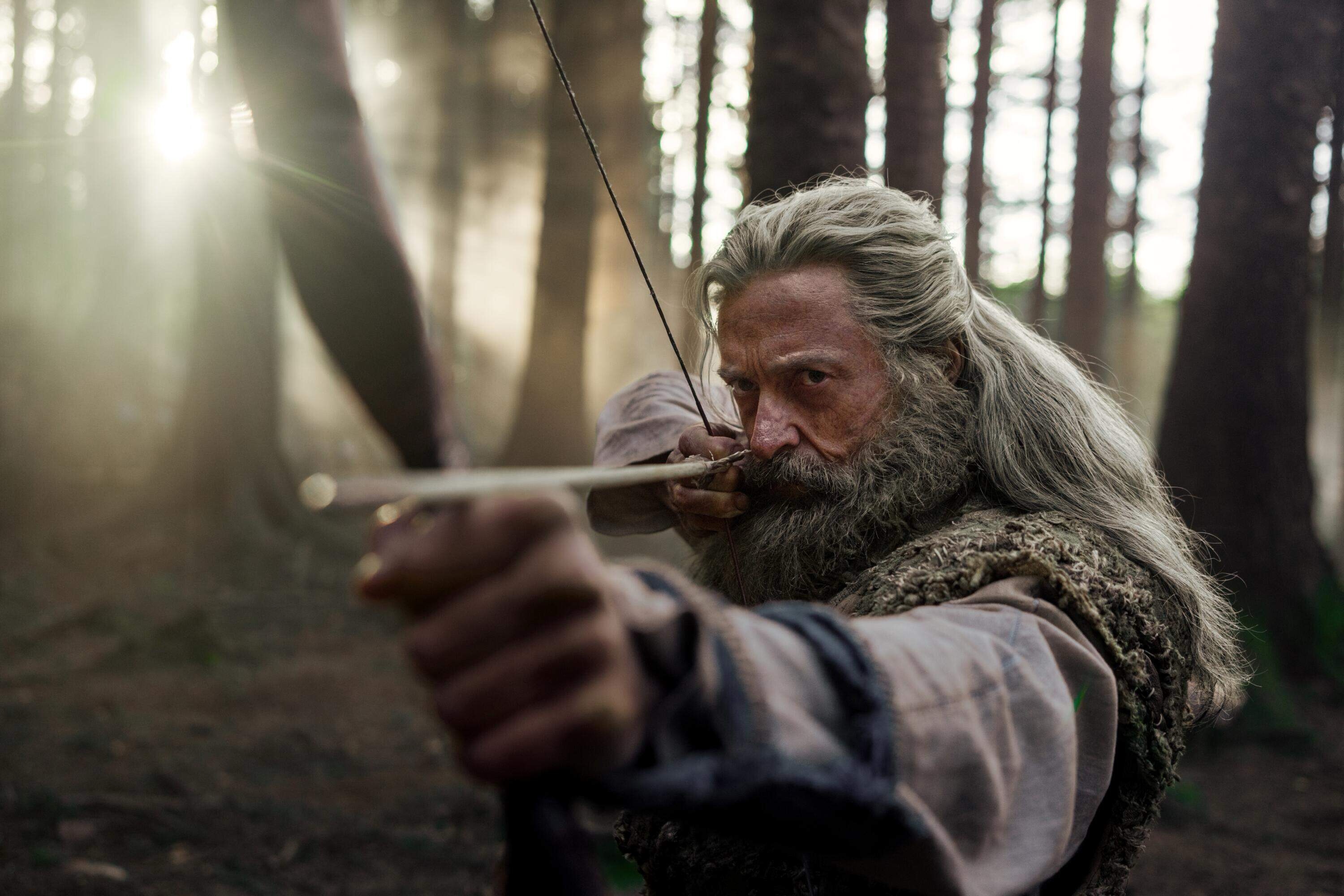
The Robin Hood portrayed by Hugh Jackman in writer/director Michael Sarnoski’s grimy, almost colorless period piece is a sociopath who has robbed and killed mostly for the fun of it. Now in late middle age he’s a solitary wanderer, always on the lookout for revenge-minded kin of his countless victims.
In an early conversation with a boy he encounters in the wilderness, the unsmiling outlaw deflates the fanciful myths that follow him everywhere. Steal from the rich and give to the poor? Fat chance.
Sarnoski’s screenplay kicks off with a reunion with Little John (Bill Skarsgard, virtually unrecognizable), who has spent the last few years laying low as a farmer, husband and father. But John has been evicted by his landlord and his wife and child held prisoner. Now he wants Robin to help him get back what’s his.
The result is a bloodbath that leaves Robin so badly injured that John takes him to an island priory where the abbess, Sister Brigid (Jodie Comer), has built a reputation for healing.
“The Death of Robin Hood” is nothing if not ambitious. First presenting us with Robin as a conscienceless killer, the yarn’s second half is virtually violence free as the incapacitated bowman slowly regains his strength and is forced to contemplate just where his life has brought him.
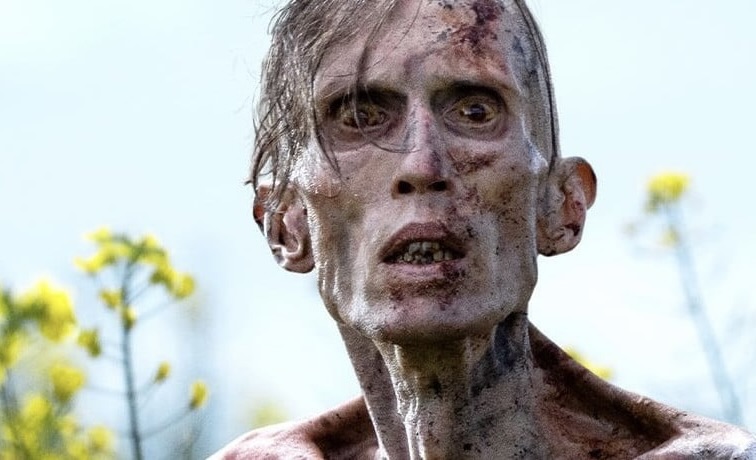
Sister Brigid, it turns out, was widowed years before by Robin. Will she remain a healer or become his executioner? Among the priory’s residents is a leper (Murray Bartlett) wrapped head to toe like a mummy but eager to delve into the outlaw’s psyche. A teen (Noah Jupe) being treated for the loss of an eye may be an assassin.
And then there’s Little John’s orphaned daughter (Katie Green), who latches onto the grizzled bad man as her new Papa. Can a child’s love soften a hardened heart?
“The Death of Robin Hood” feels historically accurate in its recreation of a time and place, and the early violence is jarringly effective.
But the real reason to see it is Jackman’s eerie transformation into a graying, bearded lump of malevolent indifference. When he’s on the screen you don’t want to look at anything else. Even when the film slows to a glacial, contemplative pace in the latter scenes, Jackman keeps our attention.
Genden Phuntsok, Tom Hiddleston
“TENZING” My rating: B+ (Apple+)
125 minutes | MPAA rating: PG
Visually ravishing and unexpectedly inspiring, “Tenzing” is a hugely effective recreation of a seminal moment in human history: the conquest of Mt. Everest.
But it’s also the fiercely personal story of one man, the Nepalese mountaineer Tenzing Norgay who along with New Zealander Edmund Hillary first reached the summit of the world’s highest point in 1953.
Director Jennifer Peedom (her track record includes numerous documentaries about mountaineering) and co-writers Luke Davies and Ed Douglas center their piece on Everest, but provide a detailed backstory of Tenzing’s boyhood, marriage and gradual rise in the world of mountaineering.
Tenzing was born into a family of herdsmen who regarded the mountain that towered over them as the goddess Chomolungma (“Mother of the World”); in fact the boy Tenzing (Samdrup Dorje Lama) at one point met British climber George Mallory, who in the early 1920s led three failed attempts on Everest.
Incapacitated by an injury, young Tensing was left by his nomadic parents at the home of a well-to-do herdsman; he never saw them again. Instead he worked as a hired hand, often ridiculed because the dominant Sherpas regarded his tribe as inferior and provincial.
Nevertheless, as a young man (Tenzin Dalha) he wooed and won his boss’s daughter Kinzorn (Lhakpa Tsanchoe), moving with her to a more populated area where he hoped to become a laborer on climbing expeditions.
Tenzing and Kinzorn’s love story is both uplifting and shattering…while their two daughters were still adolescents she died, making his prolonged absences from home that much more painful.
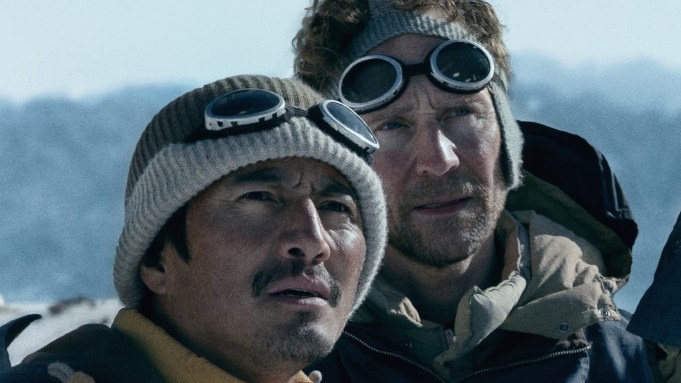
Tenzing (performed as an adult by the marvelously understated Genden Phuntsok) became a skilled climber, so much so that when British explorer John Hunt (Willem Dafoe) assembled a team to tackle Everest he put Tenzing in charge of the Sherpa crew that would lug tons of equipment up the mountain.
In that position Tenzing had to negotiate not only the incipient racism of his European bosses but also the resentment of his Sherpas, who regarded him as an outsider and fomented a rebellion that almost stalled the entire effort.
The film does a terrific job of laying out the physical dangers of Everest (the cinematography of Stefan Duscio spectacularly captures the Himalayan vistas); you can practically feel the weariness through which the climbers fought and the frigid air that surrounded them.
With just a day to go before the monsoon season made any attempt impossible, Hurt gave the final ascent assignment to Tenzing and Hillary (Tom Hiuddleston), who among his European colleagues seems to have been the most eager to regard the Nepalese native as an equal.
The rest, as they say, is history.
| Robert W. Butler