Feeds:
Posts
Comments

Posts Tagged ‘” Mary Elizabeth Winstead’

Colin Farrell

“SUGAR”(Apple+):

The year’s biggest gotcha!!! moment arrives at the end of Episode 6 of “Sugar,” and it’ll leave you reeling.

And that’s all I’ll say about that.

But there’s plenty of other stuff to relish in creator Mark Protosevich’s smart, stylish and thought-provoking re-examination of classic private eye tropes.

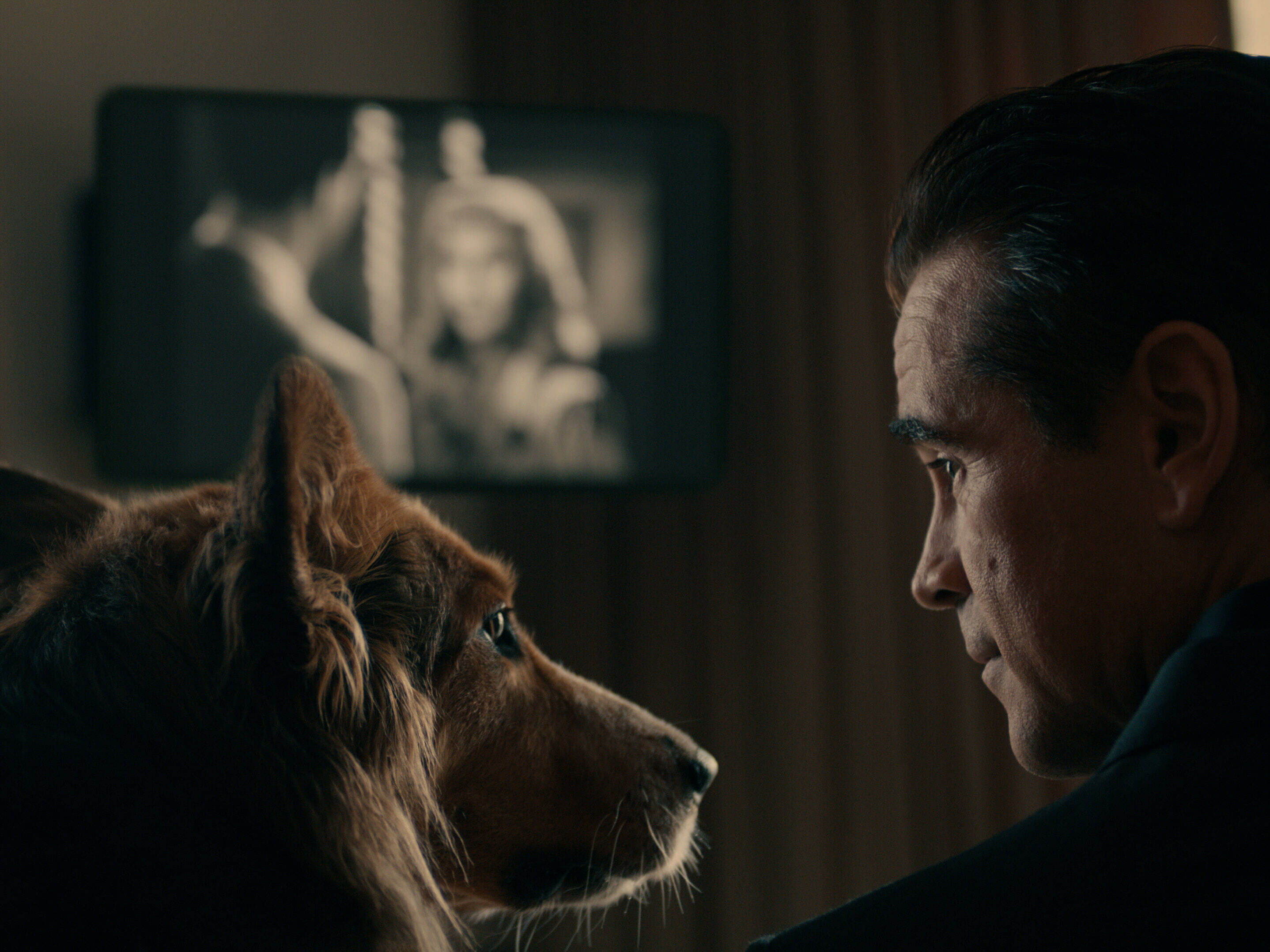
Colin Farrell is at his absolute best as John Sugar, a private investigator specializing in missing person cases.  

Noir usually requires a protagonist who is essentially honest but bummed out and bitter, a guy sickened by the corruption of the big city but driven to discover the truth.

Sugar, though, loves L.A.  For him it’s like a trip to Disneyland.  For one thing, he tools around town in a vintage Corvette convertible while sporting immaculately tailored suits. Even when facing down despicables he’s gentlemanly, more curious than judgmental.

Moreover, he loves working in the motion picture capital of the world. One  of the show’s cleverest conceits is that he’s always encountering characters and situations that remind him of classic films…and brief clips from those films are scattered reverentially throughout the series.

It’s been said that everything we need to know we learned in kindergarten.  John Sugar learned  it watching movies.

Sugar’s current case involves the disappearance of a young woman bred of Hollywood royalty.  Her grandfather (James Cromwell) is a financial titan; her father (Dennis Boutsikaris) is a ruthless producer, and her half-brother (Matt Corddry) is a former child star now wallowing in a drug-infused career burnout.

Sugar appears to have no close friends (an abandoned dog becomes his main bud), though he has a sort of Girl Friday (Kirby) who assigns cases to him and is always warning against getting too involved with the clients.

And in the course of the investigation Sugar finds himself spending time with the missing girl’s one-time stepmother (Amy Ryan), an actress and recovering alcoholic who finds herself attracted to this cooly empathetic white knight.  (Aside from the missing persons case, the series’ biggest mystery is whether these two will ever make a romantic connection.)

Now all this sounds intriguing enough, but it’s only a prelude to the mind-blowing reveal that comes halfway through.

“Sugar” is so good it’s worth subscribing to Apple+ just for this one series.
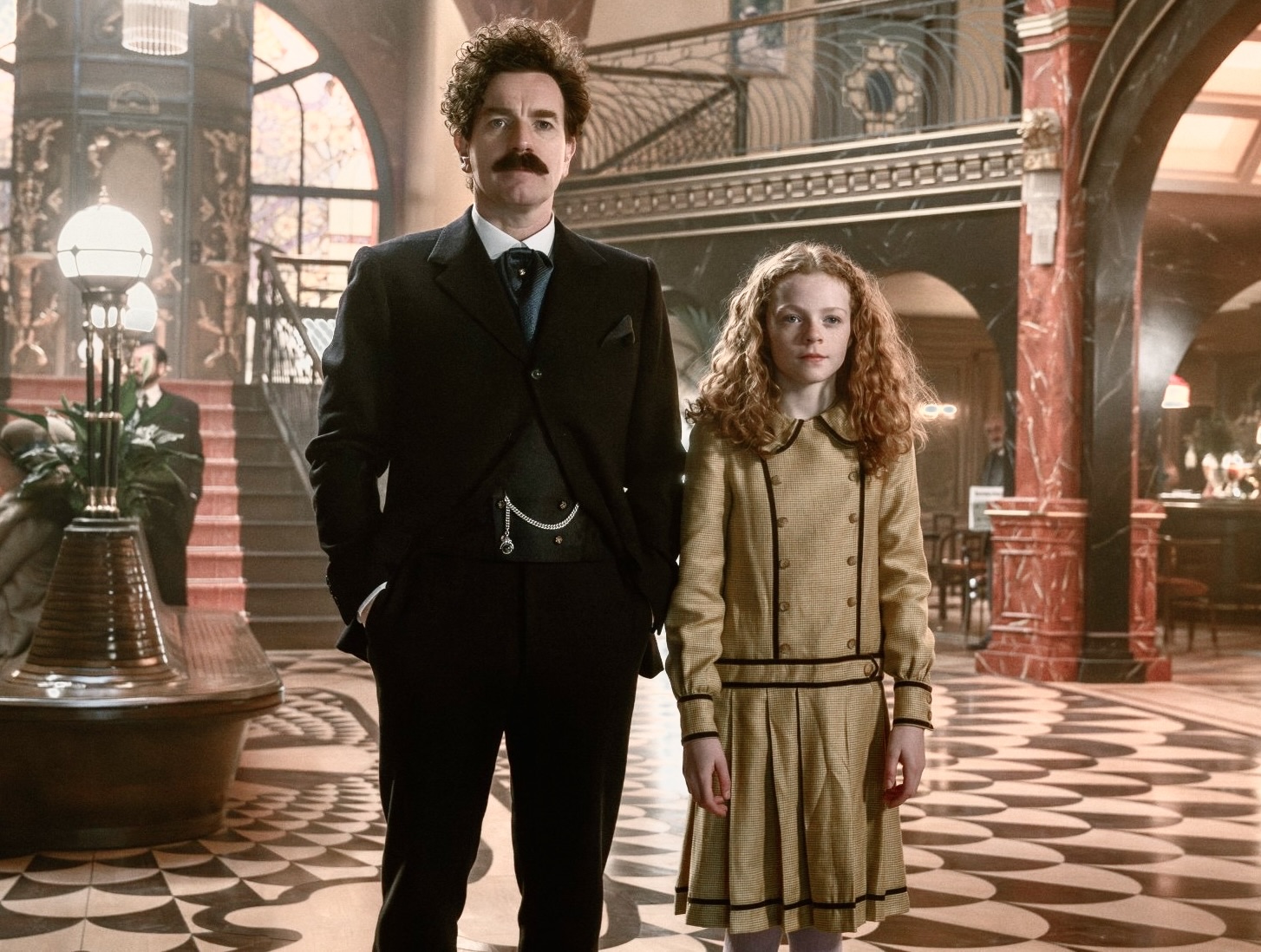
Ewan McGregor, Alexa Goodall

“A GENTLEMAN IN MOSCOW” (Paramount +):

Ewan McGregor gives what may be a career-high performance in “A Gentleman in Moscow.” 

He’s so good that one is willing to overlook some of the production’s flaws just to luxuriate in his presence.

Based on Amor Towles’ best-selling novel, “Gentleman…” over eight episodes follows the life of Alexander Rostov, a Russian count caught up in the Revolution.  

Being rich, cultured, erudite and well-educated, Alexander seems destined for a firing squad.  He’s saved when he is credited (erroneously) with composing a popular pro-Communist poem; instead of death he is sentenced to spend the rest of his life in Moscow’s Metropol Hotel.

Which is ironic, since the Metropol, an art nouveau masterpiece, is a last bastion of Western decadence in the economically devastated USSR. The Communist Party uses it as a showplace so foreign visitors can experience posh accommodations while the rest of the country starves.

 Alexander may be an impoverished prisoner sleeping in a frigid attic room, but he’s free to move about the building, to hobnob with guests and staff.  He becomes a waiter…and the in-house wine expert. And he even creates his own secret salon, a sort of throwback to his former life of luxury, this time furnished with pilfered items.

The heart of McGregor’s interpretation lies in Alexander’s mix of fatalism (the old world order is gone and isn’t coming back) and his innate humanism, which allows him to see the good in all people (though in the case of certain Party die-hards, it’s a rough go). And despite his view of himself as a loner, he becomes a father — twice.

There are four basic plot threads interwoven here.

Initially there is  Alexander’s relationship with Nina (Alexa Goodall), the daughter of a hotel guest who becomes his best friend and guide to the wonders of the hotel (the child  has somehow gotten her hands on a master key.) Years later, after the grown Nina and her husband become victims of a Stalinist purge, Alexander will care for their daughter Sofia (Billie Garson), who becomes a brilliant pianist.

Throughout his 30-year stay in the Metropol Alexander will carry on an affair with Anna Urbanova (Mary Elizabeth Winstead), a star of Soviet cinema who enjoys her decadent pastimes and especially the Count’s old-world charm. This is one of the series’ big flaws: I didn’t buy Winstead (in real life she is Mrs. Ewan McGregor) as a jaded European; there’s too much all-American girl about her. Sometimes it feels she’s playing dress-up in Mom’s closet.

Finally there’s Osip (Johnny Harris), Alexander’s bald, brutal KGB overseer. Osip is Red down to his toenails; he hates the nobility and is looking for any excuse to condemn Alexander.  But over the decades theirs becomes the series’ most intriguing relationship.  Initially Osip demands that Alexander spy on the hotel’s guests; eventually the thug finds himself relying on Alexander’s cultured past and obvious “people” skills to navigate the dark twists and turns of a Stalinist society. Weirdly enough, they almost become friends.

The physical production is sumptuous, with the Metropol Hotel presented as a sort of funhouse  wonderland.  We explore this castle from the cellar furnace room to the rooftop (as close as Alexander can get to the great outdoors), luxuriating now and then in the posh dining room and bar, and the luxurious suites…not to mention the back stairways, kitchens and offices.

Finally, there’s one aspect of the series that bugged me. Usually I’m all for non-traditional casting, but the makers of “Gentleman…” have taken it to extremes. Black actors here take roles that for historic accuracy should be portrayed by…well, people who look Russian. The Russian minister of arts is black, an American diplomat (in the 1940s and ‘50s) is black; even Alexander’s boyhood best friend (Fehinti Balogun) is black (and with braided dreadlocks, even). 

These instances took me out of the show and temporarily derailed my attention and enjoyment. 

But then I come back to McGregor’s display of unassuming decency.

Left to right: Alison Brie, Sam Neill, Annette Bening, Conor Kerrigan Turner, Essie Randles, Jake Lacey

“APPLES NEVER FALL” (Peacock):

First-rate players never get the payoff they deserve in “Apples Never Fall,” a murder mystery (sort of) about a hugely dysfunctional family that hints at becoming something dark and revealing before turning all soft and squishy.

The Delaney family of Palm Beach are local legends by virtue of running a tennis academy that has turned out the current world champion.

Mom Joy and dad Stan (Annette Bening, Sam Neill) are currently enjoying an uneasy retirement…he’s a bit of a boor who radiates possible violence, she’s a bored matron.

They’ve got four grown kids — played by Jake Lacy, Alison Brie, Conor Kerrigan Turner and Essie Randles — all of whom seem lost, professionally and/or personally.

Creator Melanie March mixes two genres here.  First there’s the arrival of Savannah (Georgia Flood), an abused woman (or so she claims) who washes up on Joy and Stan’s doorstep, is taken in my them, and slowly makes herself indispensable in ways their actual children won’t. Is Savannah a con artist? Dangerous?

Then there’s Joy’s disappearance, Stan’s stubborn refusal to cooperate with the cops, and lots of bloody evidence suggests she has been the victim of foul play.

“Apples Never Fall” dishes a ton of armchair psychology, a mess of subplots that do little more than pad the proceedings, and a jumbled time frame that makes it hard to figure out exactly where we are in the 7-episode story.

Finally, there’s a payoff that is more “meh” than “damn!”

| Robert W. Butler

Read Full Post »

Mary Elizabeth Winstead

“ALL ABOUT NINA” My rating: B-

97 minutes | MPAA rating: *

Mary Elizabeth Winstead has been on the brink of stardom for a long time.

She’s delivered some terrific TV work (“Braindead,” “Fargo”), sometimes in lead performances, but most of her movie roles have fallen into the supporting category.

“All About Nina” should change that. Written and directed by Eva Vives, “Nina” provides Winstead with perhaps her juiciest role to date.

Nina Geld is a standup comic whose fiercely rude act (menstruation, noncommittal sex) reflects her own angry essence.  She’s perennially pissed because comedy is such a boy’s club; in her private life she avoids intimacy.

Emotional intimacy, anyway. Sex is something else…Nina’s a tart-tongued man-eater who picks up strangers and leaves them whimpering for more.

Despite her tough talk and swagger, Nina is weirdly vulnerable.  After a set — even a wildly successful one — she stumbles offstage and invariably pukes in an ice bucket or other suitable receptacle.  On some level her art hurts.

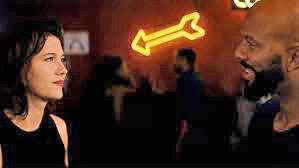
“All About Nina” follows her from NYC to Los Angeles, where her agent has wrangled her an audition for a TV show. But at the film’s real core is her relationship with Rafe (Common), a contractor who senses the pain beneath Nina’s rough exterior and decides to go slow. (It may be one of the movies’ rare instances of a guy turning down sex.)

Mary Elizabeth Winstead, Common

Vives’ screenplay has its ups and downs. The depiction of the comedy world — especially backstage at a showcase where woman comics are competing for the same gig — feels absolutely right.

And the slow-burning Nina/Rafe relationship is sweet and sexy despite the landmines with which Nina’s past is littered.

But there’s a big reveal here about our  heroine’s childhood that will shock many viewers (though it retrospect it probably shouldn’t)…it’s not that the film shouldn’t have gone there so much as Vives hasn’t quite figured out how to finesse it.

“All About Nina” is a minor film but as a showcase for Winstead it delivers in spades.

More, please.

| Robert W. Butler

Read Full Post »

John Krasinski, Margo Martindale

John Krasinski, Margo Martindale

“THE HOLLARS” My rating: C+

98 minutes | MPAA rating: PG-13

John Krasicki’s strengths as an actor — a sly sense of humor, emotional openess, a charitable view toward his own and other actors’ characters — are also on display in his feature film directing debut.

But despite a cast to die for and some heartfelt sentiment, “The Hollars” is a near miss, a movie in which everything seems just a degree or two out of whack.

Jim Strauss’s screenplay is yet another dysfunctional family dramedy.

Illness in the family brings NYC office drone John Hollar (Krasinksi) back to his middle American hometown. He leaves behind his pregnant girlfriend Rebecca (Anna Kendrick) and a dead-end job — what he really wants to do is write and illustrate graphic novels.

Ma Hollar (Margo Martindale) has been diagnosed with a brain tumor.  Even with that against her she shows more common sense than the menfolk of her clan, who are more or less eccentric idiots.

Dad Hollar (Richard Jenkins) lives in an emotional bubble of denial. Whenever he steps out of that bubble he collapses in tears. And he’s run the family’s plumbing business into the ground, forcing him to fire his oldest son Ron (Shallot Copley), who now lives in the basement.

Ron is a near-moron who is stalking the ex-wife with whom he has two little girls. And he harbors some absurd notions about minorities (he assumes that his mother’s surgeon, an Asian American, must be a master of at least one martial art).

(more…)

Read Full Post »

**, Mary Elizabeth Winstead, John Goodman

John Gallagher Jr., Mary Elizabeth Winstead, John Goodman

“10 CLOVERFIELD LANE” My rating: B

105 minutes | MPAA rating:PG-13

Intensely claustrophobic and impeccably acted, “10 Cloverfield Lane” is a mind-messer of a thriller with a forehead-slapping payoff.

In the wordless opening sequence, a young woman (Mary Elizabeth Winstead) packs her bags and flees her apartment, leaving behind a wedding ring and a ring of keys.

She’s cruising through the Louisiana countryside at night — listening to radio reports of a catastrophic electrical blackout along the Gulf Coast — when she’s involved in a bone-jarring accident.

Michelle (that’s her name) awakens in a musty cinderblock room, her leg in a splint and a chain limiting her mobility. Enter big beefy Howard (John Goodman), who explains that he pulled Michelle from the wreckage of her car and brought her here, to a bunker beneath his farmhouse. She should be thanking him for saving her life.

According to Howard, the world has come to an end. He’s not sure if it’s the result of nuclear or chemical war. Maybe it’s the doing of the Russians. Or possibly space aliens. (The film’s title, a reference to the 2008 found-footage alien invasion flick “Cloverfield,” should put canny viewers on alert.)

In any case, the air above ground is deadly and Howard announces that they’ll be holed up here for at least a year or two.  But not to worry — he’s been planning for this day for a long time. The bunker has enough supplies and equipment to easily keep three people alive.

Oh, yeah, there’s a third resident of the bunker.  Emmett (John Gallagher Jr.) is a mildly goofy good ol’ boy about Michelle’s age who for the last decade or so has been hired by Howard to work on the bunker.  At the first sign of trouble he showed up at Howard’s door. He seems like a doofus, but he may have more going on than can be gleaned at first examination.

Emmett assures the panicked Michelle that despite Howard’s ever-present sidearm and rampant paranoia, their host is an OK guy.

(more…)

Read Full Post »

Jeremy Renner as journalist Gary Webb

Jeremy Renner as journalist Gary Webb

“KILL THE MESSENGER” My rating: B+ (Opens wide on Oct. 10)

112 minutes | MPAA rating: R

Apart from featuring Jeremy Renner’s best screen performance since “The Hurt Locker,” the new film “Kill the Messenger” is noteworthy as a throwback to the good old days before around-the-clock cable news.

We’re talking about a time when the ink-stained wretches of the newspapers were widely viewed as, well, as kind of heroic.

Badly paid, sure, and probably morally reprehensible in matters of alcohol and other forms of hedonism. But these journalists happily clung to the idealistic notion that their job was to comfort the afflicted and afflict the comfortable, and in films like “All the Presidents Men” newspaper reporters shined a light on corruption and criminality.

“Kill the Messenger” is based on the  career of Gary Webb, a reporter for the San Jose Mercury News who in the mid-1990’s, while covering the crack cocaine epidemic, stumbled upon a seemingly incredible story: To fund a rebel army battling the leftist Sandinista government in Nicaragua, the Contras had been smuggling countless tons of cocaine into the US.  The ensuing scandal became known as “drugs for guns.”

Webb never alleged that the CIA was behind the program, only that the CIA must have known about the drugs and tolerated it.

In other words, during the same years that Nancy Reagan was telling America’s kids to “just say no,” our government was allowing a flood of dangerous drugs to inundate the country’s inner cities. Most of the victims of this scourge were black.

Written by Peter Landesman and directed by Michael Cuesta (a veteran of Showtime’s “Homeland”), “Kill the Messenger” starts out as a sort of journalistic procedural.  Renner’s Webb stumbles across a secret government document that suggests a partnership between the government and a major drug trafficker.  Then, through dogged research, interviews, and travel to Central America and Washington D.C., Webb puts together a story that will rock the country and win him major journalism awards.

(more…)

Read Full Post »

Mary Elizabeth Winstead battles "The Thing"

“THE THING” My rating: C (Opening wide Oct. 14)

103 minutes | MPAA rating: R

We’ve already seen two very good versions of “The Thing” (based on the classic sci-fi/horror story “Who Goes There?”), so anyone making yet a third “Thing” had better bring some new ideas to the table.

In the case of the film opening today, first-time feature director Matthijs van Heijningen and writer Bill Lancaster attempt to stir things up by making our protagonist a woman.

That’s it?  That’s the big twist?

(more…)

Read Full Post »