Feeds:
Posts
Comments

Posts Tagged ‘movies’

Steve Coogan and friend

“THE PENGUIN LESSONS” My rating: B(Netflix)

115 minutes | MPAA rating: PG-13

I’ve avoided watching “The Penguin Lessons” because, well, penguins and lessons. Sounded just a bit too emotionally pushy, you know?

Having finally watched this Peter Cattaneo-directed effort, I can report that my misgivings were misplaced.  The film is subtle, unsettling and about as unsentimental as a movie with a two-foot-tall feathered costar could be.

It helps that the film is based on the real-life story of Tom Michell, a British educator who in the 1970s found himself teaching English to the boys in a posh boarding school in Argentina.

When we first meet Michell (Steve Coogan), he’s a wryly caustic fellow oozing ennui.  We’ll learn much later that he’s attempting to outrun a personal tragedy.

On a seaside vacation to nearby Uruguay, Michell stumbles across a flock of penguins who have succumbed to a massive oil spill.  He retrieves the lone surviving bird and cleans it up in his hotel room (to be honest, his kindly display is intended to impress the woman he met that night at a dance club).

Anyway, once rescued the penguin refuses to leave. Michell is stuck with the fishy-smelling creature, reluctantly smuggling it back to Argentina in a backpack. He tries to pawn off the bird on anyone who’ll take it (a customs official, the local zoo) but ends up secreting it in his on-campus apartment.

The setup screams “cute,” but director Cattaneo and screenwriter Jeff Pope deftly sidestep all the pitfalls. For one thing, there’s no attempt to anthropomorphize the penguin.  He’s basically an eating machine that waddles. No personality to speak of — although just by being his cute, mute self he elicits confessional revelations from the humans who hang with him.

The eccentric creature — dubbed Juan Salvador by his savior — also proves a classroom asset, focusing the attention of the normally unruly rich twits who attend the school. Grades actually start improving, much to the delighted surprise of the stuffy headmaster (Jonathan Pryce).

Here’s where “The Penguin Lessons” turns the tables.  Michell was on hand for the military coup that for several years turned Argentina into a fascist camp where more than 30,000 citizens were “disappeared” for their political, intellectual and moral proclivities.

One of these unfortunates is Anna (Julia Fossi), a young cleaning lady at the school who is an outspoken liberal and always taunting Michell for his political indifference. Michell witnesses Anna being snatched off the street by a pack of government thugs. Appalled by his own cowardice for not interfering, he joins the girl’s grandmother (Vivian El Jaber) in a months-long search to discover Anna’s fate.

Now this is pretty dark stuff…and darker still because it mirrors recent images of masked ICE agents snatching dark-skinned people off America’s streets.

Coogan is a specialist at humanizing vaguely repellant characters, and here he quietly and efficiently limns Michell’s moral journey.  The supporting players are all fine, from the leads to the entitled adolescents who occupy Michell’s classroom (they could have called this “The Dead Penguin’s Society”).

Jenna Ortega

“DEATH OF A UNICORN” My rating: C (Netflix)

107 minutes | MPAA rating: R

Not even an A-list cast can do much with “Death of a Unicorn,” a hodgepodge of myth, father-daughter bonding, greedy rich folk and a big dose of gut-splattering violence.

Alex Scharfman’s film (he both wrote and directed) finds corporate attorney Elliott (Paul Rudd) and his surly daughter Ridley (Jenna Ortega) cruising down a mountain road en route to the alpine compound occupied by Elliott’s employers, a family of pharmaceutical robber barons.

At first Elliott thinks he’s hit and killed a deer.  Actually it’s a honest-to-God unicorn, a creature whose long horn is capable of delivering psychedelic experiences, healing diseases and even bringing the dead back to life.

Their moneyed hosts (Richard E. Grant, Will Poulter, Téa Leoni) quickly realize the creature’s powers could be a game-changer and launch plans to harvest whatever other unicorns may be frolicking in the woods.

What they don’t realize is that these creatures are malevolent, with the fangs of a carnivore, the speed of a charging rhino and the ability to crash through doors and walls.

The tone is all over the place.  “…Unicorn” wants to be a satire of corporate greed, but it’s hitting at a pretty obvious target. (Drug executives? Really?) Meanwhile it’s hard to root for the unicorns…they’re some mean mofos. 

And the violence is wildly gruesome…yet we’re supposed to laugh.  Those are some mixed messages.

Adolescent Ridley advocates a more humane approach to the whole situation; gradually bringing Dad Elliott into her corner.  Of course, you can’t exactly wave the flag of peace when these monsters are laying siege to your aerie.

| Robert W. Butler

Read Full Post »

Fernanda Torres

“I’M STILL HERE” My rating: A-(Netflix)

137 minutes | MPAA rating: PG-17

Audiences have the habit conflating big moments with great acting.  Indeed, the history of Oscar wins suggests that if you want a statuette, you’d best come up with a few barn burning peel-off-the-paint moments.

The Brazilian “I’m Still Here” (it was nominated for Best Picture and Best International Feature, winning in the latter category) takes another approach entirely.  

Walter Salles’ film (screenplay by Muriel Hauser, Heirtor Lorega and Marcelo Rubens Paiva) tells a hugely dramatic real-life story by concentrating not on the big moments but on the little ones. The results are quietly devastating.

This is the story of one family living through the two-decade reign of terror of a military junta that ruled Brazil from the early 1970s.  During that period more than 20,000 citizens were arrested and tortured; nearly 500 were executed without trial.

The film’s first 40 minutes are largely devoted to depicting the middle-class lives of Rubens Paiva, an architectural engineer and former member of Congress, his wife Eunice (Oscar-nominated Fernanda Torres) and their five children.

They live in a big house just yards from Rio’s fabulous beach in the shadow of Sugarloaf. The grownups are deeply in love and enjoy entertaining friends. The kids are a rowdy bunch who practically live in the ocean and adopt a lost dog.  It’s pretty damn idyllic.

But there are cracks in this blissful picture.  The Paivas’ family friends are nervous liberals; some plan to leave Brazil to avoid right-wing oppression.  And while driving with her friends the oldest daughter finds herself caught up in a military dragnet as authorities search for rebels who have kidnapped a foreign diplomat.

Papa Rubens periodically gets unexplained phone calls asking him to receive or deliver unidentified documents. We never will learn just what that was all about.

It all comes to a head with the arrival on the doorstep of armed men in civilian clothes who announced that Rubens is needed to give testimony.  He is taken away while several of the interlopers hang around the house, rifling through closets and drawers and generally terrifying the family.

Within a few days Eunice is herself dragged to a military prison where she spends nearly two weeks wallowing in filth and listening to the screams of the tortured; each day a quietly intimidating interrogator has her thumb through a thick book of mug shots, demanding to know if she recognizes any of the faces.

To her queries about the whereabouts of her husband, she is always told: “I do not have that information.”

If this story had been told by an American there would undoubtedly have been some dramatic  fireworks.  Eunice would go to court to demand the truth about her husband’s disappearance. There would be clashes between rebels and the authorities.

But if any of that happened, in this retelling it occurs offscreen. The fierce focus is on Eunice and how she deals with her confrontation with institutionalized evil. And Torres pulls it off not with big moments but with small ones, with a careful accumulation of details that are registered in the eyes, in subtle body language. This is a woman who must simultaneously nurse a terrible loss and somehow remain strong for her children.

“I’m Still Here,” which follows the Paiva family for nearly 40 years, has been impeccably acted on all fronts.  Each of the family’s offspring get a few telling moments, and one must reluctantly admire the chilling work of the actors portraying the blandly terrifying torturers. 

Finally, it’s impossible to watch the film without looking at the United States teetering on the brink of dictatorship and wondering if our own citizens will be disappeared. 

 Brenca Vaccaro, Susan Sarandon, Vince Vaughn, Lorraine Bracco and Talia Shire

“NONNAS” My rating: B- (Netflix)

111 minutes | MPAA rating: PG

Vince Vaughn, who in his three-decade career  has specialized in playing smarmy jokesters, takes a more low-keyed approach in “Nonnas.”

Basically he lets four veteran actresses do the heavy comedic lifting while he plays it straight.  It works.

“Nonnas” is inspired by the real life story of Joe Scaravella, an unnmarried NYC transit worker who, after the death of his beloved mother, decided to use his inheritance to open a restaurant…one in which real Italian grandmas (“nonnas”) cook their traditional family recipes.

Problem is, Joe knows virtually nothing about the restaurant biz and makes misstep after misstep, in the process that nearly alienated his best bud (Joe Manganiello) and his wife (Drea de Matteo), who have imprudently risked their life savings on Joe’s dream.

The nonnas Joe recruits are a colorful mixed bag.  The scratchy-voiced Roberta (Lorraine Bracco, almost unrecognizable) is a grump looking to spend a few hours outside her retirement community.  Teresa (Talia Shire) is a timorous former nun. Gia (Susan Sarandon) brings a bit of blowsy glamor as Gia, who runs her own beauty salon.  And chatty Antonella (Brenda Vaccaro) introduces Joe to his love interest, a law student (Linda Cardellini) who helps him over some legal hurdles.

The nonnas bitch and kvetch and engage in geographical rivalries (apparently Sicilians don’t get along with Mainlanders), but eventually all fall behind Joe on his march to success.

The resulting film is a pleasant blend of comedy and pathos, with writers Liz Macci and Jody Scaravella and director Stephen Chbosky  never going overboard on either.

At the very least you’ll leave the movie craving a big plate of lasagna.

Greta Garbo as Mata Hari

“GARBO: WHERE DID YOU GO?” My rating: C (Netflix)

90 minutes | No MPAA rating

As a fan of Old Hollywood I jumped at the chance to learn more about Greta Garbo, who throughout the 1930s was not only Hollywood’s best-paid actor but also widely regarded as the most famous woman on Earth.

But the Swedish-born star gave it all up after 15 intense years, retiring in 1941 and spending the rest of her life avoiding the limelight.

Why? That’s the question posed by Brit director Lorna Tucker’s documentary, and my appetite was whetted by the news that Tucker had managed to get her hands on Garbo’s private correspondence, home movies and other material never before seen by the public.

Alas, the answer Tucker comes up with his hardly revelatory.  Basically, Garbo got sick of being hounded by the press — this was before the term paparazzi had been coined — and decided to bail from the high-profile rat race.  She lived a long life, had a lover who protected her, and enjoyed a small coterie of extremely loyal friends who would be cut loose if they should spread info about her private life.

What really chaps my ass, though, are the artsy/fartsy flourishes Tucker has packed into the tale.

Periodically we are addressed by a young woman (uncredited) with a platinum blonde Monroe ‘do who dresses in tight black clothing (like a waitress at a beatnik coffee shop) and stares piercingly at a wall full of Garbo photos, post-it notes and newspaper clippings.  Apparently she’s attempting to sleuth out the story behind Garbo’s exile.  Mainly what she is is irritating.

Equally off-putting is another actress wearing a creepy Garbo mask who strikes thoughtful poses while offscree Noomi Rapace reads from the actress’s correspondence.

Okay…most folks don’t know anything about Greta Garbo, so they’ll learn a few things from this movie.  But only at the risk of getting really irritated.

| Robert W. Butler

Read Full Post »

Tilda Swinton, Julianne Moore

“THE ROOM NEXT DOOR” My rating: C+ (Netflix)

106 minutes | MPAA rating: PG-13

At a certain point in every artist’s life the old mortality bug starts nibbling away. Apparently filmmaker Pedro Almodovar has reached that stage.

“The Room Next Door” is typical Almodovar in that it concentrates on relationships among women.  But mostly it’s an atypical  contemplation of death.

Popular author Ingrid (Julianne Moore) learns that her old magazine colleague Martha (Tilda Swinton) has terminal cancer.  A visit to the hospital leads to much reminiscing (there are flashbacks to Martha’s early life and career as a war journalist) and a startling request.

Martha has obtained a “euthanasia drug” on the dark web.  She wants Ingrid to accompany her to a vacation rental in the Catskills where Martha plans to end her life. (“Cancer can’t get me if I get myself.”) She wants Ingrid simply to be on hand in an adjacent bedroom so she won’t feel she’s totally on her own.

Ingrid is reluctant (she hasn’t seen Martha in five years and, besides, her most recent book examines her own fear of death) but finally acquiesces when she learns that several other friends have already turned down Martha’s request.

The source material here is Sigrid Nunez’s 2020 novel What Are You Going Through, and there are times when the English dialogue (I believe this is the first all-English language movie in Almodovar’s resume) sounds like it has been strained through a translation app.

But the real issue here is one of tone. Almodovar is known for his wonderful wackiness (“Women on the Verge…,” “I’m So Excited”), his camp sensibilities and  his deep appreciation of over-the-top melodrama.

None of which is in evidence here.  Even Almodovar’s visual panache has been muted as if intimidated by the grim subject matter.  (Although the closer Martha comes to taking the pill, the more colorful the wardrobe she chooses.)

Clearly Almodovar wants to move us.  But I felt peculiarly unmoved.

It’s not the actresses’ fault.  Moore is solid as a reluctant participant in what is legally a crime, while Swinton, with her glacial pallor and skeletal physique certainly looks like she’s about to cash in.

Then, too, the screenplay has digressions that seem not to go anywhere.  John Turturro has a couple of scenes as the pessimistic writer both women have had relationships with.  Alessandro Nivola is a moralistic police detective who in an unnecessary coda grills Ingrid for her part in the death. 

And at the very end Martha’s estranged daughter briefly shows up. She also is played by Swinton, whose appearance has been subtly altered (either by makeup/prosthetics or CGI makeover).

Okay. Almodovar has gotten that out of his system. Let’s move on.

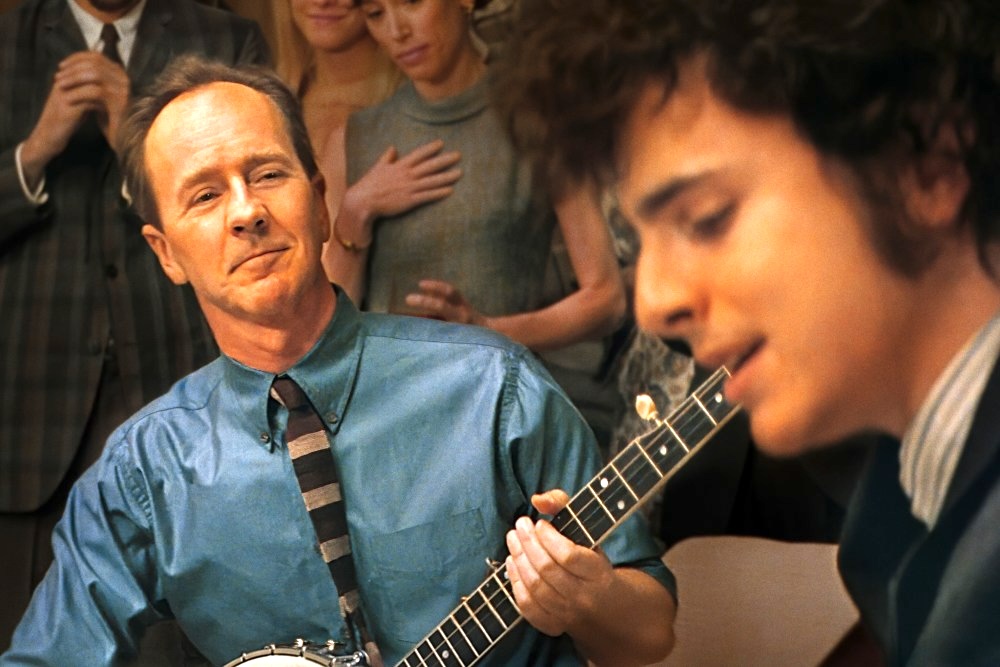
Edward Norton as Pete Seeger, Timothee Chalomet as Bob Dylan

A COMPLETE UNKOWN” My rating: B (Apple+)

141 minutes | MPAA rating: R

“A Complete Unknown” is about as good a Bob Dylan biopic as we’re likely to get.

First, it absolutely nails the where and when of the early 60s folk scene in New York City.

And second, it knows that no matter how hard it tries, its main character will remain an enigma.

I mean, I’ve been listening to Bob Dylan for more than half a century and I still couldn’t give you a reading on his personality.  Would I like him in person? Would he be a pain in the ass?  

Shut up and listen to the music.

Anyway, James Mangold’s film (the excellent screenplay is by Mangold, Jay Cocks and Elijah Wald) covers Dylan’s early years in the Big Apple, from his crashing the hospital room of the dying Woody Guthrie to his controversial (we’re talking “Rite of Spring” outrage) embrace of an electric guitar at the Newport Folk Festival.

Along the way Oscar-nominated Timothee Chalomet delivers a terrific central performance, capturing his subject’s physical and vocal quirks (the musical numbers were all recorded live on camera) while carefully concealing the innermost Bob. It shouldn’t work. It does.

Just as good is Edward Norton as folkie purist Pete Seeger, who takes Dylan under his wing, only to go ballistic when our man turns his attention to rock’n’roll.

Monica Barbaro is solid as folkie “it” girl and Dylan squeeze Joan Baez.  

You don’t need an excuse to drag out your old Dylan records, but don’t be surprised if after watching this  you do a deep dive into the catalogue.

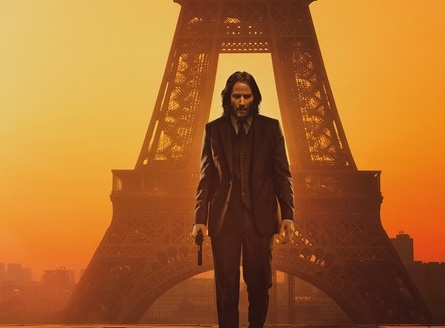
Keanu Reeves

“JOHN WICK: CHAPTER 4” My rating: B (Roku) 

169 minutes | MPAA rating: R

So far there have been four John Wick movies…although actually they’re the same movie with slightly different fight scenes.

“John Wick: Chapter 4” has the same story line as all the others.  Good-guy assassin John Wick (Keanu Reeves) once again finds himself in a one-man war against the numberless minions of The Table, the all-powerful international crime syndicate.

“Wick” regulars Ian McShane, Donnie Yen and Laurence Fishburne reprise their supporting roles…the main baddie this time around is played by Bill Skarsgard as a sort of sinister fop.

The story doesn’t matter.  It’s the fights that count, and “Wick 4” is crammed with them.

In fact, there’s so much to it  that midway through this nearly 3-hour bloodiest I found myself zoning out from too much good fight choreography. (It’s like movie nudity.  One naked woman gets your attention; 100 of them leaves you kinda ho-hum.)

Happily the film concludes with a doozie, a nearly 40-minute battle in which our man Wick must kill his way up a long outdoor staircase leading to Paris’ Sacre Coeur Cathedral where he is to engage in a final duel with his main foe.  

What’s interesting here is that director Chad Stahelski and his writers (Shay Hatten, Michael Finch, Derek Kolstad) finally accept the ridiculousness of it all and inject some humorous elements into the mayhem.  

After killing dozens of bad guys and nearly reaching his goal, Wick is sent tumbling back to the bottom of the stairs to start the whole thing over again.  It’s like that old two-reeler in which Laurel and Hardy are deliverymen attempting to carry a piano up an endless flight of stairs.

Reeves even allows a bit of comic exasperation to creep into his performance. He doesn’t quite roll his eyes at the silliness, but he comes close.

| Robert W. Butler

Read Full Post »

“BLITZ” My rating: B (Apple +) 

Saoirse Ronan, Elliott Hefferman

120 minutes | MPAA rating: PG-13

Early in Steve McQueen’s “Blitz” a single London  mother tries to convince her reluctant son that he must board a train filled with other children to spend months — even years — in the countryside, safe from the nightly rain of German bombs.

It will be, she cajoles, “an adventure for children only.”

She doesn’t know the half of it.

Rita (Saoirse Ronan) and her 9-year-old George (Elliott Hefferman) share a home with her father, the piano playing Gerald (Paul Weller). They’re a tight bunch, which helps explain George’s dismay and ultimate fury at leaving his familiar streets and being shipped off to God knows where.

So at the first opportunity he leaps off the train and heads back to the city, encountering along the way a regular Pilgrim’s Progress of characters good and bad and more than a few close calls with mortality.

“Blitz” is several things at once, not all of them coexisting comfortably.

It begins with a hair-raising sequence showing civil defense crews fighting the fires caused by the bombing. There’s a visceral oomph to the moments depicting the air raids and the citizenry’s desperate search for shelter.

George’s adventures on the road are, well, remarkable.  More happens to this kid in a few days than the rest of us experience in a lifetime.  

Sneaking aboard a freight train he shares a few giddy thrills with three brothers who, rather than being farmed out to different families, have gone rogue.

Once in London —basically he’s lost — George finds himself hijacked by a Fagin-inspired crook (Stephen Graham) who uses him to steal valuables from bombed buildings and off dead folk. Very Dickensian.

Hr’d befriended by a civil defense guard (Benjamin Clementine) and spends a couple of nights crammed into a tube station with hundreds of other Londoners. On one of these occasions the tunnels are flooded with Thames water, creating a deathtrap.

Flooded tube station in “Blitz”

Here’s something I haven’t yet mentioned.  George’s father was a black man deported years earlier. And his very blackness makes the boy’s  journey all the more problematic,

Writer/director McQueen, of course, is a black Brit, and his resume is peppered with titles that delve deeply into the black experience (“12 Years a Slave” and the TV series “Small Axe” in particular).  And in fact he was inspired to write “Blitz” after finding a vintage photo of a young black child with suitcase en route to the provinces.

So in addition to just staying alive, young George encounters numerous displays of racial intolerance. 

But that’s only half the movie.  Meanwhile Rita and her all-female fellow workers at the munitions plant must deal with the chauvinism of the management and unfair treatment.  They are particularly incensed that the government has blocked the desperate public from using certain underground shelters. (There’s no explanation of what this is all about…makes one wonder if it was trimmed from the final cut.)

Eventually Rita gets word of George’s disappearance and goes on her own frantic search of London, abetted by a neighbor and civil defense warden (Harris Dickerson) who is quietly yearning for her.

And I haven’t even addressed the extensive flashbacks of Rita’s pre-war romance with Marcus (CJ Beckford) and the inevitable racial fallout from that taboo relationship.

Whew.  That’s a lot of plot.  Too much, in fact.

The performances are good, the physical production impressive, the handling of individual scenes generally tight and effective.

But there’s just so much going on that I practically succumbed to eye-rolling.  More is not always better.

| Robert W. Butler

Read Full Post »

Zoe Saldana, Karla Sofia Gascon

“EMILIA PEREZ” My rating: B (Netflix)

132 minutes | MPAA rating: R

By all rights “Emilia Perez” should collapse under the weight of its borderline crazy ambitions.

That it doesn’t, that in fact it keeps us from sneering despite a staggering level of telenovela-level melodrama, is one of those weird wonders that makes watching movies so much fun.

This Spanish-language effort from French director Jacques Audiard (he shares screenplay credit with Thomas Bidegain and Lea Mysius) is many things all at once.

Gangster picture. Social commentary. A tale of personal (and sexual) liberation.

Oh…and did I mention it’s a musical?

The yarn starts out with Mexico City criminal lawyer Rita Castro (a makeup-free Zoe Saldana) hitting a personal and professional dead end. She hates her job getting bad people off the hook, venting her frustrations in an opening musical number.  

(Throughout the film Camille Clement Ducal’s songs are employed to reveal the psychology of the various characters.  There’s very little in a traditional musical comedy sense; the emphasis is less on melody than on percussive delivery and a kind of repetitive chanting. In many instances backup singers deliver what can only be described as choral raps. Visually the restless approach to these numbers reminds of Baz Luhrman’s work on “Moulin Rouge.”)

Looking for something new, Rita agrees to meet with a shadowy new client, and finds herself grabbed and blindfolded. When the hood comes off she’s sitting opposite one of Mexico’s most notorious drug lords, Manitas Del Monte, a bearded, tattooed terror with a long history of murders.

Manitas has a very special job for Rita.  He has for years desired a sex change operation, and wants his new attorney to search the world for medical clinics where he can undergo the transition in ultimate privacy. This is all top secret…not even his wife Jessi (Selena Gomez) and their two young children know of Daddy’s double life.  And all the while his freedom and very existence are threatened by the authorities and rival gangs.

The upshot is that Manitas fakes his own death, goes to Israel for months of surgery and therapy, and emerges as Emilia Perez.

Here’s what’s mind boggling…both the scarily masculine Manitas and the very feminine Emilia are portrayed by Karla Sofia Gascon, a Spanish actress who made the transition from man to woman several years ago. She is utterly convincing with either persona.

Manitas/Emilia returns to Mexico and with Rita’s help tries to atone for her sins by creating a non-profit that works to determine the fates of thousands of citizens who have vanished in Mexico’s never-ending drug wars.  Manitas was responsible for not a few of those deaths. There’s a documentary-style montage in which imprisoned sicarios testify to the atrocities in which they have participated.

Selena Gomez

On a personal note, Emilia finds love with the grieving mother (Adriana Paz) of a missing teenage boy. 

And, posing as Manitas’ cousin, she invites Jessi and the kids to live with her.  This way Emilia can be close to the children she was forced to abandon, and she can keep tabs on how Jessi is handling the considerable fortune her “dead” husband left behind.

Yeah, that’s a lot.  And there’s more, but this isn’t the place for a litany of plot points. Let’s just say that “Emilia Perez” had me glued to the screen even when my b.s. meter was sending up red flares.

But the acting…Holy Cow!!   No wonder Saldana, Gomez (doing a 180 from her buttoned-up character in “Only Murders…”), Paz and especially Gascon were jointly named best actress at this year’s Cannes Film Festival, where “Emilia…” also won the jury prize as best film.

Different segments of the film feel like reflections of other movies (trans drama, gangster epic, family trauma, Almodovar’s “The Skin I Live In”), yet the way these familiar elements have been combined feels surprisingly original.  And here’s where the musical elements play a big role — by having the characters periodically break into song writer/director Audiard signals early on that we’re dealing with a heightened realism, that while the film may appear to be rooted in the real world, it’s operating on an entirely different emotional and intellectual plain.

I can honestly say I’ve seen nothing quite like it.

| Robert W. Butler

Read Full Post »

Harper Steele, Will Ferrell

“WILL & HARPER”  My rating: B+ (Netflix)

114 minutes | MPAA rating: R

“Will & Harper” is both a hugely emotional paen to friendship and a sobering/reassuring look at grassroots America.

It’ll have you sobbing one minute, furious the next.

The Will of the title is Will Ferrell, famous comic actor.  Harper is the former Andrew Steele, a long-time writer for “Saturday Night Live” who at age 61 decided to transition.

At the outset of Josh Greenbaum’s documentary, Ferrell recalls getting an email from Steele announcing her new status as a woman.  Farrell never saw it coming.

But Will Ferrell is a very good friend.  Knowing that as a man Harper had often driven across America, hanging out in seedy motels and nefarious watering holes, Ferrell suggested the two buds take a road trip. 

It would give them plenty of time to explore their new relationship while seeing how, if at all, Harper would be accepted  by the everyday folk being bombarded with anti-trans propaganda.

There’s good news and bad news. At an Oklahoma road house Harper is serenaded by a group of Native American men who employ a plastic tub as a tom tom to chant a welcoming song.  Awwww.

The next day, in Texas, the two travelers take center stage at a crowded highway restaurant.  Clearly, the local folk are impressed at having a celeb in their midst, but many fire off a slew of cruel anti-trans tweets aimed at the comic’s companion.

But perhaps the most devastating part of the journey is hearing Harper speak of the many years in which she fought against recognizing her true sexual identity. It’s sad and inspiring.

Which is not to say that “Will & Harper” is a downer.  Ferrell and Steele have earned their livings by making other people laugh, and their banter has plenty of drollery sprinkled among the truth nuggets.

I believe I’m a better person for having watched it.

Brad Pitt, George Clooney

“WOLFS” My rating: B (Apple+)

108 minutes | MPAA rating: R

It really doesn’t go anywhere, but you’ve gotta enjoy the ride provided by “Wolfs,” a lean, funny crime dramedy fueled by Tarantino-esque banter.

The premise of writer/director Jon Watts’ film:  Two mob cleaners (they are hired to discreetly remove evidence — like dead  bodies — after violent encounters) find themselves working on the same assignment.

It must be a mistake because these unnamed dudes (played by George Clooney and Brad Pitt) always work alone and are fiercely protective of their trade secrets. (They’re “lone wolfs.”)

Nevertheless, here they both are in an expensive hotel room to remove the body of a young man who, while cavorting with an older woman (Amy Ryan), bounced off the bed and into a glass coffee table.

These wolfs don’t play well with each other.  The older one (Clooney) is a brooding grump. The younger (Pitt) is a cocky wise ass.  

Oil and water.

And then there’s the vinegar. (Here comes a spoiler but I don’t know how to avoid it.)

That would be “the kid” (Austin Abrams), the supposedly dead body that returns to life mid-disposal.  He’s a goofy college student who got picked up by the cougar while running an errand for a friend…an errand that involves a backpack full of drugs.

Now the two fixers and the kid are trying to return the illegal pharmaceuticals to their criminal owners without getting killed.

But not before an awesome chase through NYC with the two wolfs pursuing the whacked-out kid, who is racing gazelle-like through a snowstorm in his tidy whities. 

Remember Nicolas Cage’s quest for baby diapers in “Raising Arizona”?  It’s that good.

The thorny plot twists of “Wolfs” may not stand up to close scrutiny, but viewer doubts probably won’t kick in until after the final credits.  For the most part the flick is just plain fun.

Natasha Lyonne, Elizabeth Olsen, Carrie Coon

“HIS THREE DAUGHTERS” My rating: B+ (Netflix)

101 minutes | MPAA rating: R

Getting married. Having a kid. Losing a parent.

These are three of the most impactful experiences in a human life. Azazel Jacobs’ “His Three Daughters” examines the third event through a pressure-cooker environment and three astonishing performances.

The daughters are Katie (Carrie Coon), Rachel (Natasha Lyonne) and Christina (Elizabeth Olsen). The siblings have gathered in the New York apartment of their father, who lies dying in his bedroom (we won’t actually see him until the final moments of the film).

Though all were raised by the same single dad, the women have radically different personalities.

Katie, the oldest, is a brittle, opinionated woman who tries to come off as helpful but actually is merely bossy. Katie has rarely visited her father in recent months but now wants to dictate how this whole business of dying will unfold. The problem, of course, is that death doesn’t operate on a convenient schedule.

Christina has a husband and young daughter back in Ohio. She’s painfully insecure, always sharing appallingly sappy phone calls with her kid and shying away from argument and controversy.

Rachel is the family bohemian. She’s been living with her father for years, taking care of him in his decline. She appears not to have a real job and frequently lets off steam with a joint or two, both life choices that infuriate the judgmental Katie.

“…Sisters” unfolds almost entirely in the living room and kitchen of the apartment, creating a claustrophobic intensity that magnifies the points of conflict among the women.

Every few hours a hospice worker (Rudy Galvan) checks in; at one point Rachel’s boyfriend (Jovan Adepo) shows up to give her a bit of moral support and to unload on Katie and Christina, whom he (rightly) believes have shirked their familial responsibilities while Rachel got stuck with the role of caregiver.

“His Three Daughters” could quite easily have been conceived as a stage play rather than a film. The dialogue is tight and polished and wastes little time in exposing the character’s conflicted essences. Sometimes it sounds a bit artificial and forced, but any misgivings are quiickly dispersed by the power and subtlety of the performances.

Most of the film is brutally realistic. But in the final moments, when we finally meet the women’s father (Jay O. Sanders), it becomes borderline metaphysical. I can’t say more without ruining the effect…let’s just say that despite often rubbing our noses in dysfunction, “His Three Daughters” leaves us with a whiff of hope.

| Robert W. Butler
Read Full Post »

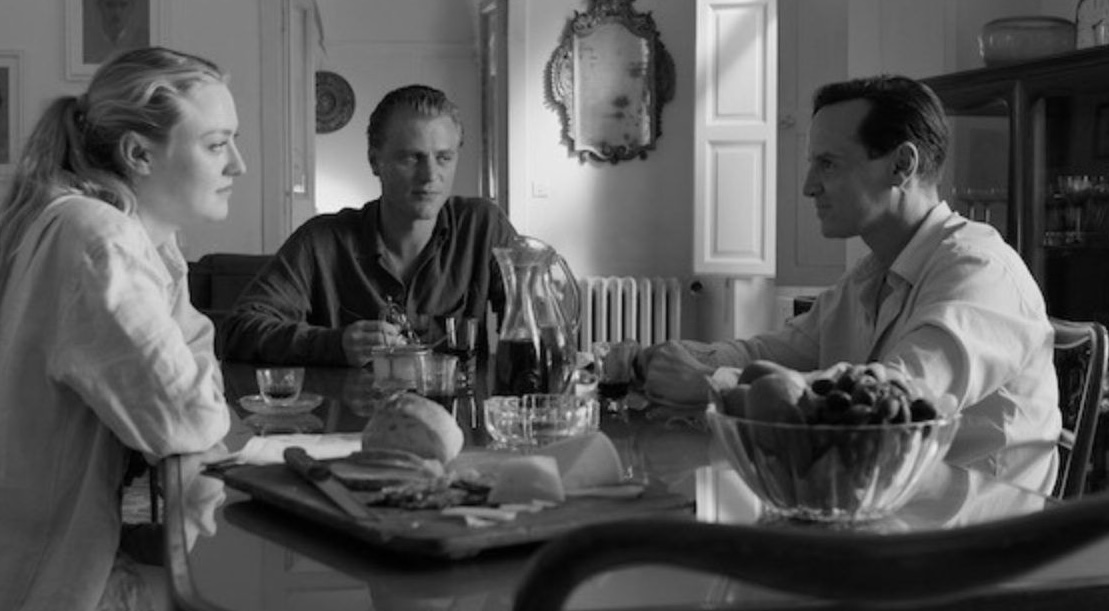
Andrew Scott

“RIPLEY” (Netflix):   

Patricia Highsmith’s charming/creepy con man Tom Ripley has been a favorite of filmmakers ever since the character first saw the light of print in 1955.

Over the years he’s been portrayed by Matt Damon, Barry Pepper, John Malkovich, Alain Delon and Dennis Hopper, among others. 

So I approached writer/director Steve Zaillian’s new adaption on Netflix with a few misgivings. What could this 8-part series possibly bring to the table that I hadn’t already encountered in all those other movies?

Silly me. 

This is now officially my favorite Ripley of all.  Andrew “Hot Priest” Scott is both seductive and repellant in the title role, deftly sliding between charm and creepiness, between superficial warmth and a near-reptilian indifference.

But sharing star billing is the series’ use of Italian backdrops, captured in black-and-white footage so jaw-droopingly rich that you want to linger on every frame, soaking up the unerringly “right” compositions and mesmerizing interplay between light and dark.

In fact, cinematographer Robert Elswit just might singlehandedly make b&w a thing again.  The format has the almost mystical ability to capture and magnify textures ranging from worn marble to fabrics. This “Ripley” is more than a crime story or a personality study…it’s a freakin’ sensory adventure.

(Elswit uses only a brief moment of color…it’s at the end of Episode 6. Look for it.)

The plot is pretty much as you remember it.  In the late 1950s New York scammer Tom Ripley is recruited by a rich man to seek out the  wayward son who has decamped to Italy.

Ripley barely knows the young fellow he’s supposed to bring back to the States, but at the very least he can spend a couple of months living high on the old man’s money.

His target, Dickie Greenleaf (Johnny Flynn), is a wannabe writer and painter who has a taste for the expensive things — like the  original Picasso on his villa wall — that a plebe like Ripley can only dream of. 

In fact, our man soon realizes he isn’t satisfied with being Dickie’s drinking buddy and traveling companion…Ripley wants to take over Dickie’s life, to actually become Dickie.  Which will of course necessitate the real Dickie disappearing.

Dakota Fanning, Johnny Flynn, Andrew Scott

Two of the series’ episodes are devoted to depicting separate murders and Ripley’s coverup efforts. Zaillian has filmed these with virtually no dialogue, studying Ripley’s efforts to clean his messes and hide the evidence in practically microscopic detail.

Along the way he ratchets up the tension to painful levels…time after time it looks as though Ripley is going to be found out…and like a cat he somehow always lands on his feet. Whether by luck or strategic thinking, he always turns the odds in his favor.

“Ripley” is pretty much a one-man show, and Scott is nothing short of hypnotic.  You find yourself rooting for Ripley against your good judgment; there’s perverse pleasure (and in several instances sardonic humor) in watching him run circles around everybody…including us viewers.

It’s not entirely a one-man show. Dakota Fanning is effective as Dickie’s girlfriend, whose almost instant dislike of Ripley may put her in his cross hairs. Eliot Sumner has some fine moments as Freddie, Dickie’s fey friend, and Maurizio Lombardi is quite wonderful as the Roman police inspector wrapped up in Ripley’s wild goose chase.

| Robert W. Butler

Read Full Post »

Carol Doda

“CAROL DODA TOPLESS AT THE CONDOR”  My rating: B- (At the Glenwood Arts)

100 minutes | MPAA rating: R

One of the more obscure outliers of modern American social history gets examined in “Carol Doda Topless at the Condor,” a documentary that succeeds more in recreating a bygone era than in coming to any definitive conclusions about its central figure.

Carol Doda (she died in 2015 at age 78) was, for a decade or so beginning in the mid-1960s.  a household name. She was famous/notorious for dancing topless at the Condor Club in San Francisco’s North Beach neighborhood.

Doda was not a stripper. Or even an exotic dancer.  She did a standard go-go routine with the difference that she was nude from the waist up.

This was in an era when even burlesque stars wore pasties; by freeing the nipple one might claim that Doda opened the door to a whole new approach to public nudity.

Whether she intended to do so or was just in the right place at the right time is one of many questions Marlo McKenzie and Jonathan Parker’s film leave unanswered.

The film does a nice job of establishing how San Francisco became “the off-season Vegas,” a nightlife center offering tourists a plethora of jazz and comedy clubs that earned the town the nickname “Baghdad by the Bay.”

Carol Doda was a waitress at the Condor Club.  But she delivered drinks with a wiggle and exuberant dance movies while wearing a white leotard.  Eventually the club’s owners suggested that she might do her dance from atop the grand piano on the bandstand.

At the same time fashion designer Rudy Gernreich was introducing his topless swimsuit (or monokini);  Doda and her bosses decided to up the ante by having her dance in the breast-baring outfit. Result: standing-room crowds and queues around the block.

Ere long Doda was making her entrance on a specially rigged piano that lowered from a hole in the ceiling with the star performer already on top and gyrating.  And she began beefing up her modest bosom with silicon injections.

Overnight virtually every club in town went topless.  The cops responded with a city-wide raid; Doda and her fellow topless dancers prevailed in court and as a result San Francisco became the  first city to recognize the legality of topless performance.

“Carol Doda Topless…” eschews narration and instead relies on dozens of talking-head snippets featuring Doda’s old bosses, fellow dancers, even bartenders at clubs where she worked.  

There are also a handful of female scholars attempting to establish Doda’s place in the feminist continuum, and they are wildly contradictory.  Was Doda exploited or was she a canny exploiter?  Was she a photo-feminist?  And if so, deliberately or accidentally?  

The film employs lots of footage of Doda being interviewed, but it’s just about impossible to pin down her personality. For a woman who nightly bared it all, she was remarkably shy.

“I want to be in show business and I don’t know any other way than showing my bosoms,” she says at one point.  In another interview she calls her act “another form of art, like a nude painting or statue.”

So who was this woman?  There are hints that she came to San Francisco after a failed marriage, leaving behind one or two children.  The movie raises the idea that Doda developed serious health problems as the result of her regular use of silicon  injections to maintain her breasts, but never comes to any conclusions.

In interviews she could be self-effacing, but there’s no evidence that irony played a role in her act.  She was a naked lady dancing. Period.

Doda never discussed her personal life; even women who worked with her for years knew little about her.  She is alleged to have had a liaison with Frank Sinatra; thereafter she preferred young men…one commentator suggests that guys barely out of their teens were more malleable and less troublesome.

In later life, when the topless bookings dropped off, Doda sang with a heavy metal band, did  phone porn, developed her own  line of face creams  and opened a boutique specializing in  intimate wear (apparently she would look at a female customer and know immediately what design and size of bra would be appropriate).

Ultimately we’re left with the sense that Carol Doda wanted desperately to be a star despite her lack of conventional talent, and had the insight or blind luck to find the one way to get there.

| Robert W. Butler

Read Full Post »

« Newer Posts