Feeds:
Posts
Comments

Posts Tagged ‘Oscar Isaac’

Jacob Elordi

“FRANKENSTEIN” *My rating: B+ (Netflix)

149 minutes | MPAA: R

For the first hour or so Guillermo del Toro’s new (and let’s face it, ultimate) version of “Frankenstein” left me a bit cold.

It’s been brilliantly designed and photographed but emotionally…kinda meh.  

Turns out I just had to show a little patience.  For once the Creature comes to life, so does the movie.

Indeed, our sympathies lie with none of the human characters…least of all Oscar Isaac’s Victor Frankenstein, the ruthless and ego-driven medical genius bent on reanimating dead corpses.

No, this “Frankenstein” belongs to Jacob Elordi’s Creature…and please note that he will not be described here as “the Monster.”  For this stitched-together superman exhibits more pure humanity than any of the “normal” folk around him.  It’s a performance that transcends the scars and death-blue pallor of the Creature’s skin to reveal, well, a beautiful soul.

Expect an Oscar nomination for Elordi, a screen heartthrob and sexual icon (“Saltburn,” the Max series “Euphoria”) who here shows unpredictable depths of loneliness, love, rage and compassion.

Del Toro’s adaptation of Mary Shelley’s novel begins at the end.  The crew of a sailing ship trapped in the Arctic ice take aboard a frostbitten man being pursued by a terrifying giant.  This is Victor Frankenstein, and to the Captain (Lars Mikkelsen) he relates his tale.

We see the boy Victor dealing with his icily controlling and intellectually cruel father (Charles Dance); this helps explain why as an adult Victor is a bit of a medical oddball, convinced of his own brilliance and openly contemptuous of his colleagues.

Victor’s ambitions know no bounds, and with the help of a rich benefactor (Christoph Waltz) — who it turns out has his own twisted motives — our man gets to work sorting through the bodies left on a recent battlefield (the setting is 1850s Europe), looking for pieces that can be sewn together and animated with a jolt of lightening.

When not impersonating God, Victor expresses a bad case of the hots for Elizabeth (Mia Goth), the fiancé of his brother (Felix Kammerer). Clearly he observes few moral boundaries.

Oscar Isaac

That becomes even more clear in his relationship with the Creature.  He keeps his nearly naked (and weirdly erotic) creation chained in the castle basement, where he berates the poor unfortunate for lacking the mental acuity to match his physical power.

It is Elizabeth who breaks through, treating the Creature with kindness and unlocking his emotions and intellect. But exasperated by what he views as a failed experiment, Victor attempts to destroy his creation in a massive conflagration.

Turns out the Creature cannot die, as much as he might wish for it. The second half of the film finds the Creature joining Victor and the captain aboard the ship to explain why he’s been pursuing the semi-mad doctor over land, sea and ice.

It is in the Creature’s backstory that we find grace notes of beauty and longing.  The highlight is his “adoption” of a farm family.  Hiding in their idle gristmill he emerges at night to leave presents of dead game and firewood at their door.  They call their mysterious and unseen benefactor “the spirit of the woods.”  

The Creature’s real education begins when the blind grandfather is left alone and befriends this stranger, teaching him to read (how a blind man teaches someone to read is a poser, but I’m not complaining) and opening up his intellect to literature, history and philosophy.

Maddened by the knowledge of both his “otherness” and his inability to end his miserable existence, the Creature decides on revenge.  He’ll pursue Victor halfway around the world for a final confrontation between father and son.

The old “Bride of Frankenstein” attempted to humanize the Monster (the blind hermit had a brief but telling scene), but the dominant themes of that classic were horror and camp.  Here del Toro goes for an emotional and spiritual catharsis.  That might seem a stretch for what is essentially a horror movie, but damned if he doesn’t pull it off.

In the end we’re left not so much with lingering terror as a disquieting sadness.

Well done.

Julia Garner

“WEAPONS My rating: B (HBO Max)

128 minutes | MPAA rating: R

A long tantalizing  tease capped by a what-the-hell ending pretty much describes every horror movie I’ve seen in recent years.

It’s no different with “Weapons,” writer/director Zach Cregger’s followup to his brutally effective creepfest “Barbarian.”

The film opens with spectacular imagery…at exactly the same moment one fall night, nearly two dozen elementary school students rise from their beds and in their pajamas race away from their  homes with arms stretched at a weird angle…it’s simultaneously scary and beautiful.

Turns out all the missing children were from the class taught by Justine (Julia Garner).  Only one little boy, Alex (Cary Christopher), shows up at school the next day.

The others seem to have vanished without a trace.

The authorities are baffled. The parents frantic…and then vengeful.  They turn on Justine, accusing her of being behind the disappearances/abductions. She’s told to go on hiatus until things settle down.

Cregger’s screenplay tells the story from several different perspectives.  First there’s Justine, whose long-dormant drinking problem gets kicked back into high gear.  There ‘sthe local cop (Alden Ehrenreich) who is part of the search and has a sexual relationship with Justine.

Archer (Josh Brolin) is one of the parents, driven to acts of desperation by the loss of his son.

Marcus (Benedict Wong) is the principal, trying to keep a lid on the town’s boiling emotions.

Austin Abrams is a young drug addict pulled into the mystery.

And finally there’s little Alex, whose home life harbors a dark secret.

Amy Madigan

About two-thirds of the way through the film we meet Alex’s Aunt Gladys (a nearly unrecognizable Amy Madigan), who’s just come to town and wears a gosh-awful orange wig that makes her look like a septagenarian Bette Davis after an all-night rave. Gladys is bleakly funny and not a little creepy — you just know she’s got something to do with the mass vanishing.

With its elements of the Pied Piper legend plopped down in contemporary suburbia, “Weapons” certainly grabs our interest and keeps us guessing as to what’s going on.  If the final reveal is a bit underwhelming, Cregger seems to think so, too, because at the last moment “Weapons” shifts from slow-creep dread to over-the-top physical comedy.

Even if the big explanation is a fairy-tale head-slapper, most of “Weapons” is extremely watchable and quite involving.

| Robert W. Butler

Read Full Post »

Willem Dafoe as Vincent Van Gogh

“AT ETERNITY’S GATE” My rating: A-

110 minutes | MPAA rating: PG-12

Epically poetic yet aching personal, “At Eternity’s Gate” may be the best film ever about Vincent  Van Gogh.

For that matter, it is among the best movies ever made about a visual artist. Undoubtedly much of the insight and emotion radiating off the screen can be traced back to writer/director Julian Schnabel who was, of course, a famed painter long  before he began  making films.

Visually lush and aurally haunting, “At Eternity’s Gate” follows Vincent through the last year or so of his life.

It is told in fragmented fashion, with scenes built around a series of dialogues between Vincent (Willem Dafoe in the best performance of his career) and others: his supportive brother Theo (Rupert Friend), his combative fellow painter Paul Gauguin (Oscar Isaac), a fellow patient in a mental institution (Niels Arestrup), a disapproving priest (Mads Mikkelsen), a sympathetic physician (Mathieu Amalric).

And when he’s not talking, this Vincent is painting, creating before our eyes the colorful masterpieces that would not be appreciated until long after his death at age 37. A good chunk of “At Eternity’s Gate” is devoted to following Vincent on his nature walks, easel and canvasses strapped to his back, head shaded with a floppy straw hat.

This is a transcendental Vincent, a man who stands in the sunshine with his arms outstretched, smiling ecstatically at the light that bathes him.

Our first encounter with this Vincent, though, occurs in darkness. We can only hear his voice. He’s talking about loneliness, about how he feels set apart from the rest of humanity: “I just want to be one of them…I’d like them to give me some tobacco, a glass of wine, or even ask: ‘How are you?’…from time to time I’d make a sketch of one of them as a gift.”

The key to Dafoe’s inspiring, heartbreaking performance is the way in which Vincent’s almost religious love affair with the world’s beauty is undercut by his sad “otherness.”  Most people don’t like him. They make fun of him. His eccentricities, poverty and neediness bring out the worst in his fellow man. (An art dealer of my acquaintance once explained that “Everybody wants a Van Gogh in their dining room; nobody wants Van Gogh in their  dining room.”)

Thus he’s an apologetic mystic, aware that he rubs others the wrong way, but unable to escape the almost epileptic thrall into which he is forever being plunged by the beauty of the world around him.

(more…)

Read Full Post »

Olivia Wilde, Oscar Isaac

“LIFE ITSELF” My rating: C-

118 minutes | MPAA rating: R

Having conquered the world of episodic television with the emotion-wringing family drama “This is Us,”  writer/director Dan Fogelman turns to the big screen with “Life Itself.”

Things don’t go well.

As the title suggests, Fogelman is here attempting nothing less than a God’s-eye view of human lives, all of them entangled — though at first that’s not obvious.  While “This is Us” appeals directly to big laughs and big tears, “Life Itself” is curiously muted, as if we’re observing the characters across vast distances.  Those looking for a good cry will probably leave looking for something to punch.

The film is perversely curious, for Fogelman has given us nothing less than a humanistic, non-violent parody/homage of Quentin Tarantino’s “Pulp Fiction.” Like that film, “Life Itself” is broken into specific chapters and employs a time-leaping narrative (something with which Fogelman is familiar…see “This is Us”). At one point characters attend a party dressed like John Travolta and Uma Thurman in “Pulp Fiction’s”  famous dance contest; at least twice in “Life Itself” the movie slows down so that characters can deliver long Tarantino-esque monologues. Tarantino regular Samuel L. Jackson even pops up in an extended cameo so weird it defies description.

So what’s the movie about?  Well, let’s break it down by  chapters.

  • In the opening sequence the bearded, unkempt Will (Oscar Isaac) is getting therapy from a shrink (Annette Bening). We gradually learn that his beloved wife Abby has left him (in flashbacks she’s played by Olivia Wilde).  We see their romantic meeting, their growing love, their relationship with Will’s parents (Mandy Patinkin, Jean Smart), their anticipation of the birth of their child. We discover that Will’s therapy was court-mandated after a suicide attempt and a few months in a mental ward. Eventually we discover what happened to Abby.
  • The next segment follows the childhood of Will and Abby’s daughter, Dylan (Olivia Cooke), who is raised by her widowed grandpa and grows up to be a smart/rebellious punk rocker, though tormented by the loss of the parents she never met. (more…)

Read Full Post »

Natalie Portman

“ANNIHILATION” My rating: B- (Opens wide on Feb. 23)

115 minutes | MPAA rating: R

Given the runaway artistic and commercial success of his 2014 debut, “Ex Machina,” it’s hard not to see Alex Garland’s “Annihilation” as a case of sophomore slump.

“Ex Machina” was an almost flawless blend of performance, tension and social inquiry (Garland’s subject was artificial intelligence) that transcended the usual sci-fi parameters.

By comparison “Annihilation,” based on Jeff VanderMeer’s bestseller, feels less original and more conventional.

Plus, it has the built-in issue of being based on the first book of a trilogy — which no doubt is why at the end of nearly two hours the yarn seems unfinished.

And yet “Annihilation” has real strengths, including a mostly-woman cast dealing with a pressure cooker situation, a couple of fine action sequences and enough creeping tension to generate mucho spinal tingles.

Biologist  Lena (Natalie Portman) is in mourning. A year earlier her soldier husband Kane left for one of his black ops missions and hasn’t been heard from since. The authorities aren’t cooperative.

And then, miraculously, Kane appears in their home. He’s an emotional blank, with no memories of where he’s been.

Oscar Isaac

Before long the couple are snatched by commandos in black and taken to a top secret military base outside “the shimmer,” an area along the Carolina coast subject to bizarre anomalies.

As psychologist Dr. Ventress (Jennifer Jason Leigh) explains, a few years earlier a meteor (or something) struck the area creating a “bubble” that is slowly expanding.  Numerous military teams, drones, even trained animals have been sent beyond the shimmer, but so far only Kane has returned.  And now he’s in a coma and on life support.

(How the authorities have kept the shimmer a secret for several years is one of those mysteries possible only in movieland.) (more…)

Read Full Post »

Daisy Ridley, Mark Hamill

“STAR WARS: THE LAST JEDI” My rating: C

152 minutes |MPAA rating: PG-13

Over the last 40 years “Star Wars” films have thrilled and delighted (the original “A New Hope”) and occasionally pissed off and dismayed (the George Lucas-directed prequels).

But until now I’ve never been bored.

We’re talking I-don’t-know-if-I-can-keep-my-eyes-open bored.

It’s not that “Star Wars: The Last Jedi” is terrible. It’s just that writer/director Rian Johnson is so handcuffed by the franchise’s mythology that there’s no hope of actually delivering anything new and unusual.

A “Star Wars” movie is now like a giant hamster wheel. We keep loping along but the scenery never changes. The same narratives, motifs and tropes play out over and over again. The filmmakers may tinker with small details, but there’s no way they can give this series the swift kick in the narrative ass it needs.

Actually, Johnson (“Loopers,” “Brick,”  “The Brothers Bloom”) delivers a flash of hope early in “Last Jedi” when the pompous General Hux (Domhnail Gleeson) delivers one of those vituperative “rebel swine” declamatory speeches, only to be phone pranked by rebel pilot Poe Dameron who cuts in on the imperial cruiser’s radio frequency.

It’s a refreshingly gonzo sequence, one that not only re-establishes Dameron as the new Han Solo but  acknowledges the cardboard villainy that has always been the hallmark of “Star Wars” baddies.

Alas, that moment passes, never to be repeated. Yeah, there are a couple of mildly amusing flashes still on tap.

“If they move, stun ’em” one of our heroes says of captives, a clear nod to “The Wild Bunch’s” “If they move, kill ’em.” And we get a throwaway glimpse of an imperial dreadnaught’s laundry room where all those fascist uniforms are being starched.

But for the most part “Last Jedi” takes itself very, very seriously. It needs a lot more finger-in-the-eye subversiveness.

(more…)

Read Full Post »

Oscar Isaacs (left)

“THE PROMISE” My rating: C+ 

134 minutes | MPAA rating: PG-13

Sometimes the story behind a movie is more interesting than the movie itself.

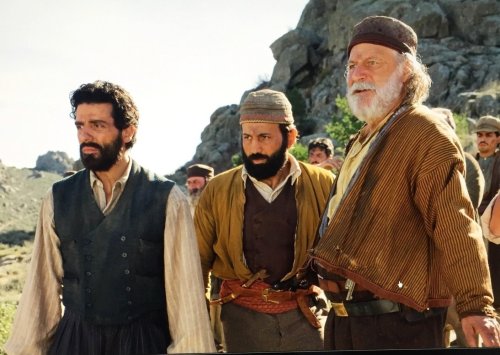
So it is with “The Promise,” a pet project of the late Kirk Kerkorian (one one of the architects of modern Las Vegas and past owner of the M-G-M Studio), who devoted years and a chunk of his fortune to create a film about the Armenian genocide of 1915-’20.

Never heard of the Armenian genocide?  Join the club.  Giving ill-educated audiences a glimpse of this swept-under-the-rug apocalypse is “The Promise’s” very reason for being. (Kerkorian was the son of Armenian emigres to the U.S.)

Historians estimate that 1.5 million Armenians — members of a Christian minority within the Ottoman Empire — were systematically murdered during World War I.

To this day the Turkish government refuses to acknowledge that the slaughter — many see it as a sort of dry run for Hitler’s “final solution” — even  took place.

In fact, a well-financed disinformation campaign currently is underway to  dismiss the history presented in “The Promise.”  After several  preview screenings  earlier this year, the film’s IMDb page was flooded with more than 86,000 user reviews, with nearly two thirds of them negative. Apparently 86,000 persons showed up for a handful of preview screenings…not!

Clearly, “The Promise” is punching buttons.  But how is it as a movie?

Just  O.K.  This David Lean-ish effort (penned by Robin Swicord, an Oscar nominee for “The Curious Case of Benjamin Button”) offers a three-way romance set against the sweep of churning world events (see “Dr. Zhivago”). It’s been directed by Terry George, who a few years back gave us the equally earnest “Hotel Rwanda” about tribal genocide in Africa. Production values are generally good, and in some instances outstanding.

(more…)

Read Full Post »

Garret Hedlund, Oscar Isaac

Garrett Hedlund, Oscar Isaac

“MOJAVE” My rating: C

93 minutes | MPAA rating: R

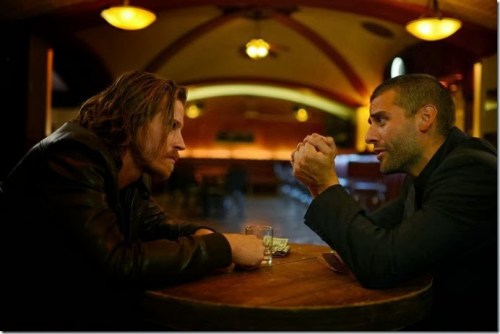
Oscar Isaac is a pretty great actor, but not even he can find a way to make sense of “Mojave,” a mashup of behind-the-scenes Hollywood existentialism and stalker thriller.

The film was written and directed by William Monahan, who won an Oscar for his screenplay for Scorsese’s “The Departed.” Alas, “Mojave” has more in common with the Monahan-penned “The Gambler” from 2014.

There’s hardly a moment here that rings true…but then maybe that’s all part of Monahan’s view of the emptiness of life in Tinseltown’s fast lane. Or maybe not. It’s hard to care, really.

Garrett Hedlund is Thomas, a filmmaker of some renown. His success has bought him a spread in the Hollywood hills (which he is allowing to go to seed) and access to women and drugs. Has this made him happy?

Hah!

(more…)

Read Full Post »

Jessica Chastain, Oscar Issacs...courting the money

Jessica Chastain, Oscar Issacs…courting the money

“A MOST VIOLENT YEAR: My rating: B-

125 minutes | MPAA rating: R

As he demonstrated in his breakout debut film, 2011’s “Margin Call” (about the meltdown of a big Wall Street firm under the weight of billions in useless mortgages), writer/director J.C. Chandor is obsessed with capitalism — especially with the odds against being both a successful capitalist and an honest human being.

In “A Most Violent Year” he’s at it again, giving us the story of a business owner struggling to maintain his integrity in a business that seems to have little use for it.

The setting is New York City in 1981, a year that apparently was remarkable for the Big Apple’s high body county. Curiously, the film isn’t all that violent — at least not physically.

Oscar Isaac (who made such a strong first impression in the Coen’s “Inside Llewyn Davis”) plays Abel Morales, the immigrant operator of a heating oil distributorship.

As the film begins, Abel is going all in on a major purchase. He’s snapping up a riverside oil storage facility, and to do it he has to put up everything he owns and promise to deliver another huge payment in 30 days. If he can’t raise the cash, he loses everything.

That’s just one of  Abel’s headaches. His trucks are being regularly hijacked, his drivers roughed up and the fuel oil resold to his competitors.  The union boss wants him to start arming his crews.

On the home front, he and his young family have just moved into a sprawling, uber-modern home out on Long Island. Not only are the payments killer, but shorty after taking up residence Abel chases away a prowler and finds a loaded pistol abandoned in the bushes outside the front door.

Even more threatening, a government prosecutor (David Oyelowo, currently seen as Martin Luther King Jr. in “Selma”) has set his sights on Abel, hoping to make an example of him for the legal fudging that is part and parcel of the heating oil business. Abel is particularly incensed because he scrupulously follows “standard industry practices”…which is to say he cheats, but not nearly as much as his competition.

“I’ve spent my whole life trying not to be a gangster,” he protests.

(more…)

Read Full Post »

Viggo Mortensen, Oscar Isaac, Kristen Dunst

Viggo Mortensen, Oscar Isaac, Kristen Dunst

“THE TWO FACES OF JANUARY”  My rating: B- (Opens Oct. 31 at the Tivoli)

96 minutes | MPAA rating: PG-13

In a cinema world filled with Bourne-ish violence and spectacular chases, there’s something quietly satisfying to be found in the work of Patricia Highsmith.  Her novels — especially those centering on the vaguely sinister Tom Ripley — were about character and motivation, not overt violence.

“The Two Faces of January” — the directing debut of acclaimed screenwriter Hossein Amini (“The Wings of the Dove,” “Drive,” “47 Ronin”) — is a minor work but a solid one, a tale of corruption and escape set against the spectacular Greek countryside.

It’s 1962 and the American couple, Chester and Collette (Viggo Mortensen, Kristen Dunst) are enjoying the pleasures of Athens.  He’s a money manager, the much younger Collette is rather obviously a trophy wife.

They hook up with another American, the young Rydal (Oscar Isaac, late of the Coen’s “Inside Llewyn Davis”), an American “poet” who sells his services as a tour guide. And because he speaks fluent Greek and can conspire with local merchants and vendors, Rydal is usually able to double-charge his clients for a bit of extra profit.


(more…)

Read Full Post »