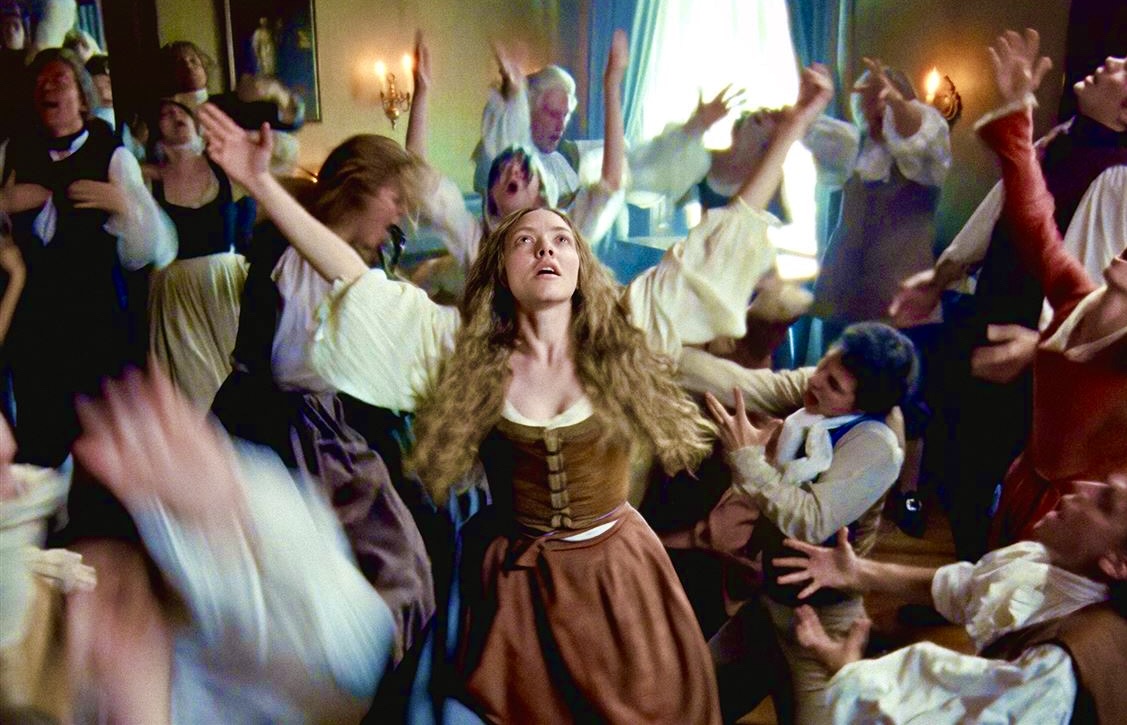
Amanda Seyfried as Shaker saint Ann Lee
“THE TESTAMENT OF ANN LEE” My rating: B (Hulu)
136 minutes | MPAA rating: R
Mainstream Hollywood rarely knows what to do with religion…unless it’s some sword-and-sandal silliness.
But Mona Fastvold’s “The Testament of Ann Lee” provides a sometimes brilliant evocation of ecstatic states while never commenting editorially on the truth (or falsehood) of its subject’s beliefs.
In the process it gives Amanda Seyfried the role for which she may some day be best known.
Ann Lee (Seyfried) was a British woman whose search for religious certainty led her to the Shaker movement, an offshoot of the Quakers in which dance and movement were essential to the spiritual quest. She left England for America in the years just before the Revolution, bringing with her a small band of followers who regarded her as an incarnation of Jesus. Over years they established several communal settlements in New England, farming and manufacturing utilitarian but beautiful items of furniture that are still popular.
At one point the Shakers had nearly 5,000 members…a remarkable number given that total avoidance of sex was central to Lee’s ministry. The church fed its ranks by adopting orphaned children who, upon reaching maturity, were allowed to decide whether to stay or seek a life in the larger world.
As scripted by director Fastvold and her husband Brady Corbet (their last outing was the spectacular “The Brutalist”), this is in many ways a straightforward historic biography.
We follow Ann’s early life, her marriage to a blacksmith (Christopher Abbott) and the tragic deaths of their four children (a huge factor in creating her views on abstinence), her gradual rise to become a spiritual leader, her preaching partnership with her brother William (Lewis Pullman) and her determination to find a respite from persecution in the New World (only to discover that thuggish assholes are to be found just about everywhere).
It’s all been mounted with an almost documentary sense of time and place.
But here’s the twist: in the many scenes of Shaker worship the film can only be described as a musical.
The congregants dance and sing in a reverential frenzy. Like the whirling dervishes of Islam’s Sufi sect, the Shakers in this film seek transcendence through sound and movement, and just by observing we can get a contact high from their shared exctasy. This is an astounding thing to say of an American feature film…simply watching it is a semi-spiritual experience.
Director Fastvold has said in interviews that while the songs and dance movements are based on real Shaker worship practices, they’ve been sweetened for this cinematic retelling. So while they may not be 100 percent authentic, they do achieve a heightened awareness in the viewer…heck, this looks like a worship service that might actually be fun.
At the core of it all is Seyfried’s performance, which makes Ann fully human even as she says and does things that many of us find, well, hugely eccentric. Apparently Ann Lee had no room for doubt, and there’s none in Seyfried’s work here. She exudes sincerity, reverence and a calm benevolence. It’s remarkable.
Keeping “The Testament of Ann Lee” from being a near masterpiece are pacing problems. The last third of the film drags a bit…to the point that viewers not naturally inclined to spiritual rumination may lose interest.
For the rest of us though, it’s a thought- and emotion-provoking experience.
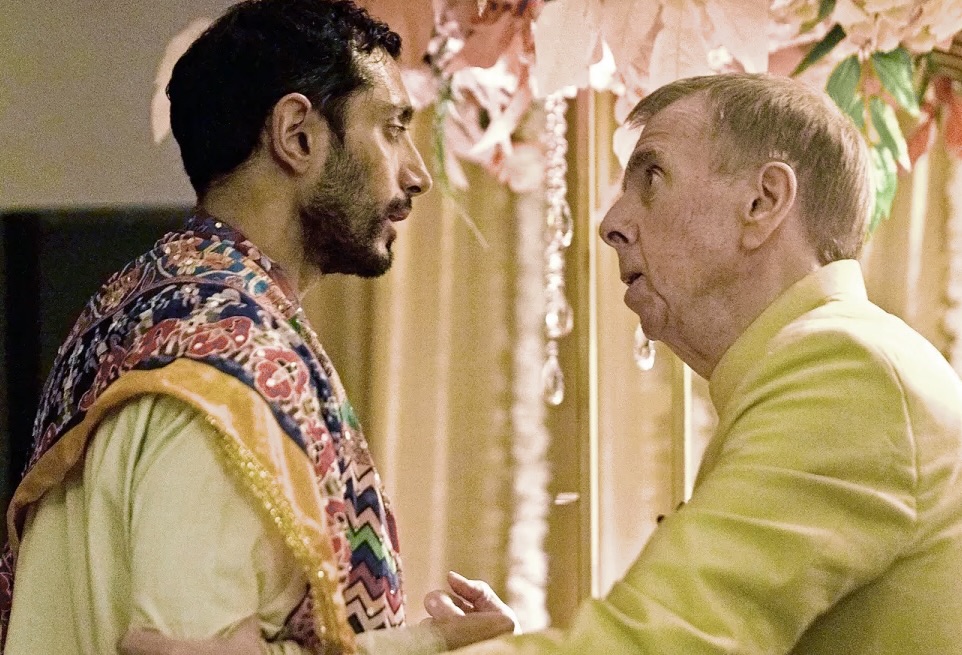
Liz Ahmed, Timothy Spall
“HAMLET” My rating: B (In theaters)
114 minutes | MPAA rating: R
“Hamlet” can survive just about any amount of directorial tinkering. What you can’t screw with are Shakespeare’s words and the necessity of having a charismatic leading man as your Hamlet.
The new version of the tragedy from Brit director Aneil Karia works most of the time. All the familiar monologues are intact (if sometimes arranged in a different chronology) and in Riz Ahmed we have a fiercely emotional Hamlet who may very well be sliding into madness.
This “Hamlet” is a modern dress interpretation (Ehthan Hawke starred in another modern version in 2000) and set in London’s South Asian community. Elsinore in this retelling is not a royal palace but the name of a massive real estate development company founded by Hamlet’s papa.
As the film begins a crew of male friends and family are preparing the magnate’s body for a traditional Hindi cremation. Hamlet (Ahmed) has been studying abroad and is appalled to learn that not only is his uncle Claudius (Art Malik) taking over the company, but he intends to wed Hamlet’s mother Gertrude (Sheeba Chaddha).
Michael Lesslie’s adapted screenplay puts Hamlet’s precarious mental state front and center…even to the point of reducing the roles of other characters. This is particularly true in the case of Polonius (Timothy Spall), who in this version is not an amusing pedant but rather a grimly ruthless enforcer for the company. His daughter, the fragile Ophelia (Morfydd Clark, most recently seen as Galadriel in the “Rings of Power” miniseries) and son Laertes (Joe Alwyn) haven’t quite been boiled down to walk-on perfs, but it’s a near thing.
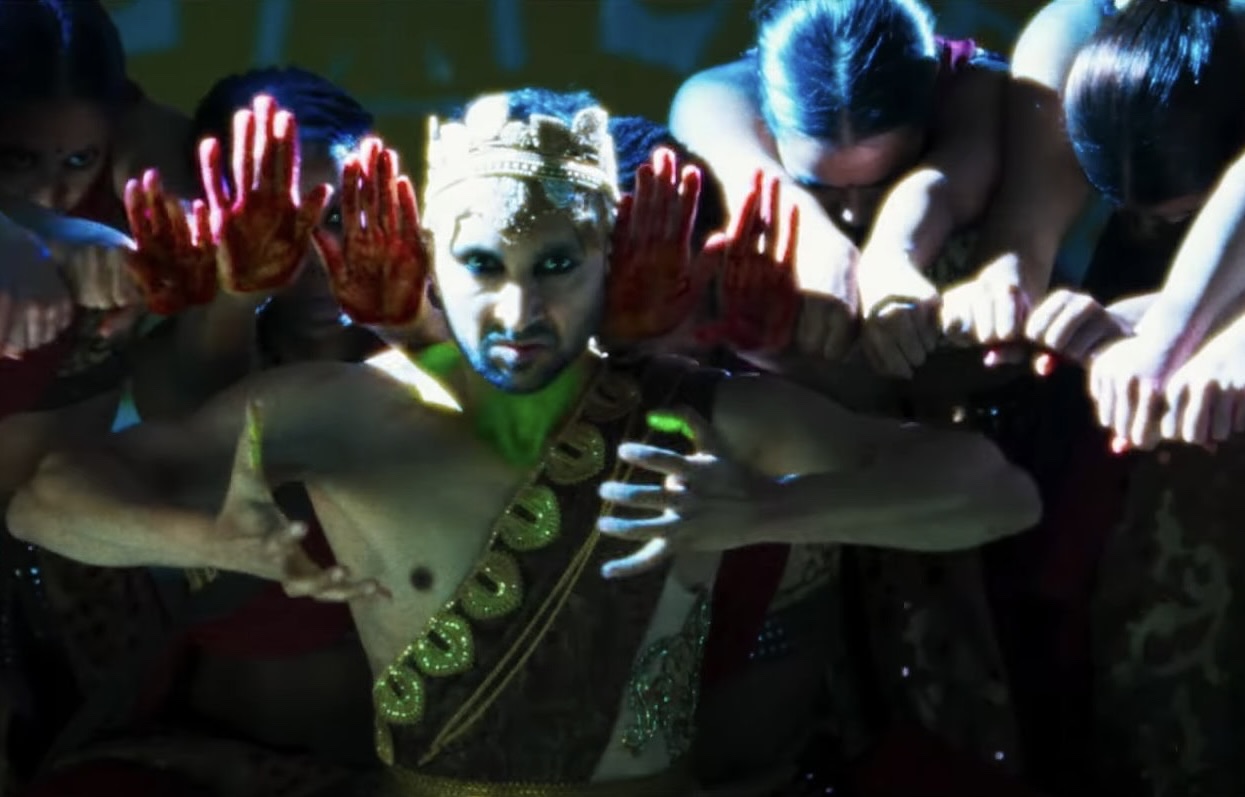
Hindu dancers perform the play-within-the-play
The good news is that director Karia uses the unique setting to good advantage. For instance, in his encounter with his father’s ghost Hamlet and his father converse in Hindi (with English subtitles). And in a small masterstroke, the famous play-within-a-play ploy which Hamlet uses to expose his uncle’s crimes is now performed by a troupe of Indian dancers whose half-trad, half-Bollywood showcase is one of the film’s highlights.
Ultimately, though, it all boils down to our Hamlet, and Ahmed more than holds his own. This actor oozes intensity and physical presence (remember his Oscar-nominated turn turn as a deaf drummer in “The Sound of Metal”?) and here he channels it into one of drama’s seminal roles.
| Robert W. Butler
 Butler's Cinema Scene
Leave a comment