Feeds:
Posts
Comments

Posts Tagged ‘movies’

Naomi Ackie, Eva Victor

“SORRY, BABY”  My rating: A- (HBO Max)

103 minutes | MPAA rating: R

Every once in a while you encounter a film so achingly on target that you instinctively realize that it had to be torn from someone’s personal experience.

So it is with “Sorry, Baby,” Eva Victor’s hauntingly beautiful film about the aftermath of a sexual assault.

The words “sexual assault” will be enough to scare off many viewers.  But while Victor’s semi-autobiographical film (she wrote, directed and stars in it) addresses trauma, it’s more about the healing aftermath.

It starts unremarkably enough with our protagonist, Agnes (Victor), being visited by her old college roommate, Lydia (Naomi Ackie).  They’re several years out of school, but while Lydia has moved to the big city and settled down (she’s gay,  not that it’s a big deal) Agnes has hung around their New England college town.  In fact, she’s now a bigwig in the English Department.

These opening scenes radiate the easy familiarity of old friends reconnecting. But soon the talk drifts back to their senior year and an unpleasant incident. In a flashback we view Agnes’ interaction with Decker (Louis Cancelmi), one of her professors.  He seems like a standup guy…until he isn’t.

Victor wisely refrains from showing the assault.  Instead we get a long shot of the teacher’s home, where the two are meeting to discuss her thesis. Agnes goes inside, and the unmoving camera records the home’s facade as the sun dims, night falls, and lights go on inside. Apparently several hours have passed before Agnes stumbles out, walks to her car and drives away in a fog of humiliation and disbelief.

In a balancing act for the ages, Victor seasons this traumatic incident with satiric flashes.  When she meets with school officials to discuss the incident, she’s told that it’s not their problem.  Decker turned in his resignation just before the assault.  This news is delivered by a couple of women administrators whose clumsy efforts at sympathy are undermined by their panicked sense of institutional preservation.

“Sorry, Baby” rises and falls with Victor’s performance.  Her Agnes is tall, gawky and unremarkable (though, weirdly enough, by film’s end I saw her as beautiful).  She’s intellectually solid but emotionally tentative.  She often masks her feelings with oddball comments and an ironic aura.

Not that she doesn’t get some solid help from the other players.  Ackie is the best friend everyone wishes they had.  Lucas Hedges shines as the vaguely nerdy neighbor with whom the post-assault Agnes has a sweetly goofy love affair.  And veteran actor John Carroll Lynch nearly steals the film as a  sandwich shop operator who takes a grieving Agnes (whom he has never met before) under his caring wing.

The world can be cruel.  But simple decency  goes a long way.

Bob Odenkirk

“NOBODY 2” My rating: C+(Peacock)

89 minutes | MPAA rating: R

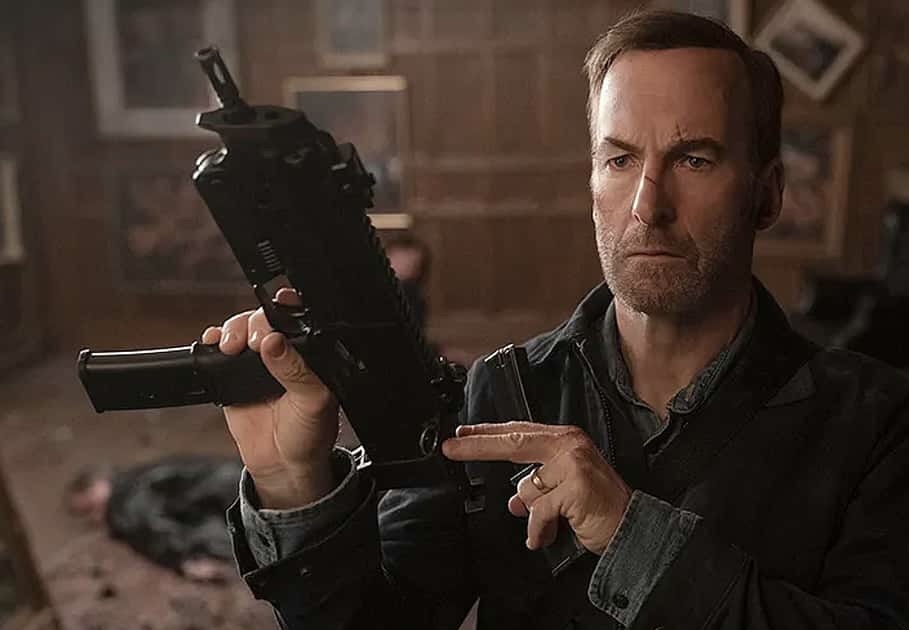
“Nobody” (2021) was an unexpected sleeper, a hyperviolent, darkly funny yarn about a nondescript family man (Bob Odenkirk) whose secret job is that of assassin.

Now we’ve got a second installment and it’s pretty much the same thing all over again…minus the sense of discovery that made the first film so enjoyable.

Imagine “National Lampoon’s Vacation” mated with “Pulp Fiction.”  Odenkirk’s Hutch Mansell takes the family (Connie Nielsen is the Missus) to the cheesy amusement park he enjoyed as a boy.  

Except he finds the place now is a front for a drug operation run by a sociopathic grand dame (Sharon Stone) and administered by a corrupt local sheriff (John Ortiz).

Much mayhem ensues.  

Except this time the brew of comedy and over-the-top violence falls to the law of diminishing returns.  (Although I did enjoy the addition of Christopher Lloyd as Hutch’s father, himself a retired black ops type.)

Colin Farrell

“BALLAD OF A SMALL PLAYER” My rating: B (Netflix)

101 minutes | MPAA rating 

“The Banshees of Inisherin.” “Sugar.” “The Penguin.”

Yeah, Colin Farrell has been on a roll. And it continues  (sort of) with “Ballad of a Small Player,” which works a bit too hard to breathe new life into the gambler-at-the-end-of-his-luck yarn.

Farrell is Lord Doyle, a polished gent who floats through the casinos of neon-lit Macau as if he owns the joints. He sophisticated, generous, impeccably dressed.

It’s all a sham.  In truth he’s a common hustler who’s developed an impressive fictional character. Lord Doyle (he’s not a lord and Doyle is not his actual name) is so good at role playing that he has credit at all the tables.

That is, until his losses get so big that they can no longer be ignored. 

Scripted by Rowan Joffe and Lawrence Osborne and directed by Edward Berger (“All Quiet on the Western Front,” “Conclave”), “Ballad…” attempts to make up for a lack of originality (really, it’s just another movie about a desperate gambling addict searching for a big score) with a heightened visual sense and an almost operatic sense of melodrama.

But it’s worth sticking with to watch Farrell navigate Lord Doyle’s existential dilemma. Toss in Tilda Swinton as a comically stuffy investigator hot on his trail and Fala Chen as the casino hostess who provides  a love interest, and you’ve got a good-looking if not terribly deep outing.

| Robert W. Butler

Read Full Post »

Rose Byrne

“IF I HAD LEGS I’D KICK YOU” My rating: B (PPV on various services)

113 minutes | MPAA rating: R

The first thing you see in Mary Bronstein’s “If I Had Legs I’d Kick You” is a looming closeup of Rose Byrne’s face.  Her character, Linda, is being mom shamed by an unseen woman — some sort of physician — about her handing of her young daughter’s medical situation.

Just a few seconds of staring into Linda’s eyes betrays an ever-changing wash of emotions.  Defiance, aquiescence, guilt, cajoling, panic…Linda’s on a feeling-fueled roller coaster.  She’s trying to hold it together, but her desperation is everywhere creeping through.

Things just go downhill from there.

“If I Had Legs…” features a great performance from Byrne. It is also a thoroughly unpleasant experience.  

Unpleasant because Linda is circling the drain and hasn’t the strength to pull herself out.

Here’s her situation: Her daughter (voiced by Delaney Quinn, who is never fully seen) has an eating disorder so dangerous that she’s being fed through a tube inserted into her abdomen.

Linda must try to get the kid to eat real food while hooking her up nightly to a feeding machine.  She’s got no help in dealing with her whining, manipulative offspring because her husband is away for several weeks on business (Christian Slater provides his voice in mansplaining phone conversations).

Linda and the child move to a transient motel after a leaky pipe causes the ceiling of the family’s apartment to cave in. The crew hired to remediate the black mold and make repairs are doing a lousy job— when they bother to show up at all.

Things are no better on the work front.  Linda is a psychoanalyst (talk about a case of “physician, heal thyself”!). Her clients include a postpartum-plagued  young mother (Danielle Macdonald) who abandons her baby, expecting Linda to care for it,  and a demanding young man (Daniel Zolghadri) who has the hots for his shrink.

Linda is herself undergoing therapy from a colleague (Conan O’Brien, solid) who is clearly bored with sessions that have become a repetitive emotional merry-go-round.

In fact, Linda has taken the plunge from merely  miserable to self-destructive.  She’s hitting the bottle and often abandons her sleeping child to engage in misadventures with a fellow resident of the motel (A$AP Rocky).

To emphasize Linda’s isolation, writer/director Bronstein rarely lets Byrne share the frame with a fellow actor. 

And then there’s the question of how much of what we see is actually happening and how much is the product of Linda’s overworked nervous system.  For instance, what’s with the eerie dots of light that swarm like fireflies in the black hole of her ceiling? 

Bottom line: I’m in awe of Byrne’s work here.  It’s Oscar-level and then some.

But the film itself is tough going.

Zoey Deutch, Guillaume Marbeck
“NOUVELLE VAGUE” My rating: B (Netflix)

106 minutes } MPAA rating: R

I thoroughly  enjoyed Richard Linklater’s “Nouvelle Vague,” his recreation of the 1959 making of  “Breathless,” the French independent film that introduced a whole new  cinematic vocabulary and launched the directing career of Jean-Luc Godard. 

But I wonder… will anyone who is not already a hard-core film geek, who had not seen “Breathless” repeatedly, who is unaware of Godard’s influence…will anyone else understand or appreciate it?

Well, screw ‘em. “Breathless” is a film fanatic’s wet dream, a story of an outsider who makes an end run around movie conventions and created one of the seminal works of the 20th century. 

Linklater’s approach is both reverent and impish…he understands what made “Breathless” work and tries to apply the same ethos to “Nouvelle Vague,” even to the point of using the same film frame ratio and grainy  black-and-white  palette that Godard emplioyed.

Guillaume Marbeck is absolutely spot on as Godard, the cryptic film critic who wants to make his own movies.  Godard is plenty weird (he wears sunglasses 24/7 and appears to live in his own world) but he somehow manages to inspire a company of young moviemakers to break all the rules to create a masterpiece on a starvation budget.

Aubry Dullin plays Jean-Paul Belmondo, the young Gallic boxer/actor who would become an international star as a result of ”Breathless.” He doesn’t look all that much like Belmondo (whose nose was one of a kind) but he nails the body language and languid/sexy humor.

Zoey Deutch, on the other hand, is a dead ringer for American actress Jean Seberg, who was highjacked into doing the film and, despite numerous attempts to bail from the production, gave a career-defining performance.

Of the supporting perfs I was taken with Matthieu Penchant’s Raoul Coutard, the cinematographer who shot scenes on the streets of Paris while hidden in a handcart, and Bruno Dreyfurst as Georges de Beauregard, the exasperated producer who nevertheless stuck with Godard to make history.

“Nouvelle Vague” (the title translates as “New Wave” and refers to the generation of young French filmmakers that  included giants like Truffaut, Chabrol, Rivette and Rohmer)  oozes  youthful exuberance and intellectual precocity.  It’s both lighthearted romp and a serious appreciation of an important moment in cinema history.

In other words, it’s a lot of fun.

| Robert W. Butler

Read Full Post »

Tom Hiddleston

“THE LIFE OF CHUCK” My rating: A-(Various PPV platforms)

111 minutes | MPAA rating: R

Mike Flanagan’s “The Life of Chuck” provides the 10 most joyful minutes of cinema I’ve seen in all of 2025.

Which is not bad for a movie that starts out depicting the end of the world.

“…Chuck” is a departure for writer/director Flanagan, possibly our best dispenser of supernatural horror (“The Haunting of Hill House,” “Midnight Mass,” both Netflix miniseries); but then it is based on what is probably the most atypical story ever penned by Stephen King.

I mean, we’re talking a weirdly-structured but deeply moving meditation on the meaning of life.

You know somebody’s tinkering with the time/space continuum when the opening titles tell us that the yarn begins with Chapter III.

Here we meet Marty Anderson (Chiwetel Ejiofor), a middle school teacher struggling (as is everybody else) with the rapid collapse of civilization.  First the Internet went down.  Now cell phones aren’t working.  TV stations are going off the air one by one, but not before announcing that most of Northern California has fallen into the Pacific.

There’s still electricity, but nobody knows how long the juice will keep flowing.

With classes cancelled, Marty wanders the streets of his town, now cluttered with abandoned cars.  He has a conversation with a funeral director (Carl Lumbly) about a blitz of billboards, banners and TV/radio commercials that have appeared overnight.  These declare “Charles Krantz. 39 Great Years! Thanks, Chuck!” and feature a photo of Chuck (Tom Hiddleston), a pleasant-looking guy wearing a business suit and spectacles.  Maybe Chuck is retiring from his job, though he doesn’t look nearly old enough.

And anyway, the world is ending.

A big chunk of Chapter III centers on Marty’s efforts to reconnect with his ex, Felicia (Karen Gillan), a nurse now jobless since all the high-tech medical machines in her hospital stopped working. Reunited, Marty and Felicia sit in her back yard watching the stars blink out one by one.

Next up is Chapter II. We find Chuck (Hiddleston) attending a conference for accountants. On a stroll through the city center he is confronted by a busking street drummer (Taylor Gordon). Listening to the percussive symphony she generates, the buttoned-down Chuck begins swaying tot he music.  

Then he starts doing a few dance steps.  Before long he’s grabbed the hand of a passer-by (Annalise Basso) and together they put on an impromptu display of big band terpsichorean razzamatazz that draws a cheering crowd.

It’s a heart-in-your-throat “Singin’ in the Rain” kind of moment. Pure movie magic. (Much love to Mandy Moore’s spectacular choreography).

Mark Hamill, Benjamin Pajak

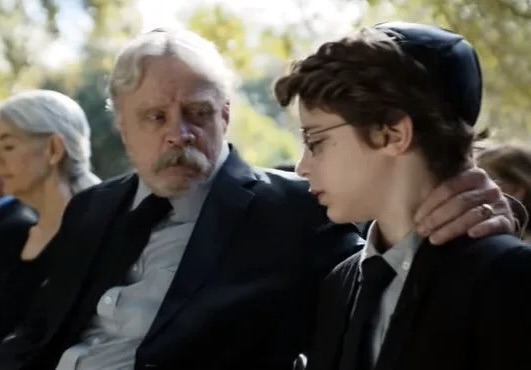
Then it’s on to Chapter I, which depicts Chuck’s childhood (as you’ve gathered by now, “The Life of Chuck” unfolds in reverse order). Orphaned by a car accident, young Chuck (he’s depicted as a middle schooler by the excellent Benjamin Pajak) is being raised by his grandparents (Mark Hamill and Mia Sara).

(Uh, wait a minute.  Mia Sara.  Wasn’t she Ferris Bueller’s squeeze only a couple of years back? Surely she can’t be anybody’s grandma.)

Anyway, this segment examines Chuck’s relationship with his loving grandparents, and his discovery of dance in an after-school club.  The kid’s a whiz…before long he’s the talk of the prom for cutting a rug with a girl two years his senior.  

Once again, the dance sequence is magic.  But what kind of career is dance for a red-blooded American boy? No, Chuck will grow up to study something more practical, like accounting.  But he’ll never forget the thrill of his body moving effortlessly to the music.

“…Chuck” bites off a big chew by attempting (in reverse) to depict one man’s life. What we come to realize is that Chapter III is actually unfolding in the head of a dying man.  Chapters I and II tell us how he got there, while introducing figures (Marty, Felicia, the funeral director) who will appear in his end-of-life reverie.

The film has been so deftly directed and acted (even from the unseen Nick Offerman, whose narration provides just the right taste of detached observation) that more than a few veiwers will find themselves in tears.  

| Robert W. Butler

Read Full Post »

Tom Hiddleston

“THE LIFE OF CHUCK” My rating: A-(Various PPV platforms)

111 minutes | MPAA rating: R

Mike Flanagan’s “The Life of Chuck” provides the 10 most joyful minutes of cinema I’ve seen in all of 2025.

Which is not bad for a movie that starts out depicting the end of the world.

“…Chuck” is a departure for writer/director Flanagan, possibly our best dispenser of supernatural horror (“The Haunting of Hill House,” “Midnight Mass,” both Netflix miniseries); but then it is based on what is probably the most atypical story ever penned by Stephen King.

I mean, we’re talking a weirdly-structured but deeply moving meditation on the meaning of life.

You know somebody’s tinkering with the time/space continuum when the opening titles tell us that the yarn begins with Chapter III.

Here we meet Marty Anderson (Chiwetel Ejiofor), a middle school teacher struggling (as is everybody else) with the rapid collapse of civilization.  First the Internet went down.  Now cell phones aren’t working.  TV stations are going off the air one by one, but not before announcing that most of Northern California has fallen into the Pacific.

There’s still electricity, but nobody knows how long the juice will keep flowing.

With classes cancelled, Marty wanders the streets of his town, now cluttered with abandoned cars.  He has a conversation with a funeral director (Carl Lumbly) about a blitz of billboards, banners and TV/radio commercials that have appeared overnight.  These declare “Charles Krantz. 39 Great Years! Thanks, Chuck!” and feature a photo of Chuck (Tom Hiddleston), a pleasant-looking guy wearing a business suit and spectacles.  Maybe Chuck is retiring from his job, though he doesn’t look nearly old enough.

And anyway, the world is ending.

A big chunk of Chapter III centers on Marty’s efforts to reconnect with his ex, Felicia (Karen Gillan), a nurse now jobless since all the high-tech medical machines in her hospital stopped working. Reunited, Marty and Felicia sit in her back yard watching the stars blink out one by one.

Next up is Chapter II. We find Chuck (Hiddleston) attending a conference for accountants. On a stroll through the city center he is confronted by a busking street drummer (Taylor Gordon). Listening to the percussive symphony she generates, the buttoned-down Chuck begins swaying tot he music.  

Then he starts doing a few dance steps.  Before long he’s grabbed the hand of a passer-by (Annalise Basso) and together they put on an impromptu display of big band terpsichorean razzamatazz that draws a cheering crowd.

It’s a heart-in-your-throat “Singin’ in the Rain” kind of moment. Pure movie magic. (Much love to Mandy Moore’s spectacular choreography).

Mark Hamill, Benjamin Pajak

Then it’s on to Chapter I, which depicts Chuck’s childhood (as you’ve gathered by now, “The Life of Chuck” unfolds in reverse order). Orphaned by a car accident, young Chuck (he’s depicted as a middle schooler by the excellent Benjamin Pajak) is being raised by his grandparents (Mark Hamill and Mia Sara).

(Uh, wait a minute.  Mia Sara.  Wasn’t she Ferris Bueller’s squeeze only a couple of years back? Surely she can’t be anybody’s grandma.)

Anyway, this segment examines Chuck’s relationship with his loving grandparents, and his discovery of dance in an after-school club.  The kid’s a whiz…before long he’s the talk of the prom for cutting a rug with a girl two years his senior.  

Once again, the dance sequence is magic.  But what kind of career is dance for a red-blooded American boy? No, Chuck will grow up to study something more practical, like accounting.  But he’ll never forget the thrill of his body moving effortlessly to the music.

“…Chuck” bites off a big chew by attempting (in reverse) to depict one man’s life. What we come to realize is that Chapter III is actually unfolding in the head of a dying man.  Chapters I and II tell us how he got there, while introducing figures (Marty, Felicia, the funeral director) who will appear in his end-of-life reverie.

The film has been so deftly directed and acted (even from the unseen Nick Offerman, whose narration provides just the right taste of detached observation) that more than a few veiwers will find themselves in tears.  

| Robert W. Butler

Read Full Post »

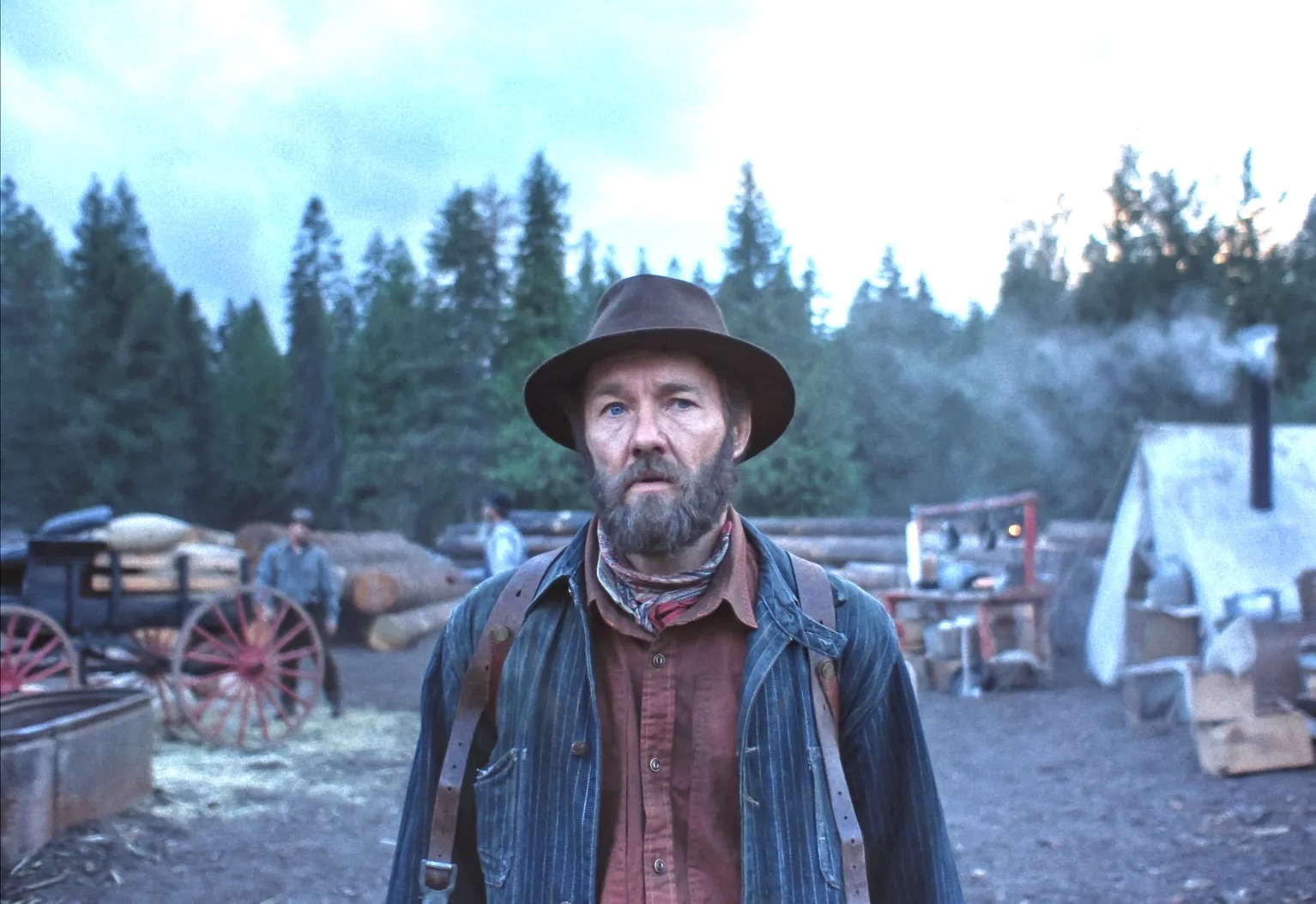
Joel Edgerton

TRAIN DREAMS” My rating: A- (Netflix)

102 minutes | MPAA rating: PG-13

If Terrence Malick and Kelly Reichart had a baby it would be “Train Dreams,” a visually ravishing examination of one human life.

This is only the second directing credit from Clint Bentley (he wrote the Oscar-nominated screenplay for “Sing Sing”), but it displays an astounding depth of  maturity and sensitivity. 

In adapting Denis Johnson’s novella (he co-wrote the piece with Greg Kwedar) Bentley has approached this sprawling tale as a sort of  visual folk song. There’s only limited dialogue, but since his leading player is the breathtakingly empathetic Joel Edgerton, little is required.

Will Patton’s voiceover narration (a device I generally despise;  here it is delivered like a poetry reading) tells us of the origins of Robert Grainier, a foundling who grows up in a small burg in the Pacific Northwest.  He comes to maturity in the early 1900s, when the mechanized modern world has not yet intruded on the wilderness.

Poorly educated, Robert excels at manual labor.  He helps build a wooden railroad bridge across a forested gulch, and witnesses the murder of a co-worker,  a Chinese man (Alfred Hsing) whose ghostly visage will haunt him throughout his long life.

Mostly Robert works for logging crews; his huge axe is practically an extension of his own arm.

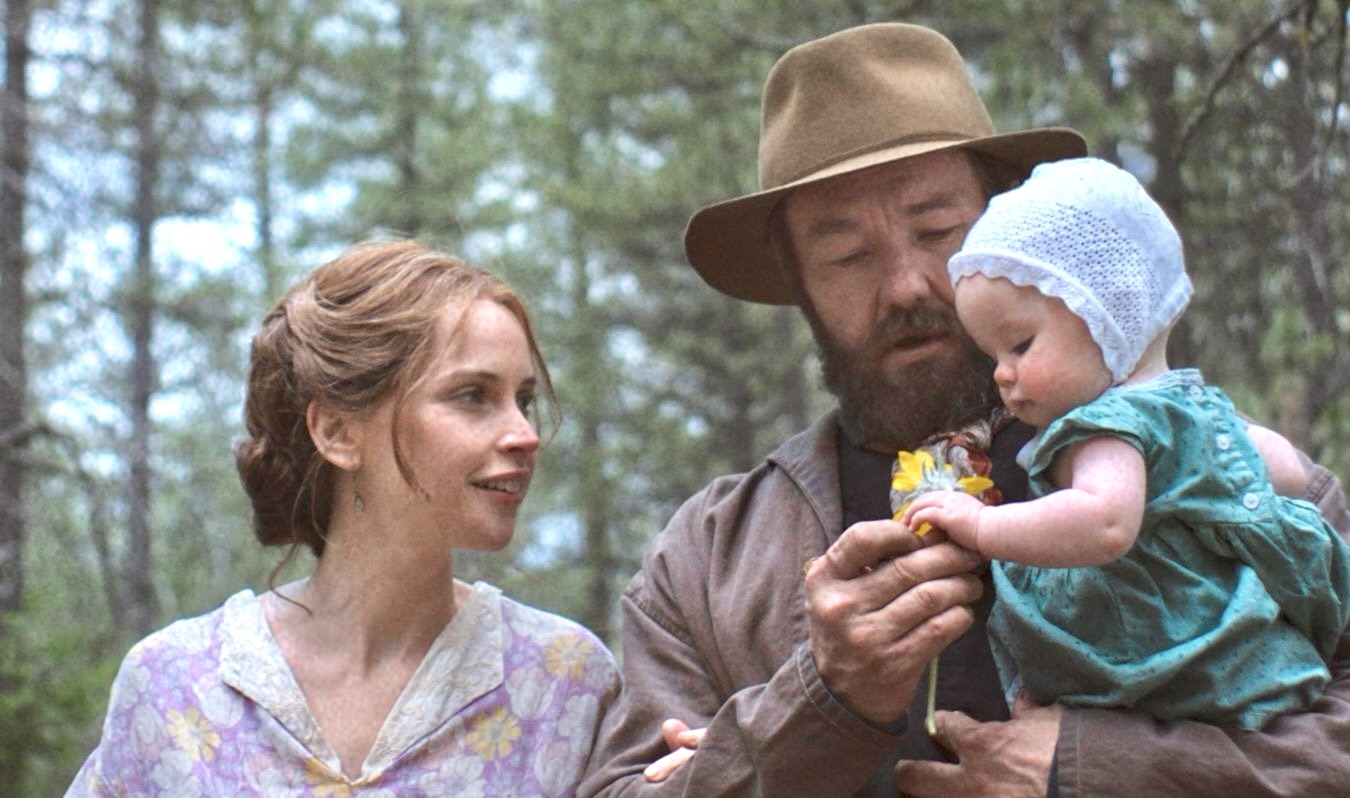
He meets and falls for Gladys (Felicity Jones) and together they build a cabin and have a daughter, though Robert’s work requires him to be away for months at a time.

The loggers are a hard-working bunch, a collection of loners who can go all day without saying a word.  There is one exception.  William H. Macy is terrific as Arn Peeples, a grizzled old codger whose main job seems to be serenading his fellows with nonstop running commentary on anything that comes into his head.

There are on-the-job accidents, some fatal.  Robert soldiers on.  His goal is to make money, return to his beloved wife and child, and start the process all over again.

Felicity Jones, Joel Edgerton

The scenes of the Grainier’s domestic life are so achingly beautiful that one is tempted to give up on civilization and take up residence in the woods. Adolpho Veloso’s camera seems to caress its subjects; frequently we’re distracted by the waving tufted tips of wild grass, or the grain of a tree trunk. Man and nature in harmony.

These scenes arebolstered by the presence of the uncredited young child who plays Robert and Gladys’ daughter.  The kid steals every scene without even trying. We’re as delighted in her as are her parents.

Then cruel fate intervenes. Robert is away on a job when tragedy strikes back home. His cabin lies in ashes; the fate of his wife and daughter unknown.

Ever faithful, Robert is determined to rebuild on his smoldering acreage so that when his family returns, he’ll be ready.

Edgerton is devastatingly effective as the stoic yet forlorn Robert. The sadness in his eyes, the gentleness in his movements, the way his posture changes over more than 60 years of physical labor…all these add up to an unforgettable portrait of a man who, by most standards, is unremarkable.

But then that’s the whole point. “Train Dreams” finds the unexpected nobility in everyday humanity.

| Robert W. Butler

Read Full Post »

Michael Shannon

“DEATH BY LIGHTNING”(Netflix)

Historical drama gets no better than “Death by Lightning,” a recreation of one of the more obscure but weirdly resonant moments in our national history.

Based on Candice Millard’s superb history Destiny of the Republic, this retelling of the assassination of President James A. Garfield in 1881 has been spectacularly well acted and produced.  It almost perfectly captures the same emotional and intellectual notes that made the book so memorable.

And it does it all in just four one-hour episodes.

It begins with Senator Garfield (Michael Shannon) leaving his Ohio farm for the 1880 Republican National Convention in Chicago . His hope is to prevent the renomination of incumbent president Ulysses S. Grant, the figurehead of a spectacularly corrupt administration.

In a twist of fate that seems more fairy tale than fact,  it is Garfield himself who ends up the party’s nominee.  It’s not that he seeks the presidency…but he’s the only candidate the warring anti-Grant delegates all can get behind. 

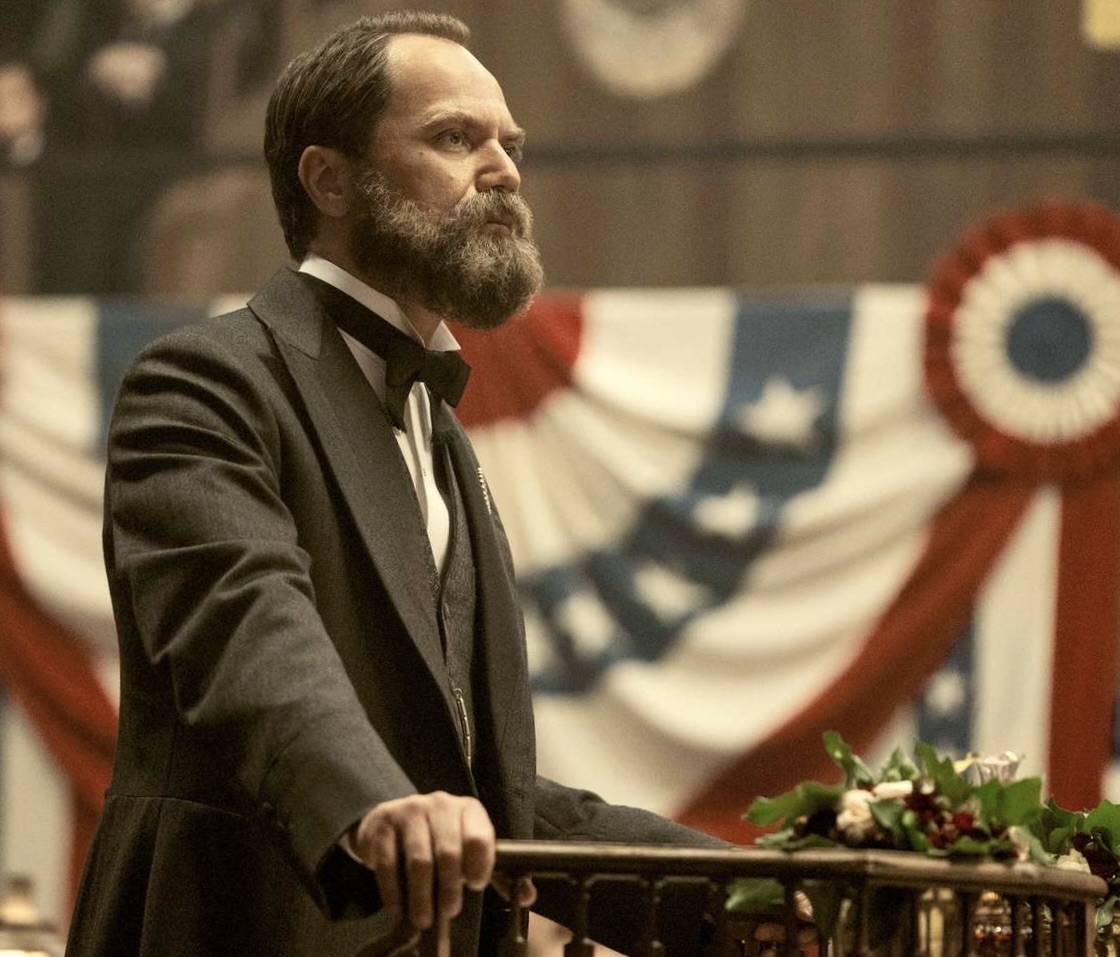
In the process he makes an enemy of Grant supporter Roscoe Conkling (Shea Whigham), the U.S. senator from New York whose control of that state’s ports holds the American economy in a stranglehold.  Conkling is a savvy pol…he’s also willing to employ pure thuggery to get his way.  The comically boozy Chester Arthur (Nick Offerman) provides the muscle behind Conkling’s manipulations.

Garfield knows he cannot win without New  York.  So he does the unthinkable…he chooses as his running mate the hapless Arthur; basically it’s an end run around Conkling’s plan to sit out the election and pick up the pieces later.

The rise of Garfield runs parallel to the story of Charles Guiteau (Matthew Macfadyen), a failed lawyer and hustler with serious mental issues.  Guiteau fantasizes that his support was vital in getting Garfield elected, and now he wants a reward.  And when his pathetic entreaties are rejected, he plots to kill the President.

Matthew Macfadyen

As was the case with Millard’s book, this series leaves viewers ruminating over what might have been.  In his three months as President, Garfield embraced a progressive agenda.  A Civil War veteran, he reached out to  African American leaders, especially black soldiers whose sacrifices were overlooked.  He laid plans to replace the spoils system with a non-partisan Civil Service.

I doubt we’ll see better acting this year than what’s delivered here by Shannon and Macfadyen.

Shannon probably has the tougher job, given that Garfield was low-keyed, modest and generous.  Not exactly a personality to set off dramatic fireworks. Yet the actor finds the heroic in Garfield’s calm reasonableness. Especially telling are the scenes with the Garfield family (Betty Gilpin is terrific as Mrs. Garfield), which bring to mind the domestic image of Abraham Lincoln and his brood.

The upshot is a genuine sense of loss.

Macfadyen, on the other hand, gets to play a crazy man…but with restraint.  The key to his Guiteau is the disarming “normalcy” of his presentation.  The guys often sounds reasonable but behind the fancy words there’s a crippling desperation at war with rampant narcissism.  In any conversation there comes a moment, a tell if you will, that suggests something is seriously wrong with this guy. Maybe you can’t quite put a finger on it, but that creepy feeling on the back of your neck is inescapable.

The fourth and final episode unfolds in the aftermath of the assassination attempt. Garfield lingered in agony for a month while inept physicians tried to locate the bullet for extraction…even calling upon inventor Alexander Graham Bell to employ a primitive metal detector.

Weirdly enough, the reform movement Garfield put into motion survived him, thanks to an unlikely proponent we won’t name here.

Now this is all pretty heavy stuff, but director Matt Ross and writer/creator Mike Makowsky often put a bleakly funny spin on the material.  The brutal cronyism of Conkling and Arthur gets the full satiric treatment (the parallels between their machinations and those of our current President are inescapable) and the characters often employ ear-burning language.  I doubt that statesmen of the 19th century were that open with their profanity, but in dramatic terms it works…most of the really vile pronouncements come from the show’s heavies.

Even the smallest roles are deftly handled.  Among the supporting players are Bradley Whitford, Vonnie Curtis-Hall, Paula Malcomson and Zeljko Ivanek.

When it’s all over, “Death by Lightning” leaves us marveling at the decency of good men and the unpredictability of fate.

Ethan Hawke

“THE LOWDOWN” (Hulu)

I love, love LOVE this show.

Lee Raybon (Ethan Hawke) is a shabbily-clothed freelance journalist whose search for truth always has him in hot water with Tulsa’s movers and shakers.

In this funny and weirdly moving series from Sterlin Harjo (the man who gave us “Reservation Dogs”)  Lee sets out to prove that the suicide of one of the local gentry is actually murder.

He runs up against the dead man’s brother (Kyle Maclachlan), who’s running for governor; the scheming widow (Jeanne Trijpplehorn), a neo-Nazi cult  and a whole bunch of corrupt power  brokers.

All while trying to keep his struggling used book store afloat and delivering questionable parenting to his teenage daughter (Ryan Kiera Armstrong). 

Plus Lee gets beat up.  A lot.

This sprawling noir comedy (think Jim Thompson on laughing gas) is crammed with eccentric and memorable characters, and the players (among them Keith David, Tracy Letts, Tim Blake Nelson, Killer Mike, Tom McCarthy, Peter Dinklage, John Doe and the late Graham Greene) take full advantage of the possibilities. Rarely have so many scene stealers been assembled in one place.

I was borderline bereft when “The  Lowdown” reached its eighth and final episode.  But I’ll tell you what…I’m gonna plop down and watch it all over again.

| Robert W. Butler

Read Full Post »

Jacob Elordi

“FRANKENSTEIN” *My rating: B+ (Netflix)

149 minutes | MPAA: R

For the first hour or so Guillermo del Toro’s new (and let’s face it, ultimate) version of “Frankenstein” left me a bit cold.

It’s been brilliantly designed and photographed but emotionally…kinda meh.  

Turns out I just had to show a little patience.  For once the Creature comes to life, so does the movie.

Indeed, our sympathies lie with none of the human characters…least of all Oscar Isaac’s Victor Frankenstein, the ruthless and ego-driven medical genius bent on reanimating dead corpses.

No, this “Frankenstein” belongs to Jacob Elordi’s Creature…and please note that he will not be described here as “the Monster.”  For this stitched-together superman exhibits more pure humanity than any of the “normal” folk around him.  It’s a performance that transcends the scars and death-blue pallor of the Creature’s skin to reveal, well, a beautiful soul.

Expect an Oscar nomination for Elordi, a screen heartthrob and sexual icon (“Saltburn,” the Max series “Euphoria”) who here shows unpredictable depths of loneliness, love, rage and compassion.

Del Toro’s adaptation of Mary Shelley’s novel begins at the end.  The crew of a sailing ship trapped in the Arctic ice take aboard a frostbitten man being pursued by a terrifying giant.  This is Victor Frankenstein, and to the Captain (Lars Mikkelsen) he relates his tale.

We see the boy Victor dealing with his icily controlling and intellectually cruel father (Charles Dance); this helps explain why as an adult Victor is a bit of a medical oddball, convinced of his own brilliance and openly contemptuous of his colleagues.

Victor’s ambitions know no bounds, and with the help of a rich benefactor (Christoph Waltz) — who it turns out has his own twisted motives — our man gets to work sorting through the bodies left on a recent battlefield (the setting is 1850s Europe), looking for pieces that can be sewn together and animated with a jolt of lightening.

When not impersonating God, Victor expresses a bad case of the hots for Elizabeth (Mia Goth), the fiancé of his brother (Felix Kammerer). Clearly he observes few moral boundaries.

Oscar Isaac

That becomes even more clear in his relationship with the Creature.  He keeps his nearly naked (and weirdly erotic) creation chained in the castle basement, where he berates the poor unfortunate for lacking the mental acuity to match his physical power.

It is Elizabeth who breaks through, treating the Creature with kindness and unlocking his emotions and intellect. But exasperated by what he views as a failed experiment, Victor attempts to destroy his creation in a massive conflagration.

Turns out the Creature cannot die, as much as he might wish for it. The second half of the film finds the Creature joining Victor and the captain aboard the ship to explain why he’s been pursuing the semi-mad doctor over land, sea and ice.

It is in the Creature’s backstory that we find grace notes of beauty and longing.  The highlight is his “adoption” of a farm family.  Hiding in their idle gristmill he emerges at night to leave presents of dead game and firewood at their door.  They call their mysterious and unseen benefactor “the spirit of the woods.”  

The Creature’s real education begins when the blind grandfather is left alone and befriends this stranger, teaching him to read (how a blind man teaches someone to read is a poser, but I’m not complaining) and opening up his intellect to literature, history and philosophy.

Maddened by the knowledge of both his “otherness” and his inability to end his miserable existence, the Creature decides on revenge.  He’ll pursue Victor halfway around the world for a final confrontation between father and son.

The old “Bride of Frankenstein” attempted to humanize the Monster (the blind hermit had a brief but telling scene), but the dominant themes of that classic were horror and camp.  Here del Toro goes for an emotional and spiritual catharsis.  That might seem a stretch for what is essentially a horror movie, but damned if he doesn’t pull it off.

In the end we’re left not so much with lingering terror as a disquieting sadness.

Well done.

Julia Garner

“WEAPONS My rating: B (HBO Max)

128 minutes | MPAA rating: R

A long tantalizing  tease capped by a what-the-hell ending pretty much describes every horror movie I’ve seen in recent years.

It’s no different with “Weapons,” writer/director Zach Cregger’s followup to his brutally effective creepfest “Barbarian.”

The film opens with spectacular imagery…at exactly the same moment one fall night, nearly two dozen elementary school students rise from their beds and in their pajamas race away from their  homes with arms stretched at a weird angle…it’s simultaneously scary and beautiful.

Turns out all the missing children were from the class taught by Justine (Julia Garner).  Only one little boy, Alex (Cary Christopher), shows up at school the next day.

The others seem to have vanished without a trace.

The authorities are baffled. The parents frantic…and then vengeful.  They turn on Justine, accusing her of being behind the disappearances/abductions. She’s told to go on hiatus until things settle down.

Cregger’s screenplay tells the story from several different perspectives.  First there’s Justine, whose long-dormant drinking problem gets kicked back into high gear.  There ‘sthe local cop (Alden Ehrenreich) who is part of the search and has a sexual relationship with Justine.

Archer (Josh Brolin) is one of the parents, driven to acts of desperation by the loss of his son.

Marcus (Benedict Wong) is the principal, trying to keep a lid on the town’s boiling emotions.

Austin Abrams is a young drug addict pulled into the mystery.

And finally there’s little Alex, whose home life harbors a dark secret.

Amy Madigan

About two-thirds of the way through the film we meet Alex’s Aunt Gladys (a nearly unrecognizable Amy Madigan), who’s just come to town and wears a gosh-awful orange wig that makes her look like a septagenarian Bette Davis after an all-night rave. Gladys is bleakly funny and not a little creepy — you just know she’s got something to do with the mass vanishing.

With its elements of the Pied Piper legend plopped down in contemporary suburbia, “Weapons” certainly grabs our interest and keeps us guessing as to what’s going on.  If the final reveal is a bit underwhelming, Cregger seems to think so, too, because at the last moment “Weapons” shifts from slow-creep dread to over-the-top physical comedy.

Even if the big explanation is a fairy-tale head-slapper, most of “Weapons” is extremely watchable and quite involving.

| Robert W. Butler

Read Full Post »

Jeremy Allen White

“SPRINGSTEEN:  DELIVER ME FROM NOWHERE” My rating: B+ (In theaters)

120 minutes | MPAA rating: PG-13

Less rock concert than chamber piece, “Springsteen: Deliver Me From Nowhere” is an intimate drama about a guy losing his mind at the same time he’s becoming one of the most famous entertainers on the planet.

As a longtime fan of the Boss, I found Scott Cooper’s film unexpectedly moving, and not just because of the brilliance of Bruce Springsteen’s songwriting.

The film is about the creative process, sure, but it’s also about  family dysfunction, personal demons, and the lifelong struggle to discover one’s true essence even when the rest of the world is all too eager to dictate what it expects you to be.

Unfolding over a year in the early 1980s, “Deliver Me…” finds Springsteen (Jeremy Allen White, stupendous) riding high from his just-completed “River” tour…or is he?  Bruce finds little satisfaction with his new star status (first new car, lakeside rental in rural Jersey, guest gigs at the Stony Pony in Asbury Park).  Something’s missing.

The screenplay by Cooper (adapting Warren Zanes’ book) follows Bruce’s retreat to his hideaway in the country where he lays low and begins writing the material that will become his album “Nebraska.” It’s less a pleasurable vacation than a furious quest. The man has ideas — dark ones at that — circling around in his head that demand expression in song.

Periodically the film delivers black-and-white flashbacks to Bruce’s childhood with a protective mother (Gaby Hoffmann) and a struggling working class father (Steven Graham) who all too often takes out his frustrations on his loved ones.

These digressions are integral to understanding the singer and his songs. Childhood trauma finds its way into the music…but, then, so do little moments of grace (dancing with Mom, being driven into the country by Dad for a romp in the cornfields).  In some cases you can draw a direct line from Bruce’s boyhood to individual songs (“My Father’s House,” “Used Cars”).

Perhaps the most problematical element of “Deliver Me…” is the brief romance between Bruce and a young waitress/mother named Faye (Odessa Young). Faye is a composite character, an amalgam of women Springsteen dated during this period. Young is solid in the role but it’s something of a thankless task…Bruce is simply so at sea with his own mental and emotional health that romantic commitment to another human being is out of the question.

Professional relationships are a bit easier to navigate.  Jeremy Strong is hugely effective as manager Jon Landau, who runs interference for his famous client and appears to care more for Bruce’s well-being than for the moneymaking machine he could soon become. When Bruce decides to release the rough demos of his “Nebraska” songs — acoustic mono, no backup musicians, no fancy mastering, no portrait on the album cover, no tour, no press — it is Landau who stands up to record company bigwigs who dismiss Springsteen’s “folk record” as a disaster in the making.

Jeremy Strong

Late in the film we see Bruce in his first session with a psychiatrist, but throughout “Deliver Me From Nowhere” we see our man making small incremental steps toward healing. The first of these is recognizing that something’s wrong.

The performances are terrific throughout, but White’s Bruce is so good that he becomes his own person.  It’s not an imitation — although White’s vocals and stage movements are uncannily accurate — but rather a reinterpretation.  There were moments when I forgot this was a film specifically about Springsteen and regarded it as a much bigger examination of the artistic imperative.  Which is saying something.

I fully expect an Oscar nomination for White…and another for Graham, whose Springsteen pere is a sad nightmare of blue-collar disappointment and emotional turmoil.  This British actor has only a few moments of screen time, but the impression he makes on the viewer gives the film a thematic backbone that keeps everything moving.

Will “Deliver Me From Nowhere” appeal to those merely on the fringes of Springsteeniana? It’s a tough call. I found the process of creating “Nebraska” and tracing the LP’s roots back to boyhood incredibly involving…but then I know these songs by heart.

But even a viewer who has never heard of Bruce Springsteen should respond to the very human conflicts depicted here. 

Fathers and sons. Failed love. Lifelong friendship. These are universal stepping stones in human life, and “Deliver Me From Nowhere” finds both the beauty and the dread.

| Robert W. Butler

Read Full Post »

Anthony Ramos, Rebecca Ferguson

“A HOUSE OF DYNAMITE” My rating: B+ (Netflix)

112 minutes | MPAA rating: R

This Halloween season’s scariest movie has nothing to do with ghosts and ghoulies.  It will nonetheless induce nighmares.

Kathryn Bigelow’s  latest directorial effort takes the same 20-minute time frame  and retells it repeatedly from different perspectives. 

 It begins with American military personnel in Alaska detecting an incoming ICBM and ends with the President faced with an impossible decision that could determine the fate of mankind.

Noah Oppenheimer’s screenplay — created with the assistance of former military types who know their stuff — exudes an aura of helplessness that not all our high-tech weaponry can dispel.

The incoming missile was launched from the Pacific, but we don’t know from where, exactly.  Without knowing who fired it, our military cannot know against whom to retaliate.  The Russians? The North Koreans?

Also. how could it be launched undetected by our surveillance capabilities?  Maybe someone inside our defense system is a saboteur?

Two of our missiles are sent to stop the intruder.  One breaks down in flight.  The other hits its target, but without effect.  The missile just keeps coming.  The most likely target is Chicago.

With each iteration of the story things get more dire, more tense. How will it end?  

“A House or Dynamite” has been crammed with familiar faces (Idris Elba. Rebecca Ferguson, Jared Harris, Tracy Letts, Anthony Ramos, Jason Clarke, Greta Lee, Renee Elise Goldsberry, Kaitlyn Dever), many of whom are on screen for only a minute or two.

They’re all solid, but I found myself being drawn to many of the background characters, soldiers and White House staffers caught in the awful realization that the horrors they trained for have now come to pass. Some maintain their by-the-book demeanor. Others come close to panicking.  Many call their families and friends with dire warnings to evacuate or simply to say “I love you.”

Bigelow cannily employs handheld cameras to capture a documentary feel; as the film progresses the tension reaches near unbearable levels.

Maybe don’t watch this one before going to bed.

“JOHN CANDY: I LIKE ME” My rating: B (Prime)

113 minutes | MPAA rating: PG-13

The late John Candy was a very funny man, but the overwhelming feeling percolating through this documentary is one of profound loss.

Director Colin Hanks (yes, Tom’s son) seems to have interviewed virtually everyone who moved in Candy’s orbit.  Among the famous talking heads represented here are Bill Murray, Dan Aykroyd, Dave Thomas, Martin Short, Eugene Levy, Andrea Martin, Catherine O’Hara, Steve Martin, Conan O’Brien, Mel Brooks and Macaulay Culkin.

Not to mention Candy’s widow, children and siblings. 

To an individual they describe a prince of a guy  — warm, empathic, considerate.  Bill Murray struggles mightily to find something negative to say (conflict is vital to drama, right?) but in the end can’t deliver.

But we learn a lot about Candy here.  His father died of a heart attack when he was just a boy…ironically Candy would die of a heart attack at age 43.

He wasn’t comfortable with his image as a jolly fat man; interviewers back in the day subjected Candy to a not-terribly-subtle form of fat shaming that would get them fired today.  He never struck out at them…just smiled thinly and carried on.

There are, of course, a ton of clips from his stint with “SCTV” and from his many feature films, including “Planes, Trains & Automobiles,” in which Candy delivered a performance of such humor and humanity that in retrospect you’ve got to wonder what the Academy folk were thinking in not giving him a nomination.

All in all this is a warm tribute to a very good man.

Keira Knightley, Guy Pearce

“THE WOMAN IN CABIN 10” My rating: C (Netflix)

93 minutes | MPAA rating: R

Reporter Laura Blacklock (Keira Knightley) is invited to cover the maiden voyage of a super yacht whose owners — a dying billionairess and her husband (Guy Pearce) — want to draw attention to their new charity.

The proletarian Laura feels painfully out of place among these rich creeps (Hannah Waddingham, David Morrissey, etc.), and when she reports that the woman in the cabin next to hers has fallen (or was thrown) overboard, she becomes the object of suspicion and ridicule.

Apparently Cabin 10 was never occupied.

I was kinda bored by the  first third of Simon Stone’s thriller (the screenplay is by Stone, Joe Shrapnel and Anna Waterhouse).  The middle section, in which Laura hides on the boat from unseen killers, has a sort of “Die Hard” tension going on.

It’s all wrapped up with a posh gala on a Norwegian fiord that deteriorates into a sort of soggy Velveeta pizza.  Didn’t believe a word of it.

| Robert W. Butler

Read Full Post »

Jorma Tommila

“SISU” My rating: B (Peacock)

91 minutes | MPAA rating: R

The Finnish actioner “Sisu” feels like a Road Runner cartoon directed by Quentin Tarantino.

Not that it’s funny, exactly.  Jamari Helander’s film is crammed with gloriously gruesome mayhem meted out by a silent fellow who, like the beep-beeping star of those old Chuck Jones cartoons, survives every attempt on his life, absorbing punishment after punishment.  

The violence is utterly outlandish, but presented with such a straight face (and with so much stage blood) that we get caught up in the whole silly premise.

It also helps that the Wile E. Coyote of the piece is a platoon of goonish Nazis.  Nature’s perfect bad guys.

We first see Astami (Jorma Tommila) in the vast treeless plains of Lapland.  Accompanied only by his dog, this heavily scarred fellow with a white beard is prospecting.  One day he finds a vein of gold so rich that he soon has a couple of backpacks crammed with fist-sized nuggets.

Up to this point we don’t really know whether this is taking place in the present or the distant past.  Then we’re introduced to a unit of retreating Germans. Okay…so World War II.

Basically this is an elaborate chase.  The Nazi commander (Aksel Hennie) takes Astami’s gold and leaves him for dead. Figuring the war is lost, the German plans on using the treasure to build a new life.

But it turns out that Astami is a Finnish national hero, a sniper/survivalist who before leaving the war behind racked up hundreds of kills. 

Now he wants his gold back. He goes after the Germans like some sort of Scandinavian Terminator.

Along the way he will be shot, nearly blown apart, set on fire, hanged and drowned. He’ll even survive a plane crash.

 You can’t keep a good Finn down.

Oh…and with the Germans is a truckload of Finnish women being used as sex slaves.  Astami makes sure that before it’s all over the ladies will be well armed and ready for vengeance.

Among the film’s “huh?” elements is the dialogue, which drifts unexpectedly between English, German and Finnish for no obvious reason.

Then there are the many virtues of “Sisu” (a Finnish word that roughly translates as “unstoppable”):  drop-dead gorgeous cinematography, spectacular fight coordination and especially the slow-burn performance of Tommila, who doesn’t say a word until the final scene but commands the screen every time a camera (or gun) is pointed at him.

Cate Blanchett, Michael Fassbender

“BLACK BAG” My rating: B+ (Peacock)

93 minutes | MPAA rating: R

About the highest praise I can give Steven Soderbergh’s “Black Bag” is that it is of John le Carre quality, a spy thriller less about violence than about the toll the business of espionage takes on the human soul.

Michael Fassbender (who seems to be in every movie) is George Woodhouse, a Brit intelligence agent who after a legendary field career is now holding down a desk. His specialty is rooting out double agents.

David Koepp’s script is set in motion when George is given a list of five fellow agents suspected of selling secrets to Britain’s enemies.  

Just one problem: One of the suspects is George’s wife Kathryn (Cate Blanchett). The big question: If it turns out that Kathryn is a turncoat, will George serve  his country or his heart?

After much preliminary sleuthing, George decides to hold a dinner for the potential traitors (the others are played by Tom Burke, Regé-Jean Page, Naomie Harris and Marisa Abela). 

It’s borderline Agatha Christie (everyone assemble in the dining room where the killer will be revealed) but thanks to the intricacies of the screenplay and a fistful of great actors playing duplicity to the hilt, “Black Bag” becomes a hold-your-breath thriller.

And then there’s the title. “Black Bag” refers, of course, to black bag operations, meaning an assignment so secret that you must keep it from your friends and loved ones. While superficially about rooting out a mole, on a deeper level this film is about living in an environment where no one — not your boss, your best friend or your lover — can be trusted.

Amazingly, all this is there in Fassbender’s quietly contained performance.  Like Le Carre’s George Smiley, George is a bespectacled straight man with a volcano of suppressed and rarely-expressed emotion smoldering within. 

Now that’s some acting. 


Rami Malek, Caitriona Balfe

“THE AMATEUR” My rating: B-(Hulu)

122 minutes | MPAA: PG-13

The Rami Malek starrer “The Amateur” has little of the depth of “Black Bag,” but as a sort of underdog espionage yarn it’s diverting and generally satisfying.

Malek is Heller, who writes top-secret computer code for the CIA.  He’s essentially a nerd, but he does have a deeply satisfying marriage to Sarah (Rachel Brosnahan), whose job requires her to travel internationally.

On one such trip Sarah becomes a hostage when terrorists take over a London hotel.  She is executed in front of the television cameras.

Heller is crushed. Then  he wants to get even, badgering his boss (Holt McCallany) to undergo field training so that he can track down the terrorists. The bigwigs figure this hopeless amateur will soon tire of the whole business.

Uh, no.

One of the virtues of Ken Nolan and Gary Spinelli’s screenplay (based on James Hawes’ novel)  is that it tricks the viewer in the same way Heller tricks his handlers.  Just when you think the jig is up and our man is going down, the film reveals that Heller has been way ahead of us all the time.

His bosses — who secretly organized the illegal terrorist action that took Sarah’s life — find they can’t keep track of Heller as he galavants around Europe because the computer programs designed for that purpose were written by Heller himself. He knows all the loopholes.

“The Amateur” has a deep supporting cast (Laurence Fishburne, Jon Bernthal, Julianne Nicholson, Caitriona Balfe, Michael Stuhlbarg) and the direction by James Hawes keeps the yarn chugging along.

As for the Oscar-winning Malek, this film will undoubtedly come to be regarded as a toss-off in a career of some depth. But as toss-offs go, it’s enjoyable enough.

| Robert W. Butler

Read Full Post »

Older Posts »