Feeds:
Posts
Comments

Posts Tagged ‘Saoirse Ronan’

“BLITZ” My rating: B (Apple +) 

Saoirse Ronan, Elliott Hefferman

120 minutes | MPAA rating: PG-13

Early in Steve McQueen’s “Blitz” a single London  mother tries to convince her reluctant son that he must board a train filled with other children to spend months — even years — in the countryside, safe from the nightly rain of German bombs.

It will be, she cajoles, “an adventure for children only.”

She doesn’t know the half of it.

Rita (Saoirse Ronan) and her 9-year-old George (Elliott Hefferman) share a home with her father, the piano playing Gerald (Paul Weller). They’re a tight bunch, which helps explain George’s dismay and ultimate fury at leaving his familiar streets and being shipped off to God knows where.

So at the first opportunity he leaps off the train and heads back to the city, encountering along the way a regular Pilgrim’s Progress of characters good and bad and more than a few close calls with mortality.

“Blitz” is several things at once, not all of them coexisting comfortably.

It begins with a hair-raising sequence showing civil defense crews fighting the fires caused by the bombing. There’s a visceral oomph to the moments depicting the air raids and the citizenry’s desperate search for shelter.

George’s adventures on the road are, well, remarkable.  More happens to this kid in a few days than the rest of us experience in a lifetime.  

Sneaking aboard a freight train he shares a few giddy thrills with three brothers who, rather than being farmed out to different families, have gone rogue.

Once in London —basically he’s lost — George finds himself hijacked by a Fagin-inspired crook (Stephen Graham) who uses him to steal valuables from bombed buildings and off dead folk. Very Dickensian.

Hr’d befriended by a civil defense guard (Benjamin Clementine) and spends a couple of nights crammed into a tube station with hundreds of other Londoners. On one of these occasions the tunnels are flooded with Thames water, creating a deathtrap.
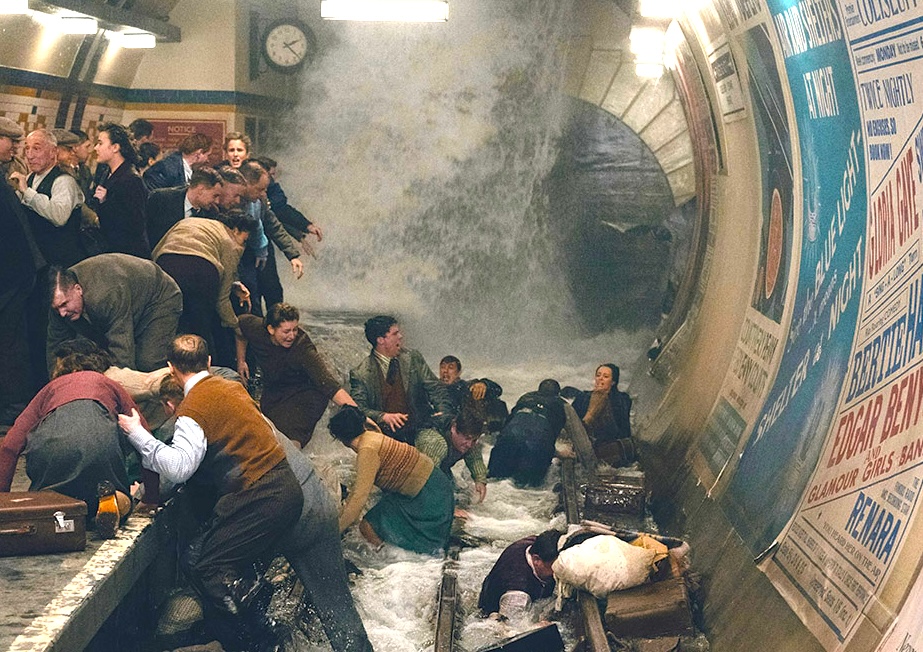
Flooded tube station in “Blitz”

Here’s something I haven’t yet mentioned.  George’s father was a black man deported years earlier. And his very blackness makes the boy’s  journey all the more problematic,

Writer/director McQueen, of course, is a black Brit, and his resume is peppered with titles that delve deeply into the black experience (“12 Years a Slave” and the TV series “Small Axe” in particular).  And in fact he was inspired to write “Blitz” after finding a vintage photo of a young black child with suitcase en route to the provinces.

So in addition to just staying alive, young George encounters numerous displays of racial intolerance. 

But that’s only half the movie.  Meanwhile Rita and her all-female fellow workers at the munitions plant must deal with the chauvinism of the management and unfair treatment.  They are particularly incensed that the government has blocked the desperate public from using certain underground shelters. (There’s no explanation of what this is all about…makes one wonder if it was trimmed from the final cut.)

Eventually Rita gets word of George’s disappearance and goes on her own frantic search of London, abetted by a neighbor and civil defense warden (Harris Dickerson) who is quietly yearning for her.

And I haven’t even addressed the extensive flashbacks of Rita’s pre-war romance with Marcus (CJ Beckford) and the inevitable racial fallout from that taboo relationship.

Whew.  That’s a lot of plot.  Too much, in fact.

The performances are good, the physical production impressive, the handling of individual scenes generally tight and effective.

But there’s just so much going on that I practically succumbed to eye-rolling.  More is not always better.

| Robert W. Butler
Read Full Post »

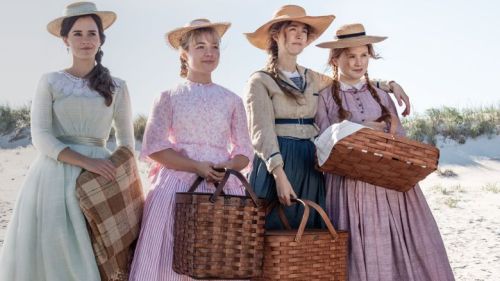
Emma Watson, Florence Pugh, Saoirse Ronan, Eliza Scanlen

“LITTLE WOMEN” My rating: B+

134 minutes | MPAA rating: PG

Each generation, apparently, gets its own cinematic “Little Women.” Count Greta Gerwig’s new version among the best.

Beautifully acted, classily mounted and delivering its emotional detonations with almost clocklike precision, this adaptation manages to do justice to Louisa May Alcott’s classic novel while viewing the tale through a protofeminist lens.

Gerwig lets us know what she’s up to in the opening scene, where aspiring writer Jo March (Saoirse Ronan) meets with a New York publisher to discuss her latest story.

“If the main character is a girl,” the bewhiskered editor (Tracy Letts) advises, “make sure she’s married by the end…or dead.  Doesn’t matter which.”

This is only the first of several moments in which the film takes aim at male privilege and arrogance in 19th century America (and, by implication, in today’s world).  Not that the film ever mounts a soapbox or goes strident.  Gerwig’s screenplay effortlessly incorporates a modern sensibility into the classic tale; it feels as if she discovered these  millennial attitudes  in the original story and merely amplifies them.

This “Women” is novel as well for its narrative juggling.  The film opens several years after the Civil War…the March sisters from Concord, Mass., are now young adults.

We’ve already seen Jo pursuing a career in the Big Apple.  We find sister Meg (Emma Watson) back in Concord; she’s married, a mother and struggling with money issues.  Little sister Amy (Florence Pugh) is in France studying painting under the watchful eye of their wealthy Aunt March (Meryl Streep, doing her best Maggie Smith).

There’s a fourth sister, Beth (Eliza Scanlen), whom we meet in the flashbacks that make up the bulk of the film.  (One of the great pleasures in Gerwig’s narrative sleight-of-hand is that we’re able to compare the mature women we first meet with their much more innocent selves seven years earlier.)

(more…)

Read Full Post »

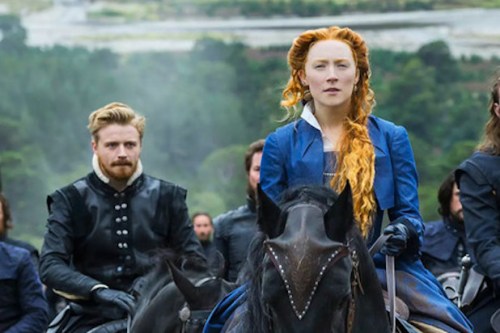
Saoirse Ronan as Mary Stuart

“MARY QUEEN OF SCOTS” My rating: B-

124 minutes | MPAA rating:R

The story of Mary Stuart, the Scottish Queen, and her long-running rivalry with England’s Elizabeth I  is one of history’s great dramas. Heck, it even ends in a beheading.

So why do cinematic treatments of the yarn always feel so hidebound and emotionally remote?

In part it may be because the two women never laid eyes on one another. Their stories run on parallel tracks, but there is no intersection.

The new “Mary Queen of Scots,” with which storied stage director Josie Rourke makes her feature film debut, solves that problem (sort of) by inventing a meeting between the two monarchs. This allows two terrific actresses — Saoirse Ronan and Margo Robbie — an opportunity for a bit of hand-to-hand thespian combat.

But it’s not enough to make this big fat slice of history dramatically compelling.

Which is not to say there’s nothing to like here.  The film is filled with spectacular scenery and some of the dankest, dimmest castle interiors in movie history. The costuming is lavish.

And then of course you have these two actresses playing a long-distance game of diplomatic chess with the future of the English monarchy at stake.

The film begins with Mary (Ronan) returning to Scotland after a long sojourn in France, where she had married a prince who promptly died on her. She reclaims her throne from her brother James (Andrew Rothney), who will launch a civil war against her.

Mary poses a real threat to her cousin Elizabeth (Robbie), who is unmarried and indifferent about producing an heir.  Should Elizabeth die childless, the Roman Catholic Mary would inherit the throne of Protestant England.

Let the machinations begin!!!

(more…)

Read Full Post »

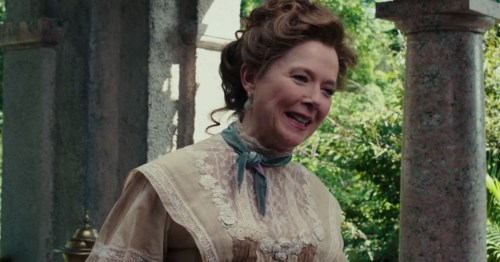
Annette Bening

“THE SEAGULL” My rating:B-

98 minutes | MPAA rating: PG-13

There’s nothing particularly wrong with the new movie version of Anton Chekhov’s “The Seagull”…save that it is a movie.

Call me old-fashioned, but I believe Chekhov was meant to be seen on the stage, where the only thing between the audience and the storytellers is air.  By its very technological nature, film has a way of distancing us from the immediacy of Chekhov’s characters.

That said, this “Seagull,” directed by Michael Mayer and featuring an impressively strong cast, will serve as an introduction — a  limited introduction that hints at the greatness revealed when one views this play in the flesh.

Set on a wooded Russian estate at the turn of the last century, Chekhov’s tale studies a handful of individuals engaged in a round robin of romantic frustration.

Irina (Annette Bening) is a famous stage actress whose current lover, Boris, is a rising literary star a couple of decades her junior.  Vain, pompous and absolutely terrified of aging, Irina is nearly undone by Boris’ obvious attraction to Nina (Saoirse Ronan), the fresh-faced daughter of a nearby landowner who has her own thespian ambitions.

Nina, meanwhile, is loved by Irina’s neurotic son Konstantin (Billy Howle), an aspiring playwright and short story writer so sensitive that he appears to be in a constant state of depression or anger.

Konstantin is worshipped from afar by Masha (Elisabeth Moss), who wears black because “I’m in mourning for my life” (she’s a real barrel of monkeys) and nips steadily from a tiny flask.

Masha is loved by Mikhail (Michael Zegen), an impoverished local school teacher.

Then there’s the good-hearted Doctor Dorn (John Tenney), who has long carried a torch for Irina; he’s the unattainable love object of the housekeeper Polina (Mare Winningham).

In other words, just about everyone in sight is in love with someone who doesn’t return the sentiment.

There are other characters blessedly free of the these romantic entanglements, especially Irina’s aging bachelor brother Sorin (Brian Dennehy) and the chatty estate foreman Shamrayev (Glenn Flesher). (more…)

Read Full Post »

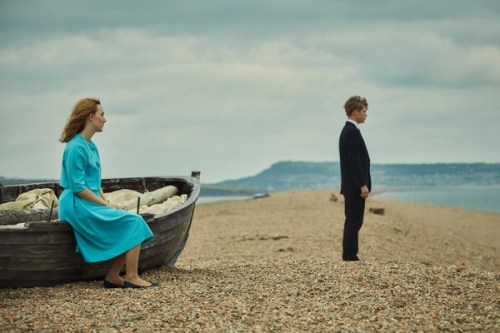
Saoirse Ronan, Billy Howe

“ON CHESIL BEACH” My rating: C+ 

110 minutes | MPAA rating: R

No film with Saoirse Ronan can be easily dismissed. Nonetheless, many will find “On Chesil Beach” a long haul.

Directed by Dominic Cooke and adapted by Ian McEwan from his 2007 novel, this is a story of lost love.  More specifically, it’s about two young people utterly unprepared for the intimacies of married life who are driven apart by sexual dysfunction.

That may sound intriguing…and on the printed page it was.  The problem is that McEwan’s novel is a deep psychological study of two individuals, and deep psychology is not one of the things the movies do particularly well.

We can see the outside, but we’re not privy to what’s happening on the inside. And despite McEwan’s use of extensive flashbacks to depict the young lovers’ courtship and backgrounds, the whole enterprise feels like it’s unfolding at an emotional arm’s length.

Florence (Ronan) and Edward (Billy Howle) check into a seaside hotel for their honeymoon. They’re nervous…this is the big night, after all.  The time is the early ’60s and these two virgins are both eager and terrified.

In a series of flashbacks we see how they met and fell in love.

Edward is working class, a bit impetuous and keyed into the burgeoning pop culture of the day. His family history is far from storybook; his mother (Anne-Marie Duff) suffered a head injury when struck by a train and now devotes herself to making art in the nude.

Florence’s background is a pure 180 from Edward’s. She comes from the upper crust, plays violin in a string quartet, and married Edward despite the disdain of her snooty/pompous parents (Emily Watson, Samuel West).

He thinks Chuck Berry is awesome.  She thinks Chuck Berry is “quite, well, merry.” (That early exchange, initially amusing, carries grim portents for the couple’s compatibility.)

(more…)

Read Full Post »

Saoirse Ronan

“LADY BIRD” My rating: B+ 

93 minutes | MPAA rating: R

That Saoirse Ronan gives an Oscar-worthy performance in “Lady Bird” is expected. She is, after all, perhaps the greatest actress of her young generation. (Exhibit One: “Brooklyn.”)

What’s really surprising about this funny/furious coming-of-age yarn is the voice behind the camera.  “Lady Bird” is the first feature soley written and directed by Greta Gerwig, the actress known as indie filmdom’s go-to gal for slightly ditzy heroines (“Greenberg,” “Frances Ha,” “Mistress America”).

Gerwig gives us not only a first-rate dramedy about a young woman’s growth from cranky teen to independent woman, but also the most incendiary mother/daughter movie relationship since “Terms of Endearment.”

Combining savage wordplay, satiric insights into adolescent life and a genuine sense of family dynamics, “Lady Bird” is simultaneously familiar and fiercely original.

Christine (Saoirse Ronan) is a high school senior (the year is 2002) and  pissed off about nearly everything. Her general dissatisfaction may be behind her decision to change her name to Lady Bird…or to at least demand that her parents, friends and teachers call her  that. A new name may lead to a new life, right?

In the film’s first scene Lady Bird and her mother Marion (Laurie Metcalf) are reduced to tears while driving down the highway listening to a book tape of The Grapes of Wrath.  It’s a rare moment when mom and daughter are on the same page; seconds later Lady Bird’s temper flares and she impulsively bails from the moving car. (She will spend much of the movie with a cast on one hand.)

The source of the argument is college.  The two are returning from a scouting trip to regional universities, but Lady Bird has her heart set on something back east, a place with “real culture, like New York…or Connecticut.” Marion, a glum financial harpie, warns that there isn’t any money for an Ivy League education.  A small state college the next town over will have to do.

This is the film’s central conflict: a smart, ambitious and somewhat spoiled adolescent versus her penny-pinching, essentially joyless parent.  (Lady Bird’s dad, played by Tracy Letts, is a laid-back  noncombatant who offers moral support to both mother and daughter but not much else, having been downsized from his tech job.)

(more…)

Read Full Post »

James Booth as Armand Roulin

“LOVING VINCENT” My rating: B

93 minutes | MPAA rating: PG-13

“Loving Vincent” is work of adoring fanaticism, an investigation into Vincent Van Gogh’s death through animation that mimics his dynamic and instantly recognizable style of painting.

Van Gogh’s portrait of the real Armand Roulin

It is, we’re told, “the world’s first fully painted feature film” in which each  of the movie’s 60,000-plus frames have been rendered in oil by a crew of more than 100 artists.

What directors Dorota Kobiela and Hugh Welshman have accomplished here is, from a visual point of view, spectacularly mesmerizing.

As a narrative their film (co-scripted with Jack Dehnel) has some issues, but ultimately it works its way under the viewer’s skin.

Unfolding a year after Vincent’s death in the small French town of Auvers-sur-Oise, the story centers on Armand Roulin (James Booth).  Armand is a dedicated drinker and brawler living in Arles, where the artist often lived and painted during his last years. (Vincent actually did a portrait of Armand, and  throughout the movie the young man wears then bright yellow jacket in which he posed.)

This handsome ne’er-do-well is sent on a mission by his father, the local postmaster (Chris O’Dowd).  The elder Roulin has in his possession a letter written by Vincent to his brother Theo but never sent.  Now the old man dispatches Armand off to Paris to deliver the letter to its intended recipient.

Alas, he discovers that Theo died not long after his brother.  Hoping to locate Theo’s widow, Armand travels to Auvers, along the way collecting information about Vincent from those who crossed his path.  (Vincent, played by Robert Gulaczyk, is seen only in black-and-white flashbacks painted to resemble charcoal drawings.)

(more…)

Read Full Post »

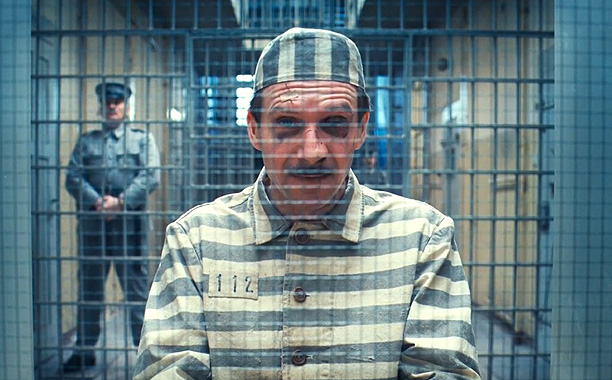
Ralph Fiennes in Wes Anderson's "The Grand Budapest Hotel"

Ralph Fiennes in Wes Anderson’s “The Grand Budapest Hotel”

“THE GRAND BUDAPEST HOTEL”  My rating: B (Opens wide on March 21)

100 minutes | MPAA rating: R

Wes Anderson’s “The Grand Budapest Hotel” is a whopper of a shaggy dog story – or more accurately, it’s a series of shaggy dog stories that fit neatly inside one another like one of those painted Russian dolls.

The film’s yarn-within-a-yarn structure and a delightfully nutty perf from leading man Ralph Fiennes are the main attractions here. I had hoped that “Grand Budapest…” would scale the same emotional heights as Anderson’s last effort, the captivating “Moonrise Kingdom.”

It doesn’t. But there’s still plenty to relish here.

Describing the film requires a flow chart. But here goes:

In the present in a former Eastern Bloc country, a young woman visits the grave of a dead author and begins reading his book The Grand Budapest Hotel.

Suddenly we’re face to face with the writer (Tom Wilkinson), who is sitting at the desk in his study. After a few introductory comments and a brusque cuffing of a small boy who is proving a distraction, the author begins telling us the plot of his novel.

Now we’re in the 1990s in the formerly sumptuous but now dog-eared Grand Budapest hotel in the Eastern European alps. Staying there is a Young Writer (Jude Law) who befriends the mysterious Mr. Moustafa (F. Murray Abraham). An aged empresario who owns several of Europe’s most luxurious hotels, Moustafa keeps the Grand Budapest running for nostalgic reasons.

(more…)

Read Full Post »