Feeds:
Posts
Comments

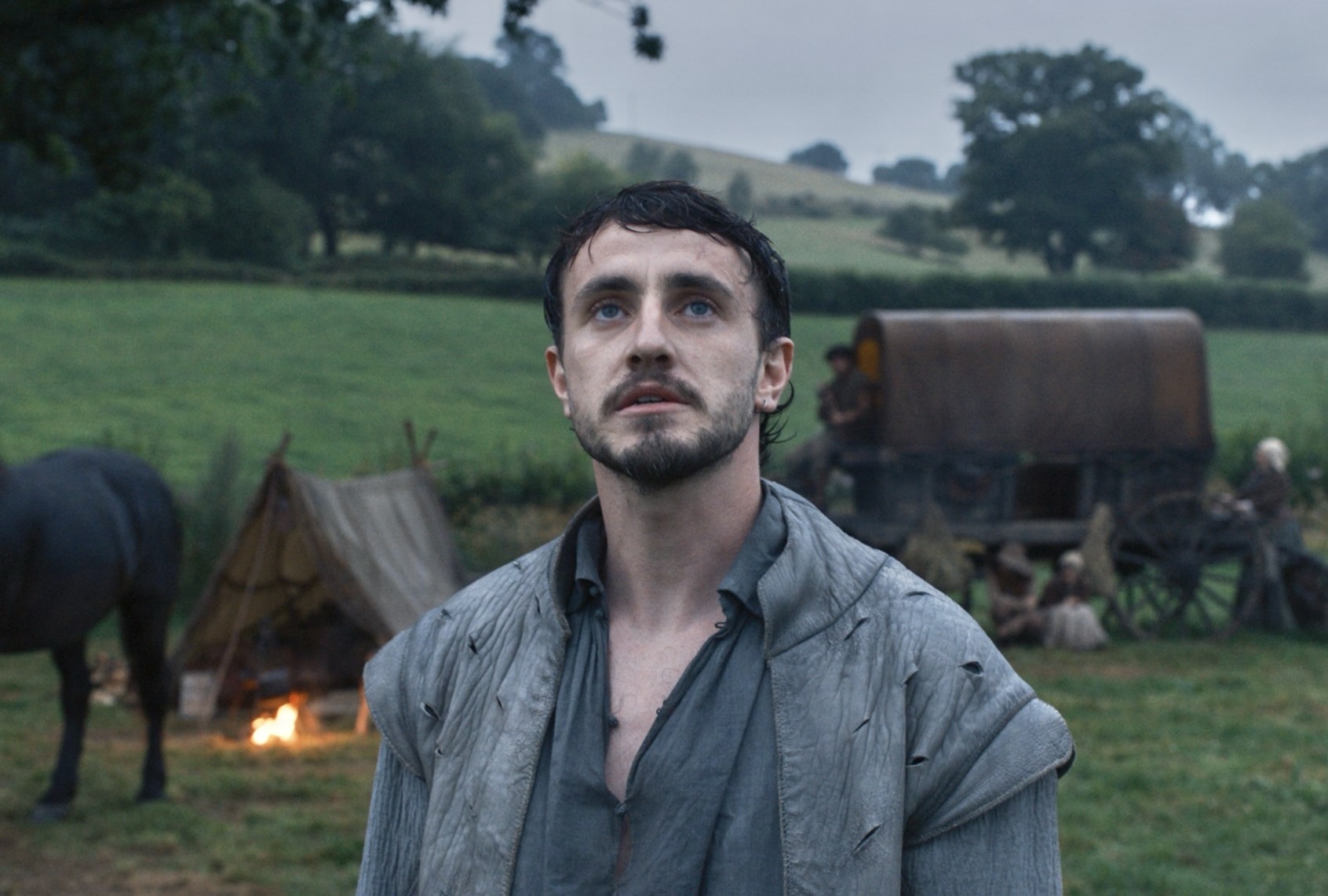
Tom Hiddleston

“THE LIFE OF CHUCK” My rating: A-(Various PPV platforms)

111 minutes | MPAA rating: R

Mike Flanagan’s “The Life of Chuck” provides the 10 most joyful minutes of cinema I’ve seen in all of 2025.

Which is not bad for a movie that starts out depicting the end of the world.

“…Chuck” is a departure for writer/director Flanagan, possibly our best dispenser of supernatural horror (“The Haunting of Hill House,” “Midnight Mass,” both Netflix miniseries); but then it is based on what is probably the most atypical story ever penned by Stephen King.

I mean, we’re talking a weirdly-structured but deeply moving meditation on the meaning of life.

You know somebody’s tinkering with the time/space continuum when the opening titles tell us that the yarn begins with Chapter III.

Here we meet Marty Anderson (Chiwetel Ejiofor), a middle school teacher struggling (as is everybody else) with the rapid collapse of civilization.  First the Internet went down.  Now cell phones aren’t working.  TV stations are going off the air one by one, but not before announcing that most of Northern California has fallen into the Pacific.

There’s still electricity, but nobody knows how long the juice will keep flowing.

With classes cancelled, Marty wanders the streets of his town, now cluttered with abandoned cars.  He has a conversation with a funeral director (Carl Lumbly) about a blitz of billboards, banners and TV/radio commercials that have appeared overnight.  These declare “Charles Krantz. 39 Great Years! Thanks, Chuck!” and feature a photo of Chuck (Tom Hiddleston), a pleasant-looking guy wearing a business suit and spectacles.  Maybe Chuck is retiring from his job, though he doesn’t look nearly old enough.

And anyway, the world is ending.

A big chunk of Chapter III centers on Marty’s efforts to reconnect with his ex, Felicia (Karen Gillan), a nurse now jobless since all the high-tech medical machines in her hospital stopped working. Reunited, Marty and Felicia sit in her back yard watching the stars blink out one by one.

Next up is Chapter II. We find Chuck (Hiddleston) attending a conference for accountants. On a stroll through the city center he is confronted by a busking street drummer (Taylor Gordon). Listening to the percussive symphony she generates, the buttoned-down Chuck begins swaying tot he music.  

Then he starts doing a few dance steps.  Before long he’s grabbed the hand of a passer-by (Annalise Basso) and together they put on an impromptu display of big band terpsichorean razzamatazz that draws a cheering crowd.

It’s a heart-in-your-throat “Singin’ in the Rain” kind of moment. Pure movie magic. (Much love to Mandy Moore’s spectacular choreography).

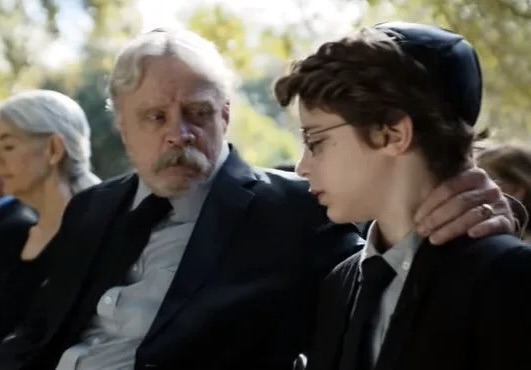
Mark Hamill, Benjamin Pajak

Then it’s on to Chapter I, which depicts Chuck’s childhood (as you’ve gathered by now, “The Life of Chuck” unfolds in reverse order). Orphaned by a car accident, young Chuck (he’s depicted as a middle schooler by the excellent Benjamin Pajak) is being raised by his grandparents (Mark Hamill and Mia Sara).

(Uh, wait a minute.  Mia Sara.  Wasn’t she Ferris Bueller’s squeeze only a couple of years back? Surely she can’t be anybody’s grandma.)

Anyway, this segment examines Chuck’s relationship with his loving grandparents, and his discovery of dance in an after-school club.  The kid’s a whiz…before long he’s the talk of the prom for cutting a rug with a girl two years his senior.  

Once again, the dance sequence is magic.  But what kind of career is dance for a red-blooded American boy? No, Chuck will grow up to study something more practical, like accounting.  But he’ll never forget the thrill of his body moving effortlessly to the music.

“…Chuck” bites off a big chew by attempting (in reverse) to depict one man’s life. What we come to realize is that Chapter III is actually unfolding in the head of a dying man.  Chapters I and II tell us how he got there, while introducing figures (Marty, Felicia, the funeral director) who will appear in his end-of-life reverie.

The film has been so deftly directed and acted (even from the unseen Nick Offerman, whose narration provides just the right taste of detached observation) that more than a few veiwers will find themselves in tears.  

| Robert W. Butler

Joel Edgerton

TRAIN DREAMS” My rating: A- (Netflix)

102 minutes | MPAA rating: PG-13

If Terrence Malick and Kelly Reichart had a baby it would be “Train Dreams,” a visually ravishing examination of one human life.

This is only the second directing credit from Clint Bentley (he wrote the Oscar-nominated screenplay for “Sing Sing”), but it displays an astounding depth of  maturity and sensitivity. 

In adapting Denis Johnson’s novella (he co-wrote the piece with Greg Kwedar) Bentley has approached this sprawling tale as a sort of  visual folk song. There’s only limited dialogue, but since his leading player is the breathtakingly empathetic Joel Edgerton, little is required.

Will Patton’s voiceover narration (a device I generally despise;  here it is delivered like a poetry reading) tells us of the origins of Robert Grainier, a foundling who grows up in a small burg in the Pacific Northwest.  He comes to maturity in the early 1900s, when the mechanized modern world has not yet intruded on the wilderness.

Poorly educated, Robert excels at manual labor.  He helps build a wooden railroad bridge across a forested gulch, and witnesses the murder of a co-worker,  a Chinese man (Alfred Hsing) whose ghostly visage will haunt him throughout his long life.

Mostly Robert works for logging crews; his huge axe is practically an extension of his own arm.

He meets and falls for Gladys (Felicity Jones) and together they build a cabin and have a daughter, though Robert’s work requires him to be away for months at a time.

The loggers are a hard-working bunch, a collection of loners who can go all day without saying a word.  There is one exception.  William H. Macy is terrific as Arn Peeples, a grizzled old codger whose main job seems to be serenading his fellows with nonstop running commentary on anything that comes into his head.

There are on-the-job accidents, some fatal.  Robert soldiers on.  His goal is to make money, return to his beloved wife and child, and start the process all over again.

Felicity Jones, Joel Edgerton

The scenes of the Grainier’s domestic life are so achingly beautiful that one is tempted to give up on civilization and take up residence in the woods. Adolpho Veloso’s camera seems to caress its subjects; frequently we’re distracted by the waving tufted tips of wild grass, or the grain of a tree trunk. Man and nature in harmony.

These scenes arebolstered by the presence of the uncredited young child who plays Robert and Gladys’ daughter.  The kid steals every scene without even trying. We’re as delighted in her as are her parents.

Then cruel fate intervenes. Robert is away on a job when tragedy strikes back home. His cabin lies in ashes; the fate of his wife and daughter unknown.

Ever faithful, Robert is determined to rebuild on his smoldering acreage so that when his family returns, he’ll be ready.

Edgerton is devastatingly effective as the stoic yet forlorn Robert. The sadness in his eyes, the gentleness in his movements, the way his posture changes over more than 60 years of physical labor…all these add up to an unforgettable portrait of a man who, by most standards, is unremarkable.

But then that’s the whole point. “Train Dreams” finds the unexpected nobility in everyday humanity.

| Robert W. Butler

Joan in Phoenix, Pedro Pascal

“EDDINGTON” My rating: C+ (HBO MAX)

148 minutes | MPAA rating: R

“Eddington” is a mess, but at least it’s an ambitious mess.

For his followup to “Hereditary” and “Midsommar” filmmaker Ari Aster has come up with a different sort of horror film in which the threat comes not from the supernatural but from within ourselves.

Unfolding in the sun-baked burg of Eddington, N.M.,  this drama attempts nothing less than to summarize all the roiling currents of contemporary America.  Which is a nice idea, but it devolves into a credulity-crushing melodrama populated less by characters than by various poltical/social points of view.

The time is the early months of the Covid pandemic, and Sheriff Joe Cross (Joaquin Phoenix) has his hands full on just about every front.  At home there’s his childlike and sickly wife Louise (Emma Stone) and her conspiracy-crazed mother Dawn (Deirdre O’Connell).

On his patrols of the town Joe finds himself refereeing standoffs between pandemic-panicked citizens in government-mandated face masks and those individuals who refuse to muffle up, whether because it’s physically uncomfortable or because they smell the nefarious efforts of Big Brother to smother individual identity.

It’s also election season in Eddington, with mayor Ted Garcia (Pedro Pascal) running for another term.  Ted’s campaign centers on bringing in a high-tech outfit to erect a data farm, or a bitcoin mine, or some other damn electicity-gobbling enterprise.  The whole thing smacks of an insider deal.

There are the kids, the teenagers who aren’t content just to smoke grass behind the grocery store.  No, they’ve all climbed on a high horse to protest everything they don’t like — which is just about everything from Native America rights to old folks who can’t be bothered with personal pronouns. They’re putty in the hand of the charismatic Vernon (Austin Butler), a rabble rouser who may be a good guy…or maybe a Charles Manson.

And finally there’s Lodge (Clifton Collins Jr.), a hirsute desert rat who wanders through town babbling angrily at demons real and imagined.

Pushed way past exasperation, Joe decides to take matters into his own hands. He’ll run for mayor, too.  Except that the key to his campaign is assassinating the opposition.

Once the crime’s been committed “Eddington” becomes a sort of Jim Thompson thriller with Joe working overtime to cover up his crime and blame it on somebody else.  Except that there are a couple of armed vigilantes (identified in the credits as Antifa Terrrorists 1 and 2) who begin stalking him in a beautifully staged nighttime action sequence.

By the time “Eddington” wraps up after nearly 2 1/2 hours the patience of most viewers will be worn thin. As a schematic of our current state of affairs the film offers some good nasty fun, but there’s not a character on screen we can actually like.

Tessa Thompson

“HEDDA” My rating: B-(Prime Video)

107 minutes | MPAA rating: R

Hendrick Ibsen’s “Hedda Gabler” gets a heavy-duty makeover in “Hedda,” in which writer/director Nia DaCosta makes actress Tessa Thompson the scene-stealing centerpiece.

Ibsen’s original was set in the 1890s Norway;  DaCosta moves the action to post-war Britain.

The story is pretty much the same with some radical casting changes…new bride Hedda (Thompson) is miserable with her stuffy academic hubby George (Tom Bateman) and uses a big cocktail party attended by his colleagues to do mischief.  She’s supposed to be boosting George’s profile for a much sought-after collegiate gig, but Hedda’s personal demons are going strong.

George’s main competition is Eileen Lovborg (Nina Hoss), an openly gay female academic working on what will surely be a best-selling book.  Eileen is a recovering alcoholic; she’s also a former lover of Hedda, though she now cohabits with the mousy Thea (Imogen Poots).

In the course of the evening Hedda will sabotage Eileen’s relationship, her husband’s career, and her own life.

“Hedda” has been very well acted, and the updatings made to the original text are intriguing and evocative.

But here’s the thing…when I think of Britain in the 1950s I’m thinking of the rather stiff world of PBS’s “Granchester,” a time when the old social mores were only slowly changing and gasoline was still being rationed.

What we get here, though, is a Bacchanal right out of the 1920s, with stuffy college professors getting blotto and dancing the boogie woogie.  The film’s frantic ambience felt forced and overstated. 

If you can get past the anachronistic elements, “Hedda” offers some terrific acting.  If.

| Robert W. Butler

Michael Shannon

“DEATH BY LIGHTNING”(Netflix)

Historical drama gets no better than “Death by Lightning,” a recreation of one of the more obscure but weirdly resonant moments in our national history.

Based on Candice Millard’s superb history Destiny of the Republic, this retelling of the assassination of President James A. Garfield in 1881 has been spectacularly well acted and produced.  It almost perfectly captures the same emotional and intellectual notes that made the book so memorable.

And it does it all in just four one-hour episodes.

It begins with Senator Garfield (Michael Shannon) leaving his Ohio farm for the 1880 Republican National Convention in Chicago . His hope is to prevent the renomination of incumbent president Ulysses S. Grant, the figurehead of a spectacularly corrupt administration.

In a twist of fate that seems more fairy tale than fact,  it is Garfield himself who ends up the party’s nominee.  It’s not that he seeks the presidency…but he’s the only candidate the warring anti-Grant delegates all can get behind. 

In the process he makes an enemy of Grant supporter Roscoe Conkling (Shea Whigham), the U.S. senator from New York whose control of that state’s ports holds the American economy in a stranglehold.  Conkling is a savvy pol…he’s also willing to employ pure thuggery to get his way.  The comically boozy Chester Arthur (Nick Offerman) provides the muscle behind Conkling’s manipulations.

Garfield knows he cannot win without New  York.  So he does the unthinkable…he chooses as his running mate the hapless Arthur; basically it’s an end run around Conkling’s plan to sit out the election and pick up the pieces later.

The rise of Garfield runs parallel to the story of Charles Guiteau (Matthew Macfadyen), a failed lawyer and hustler with serious mental issues.  Guiteau fantasizes that his support was vital in getting Garfield elected, and now he wants a reward.  And when his pathetic entreaties are rejected, he plots to kill the President.

Matthew Macfadyen

As was the case with Millard’s book, this series leaves viewers ruminating over what might have been.  In his three months as President, Garfield embraced a progressive agenda.  A Civil War veteran, he reached out to  African American leaders, especially black soldiers whose sacrifices were overlooked.  He laid plans to replace the spoils system with a non-partisan Civil Service.

I doubt we’ll see better acting this year than what’s delivered here by Shannon and Macfadyen.

Shannon probably has the tougher job, given that Garfield was low-keyed, modest and generous.  Not exactly a personality to set off dramatic fireworks. Yet the actor finds the heroic in Garfield’s calm reasonableness. Especially telling are the scenes with the Garfield family (Betty Gilpin is terrific as Mrs. Garfield), which bring to mind the domestic image of Abraham Lincoln and his brood.

The upshot is a genuine sense of loss.

Macfadyen, on the other hand, gets to play a crazy man…but with restraint.  The key to his Guiteau is the disarming “normalcy” of his presentation.  The guys often sounds reasonable but behind the fancy words there’s a crippling desperation at war with rampant narcissism.  In any conversation there comes a moment, a tell if you will, that suggests something is seriously wrong with this guy. Maybe you can’t quite put a finger on it, but that creepy feeling on the back of your neck is inescapable.

The fourth and final episode unfolds in the aftermath of the assassination attempt. Garfield lingered in agony for a month while inept physicians tried to locate the bullet for extraction…even calling upon inventor Alexander Graham Bell to employ a primitive metal detector.

Weirdly enough, the reform movement Garfield put into motion survived him, thanks to an unlikely proponent we won’t name here.

Now this is all pretty heavy stuff, but director Matt Ross and writer/creator Mike Makowsky often put a bleakly funny spin on the material.  The brutal cronyism of Conkling and Arthur gets the full satiric treatment (the parallels between their machinations and those of our current President are inescapable) and the characters often employ ear-burning language.  I doubt that statesmen of the 19th century were that open with their profanity, but in dramatic terms it works…most of the really vile pronouncements come from the show’s heavies.

Even the smallest roles are deftly handled.  Among the supporting players are Bradley Whitford, Vonnie Curtis-Hall, Paula Malcomson and Zeljko Ivanek.

When it’s all over, “Death by Lightning” leaves us marveling at the decency of good men and the unpredictability of fate.

Ethan Hawke

“THE LOWDOWN” (Hulu)

I love, love LOVE this show.

Lee Raybon (Ethan Hawke) is a shabbily-clothed freelance journalist whose search for truth always has him in hot water with Tulsa’s movers and shakers.

In this funny and weirdly moving series from Sterlin Harjo (the man who gave us “Reservation Dogs”)  Lee sets out to prove that the suicide of one of the local gentry is actually murder.

He runs up against the dead man’s brother (Kyle Maclachlan), who’s running for governor; the scheming widow (Jeanne Trijpplehorn), a neo-Nazi cult  and a whole bunch of corrupt power  brokers.

All while trying to keep his struggling used book store afloat and delivering questionable parenting to his teenage daughter (Ryan Kiera Armstrong). 

Plus Lee gets beat up.  A lot.

This sprawling noir comedy (think Jim Thompson on laughing gas) is crammed with eccentric and memorable characters, and the players (among them Keith David, Tracy Letts, Tim Blake Nelson, Killer Mike, Tom McCarthy, Peter Dinklage, John Doe and the late Graham Greene) take full advantage of the possibilities. Rarely have so many scene stealers been assembled in one place.

I was borderline bereft when “The  Lowdown” reached its eighth and final episode.  But I’ll tell you what…I’m gonna plop down and watch it all over again.

| Robert W. Butler

Jacob Elordi

“FRANKENSTEIN” *My rating: B+ (Netflix)

149 minutes | MPAA: R

For the first hour or so Guillermo del Toro’s new (and let’s face it, ultimate) version of “Frankenstein” left me a bit cold.

It’s been brilliantly designed and photographed but emotionally…kinda meh.  

Turns out I just had to show a little patience.  For once the Creature comes to life, so does the movie.

Indeed, our sympathies lie with none of the human characters…least of all Oscar Isaac’s Victor Frankenstein, the ruthless and ego-driven medical genius bent on reanimating dead corpses.

No, this “Frankenstein” belongs to Jacob Elordi’s Creature…and please note that he will not be described here as “the Monster.”  For this stitched-together superman exhibits more pure humanity than any of the “normal” folk around him.  It’s a performance that transcends the scars and death-blue pallor of the Creature’s skin to reveal, well, a beautiful soul.

Expect an Oscar nomination for Elordi, a screen heartthrob and sexual icon (“Saltburn,” the Max series “Euphoria”) who here shows unpredictable depths of loneliness, love, rage and compassion.

Del Toro’s adaptation of Mary Shelley’s novel begins at the end.  The crew of a sailing ship trapped in the Arctic ice take aboard a frostbitten man being pursued by a terrifying giant.  This is Victor Frankenstein, and to the Captain (Lars Mikkelsen) he relates his tale.

We see the boy Victor dealing with his icily controlling and intellectually cruel father (Charles Dance); this helps explain why as an adult Victor is a bit of a medical oddball, convinced of his own brilliance and openly contemptuous of his colleagues.

Victor’s ambitions know no bounds, and with the help of a rich benefactor (Christoph Waltz) — who it turns out has his own twisted motives — our man gets to work sorting through the bodies left on a recent battlefield (the setting is 1850s Europe), looking for pieces that can be sewn together and animated with a jolt of lightening.

When not impersonating God, Victor expresses a bad case of the hots for Elizabeth (Mia Goth), the fiancé of his brother (Felix Kammerer). Clearly he observes few moral boundaries.

Oscar Isaac

That becomes even more clear in his relationship with the Creature.  He keeps his nearly naked (and weirdly erotic) creation chained in the castle basement, where he berates the poor unfortunate for lacking the mental acuity to match his physical power.

It is Elizabeth who breaks through, treating the Creature with kindness and unlocking his emotions and intellect. But exasperated by what he views as a failed experiment, Victor attempts to destroy his creation in a massive conflagration.

Turns out the Creature cannot die, as much as he might wish for it. The second half of the film finds the Creature joining Victor and the captain aboard the ship to explain why he’s been pursuing the semi-mad doctor over land, sea and ice.

It is in the Creature’s backstory that we find grace notes of beauty and longing.  The highlight is his “adoption” of a farm family.  Hiding in their idle gristmill he emerges at night to leave presents of dead game and firewood at their door.  They call their mysterious and unseen benefactor “the spirit of the woods.”  

The Creature’s real education begins when the blind grandfather is left alone and befriends this stranger, teaching him to read (how a blind man teaches someone to read is a poser, but I’m not complaining) and opening up his intellect to literature, history and philosophy.

Maddened by the knowledge of both his “otherness” and his inability to end his miserable existence, the Creature decides on revenge.  He’ll pursue Victor halfway around the world for a final confrontation between father and son.

The old “Bride of Frankenstein” attempted to humanize the Monster (the blind hermit had a brief but telling scene), but the dominant themes of that classic were horror and camp.  Here del Toro goes for an emotional and spiritual catharsis.  That might seem a stretch for what is essentially a horror movie, but damned if he doesn’t pull it off.

In the end we’re left not so much with lingering terror as a disquieting sadness.

Well done.

Julia Garner

“WEAPONS My rating: B (HBO Max)

128 minutes | MPAA rating: R

A long tantalizing  tease capped by a what-the-hell ending pretty much describes every horror movie I’ve seen in recent years.

It’s no different with “Weapons,” writer/director Zach Cregger’s followup to his brutally effective creepfest “Barbarian.”

The film opens with spectacular imagery…at exactly the same moment one fall night, nearly two dozen elementary school students rise from their beds and in their pajamas race away from their  homes with arms stretched at a weird angle…it’s simultaneously scary and beautiful.

Turns out all the missing children were from the class taught by Justine (Julia Garner).  Only one little boy, Alex (Cary Christopher), shows up at school the next day.

The others seem to have vanished without a trace.

The authorities are baffled. The parents frantic…and then vengeful.  They turn on Justine, accusing her of being behind the disappearances/abductions. She’s told to go on hiatus until things settle down.

Cregger’s screenplay tells the story from several different perspectives.  First there’s Justine, whose long-dormant drinking problem gets kicked back into high gear.  There ‘sthe local cop (Alden Ehrenreich) who is part of the search and has a sexual relationship with Justine.

Archer (Josh Brolin) is one of the parents, driven to acts of desperation by the loss of his son.

Marcus (Benedict Wong) is the principal, trying to keep a lid on the town’s boiling emotions.

Austin Abrams is a young drug addict pulled into the mystery.

And finally there’s little Alex, whose home life harbors a dark secret.

Amy Madigan

About two-thirds of the way through the film we meet Alex’s Aunt Gladys (a nearly unrecognizable Amy Madigan), who’s just come to town and wears a gosh-awful orange wig that makes her look like a septagenarian Bette Davis after an all-night rave. Gladys is bleakly funny and not a little creepy — you just know she’s got something to do with the mass vanishing.

With its elements of the Pied Piper legend plopped down in contemporary suburbia, “Weapons” certainly grabs our interest and keeps us guessing as to what’s going on.  If the final reveal is a bit underwhelming, Cregger seems to think so, too, because at the last moment “Weapons” shifts from slow-creep dread to over-the-top physical comedy.

Even if the big explanation is a fairy-tale head-slapper, most of “Weapons” is extremely watchable and quite involving.

| Robert W. Butler

Jeremy Allen White

“SPRINGSTEEN:  DELIVER ME FROM NOWHERE” My rating: B+ (In theaters)

120 minutes | MPAA rating: PG-13

Less rock concert than chamber piece, “Springsteen: Deliver Me From Nowhere” is an intimate drama about a guy losing his mind at the same time he’s becoming one of the most famous entertainers on the planet.

As a longtime fan of the Boss, I found Scott Cooper’s film unexpectedly moving, and not just because of the brilliance of Bruce Springsteen’s songwriting.

The film is about the creative process, sure, but it’s also about  family dysfunction, personal demons, and the lifelong struggle to discover one’s true essence even when the rest of the world is all too eager to dictate what it expects you to be.

Unfolding over a year in the early 1980s, “Deliver Me…” finds Springsteen (Jeremy Allen White, stupendous) riding high from his just-completed “River” tour…or is he?  Bruce finds little satisfaction with his new star status (first new car, lakeside rental in rural Jersey, guest gigs at the Stony Pony in Asbury Park).  Something’s missing.

The screenplay by Cooper (adapting Warren Zanes’ book) follows Bruce’s retreat to his hideaway in the country where he lays low and begins writing the material that will become his album “Nebraska.” It’s less a pleasurable vacation than a furious quest. The man has ideas — dark ones at that — circling around in his head that demand expression in song.

Periodically the film delivers black-and-white flashbacks to Bruce’s childhood with a protective mother (Gaby Hoffmann) and a struggling working class father (Steven Graham) who all too often takes out his frustrations on his loved ones.

These digressions are integral to understanding the singer and his songs. Childhood trauma finds its way into the music…but, then, so do little moments of grace (dancing with Mom, being driven into the country by Dad for a romp in the cornfields).  In some cases you can draw a direct line from Bruce’s boyhood to individual songs (“My Father’s House,” “Used Cars”).

Perhaps the most problematical element of “Deliver Me…” is the brief romance between Bruce and a young waitress/mother named Faye (Odessa Young). Faye is a composite character, an amalgam of women Springsteen dated during this period. Young is solid in the role but it’s something of a thankless task…Bruce is simply so at sea with his own mental and emotional health that romantic commitment to another human being is out of the question.

Professional relationships are a bit easier to navigate.  Jeremy Strong is hugely effective as manager Jon Landau, who runs interference for his famous client and appears to care more for Bruce’s well-being than for the moneymaking machine he could soon become. When Bruce decides to release the rough demos of his “Nebraska” songs — acoustic mono, no backup musicians, no fancy mastering, no portrait on the album cover, no tour, no press — it is Landau who stands up to record company bigwigs who dismiss Springsteen’s “folk record” as a disaster in the making.

Jeremy Strong

Late in the film we see Bruce in his first session with a psychiatrist, but throughout “Deliver Me From Nowhere” we see our man making small incremental steps toward healing. The first of these is recognizing that something’s wrong.

The performances are terrific throughout, but White’s Bruce is so good that he becomes his own person.  It’s not an imitation — although White’s vocals and stage movements are uncannily accurate — but rather a reinterpretation.  There were moments when I forgot this was a film specifically about Springsteen and regarded it as a much bigger examination of the artistic imperative.  Which is saying something.

I fully expect an Oscar nomination for White…and another for Graham, whose Springsteen pere is a sad nightmare of blue-collar disappointment and emotional turmoil.  This British actor has only a few moments of screen time, but the impression he makes on the viewer gives the film a thematic backbone that keeps everything moving.

Will “Deliver Me From Nowhere” appeal to those merely on the fringes of Springsteeniana? It’s a tough call. I found the process of creating “Nebraska” and tracing the LP’s roots back to boyhood incredibly involving…but then I know these songs by heart.

But even a viewer who has never heard of Bruce Springsteen should respond to the very human conflicts depicted here. 

Fathers and sons. Failed love. Lifelong friendship. These are universal stepping stones in human life, and “Deliver Me From Nowhere” finds both the beauty and the dread.

| Robert W. Butler

Anthony Ramos, Rebecca Ferguson

“A HOUSE OF DYNAMITE” My rating: B+ (Netflix)

112 minutes | MPAA rating: R

This Halloween season’s scariest movie has nothing to do with ghosts and ghoulies.  It will nonetheless induce nighmares.

Kathryn Bigelow’s  latest directorial effort takes the same 20-minute time frame  and retells it repeatedly from different perspectives. 

 It begins with American military personnel in Alaska detecting an incoming ICBM and ends with the President faced with an impossible decision that could determine the fate of mankind.

Noah Oppenheimer’s screenplay — created with the assistance of former military types who know their stuff — exudes an aura of helplessness that not all our high-tech weaponry can dispel.

The incoming missile was launched from the Pacific, but we don’t know from where, exactly.  Without knowing who fired it, our military cannot know against whom to retaliate.  The Russians? The North Koreans?

Also. how could it be launched undetected by our surveillance capabilities?  Maybe someone inside our defense system is a saboteur?

Two of our missiles are sent to stop the intruder.  One breaks down in flight.  The other hits its target, but without effect.  The missile just keeps coming.  The most likely target is Chicago.

With each iteration of the story things get more dire, more tense. How will it end?  

“A House or Dynamite” has been crammed with familiar faces (Idris Elba. Rebecca Ferguson, Jared Harris, Tracy Letts, Anthony Ramos, Jason Clarke, Greta Lee, Renee Elise Goldsberry, Kaitlyn Dever), many of whom are on screen for only a minute or two.

They’re all solid, but I found myself being drawn to many of the background characters, soldiers and White House staffers caught in the awful realization that the horrors they trained for have now come to pass. Some maintain their by-the-book demeanor. Others come close to panicking.  Many call their families and friends with dire warnings to evacuate or simply to say “I love you.”

Bigelow cannily employs handheld cameras to capture a documentary feel; as the film progresses the tension reaches near unbearable levels.

Maybe don’t watch this one before going to bed.

“JOHN CANDY: I LIKE ME” My rating: B (Prime)

113 minutes | MPAA rating: PG-13

The late John Candy was a very funny man, but the overwhelming feeling percolating through this documentary is one of profound loss.

Director Colin Hanks (yes, Tom’s son) seems to have interviewed virtually everyone who moved in Candy’s orbit.  Among the famous talking heads represented here are Bill Murray, Dan Aykroyd, Dave Thomas, Martin Short, Eugene Levy, Andrea Martin, Catherine O’Hara, Steve Martin, Conan O’Brien, Mel Brooks and Macaulay Culkin.

Not to mention Candy’s widow, children and siblings. 

To an individual they describe a prince of a guy  — warm, empathic, considerate.  Bill Murray struggles mightily to find something negative to say (conflict is vital to drama, right?) but in the end can’t deliver.

But we learn a lot about Candy here.  His father died of a heart attack when he was just a boy…ironically Candy would die of a heart attack at age 43.

He wasn’t comfortable with his image as a jolly fat man; interviewers back in the day subjected Candy to a not-terribly-subtle form of fat shaming that would get them fired today.  He never struck out at them…just smiled thinly and carried on.

There are, of course, a ton of clips from his stint with “SCTV” and from his many feature films, including “Planes, Trains & Automobiles,” in which Candy delivered a performance of such humor and humanity that in retrospect you’ve got to wonder what the Academy folk were thinking in not giving him a nomination.

All in all this is a warm tribute to a very good man.

Keira Knightley, Guy Pearce

“THE WOMAN IN CABIN 10” My rating: C (Netflix)

93 minutes | MPAA rating: R

Reporter Laura Blacklock (Keira Knightley) is invited to cover the maiden voyage of a super yacht whose owners — a dying billionairess and her husband (Guy Pearce) — want to draw attention to their new charity.

The proletarian Laura feels painfully out of place among these rich creeps (Hannah Waddingham, David Morrissey, etc.), and when she reports that the woman in the cabin next to hers has fallen (or was thrown) overboard, she becomes the object of suspicion and ridicule.

Apparently Cabin 10 was never occupied.

I was kinda bored by the  first third of Simon Stone’s thriller (the screenplay is by Stone, Joe Shrapnel and Anna Waterhouse).  The middle section, in which Laura hides on the boat from unseen killers, has a sort of “Die Hard” tension going on.

It’s all wrapped up with a posh gala on a Norwegian fiord that deteriorates into a sort of soggy Velveeta pizza.  Didn’t believe a word of it.

| Robert W. Butler

Leonardo Di Caprio

“ONE BATTLE AFTER ANOTHER” My rating: B+ (In theaters)

161 minutes | MPAA rating: R

Rarely has a journey from cautious cringing to outright admiration been as marked as in the case of Paul Thomas Anderson’s “One Battle After Another.”

For the first 20 or so minutes of this epic satiric actioner I feared that the movie was going over a cliff.  Anderson is here practicing a form of exaggerated realism that, until you lock into his ethos, feels like slapstick caricature. And not very clever slapstick at that.

The dialogue in the opening minutes — most of it spoken by a sexuality-fueled young black woman with the unlikely name of Perfidia Beverly Hills (she’s played with feral ferocity by Teyana Taylor) — seems almost a parody of blaxploitation/hippie era speechifying.  

The target of her taunting is one Col. Steven J. Lockjaw (Sean Penn, looking as if he grooms with a dull-bladed Lawn Boy), the turkey-necked commander of an immigrant detention camp being raided by the French 75, the underground army of which Perfidia is one of the most outspoken and violence-prone members.

Sean Penn

Clearly Colonel Lockjaw (the names alone should have provided me with a clue as to how to navigate this material) is torn: He’s a racist being held at gunpoint by a young black woman, which is humiliating.  At the same time, this situation fulfills his most twisted  fantasies;  Perfidia sneeringly comments  on the involuntary bulge in his camouflage pants.

If all this sounds pretty over the top…well, I thought so, too.  But a funny thing happened…as the film progressed I found myself warming up to its unique blend of violence, “Dr. Strangelove”-level social/political black comedy and goofball characters.  Weirdest of all, perhaps, is “Battle’s”  genuinely moving depiction of father/daughter bonding.

The film’s prologue depicts Perfidia’s life with her lover and fellow terrorist, a bomb-maker played by Leonardo DiCaprio.  When the two find themselves facing the prospect of parenthood, he’s all for dialing back on the radical behavior.  But not Perfidia…she keeps pushing for more and bigger actions against the Establishment.  

The segment ends with Perfidia’s arrest.  Her lover and their baby girl are relocated by the underground army to a small city  in what appears to be the Pacific Northwest. He changes his name to Bob and devotes his spare time to weed.   His daughter  Willa (Chase Infiniti) grows up hearing stories of her legendary mother; she’s an overachiever who seems determined to make up for her doofus dad’s dropout lifestyle.

The bulk of the film (it’s 2 1/2 hours long but feels much shorter) centers on Colonel Lockjaw’s obsessive hunt for Perfidia’s lover and child. To that end he orders the military invasion of the sanctuary city where the pair reside.  In the chaos father and daughter are separated; the heart of the film centers on Bob’s quest to get Willa back.

Chase Infiniti

Willa is abetted in her escape by one of her parents’ old French 75 comrades (Regina Hall), while Bob (clad in plaid bathrobe) relies on the vast underground network run by Willa’s karate instructor (a scene-stealing Benecio Del Toro), who blends zen calm with barrio bravado. 

Along the way Anderson dishes some genuinely biting satire.  Willa finds herself sheltered in a leftist convent where the nuns have daily machine gun practice. And there’s an entire subplot involving the billionaire members of the Christmas Adventurers, a clandestine ultra-right cabal dedicated to racial purity (Tony Goldwyn and Kevin Tighe are among the fat-cat members).  

DiCaprio has a truly hilarious segment in which he phones the underground army’s call center (the music you hear while on hold is Gil Scott Heron’s “The Revolution Will Not Be Televised”) and totally freaks out because after years of drugs he can no longer remember the password that will allow him to talk to his old French 75 buddies.

Now it’s pretty clear that a movie like this takes several years to get off the ground, yet “One Battle…” feels as if it was torn from today’s headlines.  Its depiction of alien roundups, concentration camps and ICE-type military actions smack of our evening news.

And the Christmas Adventurers are a savage sendup of American oligarchy that in the long run feels less satirical than prescient.

I mentioned earlier that “Battle…” features “Strangelove-ean” humor.  There are moments, in fact, when the film feels like a homage to Kubrick.  A meeting of the Adventurers unfolds with the same stiff-necked formality we saw in “2001” in the office gathering on the moon. And who is Lockjaw if not a descendant of Gen. Jack D. Ripper?

Given the outrageousness of it all, it’s a miracle that the players achieve a surprising level of depth and believability.  Exhibit No. 1 is Penn’s Lockjaw, a cartoon of military macho (the guy literally walks as if there’s a ramrod up his butt)  who somehow segues from silly to weirdly chilling and maybe even a little compelling.

“One Battle After Another” is so diverting that it’s easy to overlook Anderson’s dead-serious ideas about radicalism and the difficulty of keeping one’s idealistic edge in this America of consumer excess and moral erosion. Laugh until you cry.

| Robert W. Butler

Anthony Boyle. Louis Partridge

“HOUSE OF GUINNESS” (Netflix)

Rich people misbehaving.

It’s not exactly a groundbreaking notion in the world of television (“Dynasty,” “Dallas,” “Succession”), but “House of Guinness” tosses in a few nifty  variations on a familiar theme.

Plus it may be the most perfectly produced/photographed/edited miniseries I’ve ever seen.  

Set in the 1860s, this series from Steven Knight (“Peaky Blinders”) zeroes in  on the Guinness family of Dublin, brewers of a stout that remains a favorite of barflies the world over.

It begins with the death of the brewer’s founder and the power struggle that ensues.

As the oldest son, Arthur (Anthony Boyle) inherits the factory and the family fortune.  But he’s spent the last decade in London engaging in a decadent gay lifestyle and knows almost nothing of the business.

Second son Edward (Louis Partridge) has lived at his father’s elbow and knows brewing inside out. He’ll continue running the biz while Arthur reluctantly campaigns for Parliament and searches for a wife who can provide cover for his true proclivities.

The third son, Benjamin (Fionn O’Shea) is a hopeless dipsomaniac barely sober enough to remain upright at the funeral.

The one daughter, Anne (Emily Fairs), is stuck in a joyless marriage but is determined to use some of the family fortune on social projects.

These familial struggles unfold against a background of political upheaval.  The Guinnesses represent the Protestant, Brit-leaning rich who control Ireland; they are opposed by a growing army of Irish rebels, among them the charismatic fire-breather Ellen Cochrane (Niamh McCormack) who, improbably enough, will find romance with a member of the Guinness clan.

There are several breakout performances here.  Boyle (“Masters of the Air”) is fascinating, infuriating and a bit heartbreaking as Arthur, whose true nature is constantly at war with the facade he’s expected to maintain.

James Norton

James Norton steals virtually every scene as Rafferty, the brewery foreman and fixer who’s not above brutality in protecting the family name and fortune.

And I find my thoughts returning often to Danielle Gilligan’s Lady Olivia, who marries Arthur knowing they’ll never share a bed.

A real left-field surprise is Jack  Gleeson.  This young actor was hated the world around for his portrayal of the spoiled, vindictive King Joffrey Baratheon in “Game of Thrones.” Here he’s almost unrecognizable as Hedges, a sort of leering human leprechaun who talks his way into becoming the Guinness brand’s agent in America and gradually takes over the clan’s political fortunes.

So, yeah, it’s a bit of a soap opera.  But an imminently watchable one.

John Cena

“PEACEMAKER” (HBO Max):

We’ve already got one ultra-violent, gleefully profane genre-busting superhero series in Prime’s “The Boys.”  HBO Max’s “Peacemaker” is in the same ballpark, but more overtly comic.

Now in its second season, this James Gunn-created series centers on one of the peripheral characters in the DC Universe.  Christopher Smith — aka Peacemaker — is a brawny, not-too-bright vigilante with a collection of masked headgear that impart to him special properties.

The joke here is that Peacemaker (John Cena) is so thick that he’s ready to kill as many people as possible in the name of peace (nothing more peaceful than a corpse, right?).  

He’s abetted in his often misguided efforts by a gang of fellow misfits (Danielle Brooks, Freddie Stroma, Steve Agee) and a foul-tempered pet eagle (brilliantly animated).  He’s also got a slow burn crush on a government spy/assassin (Jennifer Holland) who can’t decide if she likes or hates the big hunk.

The show’s comic tone is set with the opening credits, a huge dance number featuring most of the cast members in costume. That about half of them cannot dance to save their lives only makes the experience more pleasurable.

Season One found Peacemaker and crew battling an alien invasion.  Season Two centers on an alternate universe which appears far more copacetic than ours.  In this parallel world Peacekeeper never killed his brother and their father is a hero rather than a thuggish peckerwood.

Much of the fun comes in watching the characters interacting with their parallel universe doppelgängers. Not to mention an absolutely wonderful late-in-the-season reveal — turns out this isn’t the utopia Peacemaker hoped for.

Actually, our hero seems to be getting smarter and more empathetic. Nice to know he’s capable of change.

Not for the kiddies, put perfect for guys still working their way out of adolescence.

“ALIEN: EARTH”(Hulu):  

So much has already been written about this series that there’s not much I can add.

I will say that the first couple of episodes left me cold…I was tempted not to keep watching.

Glad I did. The series finds its voice by episode four and the final four installments offer an ever-tightening narrative noose.

Plus I’d watch Timothy Olyphant in anything…even as an emotionless cyborg.

| Robert W. Butler

“THE LOST BUS”  My rating: A-(Apple+)

129 minutes | MPAA rating: R

Forget your chest-busting aliens and serial killers.  The scariest monster I’ve ever seen on film is the fiery holocaust depicted in Paul Greenglass’ “The Lost Bus.”

Long a master of the historical recreation (“Sunday Bloody Sunday,” “United 93,” “Captain Phillips”), Greenglass here turns his attention to the 2018 Paradise fire, the devastating inferno that ripped through a wooded California town, killing more than 80 people and leaving thousands homeless.

The sneakily benign title refers to the real-life experiences of school bus driver Kevin McCay and elementary school teacher Mary Ludwig, who with a busload of 22 youngsters spent a hellish day surrounded by ever-mounting flames in a desperate search for a safe route out of the burning town.

The screenplay (by Greenglass and Brad Ingelsby) finds a few minutes in which to explore the backgrounds of these two heroes.  Kevin (Matthew McConaughey) is a life-long screwup with an angry ex-wife and a teenage son who hates him.  Mary (America Ferrera)  is a wife and mother who has always regarded her backwoods California community as a refuge from a larger and more inhospitable world.

But the bulk of the film is an  almost documentary look at what happened that day, cutting between the frantic efforts of firefighters to contain the blaze (Yul Vazquez portrays the overwhelmed local fire chief) and the efforts of Kevin and Mary to get the children to safety.

America Ferrara, Matthew McConaughey

Initially they’re far from a perfect partnership.  Kevin is dismayed/angered by Mary’s calm, slow, don’t-alarm-the-kids approach to the situation; all he can think about is the red glow getting bigger  in his rear-view mirror. But surrounded by flames and facing the likelihood that they’re going to die in this big yellow oven, the two find a common bond in the need to be strong for the children.

The acting is terrific without ever looking like acting.

But the real star of “The Lost Bus” is the production itself.  It’s impossible  here to differentiate between practical real-world effects and computer-generated imagery; they combine effortlessly to depict the horrors of  that day.  

“Awesome” doesn’t seem too hyperbolic a word to describe the accomplishment of  cinematographer Pal Ulvik Rokseth and his editors (Peter Dudgeon, William Goldenberg and Paul Rubell). They have created a vision of flame and chaos so convincing that you almost imagine heat radiating from your TV screen.

And talk about tension!  No Hitchcock movie ever had me perched so dangerously on the edge of my seat.

Seriously, folks. There were moments here so intense that even after a lifetime of moviegoing I found myself fighting the urge to freeze the action and take a break.  It’s that effective.

| Robert W. Butler