What most of us know about John Steinbeck’s 1952 novel East of Eden comes from Elia Kazan’s 1955 screen adaptation…which is to say we don’t know much aside from the fact that it was one of only three movies made by cult hero James Dean before his early death.
Kazan’s film jettisoned more than half of the book’s narrative, settling on the second half, the traumatic coming-of-age tale of twin brothers in turn-of-the-century rural California. In doing so the movie lost the novel’s epic (one might even say Biblical) scope, a study of familial dysfunction passed down through generations.
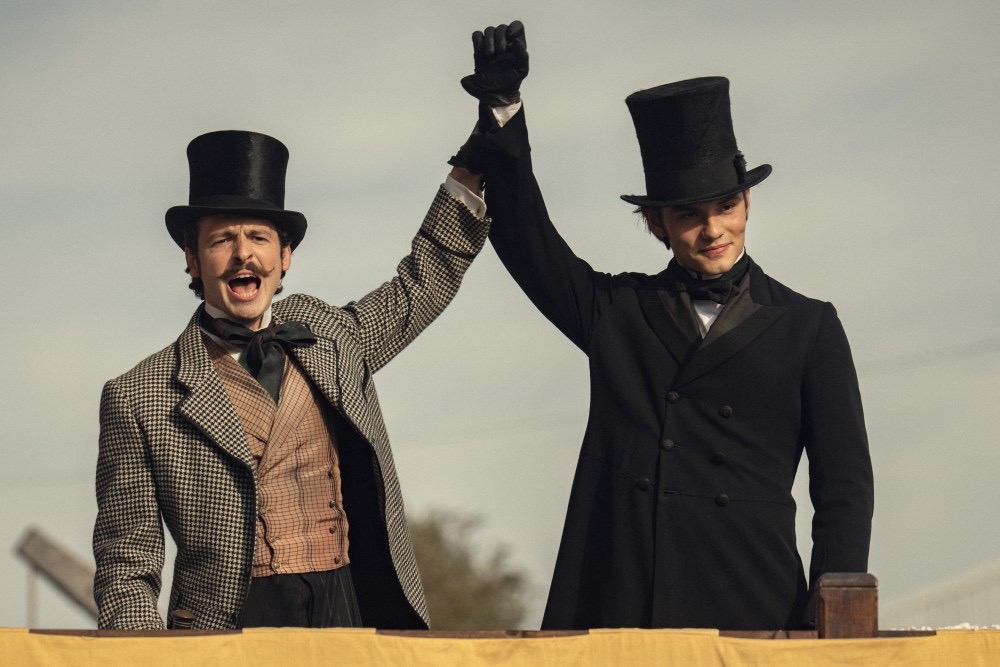
Now we have Netflix’s seven-part “East of Eden,” created and scripted, ironically enough, by Kazan’s actress granddaughter Zoe Kazan. It is, for better or worse, tremendously faithful to the book.
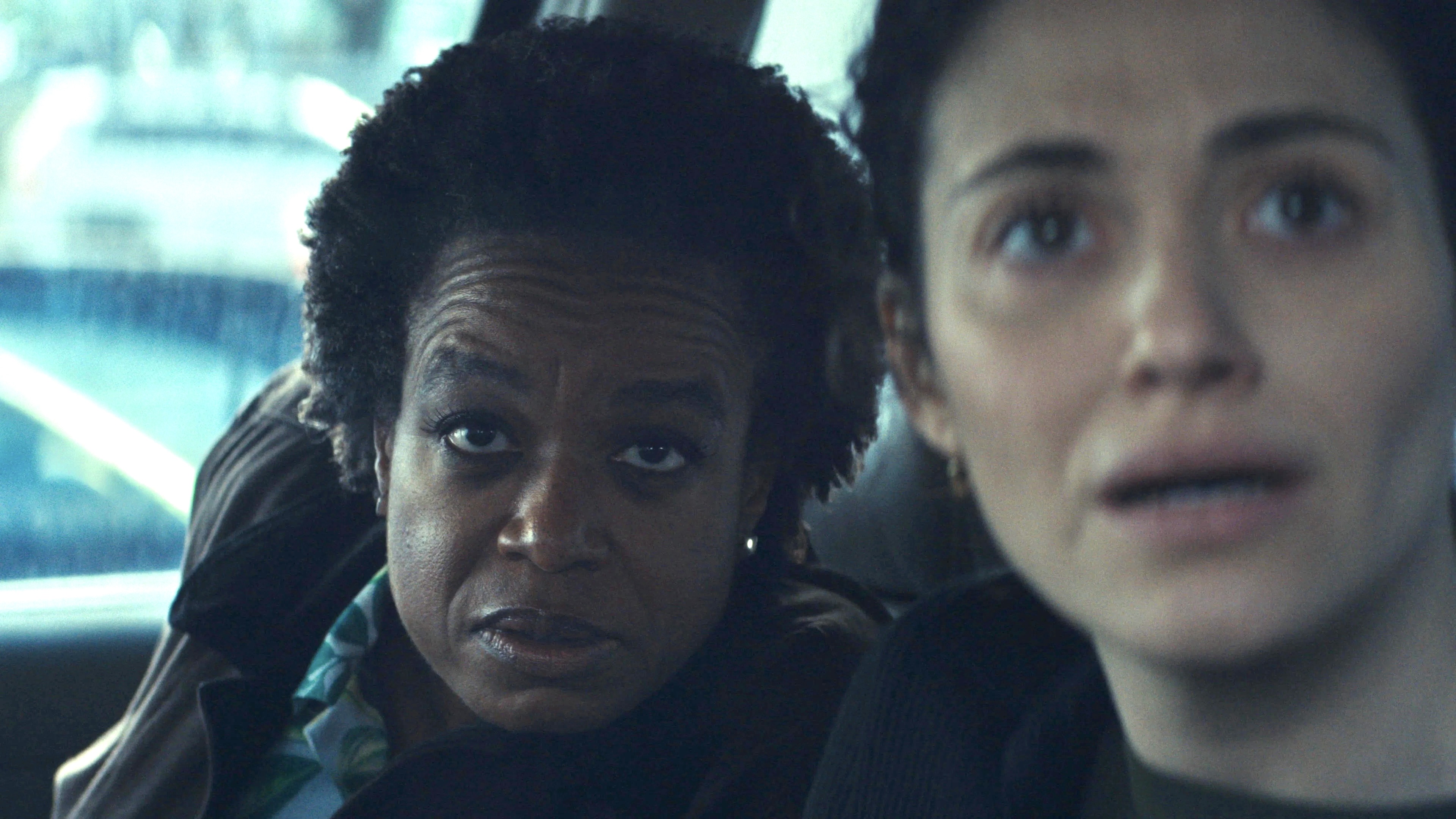
It also features Florence Pugh delivering one of the most devastating performances you’ve ever seen. Despite the overall high quality of the acting, it’s safe to say this “East of Eden” is pretty much her show.
Her character, Cathy, appeared only briefly in the ’55 film and then only as the bloated, aging madam of a Salinas bordello. But in this miniseries she’s the linchpin on which the drama turns…when she’s not on screen the show is OK, but when she’s front and center you cannot look away.
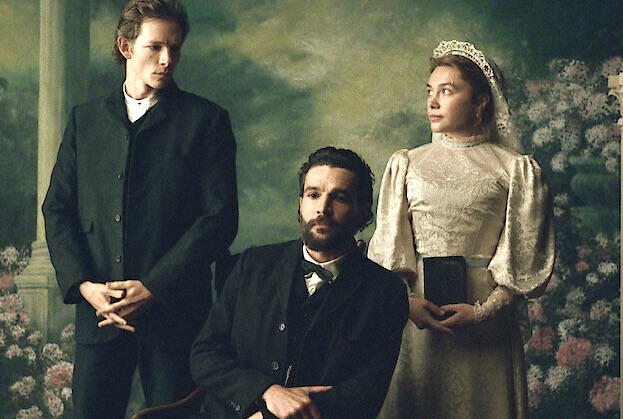
We first see her beaten to a bloody pulp and crawling across a plowed field toward a Massachusetts farmhouse. There she is discovered by bachelor brothers Adam and Charles Trask (Christopher Abbott, Mike Faist), who take her in and send for the local sawbones.
The series’ episodes have been structured in such a way as to introduce the main characters as adults and then delve into their pasts.
Thus we see Adam and Charles as boys (played by Asher Whitehead and Gus Turner), being reared by their martinet of a father (Tracy Letts), a cruel blowhard who has parlayed his brief Civil War service into a full-time gig in the Washington bureaucracy. The brothers have been twisted in different ways by their sneering sire…Adam is cowed and naive, Charles tough and cynical.
Moving ahead we find Adam playing nursemaid to the recuperating Cathy; Charles doesn’t trust her for a minute. Obviously, Adam is falling for his beautiful (once the blood has been wiped off) patient.
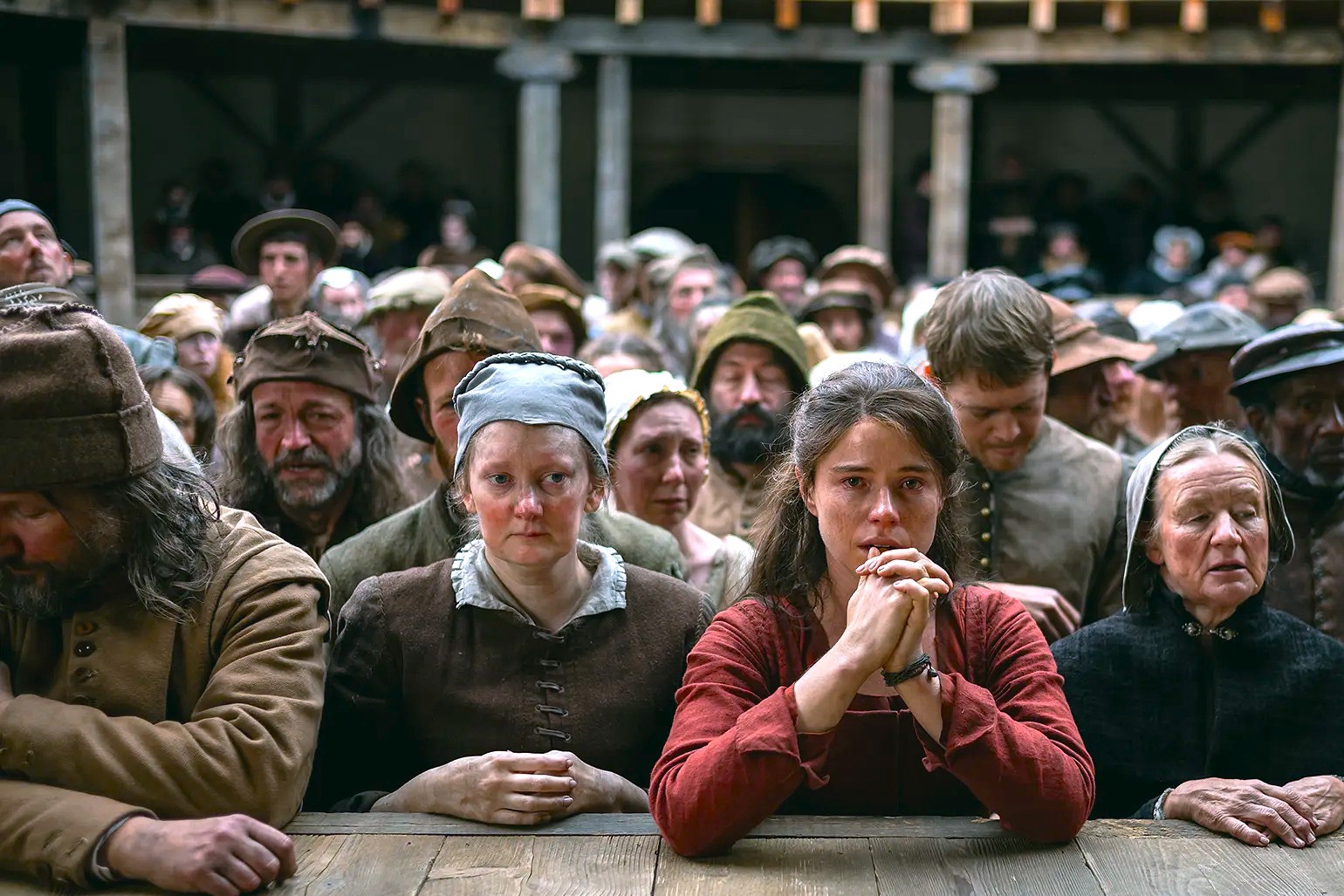
Then we get an entire episode keyed to Cathy’s childhood (she’s played as a teen by Ella Gillan) in a deeply religious family and her growing anger at the limited options available a woman in that time and place. She proves herself to be something of a shape shifter, hiding her true personality to adapt to her circumstances.
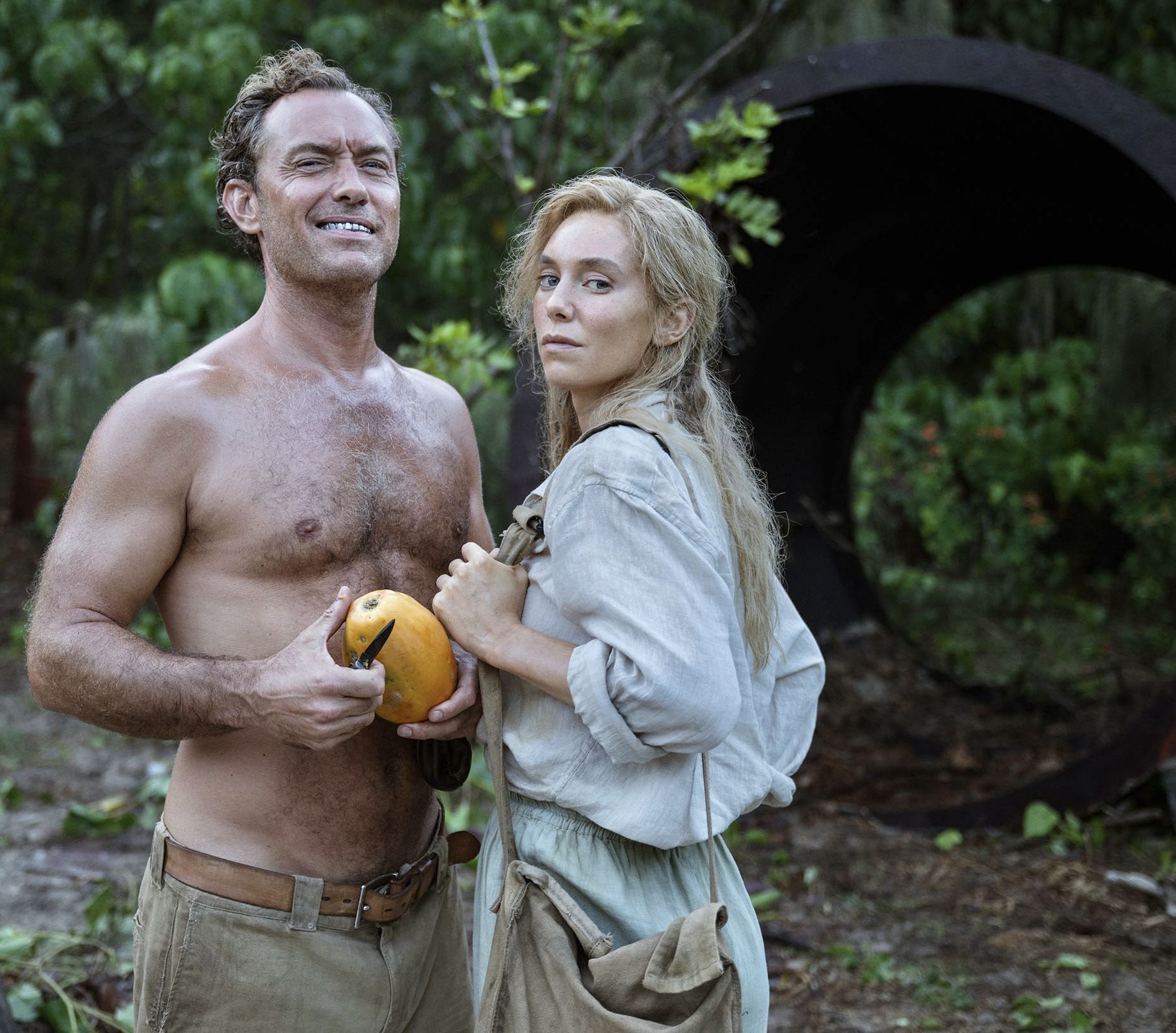
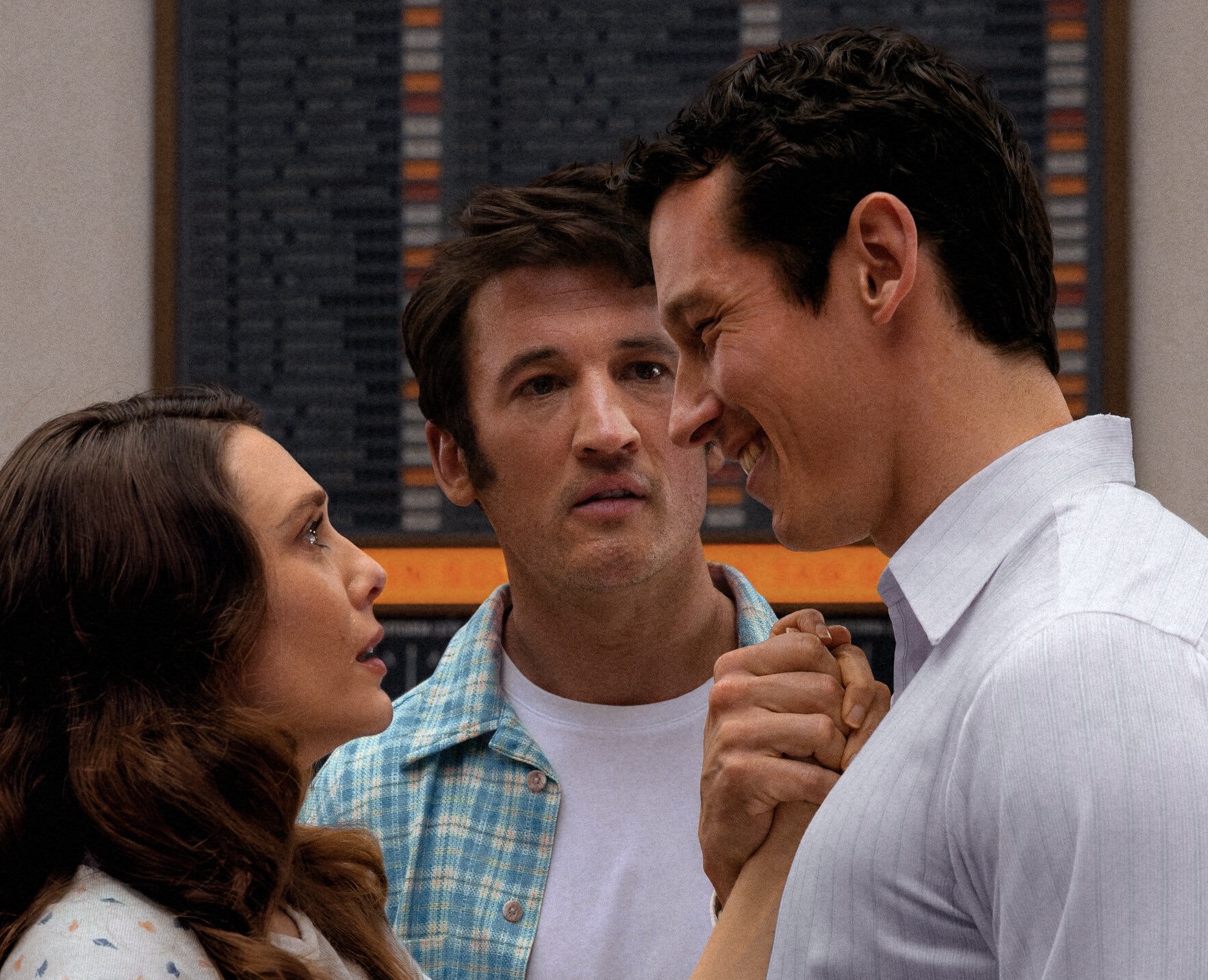
Mike Faust, Christopher Abbott, Florence Pugh
We quickly realize that Cathy is profoundly amoral, if not downright sociopathic. She will literally kill to realize her independence.
Married to the clueless but desperately adoring Adam, she resettles with him on a California ranch and gives birth to twin boys. (Are they Adam’s or his brother Charles’?) Feeling trapped, she abandons her family, vanishing into the world of prostitution.
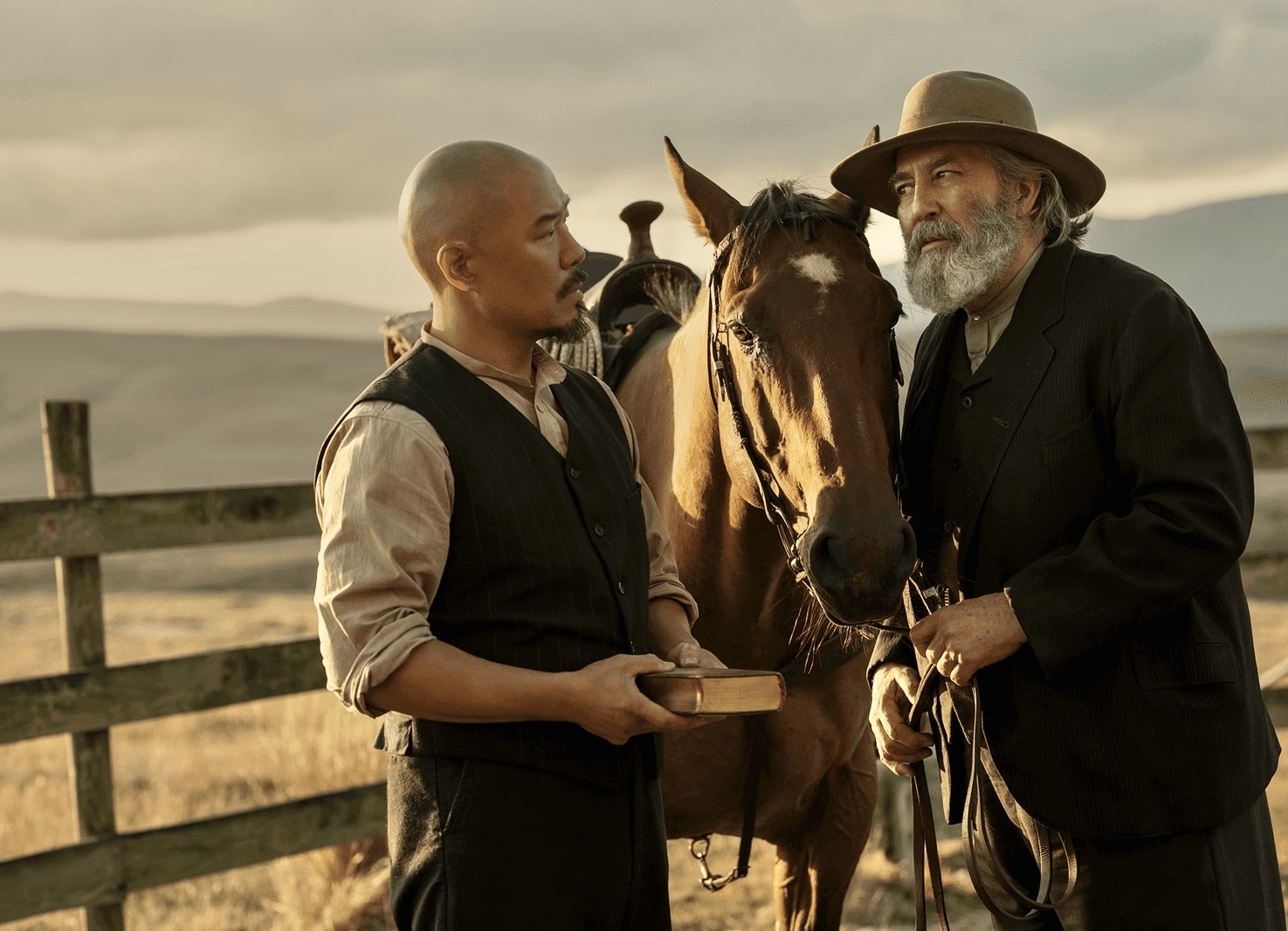
Thereafter the heartbroken Adam barely moves from his rocking chair. Young Cal and Aron are basically reared by their Chinese cook/housekeeper (Hoon Lee) and a garrulous neighbor (Ciaran Hinds). (Lee and Hinds are a revelation, belying the old notion that nice guys are boring.)
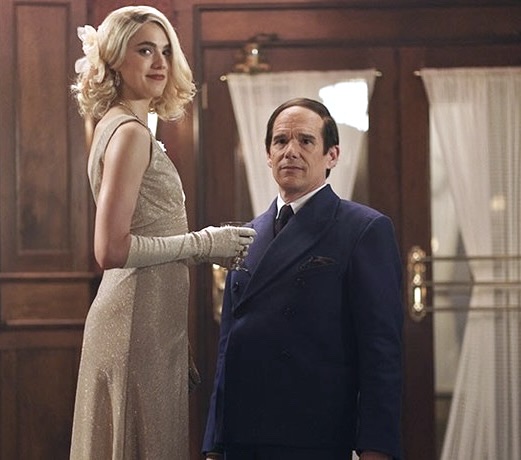
Hoon Lee, Ciaron Hinds
Running throughout “East of Eden” are intimations of the biblical Cain and Abel. Just as Adam is compassionate and his brother Charles hard, so is Aron (Joe Anders) the good son and Cal (Joseph Zada) the black sheep who acts impetuously and is always in and out of trouble. (Zada has his work cut out for him…the role of Cal will always belong to James Dean, whose ability to sell adolescent angst is unsurpassable.)
Now all of this is fine. But what sticks with the viewer are the moments when the narrative turns to Cathy as she worms her way into the good graces of an aging brothel owner (Martha Plympton) and in short order inherits the operation.
Pugh’s Cathy is conscienceless, a demonic succubus who radiates allure but sees sex merely as a means to an end. She’s one of the nastiest pieces of work ever depicted, but in Pugh’s hands she is not only watchable but compelling. This perf is nuanced beyond belief. There’s something almost heroic in Cathy’s determination to be her own person. You’ll find yourself reluctantly admiring her unapologetic quest for agency and self-realization. Ayn Rand would have loved her.
“East of Eden” has been directed by Garth Davis and Laure de Clement-Tonnerre, who eschew cinematic tricky for straightforward storytelling. The production values are first rate, my only complaint being that 1900s Salinas CA is depicted as having massive European-style stone buildings inappropriate for a frontier farming community (BTW the show was filmed in New Zealand).
When it’s all over, though, what we recall is Pugh as the scheming, terrifying but spellbinding Cathy. Most actors work a lifetime for a role this juicy…once this one sets up in your head there’s no getting rid of her.
“THE MINISTRY OF UNGENTLEMANLY WARFARE” My rating: C(Netflix)
202 minutes | MPAA rating: R
It’s hard to sympathize with Nazis — but that was before Guy Ritchie’s “The Ministry of Ungentlemanly Warfare.”
In this stiff-upper-lip variation on “The Dirty Dozen” a crew of British military prisoners — members of the armed services who have been condemned for their bloodthirsty ways — are sent out to sabotage a ship carrying vital supplies for Hitler’s U-Boat fleet.
Apparently the film has some basis in fact. We’re told newly declassified documents have revealed that during WWII Winston Churchill authorized a clandestine group of killers. The unit’s methodology was so appallingly brutal that their activities were kept a secret from the British public. In fact, only a few highly-placed military men knew of it.
Ritchie’s retelling (the script is by Paul Tammy, Eric Johnson and Arash Amel) offers seemingly endless action scenes seasoned with big dose of black humor and a nihilist sensibility.
Not to mention the torn corpses of countless Germans unlucky enough to encounter our heroes, who positively relish the mayhem.
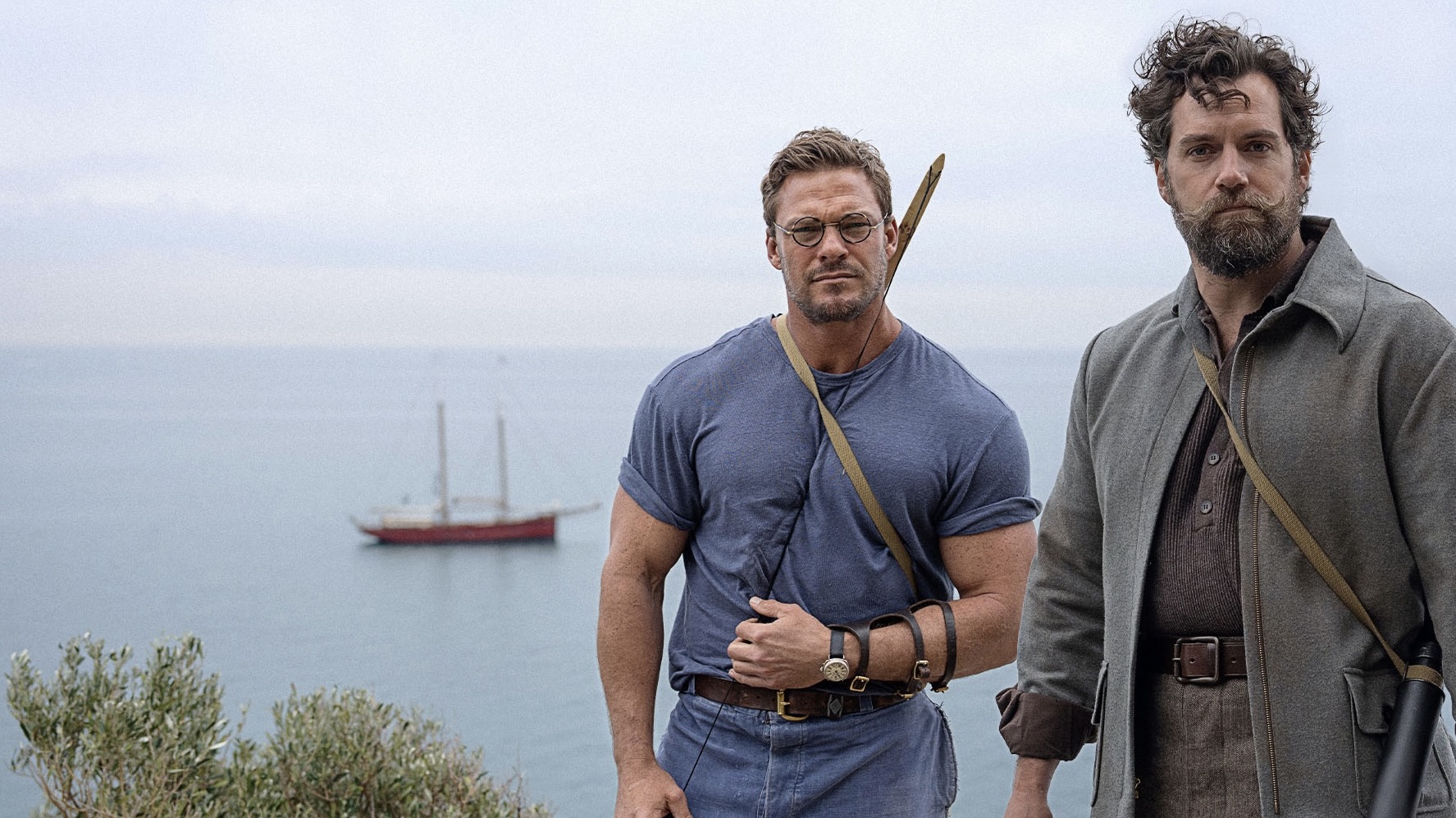
Leading the band of merry murderers is Gus March-Phillips (Henry Cavill with luxurious beard) and a towering Swede (Alan Ritchson) who enjoys thinking up the most painful and personal ways to dispatch Germans. Alex Pettyfer, Hero Fiennes Tiffin and Henry Golding round out the crew. Taken as a whole, they look like carousing male models.
Much of the film unfolds on the high seas as our guys pose as fishermen in an effort to sneak up on their target.
Meanwhile they have help from a couple of spies (Eliza Gonzalez and Babe Olusanmokun) who have infliltrated a German-occupied seaport on the West African coast. There they get things ready for our guys and deal with a sadistic (is there any other kind in the movies?) German officer (Til Schweiger).
We also have Rory Kinnear as Churchill (a usually reliable actor who here didn’t convince me for a minute), Freddie Fox as Ian Fleming (yes, the creator of James Bond) and Cary Elwes as Brigadier Gubbins, the model for the Bond series’ “M.”
Viewers looking for a big fix of bloody action will get that and more. Violence usually doesn’t bother me, but the murderous glee on display here really rubbed me the wrong way.
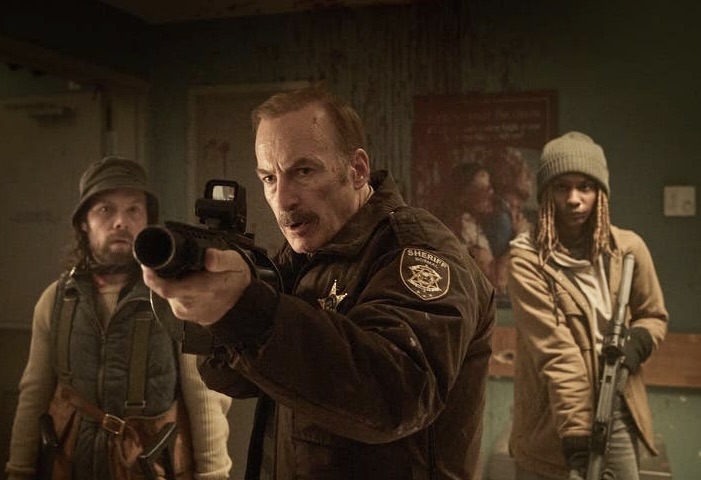
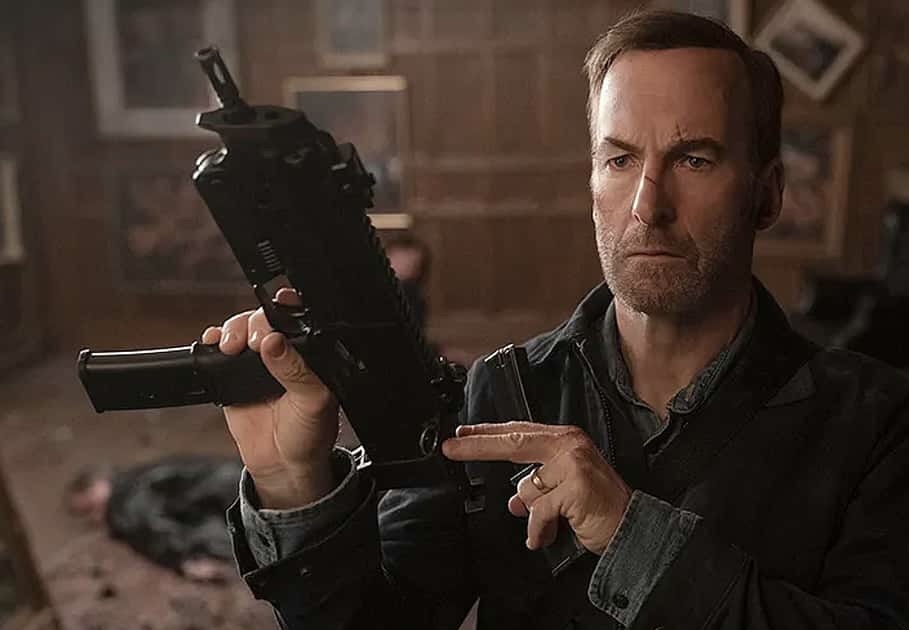
Bob Odenkirk
“NORMAL” My rating: C+(HBO Max)
91 minutes | MPAA rating: R
The transformation of funny guy Bob Odenkirk into a full-fledged action star (“Nobody,” “Nobody 2”) continues with “Normal,” the latest from Brit auteur Ben Wheatley (“Kill List,” “A Field In England”).
The setting is Normal, a Midwestern farm burg in the dead of winter. Odenkirk plays Ulysses Richardson, a law enforcement floater who has been temporarily assigned to take over the sheriff’s department after the mysterious death of the old sheriff.
Ulysses is an underachiever waiting to reach retirement age. Turns out he picked the wrong town in which to lay low.
The script by Derek Kolstad and Odenkirk kicks into gear with an attempted robbery of the local bank. That act triggers an eruption of murder, culminating with the town being invaded by an army of Japanese Yakuza.
In a sort of perverse variation on “High Noon” Ulysses finds he cannot rely on this fellow citizens for help…not because they’re cowards but because they’re all working for the bad guys.
“Normal” features a couple of sneaky guest appearances (Henry Winkler, Lena Headey) and a whole lot of spectacularly staged violence. The tone is tongue-in-cheek, plenty of action but not the kind to leave a bad taste in your mouth.
“STAR WARS: THE MANDALORIAN AND GROGU” My rating: C(Disney+)
132 minutes | MPAA rating: PG-13
We might as well accept that “Andor” was so freaking good that no other “Star Wars” spinoff comes even close to matching it.
Certainly not “The Mandalorian and Grogu,” a feature-length addition to the “Mandalorian” saga that never rises above the level of kiddie matinee filler.
Oh, it’s a technical marvel, sure. Great sets and costuming, killer S/F and some pretty good fight scenes.
But the script (from director Jon Favreau, Dave Filoni and Noah Kloor) isn’t even up to the standards of the streaming series.
Maybe it’s the length…each half-hour “Mandalorian” episode successfully stood alone while contributing to an expanded narrative. (They also has nifty references to past cinematic landmarks.) But at two hours plus the film’s near-complete lack of forward momentum becomes exhausting.
The plot, to the extant the movie has one, finds Mando (Pedro Pascal) and Grogu (aka Baby Yoda) in the hire of the New Republic. They’re bounty hunters assigned with rounding up former bigwigs of the defeated Galactic Empire who are still making trouble in various corners of the universe.
A huge chunk of the film is devoted to their attempt to rescue Rotta Hutt (voiced by Jeremy Allen White), nephew of the late Jabba and now a gladiatorial slave on a distant planet. Rotta, of course, is one of those big slug creatures whose fighting style is part sumo wrestler and part steamroller.
There are also a crew of sawed-off space mechanics who seem derived from both the Ewoks and the cartoon Minions.
Among the few recognizable human faces is that of Sigourney Weaver, playing the Republic colonel in charge of the sweep effort…she looks really bored. Various voices are supplied by Martin Scorsese, Shirley Henderson, Stephen McKinley Henderson and others.
The yarn finds little Grogu growing into his role. He doesn’t speak, and he still has a childlike curiosity and ravenous appetite that are forever getting him into trouble, but he’s learning to use his Jedi powers. One comes to this effort hoping for more comic interplay between Mando and his little green sidekick, but it’s all pretty weak tea.
Pascal has only one scene without his helmet. Mostly he provides Mando’s voice. Two other performers, Lateef Crowder and Brendan Wayne, are credited respectively as Mandalorian Stunt Performer and Mandalorian Suit Performer.
Which I guess means that Pascal recorded his dialogue but was rarely on the set.
Chiwetel Ejiofor
“BACKROOMS” My rating: B-(Rent on Prime)
126 minutes | MPAA rating: R
Kane Parsons’ “Backrooms” defies explanation. So if you like your mysteries wrapped up with a nice tidy bow, you’re in for a long night.
Still, few films can match “Backrooms” for establishing and maintaining a waking dream from which there is no escape.
The operator of a shabby discount mall furniture store (Chiwetel Ejiofor) discovers in the basement a portal into a series of backrooms…a maze of what looks like an abandoned strip mall office spaces and hallways that goes on endlessly. Everything is painted in a sickly pastel yellow and lit by fluorescent ceiling fixtures.
It’s almost as hellish as a real strip mall office.
The deeper he ventures into this alternative universe, the more bizarre the architectural elements. Doors on ceilings, slanted floors, furniture that appears to have melded with the surrounding surfaces. In the distance we can hear voices muttering in different languages.
(Just a moment here to applaud the work of production designer Danny Vermette, who has created a sprawling backrooms world so big that it can be traversed by camera in a seemingly endless single take.)
The screenplay by Parsons and Will Soodik establishes early on that our protagonist, Clark, is a troubled soul. In sessions with his psychiatrist (the great Renate Reinsve, late of the Oscar-nominated “Sentimental Value”) Clark talks about his failed marriage, his struggling business and his long-dashed dream of becoming an architect.
Weirdly, his experiences in the backrooms appear to reflect— in hugely distorted form — those failures.
Eventually Clark pulls a couple of his twentysomething employees (Finn Bennett, Lukita Maxwell) into an exploration of the backrooms, an experiment that proves deadly. And late in the film the shrink finds herself trapped in her patient’s bizarre environment.
What does it all mean? Well, that’s the question.
A few years back Parsons produced a “Backrooms” internet series, and folks who are familiar with that says it goes a long way toward explaining what’s happening in the film. But I can only go on what we’re given…including occasional appearances by Mark Duplass as Phil, who watches all this unfold on a closed-circuit TV network. Apparently the backrooms are being studied by some shadowy corporation.
“Backrooms” never quiet satisfies narratively, but environmentally speaking it is a world unto itself. Glad I visited. Would hate to live there.
Female rage is front and center in the aptly named “Furious,” a female revenge tale that is both cathartic and deeply disturbing.
This eight-part Hulu offering owes a lot to 1987’s “Black Widow,” the Debra Winger/Theresa Russell thriller about a female serial killer who marries wealthy men and then sneakily murders them for their fortunes.
This time around the serial killer is the streetwise Catherine (Lola Petticrew), who as a teen was sex trafficked by rich and powerful men (think Epstein) and now employs an arsenal of characters and disguises to seduce and murder the guys who done her wrong.
On her tail is Alice Black (Emmy Rossum), a one-time NYPD detective now starting her career with the FBI. Alice serves on a joint task force with Manhattan cop Danny (Scoot McNairy) and FBI agent Nora (Quincy Tyler Bernadine), who has spent her career down in the basement investigating sex crimes.
The two women are damaged goods. Alice was frequently physically abused by her former policeman boyfriend (Jake Lacy), while Nora is a raging alcoholic, thanks in part to a job that has her watching and cataloging kiddie porn day after day.
Both women carry a tankful of contempt for the men they work with…well. all men, actually. Danny is the sole exception, being a soulful guy who has long adored Alice from afar.
The plot of “Furious” centers on the authorities’ efforts to identify and capture the killer. But what really gives the show depth are the deep, soul-shredding performances of the three female leads.
Catherine has been driven borderline crazy by what she endured as a young woman. But neither Alice or Nora is your usual cop-show heroine. Both are deeply troubled and do things that repel us even as we recognize how they got to this state.
Bernadine’s Nora is particularly effective, displaying a biting sense of humor and a “screw you” attitude toward her patronizing bosses. Despite the overall grimness of the show you’ll find yourself laughing at her savage put-downs.
Lola Petticrew
Even the merciless Catherine is fully rounded. She survives as a caregiver for a wheelchair-bound young man (comic Steve Way, whose muscular dystrophy forces him to emote through an oxygen mask). On some level theirs is a love story.
Even the smaller roles are exquisitely cast and performed: Campbell Scott and Rob Delaney as two of Catherine’s targets; PeterMcRobbie as a dying industrialist addicted to watching old sex videos of himself and his victims, and Hope Davis as his daughter and partner in crime.
The show’s six writers and four directors display a deft touch in juggling moods, and as a study in the lingering fallout of abuse “Furious” s in a class of its own.
“DANCE LIFE” (Prime Video)
Back in the bad old days dancers ran the risk of being called sissies. If you ever thought that depiction accurate, the Aussie documentary series “Dance Life” will pretty much twist your head around.
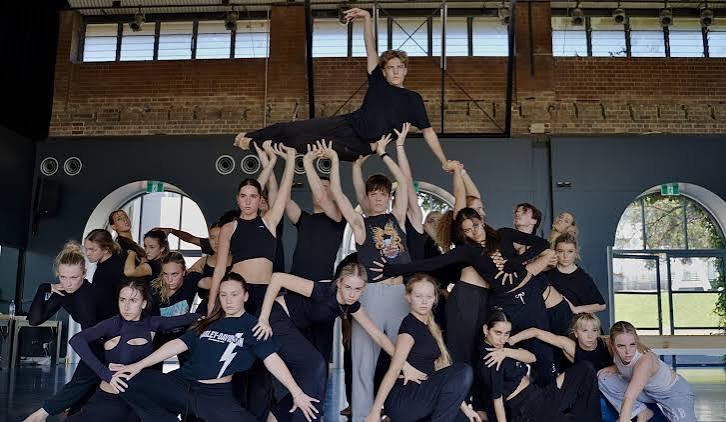
Luke Cornish’s five-part series follows first-year dance students at Australia’s Brent Academy, an arts school not unlike that depicted in the “Fame” movie and TV series.
What sticks with you from the show — even more than the spectacularly performed and filmed dance segments — is the students’ devotion to their art through pain, injury and emotional turmoil.
The primary teacher is choreographer and dancer Cassie Bartho, a familiar presence on Down Under dance stages, who combines tough love and a surprising vulnerability in guiding her students through a killer curriculum.
The kids’ stories are varied and frequently moving. One girl dances through a congenital spinal injury. Broken toes and bloody feet are everyday occurrences.
Every viewer will develop his or her own favorites. I found myself being particularly drawn to Emily Smith, whose physique is just about the opposite of your typical reed-thin ballerina. While everyone else is in shorts and halter tops, Emily hides her figure in bulky sweatshirts…clearly she has a bad case of body image. What’s surprising then, are her eruptions of energy in hiphop and breaking routines — she’s like a tsunami of determined movement.
And then there’s Archer Rose, a trans dancer whose willowy figure and long blonde hair make him an icon of sexual ambiguity.
The series follows the kids through training, rehearsals and big public performances. By the time it’s all over you don’t just want to watch them…you want to be them.
That’s the inescapable lesson of Ridley Scott’s “The Dog Stars,” an overcooked adaptation of Peter Heller’s end-of-the-world novel.
On the printed page “Dog Stars” is apocalypse on an intimate scale, fueled not by big action moments but by a creeping sense of loss. But Mark L. Smith’s screenplay pumps things up in an effort to please the lowest common denominator and the results have more in common with your average zombie flick than, say, Cormac McCarthy’s The Road.
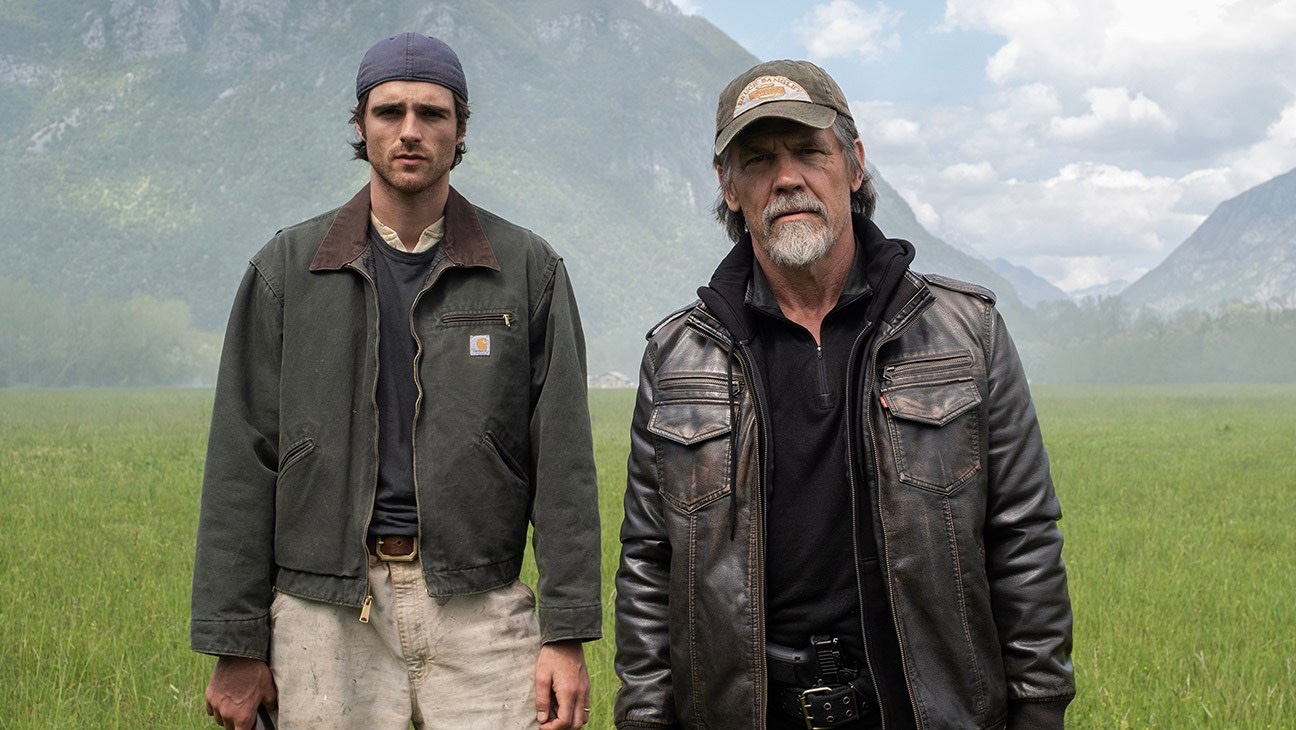
Ten years after a pandemic has wiped out most of humanity, Hig (Jacob Elori) and Bangley (Josh Brolin) eke out a living on an abandoned airstrip in the foothills of the Rocky Mountains.
Hig is a pilot who has managed to keep one Cessna running; he periodically flies into what’s left of Denver to collect food and other necessities. He seems to be a decent guy. Hig loves his dog and visits a Mennonite community in a nearby valley to deliver food and medicine.
Bangley, on the other hand, is a long-time survivalist (no doubt he’s ex-military) who thrives on isolation. Early on he uses his long-range rifle to kill a couple of teens who have wandered into his domain. His approach is to shoot first and question the corpses later.
The plot centers on Hig’s determination to reach Grand Junction after hearing a broadcast from that town’s airport. Forced down by engine trouble, he stumbles upon a father and daughter (Guy Pearce, Margaret Qualley) who have been living peacefully deep in the mountains. The old man is suspicious of this interloper but the woman sees in Hig a last chance for a more-or-less normal existence.
The film’s first half is actually pretty good. Then things go downhill fast.
Screenwriter Smith suddenly changes gears. All that melancholy moodiness is tossed out on its ear in favor of two huge action sequences. In one Hig and his newfound friends must outrace a mounted band called the Scavengers to his newly-repaired airplane. Meanwhile Bangley undergoes a siege by a small army of tattooed berserkers.
Jacob Elori, Margaret Qualley
Things get even more ridiculous when Hig and his new comrades set down in Grand Junction to find the place a fiefdom presided over by the bonkers Darlene (Allison Janney in scenery-chewing overdrive), who wears a spotless airline hostess outfit from the 1970s (love the pillbox hat) and has developed an unconventional diet for her doped-up minions. (Use your imagination.)
At one point we’re supposed to believe that three hand grenades have the destructive power of a small thermonuclear device.
“The Dog Stars” at least looks good, thanks to Erik Messerschmidt’s cinematography — though Italy’s Dolomite Mountains don’t really look much like the American Rockies.
Acting honors go to Brolin for his tough-minded, utterly unsentimental Bangley, whose brusque approach to every action provides the film’s only brief flashes of humor.
“TEENAGE SEX AND DEATH AT CAMP MIASMA” My rating: B (In theaters on Aug. 21)
112 minutes | MPAA rating: R
There’s so much to unpack in Jane Schoenbrun’s “Teenage Sex and Death at Camp Miasma” that you practically need a flow chart to keep on top of all its ideas.
As the name implies, it’s a parody of those teen slasher films in which horny adolescents are carved up by a mysterious masked individual.
But it’s also a tale of sexual liberation. And a visual tour de force. And a sly look at the process of artistic creation.
And, believe it or not, a showcase for two of the year’s best performances.
That said, it ain’t for everyone.
Schoenbrun’s previous film, 2024’s “I Saw the TV Glow,” centered on outsider teens obsessed with a cheesy ’80’s TV horror/fantasy. It was a somber affair, sad even, but it got under my skin even if I wasn’t quite sure of just what was going on.
“Teenage Sex…,” on the other hand, is a goofy lark, albeit one that draws heavily on Schoenbrun’s own childhood and career.
Just so you know where we’re coming from here: Schoenbrun is transgender (their early films were made under the name Dan Schoenbrun) and while in the fifth grade they devoted a month to watching every “Nightmare on Elm Street” film. All that is in evidence in this latest effort.
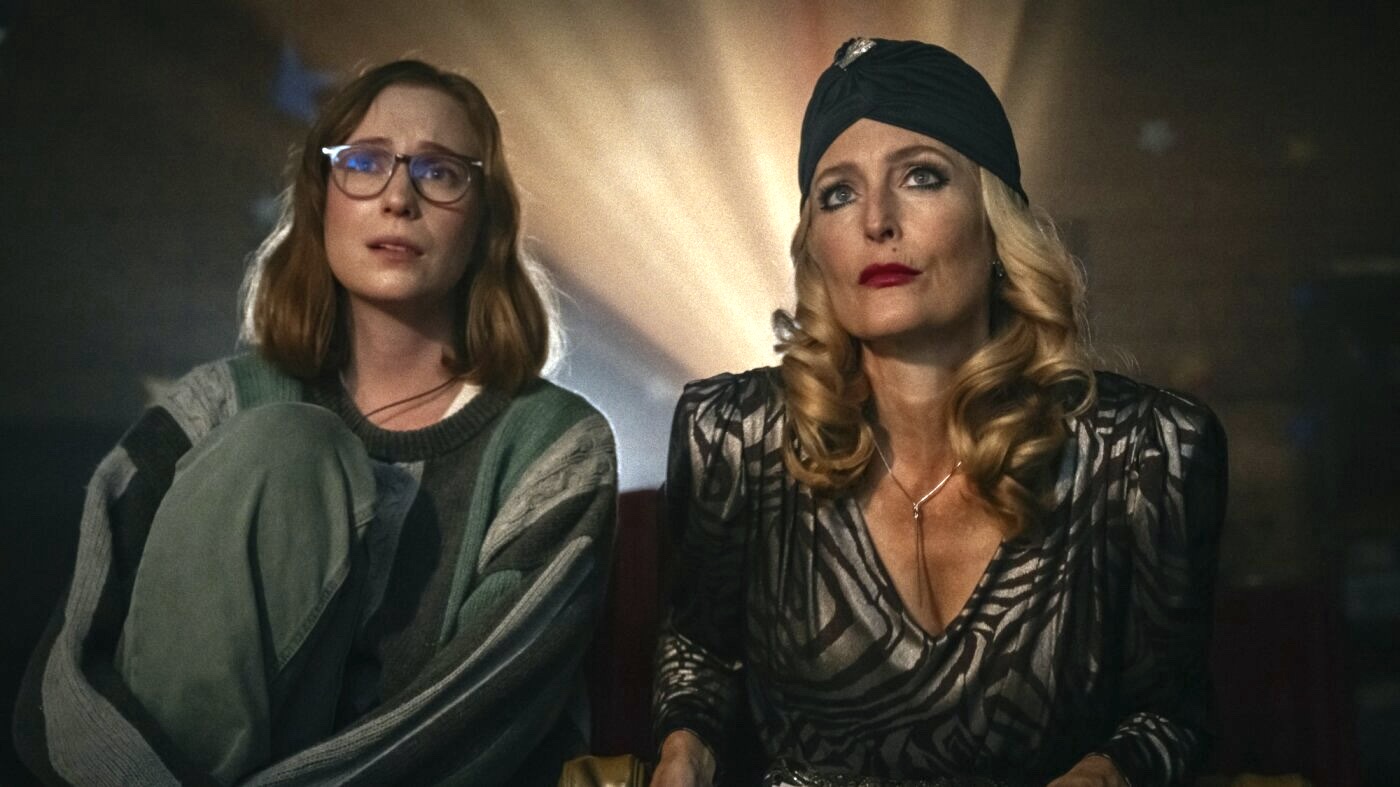
The setup: Lesbian filmmaker Kris (Hannah Einbinder) has come to the Pacific Northwest to visit the summer camp that was the setting for her favorite series of horror flicks. She’s planning a reboot of the “Camp Miasma” franchise, and her goal is to track down the female star of the original film.
That would be Billy (Gillian Anderson), who dropped off the map after her screen debut and for 30 years has been living as a recluse in a cabin at the long-abandoned summer camp.
Einbinder and Anderson dominate what is essentially a two-character film. As she showed in her Emmy-winning work in “Hacks,” Einbinder is a comic engine. Here she lacks the killer one-liners that fueled “Hacks,” but makes up for it in dorky earnestness and her fan-boy mania. Kris is a post-modern intellectual, but when it comes to her unfulfilled sexual and emotional needs she’s comically childlike.
Anderson’s Billy, on the other hand, comes off a bit like a turbaned Gloria Swanson in “Sunset Boulevard,” albeit with a molasses-tinged southern accent. Sexy but weird.
Schoenbrun’s screenplay has Kris staying at the snowbound camp so as to coax Billy into signing up for her new movie. Along the way they watch the original “Camp Miasma,” which introduced Little Death, a killer in a white hazmat suit and a head-covering mask that looks like an air duct vent.
So basically we’ve got two movies here. The one about Kris and Billy, and then the one they’re watching on an old 16mm film projector. “Teenage Sex…” is forever shifting between the two.
Little Death
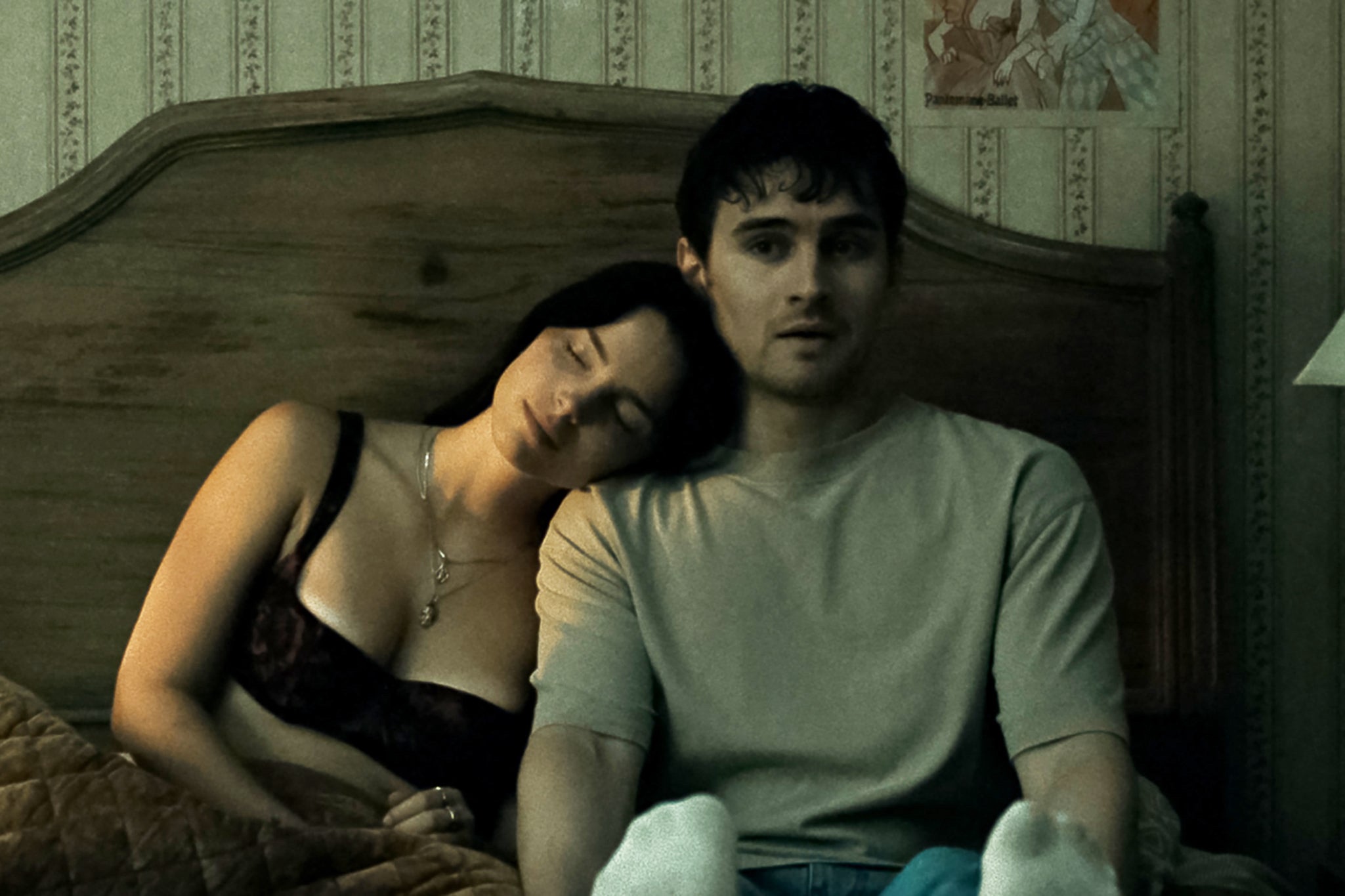
All this comes to a head when Little Death rises from the lake bottom where he/she/it has been hibernating and gets to work slashing. Simultaneously the uptight Kris at last finds sexual liberation in Billy’s arms.
The name “Little Death” (the character is portrayed by trans actor Jack Haven, who starred in “I Saw the TV Glow” under the name Brigette Lundy-Pain) is an English translation of the French term le petite mort, a reference to post-orgasmic bliss.
So the threat posed by Little Death drives Kris to sexual fulfillment.
Or maybe not. Perhaps all this is just happening in Kris’ fevered mind.
While some of “Teenage Sex…” has been shot in a real summer camp, other scenes play out against stagey backdrops done in such a way that you have to look twice to be sure whether it’s a real forest or just painted canvas. I think it’s Shoenbrun’s way of telling us not to trust everything we see — especially when it comes to the over-the-top gore of Little Death’s killing spree.
The film is also a sort of cautionary comedy about artistic struggle. There’s a marvelous scene which has Kris dealing with three of her producers on a Zoom call…Dylan Baker is spot on as a crass philistine who hasn’t time for Kris’ intellectual navel-gazing. He’s the kind of guy who just wants a movie with tits and blood. A demand, by the way, that Shoenbrun slyly satisfies.
Not everything here works. The movie-within-a-movie sequences, for example, so accurately mimic those old slasher flicks that, like the originals, they’re boring between bloodbaths. Is bad acting bad acting, even if it’s a parody of bad acting?
And Schoenbrun’s fragmented narrative style is bound to alienate literal-minded audiences. What can I say? Dreams and nightmares don’t always make sense. But the weirder they get the more we remember them. And it’ll be hard to forget “Teenage Sex and Death at Camp Miasma.”
What can I say, folks? So much hyperbole — both positive and negative — has been heaved at Christopher Nolan’s “The Odyssey” that it’s just about impossible to approach this epic with anything like a completely open mind.
What I took away from my experience was a sense of awe at the technical precision on display (there’s not a shot in the film that doesn’t seem to have been labored over ), a real sense of a journey that covers two decades, some riveting set pieces and a frustrating lack of emotional involvement. (I mean, the most intense feeling is delivered by a dying dog.)
The film is peppered with familiar faces, but most of the characters are barely skin deep.
It doesn’t feel like the film has a real point of view…yet it never feels like a slog. There’s always something interesting to look at.
Noland has never worn his heart on his sleeve. Most of his non-“Batman” films — from “Memento” through “The Prestige,” “Inception” and “Oppenheimer” — have been about ideas. Human emotions tend to take a back seat.
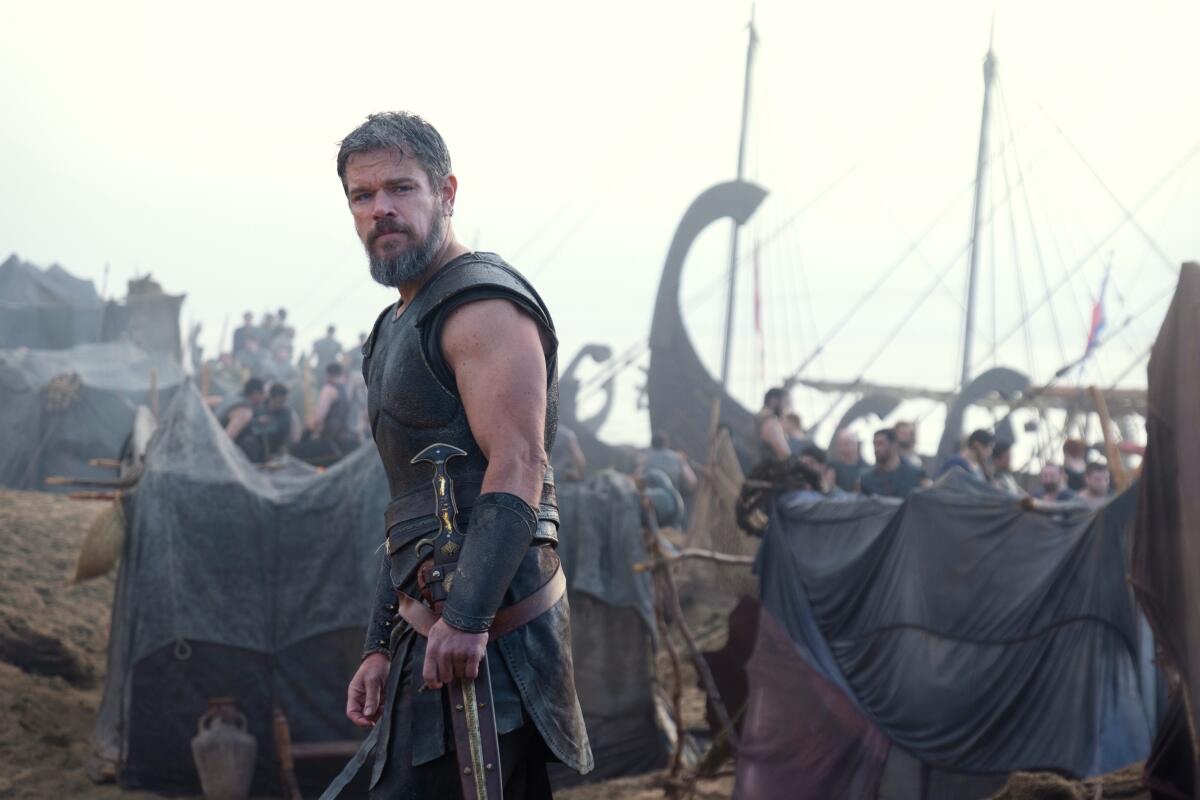
In this case it’s all about the journey. This is both the yarn’s strength and, for dramatic purposes, its big drawback. Homer’s poem is no well-made drama. It’s a series of encounters — sirens, Titans, cyclops, whirlpool — without a gripping through line (except, of course, the desire of Matt Damon’s Odysseus to get back home).
Nolan’s screenplay seems unsure of just what to make of the ancient Greeks’ world view. There’s much talk of what Zeus expects of men (in breaking that moral code Odysseus carries the burden of guilt), but the gods themselves rarely make an appearance. Zendaya does show up periodically as the goddess Athena, engaging Odysseus in conversation…but it’s pretty clear she’s a figment of his imagination. At least, none of his comrades seem to notice her.
Like just about every Nolan film, “The Odyssey” messes with time. The film is arranged non-chronologically. The yarn drifts back and forth between Odysseus’ long voyage, the siege of Troy, his life before the Trojan war, and the travails experienced back in Ithaca by his wife Penelope (Anne Hathaway) and son Telemachus (Tom Holland). It’s one of the smarter things Nolan has done to the material, with the past present and future all seeming to unfurl simultaneously. It keeps you slightly off balance and paying close attention.
Highlights? Well the segment with the cyclops is genuinely awesome. So is the vision of the Trojan horse, the wooden statue in which Odysseus and his men secret themselves in order to enter the city.
Damon is certainly watchable as our hero, but I rarely got a sense of Odysseus’ inner life.
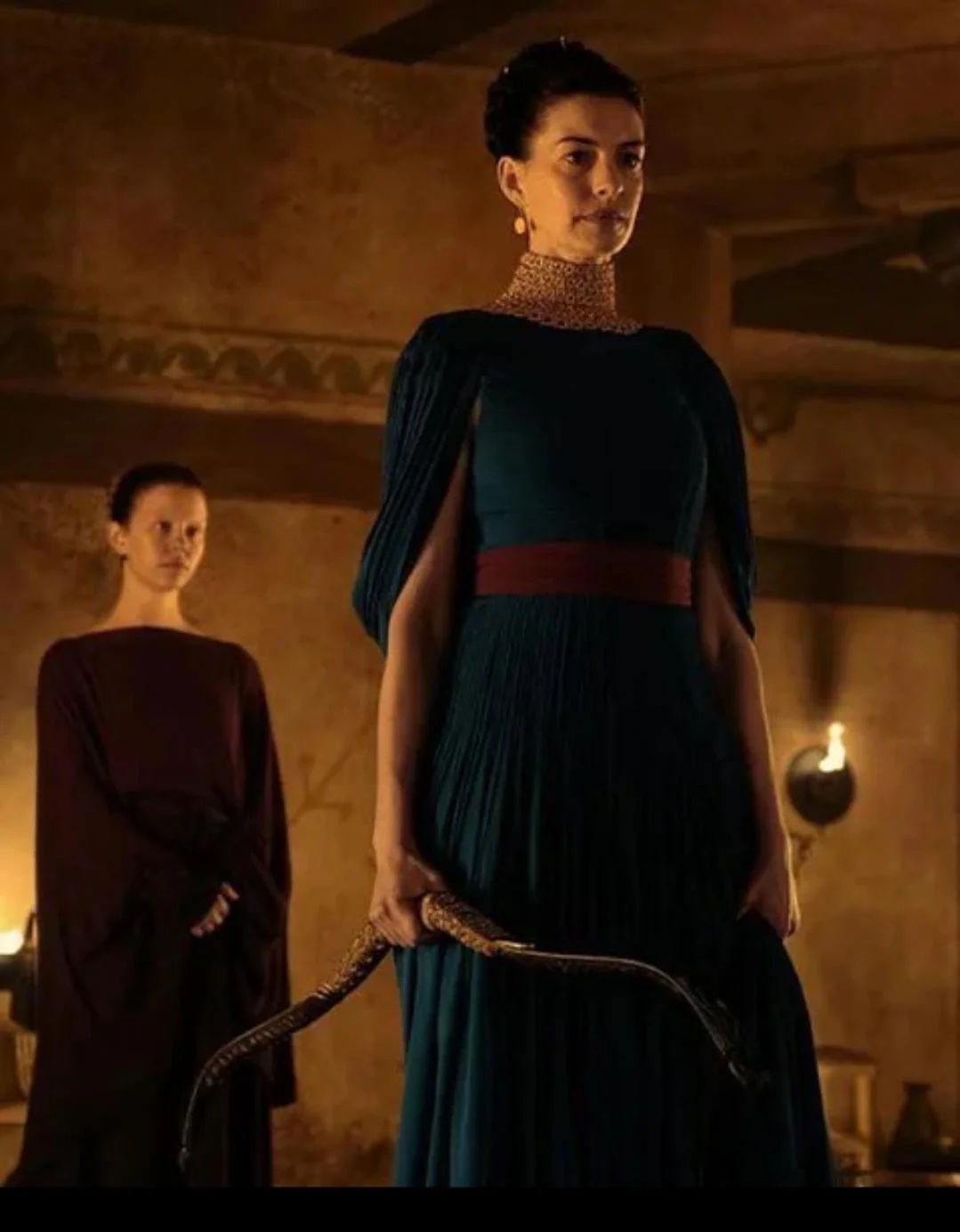
Hathaway has a few moments of genuine fierceness as Odysseus’ abandoned queen. Samantha Morton is riveting as Circe, the man-hating witch who transform’s Odysseys’ crew into swine. John Leguizamo is quite good as the aged blind herdsman whose loyalty to his master spans the years.
Anne Hathaway
Absolutely loved Ruth De Jong’s art direction, especially Odysseus’ hilltop palace in Ithica and the cave where worshippers pay homage to Athena.
Ludwig Goransson’s musical score is a hugely effective blend of sonic rumblings and primitive-sounding whistles and drums.
Didn’t like much of the sound mix, which rendered at least half the dialogue unintelligible.
Also, Nolan’s appropriation of modern language — did the ancient Greeks really use phrases like “okay” and refer to their fathers as “my dad”? — took me out of the moment.
And while we’re at it, very little of Nolan’s dialogue was memorable. The Odyssey is great poetry, yet there’s nothing the least poetic about these conversations.
Bottom line: I don’t regret devoting three hours to watching ”The Odyssey.”
Curry Baker’s “Obsession” (he wrote, directed and edited) has been getting lots of love, and not just from horror geeks.
It deserves it.
The setup is as old as the Midas myth…a wish comes true but brings with it unexpected consequences. The delivery, though, is a slow-burn dose of creepiness featuring a couple of killer performances.
Bear (Michael Johnston, who looks like he could be Daniel Radcliffe’s little bro) has long been infatuated with his co-worker Nikki (India Navarette) but fears scaring her off if he reveals his feelings. Bear’s pretty unsure of himself…he might still be a virgin.
But one day at a funky gift shop he picks up a novelty item called the One Wish Willow. According to the label on the box if you take out the stick inside, snap it in two, and make a wish…well, that wish will come true.
So he wishes that Nikki would love him more than anyone else in the world.
Oh-oh.
Baker’s screenplay is a model of careful observation and unexpected eruptions.
Nikki does indeed announce her love for Bear, and they are almost immediately in a passionate romance. She moves into his house. She caters to his every whim.
So far, so good.
But in short order her love has turned oppressive. She’s a whimpering mess when not in his presence. She even tries to seal his front door with masking tape to keep him at home. On her day off she stands unmoving in his living room, a sickly smile of hopeful anticipation frozen on her face and a puddle of urine at her feet, until he comes back from work.
She gets jealous — murderously so.
“Obsession” is creepy as hell. It’s also weirdly funny. A desperate Bear calls up the manufacturer of the One Wish Willow only to have the voice on other end (director Baker in a bored/stoned fugue) tell him that he only way to undo his wish is to die. And Darin Toonder is grimly funny as the gift shop clerk who’s had it up to here with customers bitching about the One Wish Willow.
One generally does not turn to horror for great performances, but Navarette approaches Oscar-level intensity as Nikki, turning on a dime from caring cajoling to screaming threat.
Be careful what you wish for.
Cooper Hoffmann, David Jonsson
“THE LONG WALK” My rating: B(Hulu)
108 minutes | MPAA rating: R
One might easily dismiss “The Long Walk” as a “Hunger Games”/“Battle Royale” clone designed as fodder for the YA market. Especially since it was directed by “Hunger Games” veteran Francis Lawrence.
So it comes as a surprise to discover a personality-and-dialogue-driven melodrama that carries an unexpected emotional heft.
Cooper Hoffmann (yes, Philip Seymour Hoffman’s kid…you may recognize him from “Licorice Pizza”) stars as Raymond, who as the film begins is preparing to participate in The Long Walk.
We learn (in bits and pieces sprinkled throughout the film) that 20 years ago the USA was engaged in a civil war and ever since has suffered through Depression-era hard times.
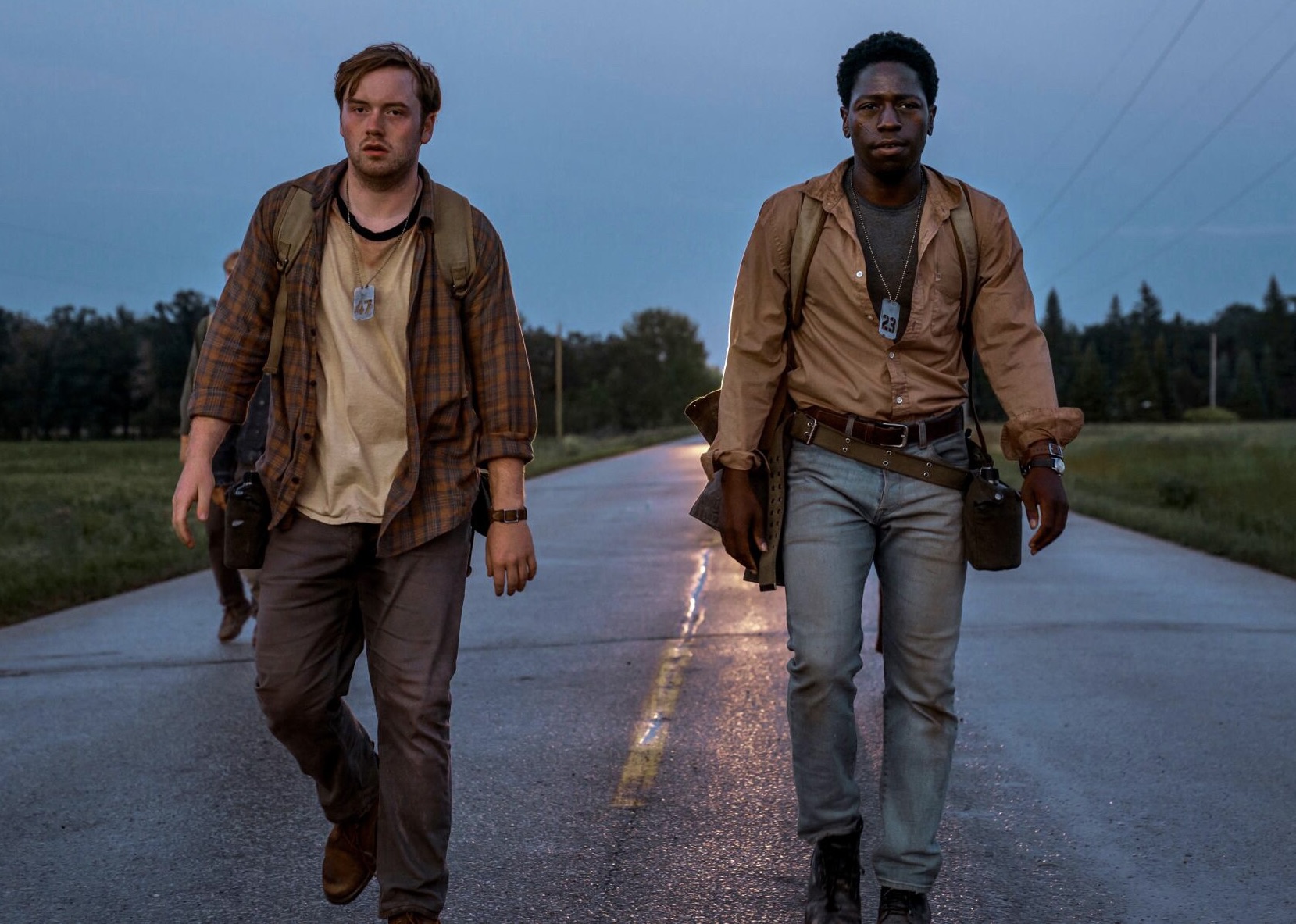
But each year the citizenry is rallied by a competition in which 50 young volunteers — one young man from each state — set off on a walk. Special wristwatches measure their speed…if they fall below three miles per hour they run the risk of being shot by the mute and stony-faced soldiers who accompany this parade.
There is no stopping, no sleeping, no leaving the pavement of the rural highway they are traversing. Eat, drink and defecate while maintaining a brisk pace. Eventually — after days of nonstop movement through sun and rain— one lone survivor will be crowned the winner.
J.T. Mollner’s screenplay (based on a Stephen King novel) is remarkable in that the characters are developed almost exclusively through dialogue. This is a walk-and-talk film…literally. The performances are an intriguing blend of stream-of-consciousness chatter and segments in which the dialogue seems as carefully crafted as that of a stage play or classic ‘50s film.
Raymond is almost immediately befriended by Peter (David Jonsson), a black kid whose garrulous personality makes the unending drudgery of walking a bit less oppressive. Indeed, the contestants are a regular smorgasbord of American youth — Asian, white, black, Native American. Intellectually they range from standard-issue rednecks to an aspiring author who hopes to turn his experience into a book.
What’s kinda unsettling is the way in which we the audience find ourselves participants in this exercise, sharing the ever-creeping exhaustion and growing desperation of the young men. There’s a kind of purity in the film’s narrow focus, a sort of cinematic minimalism that feels weirdly revelatory.The effect is not unlike that of “They Shoot Horses, Don’t They?”
Drawbacks? Well, Mark Hamill’s performance as The Major — the officer in charge of the operation —might seem a caricature, a parody of the military martinet oozing motivational gung-ho. But the Major is also the key to understanding what the US has become. Clearly the civil war was not won by the humanists.
Not a happy film, but one that sticks with you long after the lights go out.
Meryl Streep, Anne Hathaway, Stanley Tucci
“THE DEVIL WEARS PRADA 2” My rating: B-(Hulu)
119 minutes | MPAA rating: PG-13
Do we really need “The Devil Wears Prada 2”? Especially those of us — meaning me — who lack the fashionista gene?
So let’s admit that as time killers go, this sequel (directed by David Frankel, who helmed the original) is kinda charming.
Not for the too-familiar plotting or the clothes, but for the people.
I’m talking here mostly about Meryl Streep reprising her role as chilly, arrogant magazine editor Miranda Priestly and Stanley Tucci as her loyal doormat Nigel. (Is he gay? Straight? Sexless?)
In a weird way neither character is complete without the other. It’s a real oddball pairing, but I’d forgotten how terrific these two were together.
Of course Anne Hathaway is back as Andy. Twenty years ago she was Miranda’s much-abused gofer girl; now she returns as a prize-winning journalist left jobless by media upheaval and hired to give Runway magazine a socially conscious vibe to go with the fashion and fluff.
Andy considered herself a serious journalist, something Miranda and Co. have little use or tolerance for. Humorous situations develop. Not to mention a hostile takeover of the mag.
Returning also is Emily Blunt as Emily, one-time Miranda acolyte now running a high-end boutique. She’s engaged to a dweeby tech billionaire (Justin Theroux, cast against type and having the time of his life) but is at heart still a scheming witch. She also gets the best line in Lauren Weisberger and Aline Brosh McKenna’s screenplay:
“May the bridges I burn light the way.”
Has a character ever been so succinctly limned in just eight words?
Toss into the brew Kenneth Branagh and Lucy Liu and you’ve got a ridiculously attractive murderer’s row.
“Prada 2” isn’t entirely frivolous. The film strives for relevance by protesting the demise of American journalism and the rise of the misinformed multitudes…well, it’s not so much a protest as a grumpy observation stirred in with the fun and fashion.
Hey, audiences for this film didn’t come for a civics lesson.
Four women come to grips with their futures (and mortality) in Alice Winocour’s “Couture,” set in the Paris during Fashion Week.
The film is ambitious, wearing its feminism on its sleeve, but unfocused, with some of the characters developing genuinely involving situations and others merely treading water.
American filmmaker Maxine Walker (Anglina Jolie), who usually specializes in horror, has signed on to direct a short film to open the runway show of a major label. It’s a high-tension job in the best of circumstances, but Maxine has just discovered a health crisis that threatens to upend her life.
Ada (Anyier Anei) îs a naive 18-year-old refugee from the war in Sudan. Recruited by video, she soon finds herself both delighted and intimidated by the big city, especially the catty attitudes of the other models with whom she shares an apartment. She has a short learning curve but has to nail it…otherwise it’s back to a questionable fate in Africa.
Angele (Ella Rumpf) is a makeup artist kept busy zipping from one show top the next. Her real love, though, is writing. Early on an agent shoots down her manuscript and she now must come up with a new idea.
Finally there’s Garance Marillier as Christine, a young seamstress facing a deadline to finish work on the dress that will open her fashion house’s big show.
Of these four plot threads only Maxine’s is fully worked out. Faced with the need for an immediate surgery, she goes through all the stages of grief in just a couple of days. . The fact that Jolie is herself a breast cancer survivor gives extra oomph to her heart-wringing performance.
There are a couple of male roles…Vincent Lindon is quietly reassuring as Maxine’s new MD, and Louis Garrel is both sexy and sincere as a co-worker with who she has one last fling before surgery.
The highlight of the film — aside from Jolie’s perf — is it’s depiction of a runway show staged in a forest an nearly ruined by a thunderstorm.
Sam Rockwell (center)
“GOOD LUCK, HAVE FUN, DON’T DIE” My rating: B (Hulu)
124 minutes | MPAA rating: R
Sam Rockwell gets the best opening scene of any movie in ages with “Good Luck, Have Fun, Don’t Die,” a mind-bender that’s part apocalyptic sci-fi, part fiendish social satire, and part action epic.
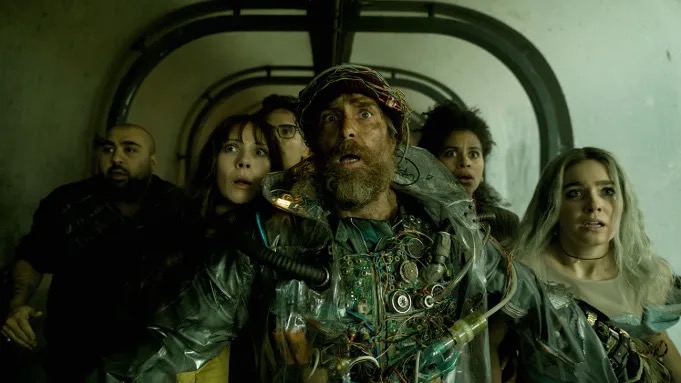
It’s late at night in a Los Angeles diner. There’s a flash of light outside the window and in walks the Man from the Future” (Rockwell), a bearded ragamuffin wrapped in a transparent raincoat and covered with wires, blinking lights and, it turns out, several bombs.
The Man greets the diners, calling some of them by name, even predicting what they’ll do or say next. He is, he says, from the future. This is the 117th time he’s appeared at the diner to recruit a half-dozen eaters to go on a mission to destroy the AI that is poised to ruin the world.
So far the Man and those he’s chosen to accompany him (they’re different on every iteration of the mission) have failed miserably…killed and apparently resurrected as time resets. But the sardonic, wise-cracking Man has to keep at it, learning from each mistake and getting ever closer to destroying the source of the electronic hell that is his future.
On this night he’ll find just the right combination of subjects to pull it all off. And through a series of clever flashbacks we’ll learn how these folk became qualified for the gig.
Mark and Janet (Michael Pena, Zazie Beetz) are high school teachers terrified that their cellphone-addicted students are just a text away from becoming a sort of zombie mob.
Ingrid (Haley Lu Richardson) is a bad-tempered goth girl who works as a fairy princess for little girls’ birthday parties. She’s allergic to most kinds of electronic gizmos…being too near a cell phone gives her a nosebleed.
Susan (Juno Temple) lost her teenage son to a school shooter. Recently she paid to have him cloned…though this new version of him is more robotic than human.
Together they will battle mysterious assassins, armies of hypnotized teenagers — even a giant creature that is part horse and part cat. But will they be able to stop the inexorable creep of the electronic “other”?
“Good Luck…” — written by Matthew Robinson and directed by Gore Verbinski — is by turns funny and a bit frightening. Granted, it cannot keep up the high level of comedy/wonder that Rockwell establishes in the opening moments, but even in the slow moments it’s fun to watch.
And when it’s all over it leaves us satisfied, yet cautious. We’re led to believe that our heroes have stymied AI…but perhaps even their presumed victory has been staged as part of vast virtual reality experiment. Who knows?
“Spider-Noir” is such a promising variation on the usual superhero tropes that I probably stuck with it longer than it merits.
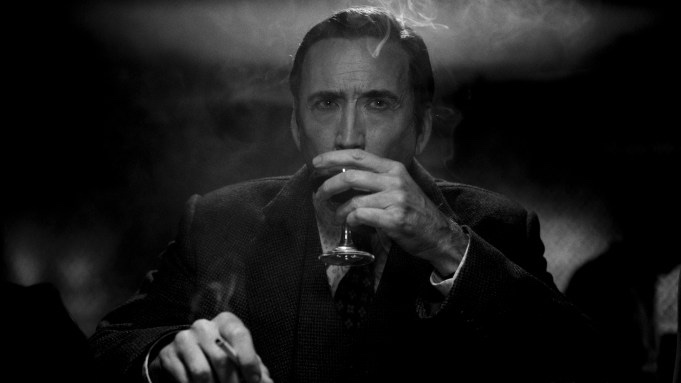
Oren Uziel’s 8-part miniseries gives us Nicolas Cage as Ben Reilly, a down-on-his-luck private eye in Depression-era NYC who is also a web-slinging crime fighter.
Or was. Ben burned out and hasn’t done the Spidey-thing for several years. Maybe it has to do with the fact that his costume consists of a Sam Spade-ish trench coat and a Spy-vs-Spy fedora…not exactly the ideal duds for aerial acrobatics.
Anyway, Ben is a crotchety font of sardonic bad vibes, full of amusing too-weary-to-be-a-tough-guy banter. I loved getting to know him.
But the sad truth is that “Spider-Noir” ran out of compelling ideas after the first two or three episodes. I lost interest.
The plot? Well, turns out the Big Apple is suddenly inundated with crooks flashing all sort of superpowers. Their origin story — and Ben’s — leads back to German experiments on Allied POWs during the Great War.
Ben must return to his Spider persona to battle this army of mutants, which is led by crime boss Silvermane (Brendan Gleeson, a good actor stuck here with comic book villainy). There’s a love interest in the form of nightclub singer Cat Hardy (Li Jun Li), but that fizzles in the absence of any erotic chemistry between Cage and Li.
There are a couple of nice supporting perfs by Jack Huston as a mutant undergoing a crisis of conscience, and from Karen Rodriguez as Ben’s long-suffering Girl Friday.
The real heroes here are production designer Warren Alan Young and cinematographers Darran Tiernan and Peter Deming, who give the series a ravishing look that reminds of “Ripley.” Prime Video has done something quite wonderful by allowing viewers to choose between color and black-and-white versions of the show. I much prefer the shadowy, atmospheric B&W, which perfectly captures the atmosphere of film noir classics from Hollywood’s Golden Age.
Anna Maxwell-Harris
“STAR CITY” (Apple+)
For several seasons “For All Mankind” has given us an alternative history of the U.S. space program, beginning with the early Mercury missions and moving on to the moon landings.
But whereas in real life NASA reined in its explorations for nearly nearly 40 years, in this version we race on to establish bases on the moon, on Mars, and on asteroids being mined for rare minerals needed back on Earth.
The series appears to be scrupulously scientific in its approach. What makes it really interesting, though, are the ways we carry our human foibles with us to the stars. Science advances. Human nature…not so much.
One of more disturbing aspects of “For All Mankind” is its notion that the Soviet Union, far from breaking up, became more controlling than ever.
This notion is taken to the limit in “Star City,” a companion piece that follows the space race from the Russian POV.
Star City is the newly-built, top-secret complex where the Soviet space program does its work.
Rhys Ifans stars as the Chief Designer, determined to expand the USSR’s grasp of the cosmos even when he runs afoul of a stifling party apparatus. His main nemesis is a uniformed security official (Anna Maxwell-Harris) whose dedication to the Party is such that she will kill even a famous cosmonaut who runs afoul of the rules. Not even national heroes are safe.
“Star City” is a vast canvas that pits scientific outreach against the controlling interests of a police state. We’re talking about hidden microphones in every apartment, neighbors who inform on neighbors, contraband records of American pop groups that can get you permanently exiled to a Siberian work camp.
Despite this downer premise, the series gives us a whole slew of interesting characters, many of whom we end rooting for despite their country’s soul-sucking repression.
Peter Capaldi
“CRIMINAL RECORD” (Apple+)
Peter Capaldi first hit the radar of cineastes as the goofy/gangly sidekick in Bill Forstythe’s “Local Hero” (1983) and over the last 50 years has racked up numerous film and TV appearances, including a 43-episode stint as Dr. Who.
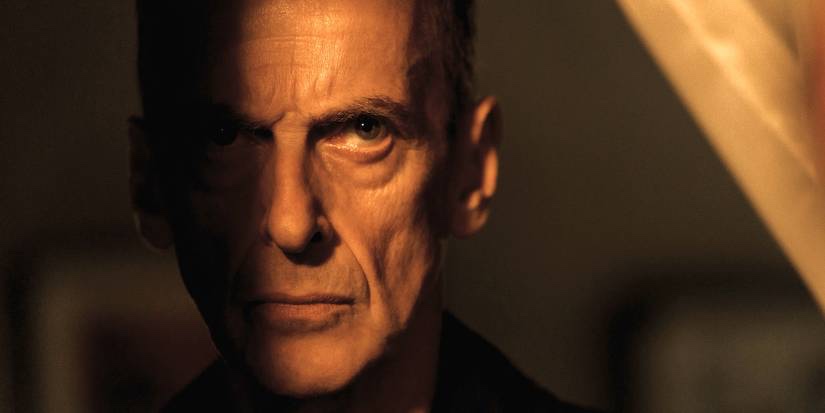
A few years back his career shifted from charming to chilling…he was a prison inmate with possible supernatural abilities in 2022’s “The Devil’s Hour,” and puts his gray hair and cadaverous features to good use in “Criminal Record,” playing a Brit police detective who may be as evil and conniving as the killers he goes after. (Nowadays he reminds me of John Carradine’s Dracula…a role he really ought to tackle.)
Cush Jumbo (“The Good Wife,” “The Good Fight”) stars as June Lenker, a cop who stumbles across evidence suggesting that a man doing life in prison for murder is in fact innocent. The cop who put together the case is Daniel Hegarty (Capaldi), an old wolf on the force (meaning possibly racist and misogynist) who isn’t happy with this young woman questioning his arrest record.
Circumstances force June and Hegarty to work together…and she can never be sure that he isn’t planting little mines to explode in her lap.
Paul Rutman’s series covers two seasons (in the second our heroes take on a right-wing conspirators who plan to use stolen military detonators to blow up London landmarks), but the scripts also find time to delve into the characters’ personal issues. Hegarty has a twentysometing daughter with a heroin habit, while June finds her devotion to the job taking a toll with her live-in boyfriend and teenage son from a failed marriage.
Jumbo makes for an intriguing protagonist (she has just enough foibles to keep her from being a goody-goody) and Capaldi keeps us wondering about where his loyalties lie.
A terrific 2025 release that slipped past my radar, “The History of Sound” offers a love story that resonates on a whole bunch of levels.
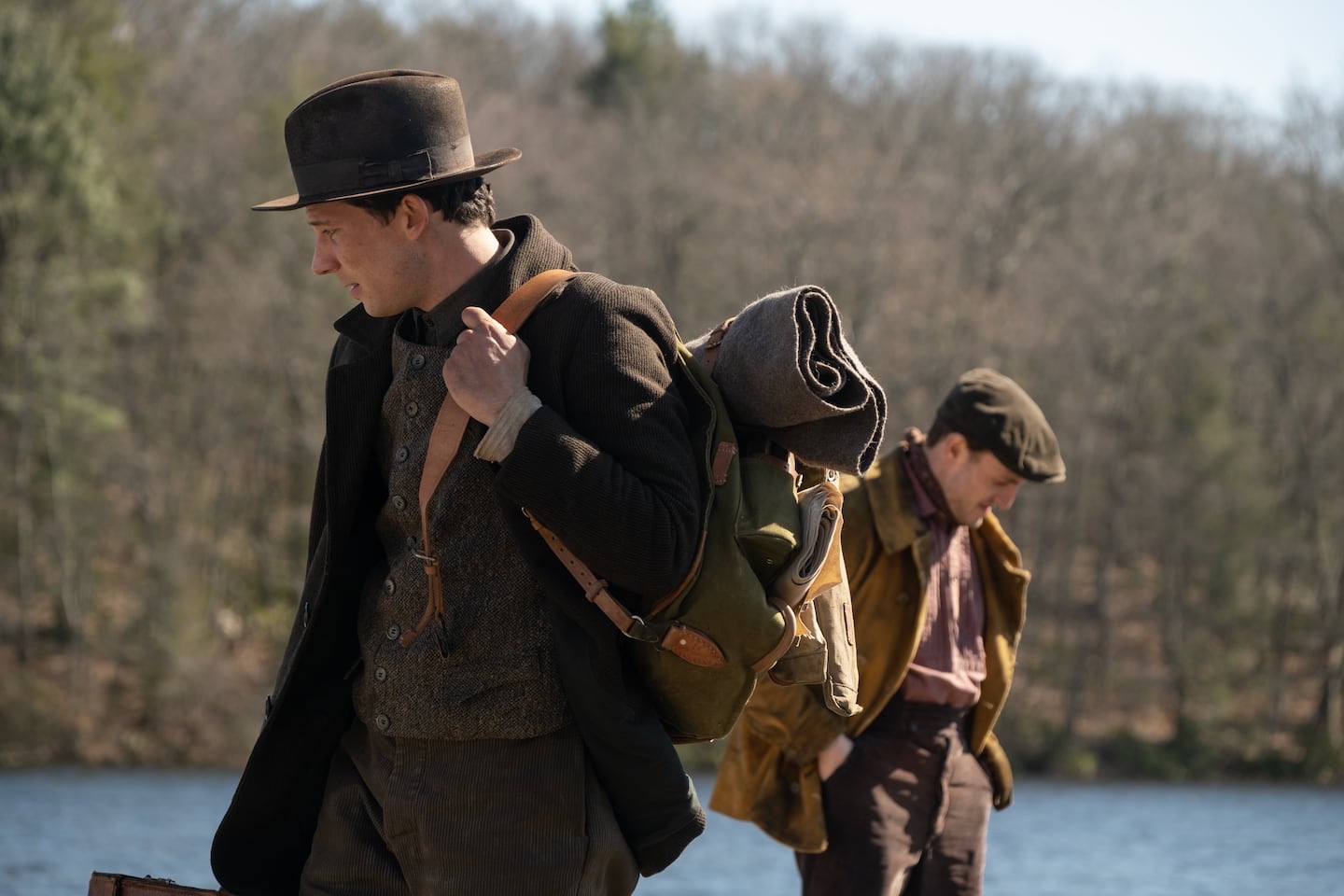
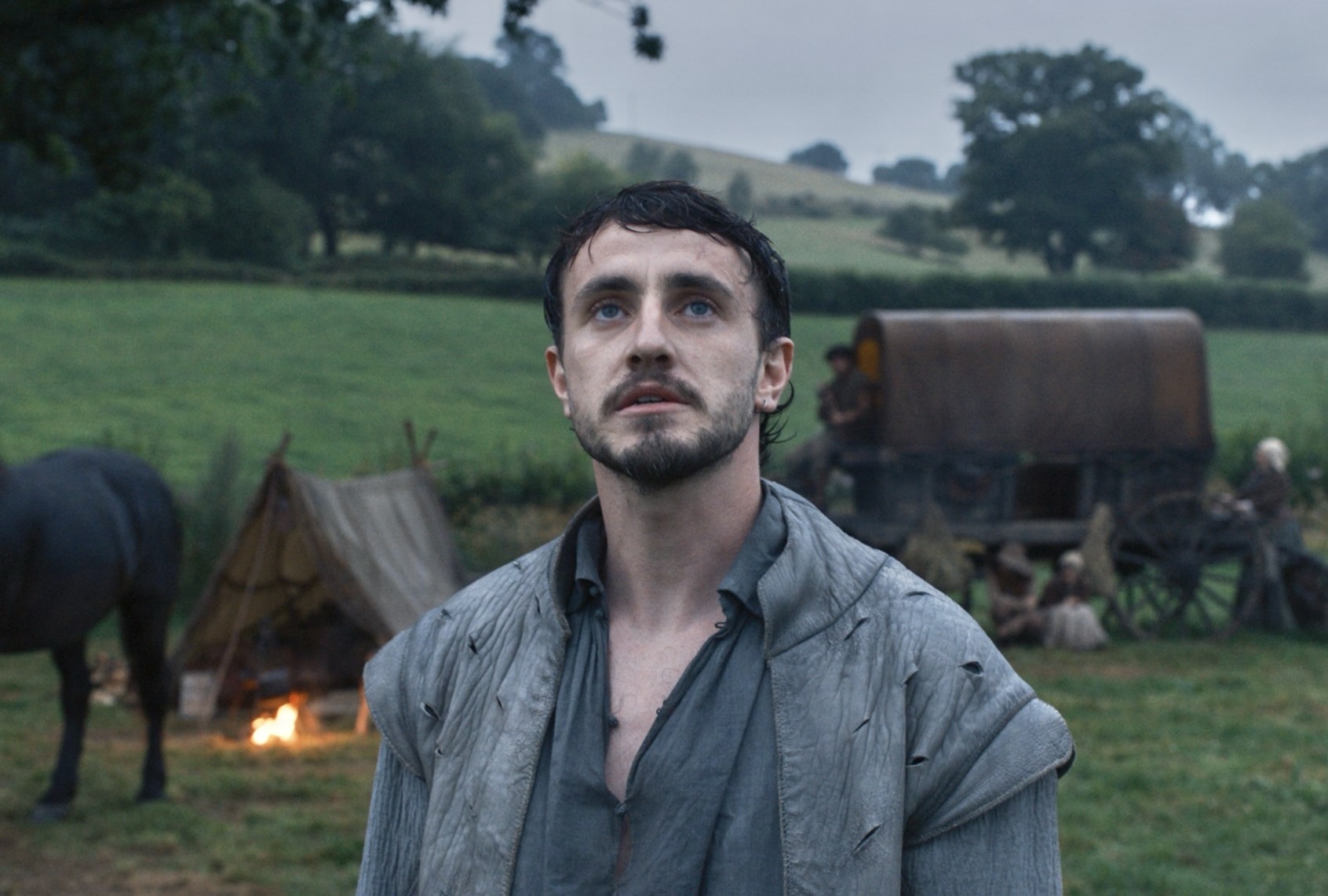
Adapted by Ben Shattuck from his short story and directed by Oliver Herrmanus (”Beauty,” “Living”), the film stars Paul Mescal and Josh O’Connor as young men who spend the fall of 1920 traipsing around rural Maine with a primitive machine to record on wax cylinders the songs of the common folk.
That the young men are also engaged in a love affair is enough to earn “The History of Sound” the label of “gay movie,” but it is so much more than that.
The yarn unfolds from the perspective of Mescal’s Lionel, a Kentucky farm boy whose singing voice earns him a slot at the prestigious Boston Conservatory. There he meets aspiring composer David (O’Connor), who is as urbane and charming as Lionel is shy and unsophisticated.
The two begin a relationship interrupted by David’s enlistment in the Army to fight in France. Upon his return David gets a university gig and invites his friend to accompany him on a three-month wander through fields and woods, recording the music made by the locals.
“The History of Sound” echoes a couple of movies: “Soundcatcher” and “Brokeback Mountain.” If you’re going claim antecedents, those are winners. Toss in atmospheric and narrative touches reminiscent of “Train Dreams” and you’ve got a low-keyed heartbreaker.
The screenplay follows Lionel’s life after David. He studies and teaches abroad. He has relationships with both men and women. But always gnawing beneath his seemingly imperturbable surface is a sense of loss. For David has apparently dropped off the map.
Late in the film Chris Cooper appears as the elderly Lionel, a successful musician and academician who has grown gray resigned to a solitary life. No one has ever touched him the way David did. No one ever will.
“The History of Sound” is a quietly beautiful experience, filled with longing, loss and a reverence for the ways in which music works upon the soul. Technical aspects are first rate, from Alexander Dynan’s rich cinematography (it’s never show-off, but always feels right) and the musical soundtrack crammed with sorrowful folk ballads and plaintive fiddle playing.
The acting…well, as if I didn’t already love Paul Mescal to pieces, he here so fully inhabits Lionel that we can almost hear his thoughts beneath that respectful reticence. He’s perfectly matched by O’Connor as a man whose inner life is so carefully guarded that it becomes an unbearable weight.
Martin Short, Nancy Dolman
“MARTY, LIFE IS SHORT” My rating: B(Netflix)
99 minutes | No MPAA rating
Martin Short is one of the funniest men on the planet.
Which doesn’t mean he hasn’t endured some pretty hard knocks.
Lawrence Kasdan’s “Marty, Life is Short” is a cinematic tribute from one of Short’s good friends. Actually a lot of Short’s good friends.
Few people, in fact, are so beloved by so many heavy hitters. Among the talking heads who testify to Short’s comedy genius and personal warmth are Steve Martin, John Mulaney, Eugene Levy, Andrea Martin, the late Catherine O’Hara, Tom Hanks, Steven Spielberg.
The film of course features a ton of clips from Short’s career (I could endlessly watch him as geeky Ed Grimley or the pompously uninformed Jiminy Glick), but there are also tons of home movies, many shot during Short’s legendary party weekends.
And the doc also serves as a kind of love story, chronicling Short’s marriage to Nancy Dolman, a fellow actor and comic who appears to have been his ideal spouse. If Short had given up comedy after her death in 2010 no one would have blamed him. Instead he once again demonstrated the life-affirming resilience that has gotten him through career bumps and personal tragedy.
Sound Mandala is the world’s coolest stereo system. And a pretty nifty diversion for Kansas Citians this summer.
The brainchild of (among others) soon-to-retire UMKC prof and Kansas City Rep sound designer Tom Mardikes, Sound Mandala has taken over the Unicorn Theatre at 3828 Main for two months of mind-blowing aural experiences.
The theater’s auditorium has been converted to an acoustically perfect (or darn close to perfect) listening room. Guests sit in one of about 40 chairs surrounded by 100 speakers (we’re talking front, sides, rear, overhead). The lights dim and the magic begins.
I recently caught one of three 45-minute programs that will be playing in rotation and was blown away by the sounds that came at me from all directions. (Unlike your home stereo you don’t have to sit in the middle to get an ultimate experience…it’s the same everywhere in the room.)
It began with an approaching thunderstorm, from distant rumblings to crashes of lightning that seemed to land in your lap. I could practically smell the approach of rain. If only Ferde Grofe had Sound Mandala to play with while writing his Grand Canyon Suite.
There were spoken word passages (with appropriate sound effects). The local (and now defunct) band The Plant delivered a knockout slice of psychedelia with “In the Garden.” One of the tracks had a strong Captain Beefheart/Wild Man Fischer anarchistic vibe (extra points if you know what I’m talking about).
The presentation wrapped up with a stunning cover of “Tomorrow Never Knows,” already the trippiest tune in the Beatles catalog and here blasted into the stratosphere by the soul-liberating spacial effects, especially the electronically-generated noises (sounds to me almost like a flock of birds) that seem to fly back and forth across the auditorium.
This is pretty much a home grown affair. Instead of relying solely on commercially available songs Mardikes and Co. have turned to many artists recorded right here in Kansas City over a number of years. Among the featured performers are beatboxer Luke “Skippy” Harbor, Austen Schober, rapper Krizz Kalico, actress Vanessa Severn and Dwight Frizzell.
But wait. That’s not all.
One of the programs features cuts by five bands/performers represented by Challenger Artists. Participating are Mini Trees, Toledo, Valley Boy, Capital Soiree and the evocatively named Post Sex Nachos.
And as if all that was’t nifty enough, Sound Mandala also will be screening the silent horror classic “The Cabinet of Dr. Caligari.” It features a specially composed and recorded soundtrack by Thomas Newby and chamber pop pioneers The Green Zoo that takes full advantage of the technology’s possibilities.
For information on showtimes and ticket prices, visit http://www.soundmandela.org or the Unicorn boxoffice at 816-531-7529 (or visit unicorntheatre.org
“DISCLOSURE DAY” My rating: C+ (In theaters on June 12)
165 minutes | MPAA rating: PG-13
The intergalactic mayhem of “War of the Worlds” notwithstanding, no filmmaker has done more to promote the idea of benevolent aliens than Steven Spielberg.
“Close Encounters of the Third Kind” and “E.T.: The Extraterrestrial” imbued in audiences a sense of awe, in no small part because they had as protagonists a child and a child-like adult through whose eyes we experience the wondrous possibilities of the universe.
Oh, that “Disclosure Day” had a bit of that magic. In plot (the story and screenplay are by Spielberg and David Koepp) this is in many ways a clone of “CE3K,” but in feeling, emotion, it’s dead in the water.
By now most of us are aware that “Disclosure…” is about a perilous effort to reveal to the world nearly 80 years of UFO documentation suppressed by our government. The good guys have stolen from an evil think tank dozens of super-sophisticated thumb drives containing many hundreds of hours of video, sound transmissions, photos and printed data on the phenomenon.
And now the chase is on.
Throughout the film we follow the efforts of four groups.
First there’s computer geek Daniel Kellner (Josh O’Connor) who has gone from being a safekeeper of these secrets to a saboteur. With a backpack crammed with world-changing data Daniel and his girlfriend Jane (Eve Hewson) are on the run.
They are pursued by the black-clad agents of Daniel’s former employer, led by Scanlon (Colin Firth), a corporate monster with a maniacal determination to suppress this information.
Colin Firth
There’s a group of revolutionaries led by Wakefield (Colman Domingo). These are folks who once worked to keep those secrets who are now convinced they must be shared with the world.
And finally there’s Margaret Fairchild (Emily Blunt)l, a weather lady for a Kansas City TV station who finds herself fluent in languages she has never studied, including — in the middle of a live broadcast — a guttural clicking that appears to be of extraterrestrial origin. She also develops the ability to read and manipulate other people’s minds (or maybe it’s their souls), making her a sort of corn-fed Obi-Wan Kenobi.
Spielberg has described “Disclosure Day” as a chase film, and that’s on the money. Here’s a filmmaker who has been creating spectacular chases for 50 years (“Duel,” “The Sugarland Express,” all of the Indiana Jones titles) and he brings all that know-how to bear on several spectacular action sequences. And thank God for his expertise, because the sheer momentum created by these moments keeps us engaged even after we start to wonder if this isn’t in support of a frothy mess of woo-woo and flapdoodle.
Spielberg and Koepp throw tons of alien mythology at the screen (crop circles, the Roswell crash, alien autopsies) , but it dribbles out in disconnected bits and pieces. Momentarily diverting, yes, but if there’s a logic behind it I can’t find it.
Acting honors here go to Blunt, who is terrific at expressing the terror and puzzlement of her newly-developed powers (she’s got an emotional meltdown that should become a permanent part of her resume reel), and to Firth, who makes his corporate overlord a Voldemort-ish font of ruthlessness. He’s genuinely scary.
Josh O’Connor
Spielberg is a master technician…the film is beautiful and the way he moves his images within a frame (the frame is often moving as well) is spellbinding.
The weak link here is a half-baked idea and a screenplay that tries to cover up its emptiness with superficial bustle.
Spielberg and Co. toss in an irritating hodgepodge of religious imagery and ideas. Jane once studied to become a nun and in one scene reacts to a form of mental torture by using the cross on her necklace to pierce her own palm. Stigmata, anyone? And her former mentor is a Reverend Mother (Elizabeth Marvel) who suggests that, sure, God might have created non-human intelligence.
The filmakers also muddie things up with their version of Hitchcock’s MacGuffin, in this case an alien artifact that looks like a hotdog-sized metal ingot. The determined Scanlon uses this device to locate his prey at great distances and then enters their minds, interrogating his mesmerized victims. Mishandled the device can be dangerous, as discovered by Scanlon’s chief thug (Henry Lloyd-Hughes), who finds himself atomized and reconstituted by the technology.
Spielberg is a great enough filmmaker that I spent the 2 1/2 hours of “Disclosure Day” being mildly entertained while waiting for a big payoff that never came. Indeed, the real story here is how humanity would react to this Earth-shaking revelation…and Spielberg isn’t interested in that…or is afraid of the answer.
The results are simultaneously too much and not enough.
Goofball affability comes so naturally to Paul Rudd that it’s easy to forget that with the right material he’s a formidable performer.
He gets just such an opportunity in the bittersweet dramady “Power Ballad,” the latest from writer/director John Carney and, like his memorable “Once” from a decade back, a look into the life and dreams of a struggling Dublin musician.
The screenplay by Carney and Peter McDonald centers on Rick, the American-born (Kansas City, no less) lead singer of Bride and Groove, a quintet billed as Ireland’s premiere wedding band.
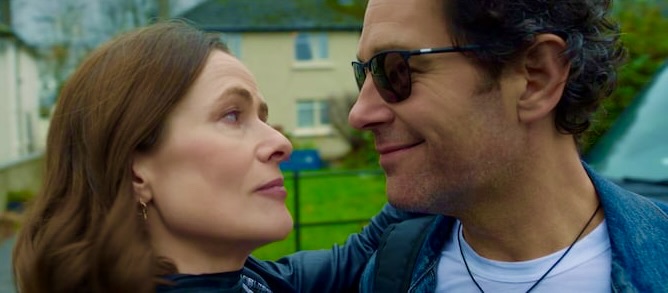
Rick has an Irish wife and daughter (Marcella Plunkett, Beth Fallon), a modest house in the ‘burbs and a vast backlog of unfinished songs,. He dreams — literally — of selling out arenas to sing his compositions. In the meantime he and his bandmates schlep around in a tour van playing gigs in which they cover, practically note for note, the pop catalog of the last 50 years.
These opening segments are crammed with sly observations about fiftysomething geezers pounding out rock ’n’ roll and donning glasses to read the fine print. They also establish that Paul Rudd can actually sing.
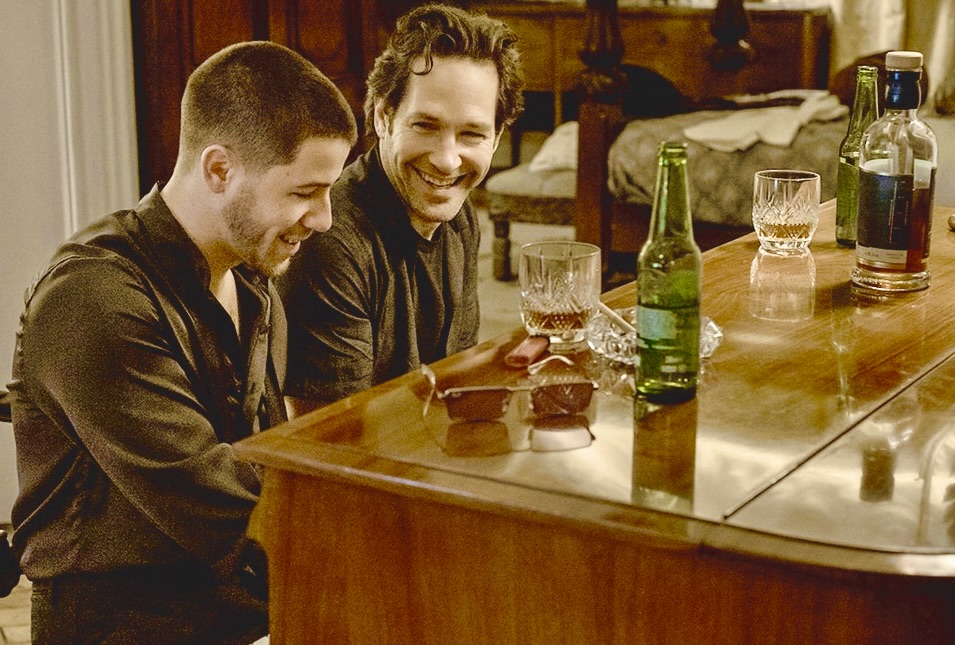
One of the wedding guests at their latest gig is none other than Danny Wilson (Nick Jonas), formerly famous as part of a boy band but now struggling to establish a solo career. At the request of the bride Danny joins the band for a few songs.
He and Rick share a moment on stage and, after the reception has shut down, spend the rest of the night trading riffs over a piano and a good single-malt whiskey. Rick plays some stanzas from a song he’s been working on for 15 years; Danny makes a few suggestions. Damned if it doesn’t sound pretty good.
A year later Rick is shopping in a Dublin mall when over the piped-in Muzak he hears…yes, his song. It’s pretty obvious that Danny Wilson has claimed the tune as his own and turned it into an international hit.
The major plot thread here is Rick’s seemingly hopeless quest to get recognition for the song. It isn’t so much the money the tune has generated (although he wouldn’t mind getting some of it) but the principle of the thing.
Here’s the problem. Rick cannot prove to anyone — even his family — that the song is his. He never recorded it, and any early versions he committed to paper can be dismissed as recent forgeries. Knowing he’s being cheated threatens to push the poor guy over the edge.
Marcella Plunket, Paula Rudd
Rudd is really terrific as an Everyman whose obsession is driving away his friends, co-workers and even loved ones. Finally, after all attempts to contact Danny Wilson have been rejected, he buys a plane ticket and with his scuzzy bandmate Sandy (Peter McDonald, the film’s co-writer) heads off to La-La Land for a showdown.
This may be Rudd’s best work since the underappreciated 2013 gem “Prince Avalanche” (it’s currently streaming on Amazon Prime…watch it), with his innate likability providing a vital counterpoint to Rick’s self-destructive fame fixation.
He’s nicely matched by Jonas’ turn as a guy so desperate to get back on top that he puts his conscience on the back burner. Danny is clearly the villain of the piece, but Jonas’ perf and the writing make his transgressions understandable if not acceptable.
And practically stealing his every scene is McDonald as the boozy, guitar-shredding Sandy. (Think Bill Nighy in “Love Actually.”)
The tone Carney achieves here reminds a lot of Bill Forsythe, especially 1984’s “Comfort and Joy.” It’s a tightrope act that bends back and forth between mild comedy and real emotional pain.
My one objection to “Power Ballad” is a brief coda tacked on the end, a sort of cop-out that plays to the cheesy expectations of the least-sophisticated viewers and undermines what up to then had been a ambivalent but deeply satisfying conclusion. I wouldn’t be surprised if some studio suit told Carney he had to tack it on.
Part noir crime thriller, part love story, part buddy comedy, Daniel Roher’s “Tuner” overcomes a plot thick with unlikely coincidence to deliver a generally satisfying suspense yarn peppered with oddball moments.
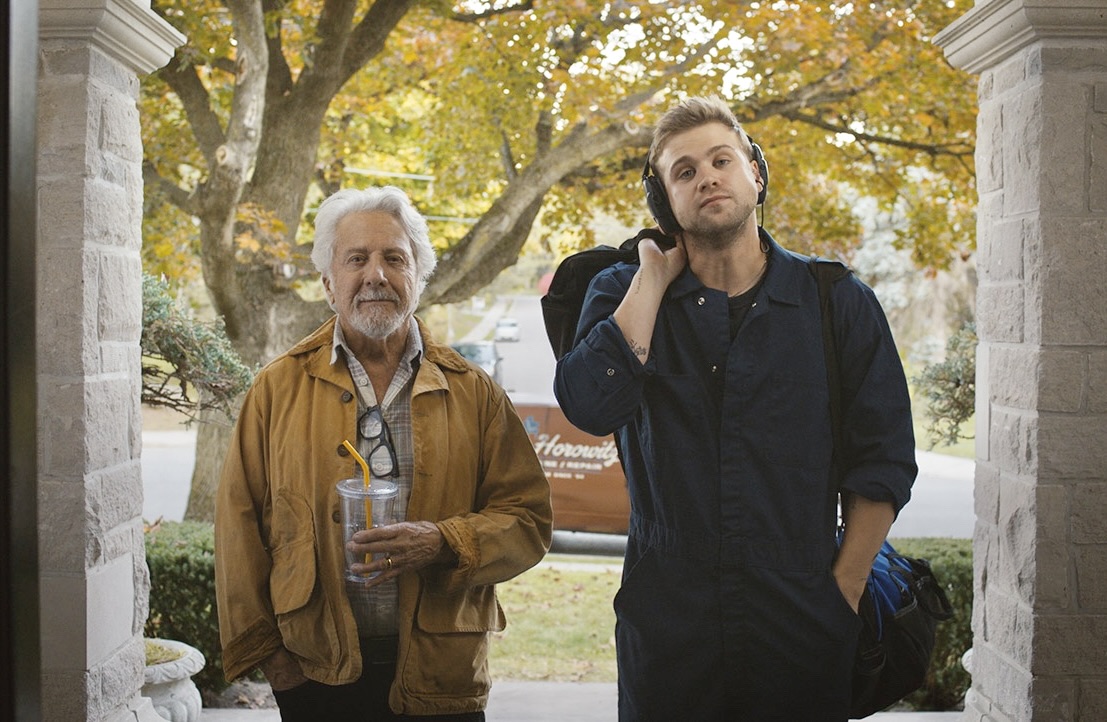
Niki (Leo Woodall) is a baby-faced piano tuner in the Big Apple. He’s technically an apprentice to old timer Harry Horowitz (Dustin Hoffman), but in reality Harry does little more than sit around spouting dietary conspiracy theories. Niki does all the real work.
Turns out he’s ideally suited for the job. Niki was a child prodigy on the keyboard but developed a hearing issue that forced him to give up playing. Not deafness…just the opposite. His hearing is so acute that everyday sounds are painful. He goes through life wearing a pair of noise-dampening headphones.
The screenplay by Roher and Robert Ramsey begins as an affable study of friendship. Harry and his wife (Tovah Feldshuh) regard Niki as the son they never had. There’s a good deal of familial kvetching.
On one of his jobs Niki encounters Ruthie (Havana Rose Liu), a conservatory student in piano and composing. Little by little they hit it off.
Conflict arrives in the person of Uri (Lior Ray), whose home security firm is basically a front for a mini crime syndicate. It’s all too easy for Uri to bypass the systems he installed and rob his clients. Except that he needs someone who can open safes and lockboxes. Turns out that Niki’s sensitive ears are just right for hearing the tumblers click into place.
Now our hero isn’t a dummy. He knows this is dangerous business. But Uri can be quite charming and/or threatening and when Harry ends up in the hospital Niki decides to keep cracking safes until the bills are paid. Of course the thuggish Uri has his own ideas for Niki’s career in crime.
“The Player” musters a good deal of tension, but the real meat here is Woodall’s low-keyed performance. Niki’s handicap has made him something of a loner…not exactly anti-social but borderline. Which makes his journey into romantic love all the more affecting.
Sally Field
“REMARKABLY BRIGHT CREATURES” My rating: B(Netflix)
111 minutes | MPAA rating: PG-13
I don’t know what bugs me the most: that “Remarkable Bright Creatures” is so overtly manipulative or that most of the time that manipulation works.
In any case, Olivia Newman’s adaptation of Shelby Van Pelt’s best selling novel gives us national treasure Sally Field in one of her best roles in years. Hard to complain too much with that on the table.
Field plays Tova Sullivan, a widow in a coastal town in the Pacific Northwest and the night custodian at the local aquarium. Tova has plenty of elderly gal pals (Kathy Baker, Joan Chen, Beth Grant) but her best buddy is Marcellus, the giant pacific octopus with an uncanny ability to slip out of his tank and go on nocturnal prowls around the building.
As was the case with the novel, Marcellus is the narrator of this tale (voice provided by an uncredited Alfred Molina), though for some reason I found this device worked better on the printed page than it does here.
The heart of the yarn lies with Cameron (Lewis Pullman), a young nomad living out of his minivan who becomes Tova’s assistant. He’s a bit creeped out by the computer-generated Marcellus but he and Tova form a bond. She lost her own son years before in a boating accident and Cameron allows her to indulge some of her long-suppressed maternal instincts.
Turns out the old lady and her young helpmate are connected in ways neither could have anticipated…although Marcellus the octopus has it all figured out long before the pokey humans come around.
I cannot count the number of acquaintances who’ve told me how much they love this movie.
I enjoyed it, but with reservations.
Sienna Miller, Wendell Pierce, John Krasinski
“TOM CLANCY’S JACK RYAN: GHOST WAR” My rating: C (Prime Video)
105 minutes |MPAA rating: R
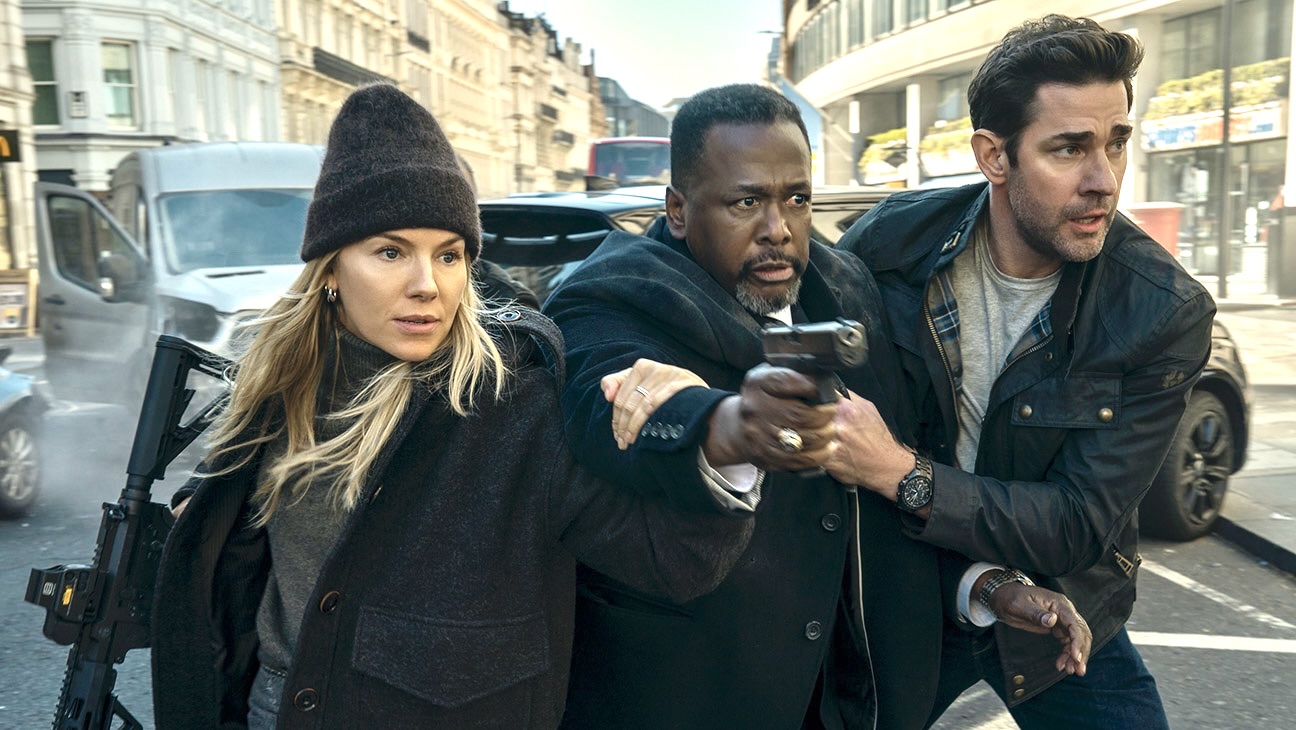
I’m a sucker for both John Krasinski and Wendell Pierce, but there’s no escaping the by-the-numbers blah-ness of “Jack Ryan: Ghost War.”
Scripted by Krasinski, Aaron Rabin and Noah Oppenheim, and directed by Andrew Bernstein, “Ghost War” is a hodgepodge of spy movie cliches held up by a script so fuzzy I’m still not sure exactly who is doing what and why.
As I understand it, former British spy Liam Crown (Max Beesley) has started murdering British and American agents because he misses the good old days when spies could kill with impunity. No codes of conduct, no ethical review boards, no red tape.
Apparently Crown intends to use his mercenary army (where does he get the money?) to force the good guys (the CIA, MI6) to return to their scorched earth policy of bygone days.
No, it didn’t make any sense to me, either.
Krasinski reprises his role as reluctant action hero Jack Ryan, while Pierce is his boss at the Agency. Both are imminently watchable but have to work way too hard at selling this nonsense.
Sienna Miller pops up as a tough-as-nails British operative, but the script really doesn’t give her much to do. Michael Kelly is back as Ryan’s wise-cracking sidekick.
There’s some nice scenery (Dubai, London) and a nifty car chase through crowded city streets.
But mostly “Jack Ryan: Ghost War” feels like a franchise on its last legs.
As was the case with the DC-based “Penguin” of a couple of years back, the latest incarnation of Marvel’s Daredevil character is noteworthy for its high degree of psychological sophistication.
Both miniseries unfold in worlds that seem far more nuanced and believable than your usual comic book fantasy.
Curiously, both get their oomph not from a traditional superhero (the character of Batman never even appeared in “The Penguin”) but from their villains.
Colin Farrell won an Emmy for his portrayal of the Penguin, a malformed ugly duckling (and mama’s boy) determined to make himself into a crime king through a regimen of self-effacing charm and Machiavellian scheming.
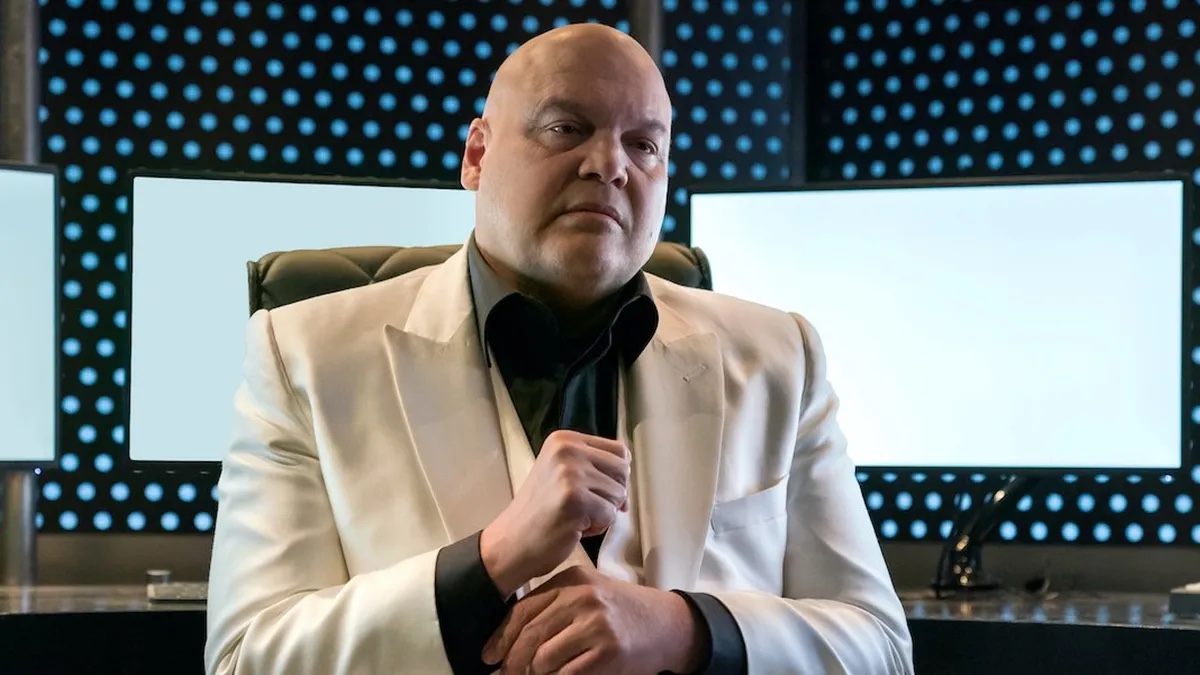
With “Daredevil: Born Again” the heart of the season lies not with our blind-but-sensorially-gifted vigilante title character (Charlie Cox), but with his nemesis Wilson Fisk. aka Kingpin, a crime-boss-turned-politico played by Vincent D’Onofrio with terrifying intensity.
“Born Again” has a torn-from-the-headlines immediacy with Fisk, newly elected mayor of NYC, declaring war on masked vigilantes like Daredevil. He uses this as an excuse to send out a specially trained army of thugs to arrest and detain anyone opposing his despotic reign.
Series creators Matt Corman, Chris Ord and Dario Scardapane obviously were working on this project long before Donald Trump unleashed his ICE army, but the parallels are unmistakable. Indeed, D’Onofrio’s Kingpin plays like a smarter, slicker version of Trump, a crook fully capable of playing three-dimensional chess while bending public opinion to his will.
This season also benefits hugely from perfs by Ayelet Zurer as Fisk’s beloved Lady Macbeth of a spouse, Michael Gandolfini as the mayor’s public information officer (whose corruption and ultimate redemption forms one of the show’s most emotionally satisfying threads), and Hamish Allan-Headley as the chief of Kingpin’s Gestapo, who comes off like the love child of Pete Hegeseth, Gregory Bovino and Kristi Noem.
Plus, the action scenes are spectacular.
“LEGENDS” (Netflix)
Perennial underdogs get to flex their sleuthing muscles in “Legends,” based on a real-life episode in which Her Majesty’s customs officials — uniformed drones most accustomed to searching suitcases at airports — entered a life-and-death battle with a heroin cartel.
Steve Coogan stars as a former spook who gave up espionage for a cushy job in customs but now finds himself training customs inspectors to go under cover in the world of drug smuggling.
The key to survival, he drills into his wannabe Bonds, is to believe utterly in your “legend,” the phony persona under which you will enter the shadowy world of crime. The problem, as one newbie spy played by the ever watchable Tom Burke discovers, is that one’s criminal alter ego cannot easily be abandoned at the end of the day. This makes for some anxious moments with the wife and daughter.
In theory these misfits shouldn’t be able to solve a problem that has stymied the British police and military. Damned if they don’t — although with too many close calls for comfort.
No doubt the story has been given a big shot of melodrama in its transition to the screen; nevertheless, “Legends” is one of those rare crime dramas that never stoops to the implausible. Good stuff.
David Tennant, Nafessa Williams
“RIVALS” (Disney+)
Here’s yet another fiendishly watchable British drama, a lusty soap opera about shenanigans (sexual and otherwise) centering on a rural television network during the Thatcher era.
“Poldark” leading man Aidan Turner (nearly unrecognizable beneath a walrus mustache) stars as Declan O’Hara, a television journalist wooed away from the conservative BBC to host an interview show on a regional network in aptly named Rutshire.
His new boss is Tony Baddiingham (David Tennant), a powerful schemer who rules his operation with an iron fist, abetted by his gorgeous producer and mistress Cameron (Nafessa Williams).
There are at least a dozen major characters in this miniseries, and most of them are, um, very sexually active. That especially goes for Rupert Campbell-Black (Alex Hassell) — MP, former equestrian champion and a Lothario of legendary accomplishment.
The show is divided between workplace crises and various love affairs.
Declan is too busy pushing his journalistic agenda for sexual diversions. On the other hand, his very bored former actress of a wife (Victoria Smurfit) is continually on the prowl. And in one slow-burning relationship that literally aches with unfulfilled desire, their 20-year-old daughter (Bella Maclean) has a bad case of the hots for the priapic Rupert, who (quite out of character) makes a point of not despoiling this young woman.
“Rivals” nicely balances humor and drama, and just about everybody in the cast gets naked at one point or another. After this it’s hard to think of our Brit cousins as stuffy and reserved.
Winston Sawyers as Ralph, Ike Talbut as Simon, David McKenna as Piggy
“LORD OF THE FILES”(Netflix)
William Golding’s novel Lord of the Flies was written 62 years ago at the height of the Cold War, but seems as relevant today as it did back in the era of nuclear saber-rattling.
That’s because its true subject is man’s (or boy’s) propensity for violence, power and retribution. It’s baked into the human psyche.
There already have been two filmed versions — a 1963 rendition in stark black and white and another in 1990 — and now Netflix has dropped a brand new four-hour miniseries produced by the BBC.
It may not be perfect, but it’s about as good a cinematic interpretation of this modern classic as we’re likely to see.
The premise — for those who slept through high school English — is that a planeload of British schoolboys have been marooned on a tropical island. With their adult chaperones killed, these prepubescents are left to their own devices.
Initially they form a society based on the rules and manners drilled into them at their posh boarding school. Stiff upper lip and all that. But little by little their savage side takes over. Result: Chaos, cruelty and murder.
The man behind this retelling is writer/producer Jack Thorne, who has among his credits the amazing “Adolescence.” As that show proved, he’s got a real affinity for the behavior of young males.
Each of the episodes centers on one of the four main characters.
First we encounter Piggy, a fat kid with bottle-bottom spectacles and a bad case of asthma. As played by David McKenna, he’s a dead ringer for an 11-year-old Alfred Hitchcock.
Piggy is probably the smartest of the two-dozen castaways. He’s obviously no sportsman; he’s spent his time reading and immediately starts dispensing advice on housing, food, sanitation and the maintenance of a signal fire should a rescue ship appear on the horizon. (Piggy’s glasses play an important role…they magnify the sun’s rays to ignite collected tinder.) Piggy has the organizational imperative of a lifelong bureaucrat; he wants things neat and tidy.
One of the few boys not irritated by Piggy is the good-hearted Ralph (Winston Sawyers), who is elected chief of this ragtag tribe. Ralph is nice kid, popular and honest. Turns out he’s in way over his head.
Lox Pratt as Jack
And then there’s Jack (Lox Pratt), the head boy of the school choir whose members appear in long black robes like time travelers from the Dark Ages. Basically they’re a tribe within the tribe, and under Jack’s leadership they begin rebelling against Piggy and Ralph.
Jack declares he’s going to have fun and enjoy life now that there are no grownups looking over his shoulder. He decides his singers will become hunters, tracking and killing the wild pigs that inhabit the island. And he’ll do the same to anyone who crosses him.
And finally we have the wide-eyed Simon (Ike Talbut), a sort of artist/mystic who never quite fits in and is subject to disturbing visions.
If I correctly recall, the novel suggested that the boys were part of an air evacuation to get them out of Britain on the eve of an nuclear attack. That idea is never broached here, though the mid-1950s time frame is retained.
What is new is the mixed enthicity of the cast. In addition to the white kids there are blacks, Asians and all the colors in between. Ralph, for instance, has a black mother and a white father.
Does Lord of the Flies really require four hours? Perhaps not, but one of the piece’s strengths is the way we settle into the lush landscape. This version feels truly lived in; it’s an immersive experience.
The young actors are first rate and the pacing set by director Marc Munden slowly pulls us into the horror of civilization being stripped away.
Not everything works. Most of the main characters are given flashbacks (this allows cameos by such recognizable faces as Rory Kinnear and Daniel Mays), none of which struck me as particularly informative or useful.
And director Munden (or it could be cinematographer Mark Wolf) periodically shoots through a filter (or maybe it’s post-production trickery) that turns the deep green foliage red and orange. No doubt it’s mean to reflect the growing ugliness of the boys’ society (or it may be a premonition of the flames that will all but consume this paradise)…whatever the intent, it’s more distracting than illuminating.
And several boys — especially Pratt’s Jack —seem to have undergone a make-over with blue-dyed eyelids and rosy red lips. Is this some sort of homoerotic commentary on the part of the filmmakers? Again, unnecessary.
Possibly the highest compliment I can pay this production is that it frequently took me by surprise despite my familiarity with the material.
And in the anarchistic rebellion of Jack and his minions we have a political allegory that seems all too familiar and way too uncomfortable. It’s not that Thorne and Company go out of their way to hammer home these points. They were always there in Golding’s prose…but until recently we shrugged it off as a case of it can’t happen here.
Almost as diverting as it is unnecessary, “Apex” gives us Charlize Theron in yet another action-heroine role, this time battling a psycho killer in one of Australia’s mind-boggling national parks.
Jeremy Robbins’ screenplay borrows heavily from the Meryl Streep survival flick “The River Wild” while referencing ideas from the various filmic incarnations of the 1924 novel The Most Dangerous Game.
In the vertigo-inducing intro Sasha (Theron) and her squeeze Tommy (Eric Bana) are scaling a terrifying cliff face towering over a Norwegian fiord. She wants to forge ahead; he advises caution. Disaster ensues.
Months later Sasha shows up in a remote Aussie wilderness; apparently she’s trying to escape her demons by kayaking solo down a rapids-heavy river. Except she has drawn the attention of Ben (Taron Egerton), a local whose chatty demeanor masks demons of his own.
What ensues is a life-and-death chase through some of the most spectacular scenery ever captured on film. Cinematographer Lawrence Sher was obviously inspired by the landscape of New South Wales’ Blue Mountains, where the shoot took place.
Theron is her usual capable self. But Egerton is genuinely disturbing. His Ben is a font of smarmy friendliness with a core of cold-blooded malevolence. In retrospect it’s obvious that his turn last year in in the mini-series “Smoke” was a sort of dry run for the two-faced character he plays here.
Baltasar Kormakur’s direction is taunt and creepy, slowing sowing seeds of premonition that bloom into outright panic. Pulse-pounding stuff.
Chris Hemsworth
“CRIME 101” My rating: C+(Netflix)
140 minutes | MPAA rating: R
The buzz on Bart Layton’s “Crime 101” was that of a crime drama in the same league as Michael Mann’s “Heat.”
Well, the films have a lot in common. Both are stories of cops and robbers in L.A. Both have a whole slew of characters played by an A-list roster of talent. Both aspire to epic status.
But Layton is no Michael Mann. “Crime 101” is an OK ride, but it never gets close to the heights of “Heat.”
Chris Hemsworth is Davis, whose specialty is robbing jewelry stores and couriers carrying diamonds and other valuable stuff. He’s a real pro who plans carefully and prides himself on never physically harming his victims.
He’s also socially backwards, a guy who tries so hard to remain anonymous that he has abandoned his personality in the process. In other words, he’s a lonely S.O.B.
His M.O. has attracted the attention of LAPD detective Lou (Mark Ruffalo), a vaguely seedy fiftysomething. With no personal life to speak of, Lou dedicates his existence to identifying the man behind a series of jewel heists that invariably occur along the 101, the superhighway that bisects the city.
The plot is set in motion by a rift between Davis and Money (Nick Nolte) the aging crook who finances his capers. They break up their partnership, but Davis isn’t aware that Money plans on going ahead with their last planned job, taking on a blond psycho with violent tendencies (Barry Keoghan).
And then there’s the high-end insurance company agent (Halle Berry) whose insider knowledge of the rich and famous make her a font of useful info for a criminal mind.
Toss into the mix brief appearances by Jennifer Jason Leigh and Tate Donovan and you’ve got plenty of acting talent. But the results are just so-so.
Most documentaries aim to neatly answer our questions.
Patricia Gillespie’s “#Skyking” leaves us in limbo.
In 2018 28-year-old Richard “Beebo” Russell, who worked on the tarmac at Seattle-Tacoma International Airport, singlehandedly stole an empty Q400 turboprop air liner and, without benefit of formal flight training, took it on a aerial joyride.
He was in the air for 75 minutes, watching the fuel gauge approach empty. Then he crashed on an island in Puget Sound. He did not survive.
Apparently he didn’t plan to.
The backbone of this riveting documentary is the audio tape of Beebo’s radio exchanges with a Seattle air traffic controller. The tape was only recently released and filmmaker Gillespie had the inspired idea of having the recorded conversation play while Beebo’s friends and family members heard it for the first time.
This setup allows Gillespie to stop the playback so that these individuals can respond to what they’ve just heard. Along the way we learn a great deal about Beebo.
That he was fun loving and goofy. That he was a devout Christian. That he grew up in small-town Alaska, was a high school athlete. He met his wife Hannah while attending college in Oregon, and they later opened a bakery together.
The Beebo who emerges from the tape recording is friendly but evasive. He’s embarrassed at having been hit with air sickness (or it could just be a bad case of nerves) and apologizes for making a mess in the cockpit. He advises ground control that he has no intention of hurting anyone, and comments on the beauty of the mountain he is circling.
He does ask the perplexed controller if the Q400 is capable of making a barrell roll. Told the aircraft was definitely not designed for such shenanigans, Beebo went ahead and did a successful barrell roll anyway.
Remember, this was the first time the young man had even been in an airplane cockpit.
The question hanging over all this is why? What drove Beebo to this act?
We learn that he was upset that his career was going nowhere. But is that reason enough for suicide?
Maybe marital issues? We may never know, since his widow refused to participate in the filmmaking process.
What we’re left with is the impression of a likable young man whose demons were kept in check until a final defiant statement in the air over Seattle.
Ana de Armas
“BALLERINA” My rating: C+(HBO Max)
124 minutes | MPAA rating: R
“Ballerina” does not start off promisingly.
Set in the John Wick universe (Keanu Reeves makes a brief appearance) it centers on Eve (Ana de Arias), who as a little girl lost her father to assassins and has been raised by a crime syndicate both to dance ballet and serve as a killing machine. (Talk about multi-tasking!!!!)
Yeah, it’s a “La Femme Nikita” clone, and not a particularly good one. Not even pop-up appearances by Ian McShane and the late Lance Reddick reprising their “John Wick” roles can dispel the aura of cheesy revenge melodrama.
But here’s the thing…if you can sit through the gosh-awful opening scenes, director Len Wiseman and his crew unleash a slew of spectacularly choreographed fight sequences. Yes, they’re utterly preposterous, featuring staggering body counts while de Armas’ Eve absorbs enough punishment to lay low a battalion of tough guys. Yet she keeps on shooting, kicking, leaping and punching — a veritable Energizer Bunny of mayhem.
The film climaxes with a gloriously over-the-top segment in which our girl finds herself in a scenic alpine village which is the headquarters of a rival gang (Gabriel Byrne is the chief baddy).
Turns out everybody in the burg — from the barmaid at the inn to a young couple casually dining in their ski outfits — is a trained killer.
The acting? Well, there’s not much of it. But perhaps that’s the point — just keep a straight face long enough to sell the silliness.
“CAVE OF FORGOTTEN DREAMS” My rating: A-(In theaters on April 15)
90 minutes | No MPAA rating
Werner Herzog’s great documentary, first released in 2011, has been digitally spiffed up and is now playing at theaters. Thought I’d share my original review:
The art on display in “Cave of ForgottenDreams” is so jaw-droppingly beautiful that it can move a viewer to tears.
These are the oldest known paintings on Earth, created in charcoal on the walls of France’s Chauvet-Pont-d’Arc cave more than 30,000 years ago.
Discovered in the early ’90s, the cavern’s natural entrance was long ago blocked by a landslide, leaving the treasures untouched and hermetically sealed for millennia. This Pleistocene art is so fragile and priceless that only scientists and scholars are allowed to view it.
Except, that is, for director Werner Herzog, who got permission to take small 3-D cameras into Chauvet, emerging with a documentary so ravishing and eerily evocative that it’s like discovering the magic of art all over again.
Our Ice Age ancestors decorated the walls with incredible renderings of the animals they depended on. There are lions, huge rhinos, woolly mammoths, stags with immense horns, massive bison, all rendered with an eye for each breed’s characteristics that reveals a lifetime of observation. Three racing horses are uncanny … they look as if they were painted by Matisse.
There are also the handprints in red stain. We know they were made by the same person because of his/her broken little finger.
Herzog interviews the scientists. One produces a reproduction of a prehistoric bone flute and notes that it works on the same pentatonic scale used today. He demonstrates by cheekily blowing “The Star-Spangled Banner.”
But mostly Herzog lets his camera linger on the art, with the 3-D magically revealing how countless painters over several thousand years employed undulations in the cave walls to capture their subjects.
The camera floats across the cavern floor, littered with dozens of skulls of now-extinct cave bears who sometimes violated the manmade art by sharpening their claws on the limestone. A child’s footprint has been preserved. The remains of campfires have sat untouched since a time when glaciers sat a mile deep on the continent.
The experience is transcendent. Herzog may strike some as a pragmatic filmmaker, but “Cave of ForgottenDreams” is about nothing less than the birth of the human soul.
Mainstream Hollywood rarely knows what to do with religion…unless it’s some sword-and-sandal silliness.
But Mona Fastvold’s “The Testament of Ann Lee” provides a sometimes brilliant evocation of ecstatic states while never commenting editorially on the truth (or falsehood) of its subject’s beliefs.
In the process it gives Amanda Seyfried the role for which she may some day be best known.
Ann Lee (Seyfried) was a British woman whose search for religious certainty led her to the Shaker movement, an offshoot of the Quakers in which dance and movement were essential to the spiritual quest. She left England for America in the years just before the Revolution, bringing with her a small band of followers who regarded her as an incarnation of Jesus. Over years they established several communal settlements in New England, farming and manufacturing utilitarian but beautiful items of furniture that are still popular.
At one point the Shakers had nearly 5,000 members…a remarkable number given that total avoidance of sex was central to Lee’s ministry. The church fed its ranks by adopting orphaned children who, upon reaching maturity, were allowed to decide whether to stay or seek a life in the larger world.
As scripted by director Fastvold and her husband Brady Corbet (their last outing was the spectacular “The Brutalist”), this is in many ways a straightforward historic biography.
We follow Ann’s early life, her marriage to a blacksmith (Christopher Abbott) and the tragic deaths of their four children (a huge factor in creating her views on abstinence), her gradual rise to become a spiritual leader, her preaching partnership with her brother William (Lewis Pullman) and her determination to find a respite from persecution in the New World (only to discover that thuggish assholes are to be found just about everywhere).
It’s all been mounted with an almost documentary sense of time and place.
But here’s the twist: in the many scenes of Shaker worship the film can only be described as a musical.
The congregants dance and sing in a reverential frenzy. Like the whirling dervishes of Islam’s Sufi sect, the Shakers in this film seek transcendence through sound and movement, and just by observing we can get a contact high from their shared exctasy. This is an astounding thing to say of an American feature film…simply watching it is a semi-spiritual experience.
Director Fastvold has said in interviews that while the songs and dance movements are based on real Shaker worship practices, they’ve been sweetened for this cinematic retelling. So while they may not be 100 percent authentic, they do achieve a heightened awareness in the viewer…heck, this looks like a worship service that might actually be fun.
At the core of it all is Seyfried’s performance, which makes Ann fully human even as she says and does things that many of us find, well, hugely eccentric. Apparently Ann Lee had no room for doubt, and there’s none in Seyfried’s work here. She exudes sincerity, reverence and a calm benevolence. It’s remarkable.
Keeping “The Testament of Ann Lee” from being a near masterpiece are pacing problems. The last third of the film drags a bit…to the point that viewers not naturally inclined to spiritual rumination may lose interest.
For the rest of us though, it’s a thought- and emotion-provoking experience.
Liz Ahmed, Timothy Spall
“HAMLET” My rating: B (In theaters)
114 minutes | MPAA rating: R
“Hamlet” can survive just about any amount of directorial tinkering. What you can’t screw with are Shakespeare’s words and the necessity of having a charismatic leading man as your Hamlet.
The new version of the tragedy from Brit director Aneil Karia works most of the time. All the familiar monologues are intact (if sometimes arranged in a different chronology) and in Riz Ahmed we have a fiercely emotional Hamlet who may very well be sliding into madness.
This “Hamlet” is a modern dress interpretation (Ehthan Hawke starred in another modern version in 2000) and set in London’s South Asian community. Elsinore in this retelling is not a royal palace but the name of a massive real estate development company founded by Hamlet’s papa.
As the film begins a crew of male friends and family are preparing the magnate’s body for a traditional Hindi cremation. Hamlet (Ahmed) has been studying abroad and is appalled to learn that not only is his uncle Claudius (Art Malik) taking over the company, but he intends to wed Hamlet’s mother Gertrude (Sheeba Chaddha).
Michael Lesslie’s adapted screenplay puts Hamlet’s precarious mental state front and center…even to the point of reducing the roles of other characters. This is particularly true in the case of Polonius (Timothy Spall), who in this version is not an amusing pedant but rather a grimly ruthless enforcer for the company. His daughter, the fragile Ophelia (Morfydd Clark, most recently seen as Galadriel in the “Rings of Power” miniseries) and son Laertes (Joe Alwyn) haven’t quite been boiled down to walk-on perfs, but it’s a near thing.
Hindu dancers perform the play-within-the-play
The good news is that director Karia uses the unique setting to good advantage. For instance, in his encounter with his father’s ghost Hamlet and his father converse in Hindi (with English subtitles). And in a small masterstroke, the famous play-within-a-play ploy which Hamlet uses to expose his uncle’s crimes is now performed by a troupe of Indian dancers whose half-trad, half-Bollywood showcase is one of the film’s highlights.
Ultimately, though, it all boils down to our Hamlet, and Ahmed more than holds his own. This actor oozes intensity and physical presence (remember his Oscar-nominated turn turn as a deaf drummer in “The Sound of Metal”?) and here he channels it into one of drama’s seminal roles.
“FANTASY LIFE” My rating: B (At the Glenwood Arts)
91 minutes | MPAA rating: R
With the serio-comedic “Fantasy Life” actor Matthew Shear makes a way-more-than-adequate writing/directing debut…and along with it he gives Amanda Peet what may be the best role of her career.
We first meet law clerk Sam (Shear) on the day he’s fired from his job.
Sam is a somewhat chubby, bearded, bespectacled thirtysomethibng with a deer-in-the headlights stare. If you look up the word “schlub” in the dictionary, it’s probably illustrated with his picture.
Anyway the newly unemployed Sam promptly melts down in a massive public panic attack. Visiting his psychiatrist (Judd Hirsch…God, I’ve missed him) and the shrink’s wife/receptionist (Andrea Martin), Sam learns that their son and his wife desperately need a babysitter — a manny — for their three young daughters.
A less ambitious film would amuse us with Mrs. Doubtfire-ish situations involving the male sitter and the fiercely manipulative little girls. Shear has bigger things in mind.
“Fantasy Life” is a couple of things at once. It’s an insightful study of a troubled marriage…Dianne (Peet) and her husband David (Alessandro Nivola) are well-to-do Manhattanites (there’s family money involved) who look pretty normal from the outside but are essentially living separate lives.
David isn’t home much since he got a gig performing with a touring musical group (sort of a mid-life crisis deal).
Dianne is a once-promising actress who hasn’t landed a role in a decade and some mornings can barely drag herself out of bed. By assuming many mothering chores the owlish Sam takes some of the pressure off of her.
Except that he finds himself falling for his fragile but often funny employer. Who cares if she’s 20 years his senior? (Certainly not the men in the audience. This is where the fantasy comes in… there’s terrific comfort in the thought of Peet responding to a bumbling but sincere dweeb.)
One of the marvels of Shear’s screenplay is that it never takes the expected route; instead it is always pirouetting in different directions. Another is the charity with which it approaches all of the characters…played by a murderer’s row lineup of thespian talent: Peat, Hirsh, Martin, Bob Balaban, Zoysia Mamet, Jessica Harper, Holland Taylor.
But ultimately this is Peet’s movie. Her depiction of a woman lost in late middle age is reminiscent of the great roles John Cassettes wrote for his wife, Gena Rowlands. Dianne’s constant battle to hide her anxiety and depression beneath an outward show of hip sardonicism is riveting and not a little heroic. Late in the film she has a breakdown in her therapist’s office that in a more just world would earn her an Oscar nomination.
Also remarkable is Shear’s ability to balance the film’s moments of poignancy and wry humor. It’s the sort of thing that takes some directors an entire career to nail. He gets it right out of the gate.
Ralph Fiennes, Jack O’Connell
“28 YEARS LATER: THE BONE TEMPLE” My rating: C(Netflix)
119 minutes | MPAA rating: R
Sometimes it’s best to leave well-enough alone.
I was really looking forward to the second installment of “28 Years Later,” but “The Bone Temple” left me with a bad taste in my mouth.
It’s not like I can’t enjoy a good zombie apocalypse. But “The Bone Temple” is so unrelentingly sadistic that you’ll need a shower afterward.
Basically we have two stories that meet at the end. In one story, young Spike (Alfie Wiliams), the adolescent protagonist of the first film, becomes a reluctant member of the nomadic religious cult lead by the manipulative Sir Jimmy Crystal (Jack O’Connell, who was so effective as the head bloodsucker in “Sinners”).
The clearly bonkers Sir Jimmy (think Charles Manson) calls the shots for a band of parent-less teens, all clad in filthy running suits and sporting raggedy blond wigs. Claiming to be the son of Satan, Jimmy has his minions torture unfortunate survivors they encounter…and poor Spike is expected to participate.
The second plot centers on Dr. Kelson (Ralph Fiennes), the half-mad proprietor of the Bone Temple, a sprawling graveyard whose towering monuments are constructed of human remains. (Hats off to art director Karansinh Pratapsinh Chanda and crew…the Bone Temple is a visual tour de force.)
Though undeniably eccentric, Kelson (we met him briefly in the first film) still has a scientist’s curiosity, and a good chunk of the film is devoted to his efforts to drug and “civilize” the alpha zombie (Chi Lewis-Parry) who stalked Spike and his father in the first film.
Ralph Fiennes delivers a demonic floor show
Eventually the two plots collide in a moment of sublime lunacy. Kelson agrees to pretend to be Sir Jimmy’s father — yes, the Devil — so as to impress the kids. He does so by slipping an ancient Iron Maiden LP on the turntable and lip-syncing his way through the tune, proving suitably demonic choreography along the way.
The kids are impressed. Hell, I was impressed.
Like the first film, this one was scripted by Alex Garland. But “Bone Temple” reeks of desperation. It’s as if Garland was heaving ideas against a big bloody wall hoping some would stick.
Perhaps if Danny Boyle was back as director he could shape this material into something meaningful. But this effort was helmed by Nia DaCosta, who made a splash last year with “Hedda” but here can’t find a compelling theme save unrelenting cruelty.
“Peaky Blinders: The Immortal Man” My rating: B- (Netflix)
112 minutes | MPAA rating: R
The new stand-alone final episode of “Peaky Blinders” isn’t bad — just unnecessary.
The Brit series, which ran on Netflix from 2013 to 2022, was exemplary television, a crime drama and family saga that occasionally reached Shakespearean heights. Kind of an episodic “Godfather” with a Birmingham accent.
One wonders if creator Steven Knight’s decision to add a final filmic coda to the story of the outlaw Shelby clan was prompted by the Oscar win (for “Oppenheimer”) by Cillian Murphy, whose brooding presence as the ruthless and tormented Thomas Shelby was the show’s driving force.
Certainly it wasn’t because Knight had some sort of important story to tell. “Peaky Blinders: The Immortal Man” feels like it was thrown together, a movie in search of a reason for being.
Oh, the atmosphere is as brooding as ever, and Murphy is always watchable. But the whole production seems to have been glued together from a bunch of pieces Knight had lying about.
It’s World War II and the British fascist Beckett (Tim Roth at his most reprehensible) is charged with smuggling into England several million dollars in fake pound notes counterfeited by the Nazis. The idea is to crash the economy and bring the German conquest of Britain to a swift conclusion.
To facilitate this scheme Beckett needs the assistance of the Peaky Blinders, the crime syndicate created by Tommy Shelby but now run by his estranged son Duke (Barry Keoghan).
Duke apparently has no patriotic sensibilities. But his father Tommy, long retired on his country estate and haunted by the memories of the loved ones he has lost, gets wind of the plot and comes out of retirement to foil it.
That’s all you need to know. There are several solid action sequences and the production values are top notch, but something feels off.
Mostly it’s the feeling that Tommy’s newfound love of country has been manufactured out of whole cloth. It’s a convenient but squishy plot device.
Moreover, Knight’s screenplay (the director is Tom Harper) has Tommy doing some pretty reprehensible things. Like murdering a British soldier on leave because he and his pals are making too much noise in Tommy’s favorite pub. Not exactly the way to prove your nationalistic bona fides.
Along the way we get some wacko diversions, like Rebecca Ferguson as the twin of Tommy’s long-dead gypsy wife. She periodically goes into trance in which her body is inhabited by the spirit of her dead sister. No, really.
Jorma Tommila
“SISU: ROAD TO REVENGE” My rating: C+ (Netflix)
89 minutes | MPAA rating: R
“Sisu” was one of 2022’s guilty pleasures.
Alas, the new followup, “Sisu: Road to Revenge” mostly left me feeling guilty.
The original film was a combination of “Saving Private Ryan” and a Road Runner cartoon, with a silent Finnish commando taking out a platoon of goonish Germans in one spectacular action sequence after another.
This sequel once again features Jorma Tommila as Astami, the bearded loner whose survival skills are legendary. The war is over and Astami (accompanied by his fluffy pooch) squares off against the Soviets who now occupy his old stomping grounds in eastern Finland.
It’s a road movie. Our hero has returned to dismantle the home he once shared with his now-deceased family so that he can rebuild on free Finnish soil. The action takes place as he drives a flatbed truck loaded with lumber, pursued by same Russian war criminal (Steven Lang) who murdered his family.
There are some spectacular (and, frankly, ridiculous) stunts with tanks, motorcycles and fighter planes, and a long sequence taking place on a train suggests that writer/director Jamari Hollander is well acquainted with Buster Keaton’s silent classic “The General.”
Lang’s bad guy oozes menace. Astami once again endures punishments that approach “Passion of the Christ” levels of torture porn.
But this time around it feels forced and phony — not that the original was realistic, but it at least radiated originality. “Sisu: Road to Revenge” feels too calculated, too by-the-numbers.
Rami Malick, Russell Crowe
“NUREMBERG” My rating: B (Netflix)
148 minutes | MPAA rating: PG-13
James Vanderbilt’s “Nuremberg” starts off feeling like a made-for-TV movie with an A-list cast.
But stick with it and you’ll find a historical drama that resonates with uncomfortable lessons still relevant today.
The screenplay by Vanderbilt and Jack El-Hai focuses on the war crime trials that unfolded in Nuremberg, Germany, at the end of the World War II.
The main focus is on Herman Göring (Russell Crowe), Hitler’s second in command, and an American military psychiatrist, Douglas Kelley (Rami Malek), assigned to befriend and evaluate the unrepentant Nazi before his trial can proceed.
So what we’ve got here are two Oscar winners in a duel of words and ideas. Göring is pompous, arrogant and defiant, yet still capable of charm. Kelley finds himself fascinated by his prisoner/patient…so much so that he develops an unhealthy interest in Goring’s wife and daughter.
There’s plenty of star power orbiting around these two. Michael Shannon plays Robert Jackson, an American jurist prosecuting the case; Richard E. Grant is his British counterpart. John Slattery is the hard-ass officer in charge of the prisoners. Leo Woodall is the German-speaking interpreter who must assist Göring while not revealing that most members of his Jewish family died in the Holocaust.
“Nuremberg” is most effective in hammering home the idea that the rise of Naziism was not some aberration but rather a sly exploitation of the fears, foible and prejudices that still afflict the human race.
It could happen all over again. Hell, perhaps it already has.
A survival drama that verges on the surreal, Oliver Laxe’s “Sirat” unfolds with a matter-of-factness that lulls us before pelting us with one devastating event after another.
It starts out a bit like a documentary. In the North African desert a crew of scuzzy-looking nomads unload and set up a massive wall of speakers. Apparently they’re part of a network producing illegal raves.
Before long dozens of cars and busses have pulled up and unloaded hundreds of doped wraiths dancing to the seductive, incessant electronic music.
Sticking out like a sore thumb among these gyrating hipsters is Luis (Sergi Lopez), a pudgy middle-aged Spaniard accompanied by his young son Esteban (Bruno Nunez). Louis has been hitting the rave circuit in a weathered micro-bus in search of his runaway daughter, whom he hopes will be found at one of these outlawed gatherings.
When the event is raided by military units of the local government (apparently some sort of civil war recently has been waged in the area), Luis and Esteban make a run for it with a group of ravers living out of a converted bus. The goal is to elude the authorities and, hopefully, make the trek through the desert to the next designated party spot.
What unfolds in Laxe and Santiago Fillol’s screenplay is a slow-burning death trip. There are moments of grace as Luis and son are more-or-less adopted by these goofy but weirdly compelling wanderers. (They’re played by Stefania Gadda, Joshua Liam Henderson, Richard Bellamy, Toni Javier and Jade Oukid…and each of them has some physical or personality tic that makes them memorable).
But the desert is not a friendly place. Heat, wind, rough terrain and lack of water make for misery. Not to mention the land mines left over from the recent conflict.
The film’s title may give a hint as to where Laxe is going with this. In Muslim eschatology “sirat” is a bridge spanning hell while connecting this world to paradise. The righteous may pass unscathed, but sinners fall to a flaming punishment.
There’s no point in giving away the yarn’s devastating plot developments. Let’s just say that Lopez (he was the chief villain in Guillermo Del Toro’s “Pan’s Labywrinth”) is haunting as a Job-like Everyman being put through one horror after another.
Alan Ritchson
“WAR MACHINE” My rating: C (Netflix)
106 minutes | MPAA rating: R
Movies don’t get much sillier than “War Machine,” a fascist wet-dream mated to a “War of the Worlds” actioner.
Alan Ritchson, the bulked-up leading man of Netflix’s “Jack Reacher” series, stars as 81, a candidate for the U.S. Army Rangers.
He’s called 81 because in this grueling training participants are expected to use a number rather than their actual names.
81 is a silent, brooding giant determined to become a Ranger to honor his brother who died in Afghanistan. He speaks only when spoken to, and often not even then. But he runs harder, moves faster and lifts more than any of the other candidates.
The first half hour of Patrick Hughes’ film depicts the training, overseen by a couple of brusque NCO’s (Dennis Quaid, Esai Morales). The episode so reeks of percolating testosterone that I found myself wondering if this was supposed to be a celebration of American macho or a satire of it. (Kinda like “Starship Troopers” in that regard.)
Finally our man and a few finalist candidates go out on their “Death March,” a war-playing exercise in the remote Rockies of Colorado. Since this is for training only, they haul all the usual equipment save for live ammunition.
Well, wouldn’t you know it…out there in the woods they stumble upon an alien war machine, apparently the vanguard of an invasion of Earth. This otherworldly bit of merchandise looks suspiciously like a Transformer toy.
Anyway, our guy has to stay alive, get his injured buddies back to safety and save the planet…without ammo for his gun.
Frankly you have to wonder about an alien race that can navigate across the galaxy but crash lands in one of the most remote and unpopulated places in the Lower 48. And despite all the technology, the war machine is a crappy shot. Must have been trained by storm troopers from “Star Wars.”
Having expanded the “Predator” franchise with “Prey” (set among 17th-century Native Americans) and “Predator: Killer of Killers” (an animated omnibus of yarns about predators visiting various cultures) , director Dan Trachtenberg swings for the outfield wall with “Predator: Badlands.”
Imagine your standard issue buddy movie — think “48 Hours” — as an interspecies dramedy.
Our Nick Nolte character is Dek, a member of the Yaujta race, a warlike bunch who make “Star Trek’s” Klingons look like Teletubbies. Dek is considered the runt of his predator clan; to prove his worth he decides to travel to the “death planet” Genna, where even the grass can kill you. His goal is to be the first to bring back the head of the Kalisk, a fearsome creature that has killed every Yaujta warrior who dared confront it.
The Eddie Murphy character is Thia (Elle Fanning), a humanoid robot who lost her legs in an encounter with the Kalisk. Thia is chatty, ironic, whimsical — everything the grunting, brusque Dek is not. But she knows the territory and Dek is smart enough to use Thia as a navigational tool and survivalist encyclopedia. He carries her around like a talkative backpack.
There are plenty of encounters with Genna’s deadly life forms. Along the way the grumpy Dek and Thia become friends of a sort. They become a trio when they’re adopted by a vaguely simian creature Thia names Bud.
Trachtenberg and co-writers Patrick Aison and Jim Thomas carve out some new ground here while cross referencing other movies and franchises. For starters, we’re meant to experience the story from the Predator’s point of view. Usually, of course, the Predator is the bad guy.
But Dek can talk (his voice is provided by Dimitrius Schuster-Koloamatangi; his physical form apparently is all computer-generated). We can understand him thanks to subtitles.
And then there’s Thia’s origin story. She was sent to Gemma with dozens of other humanoid robots as a project of the Weyland-Yutani Corporation, the villlainous entity of the “Alien” franchise.
Actually Fanning gets two roles here…as the goofy Thia and as her ruthless no-nonsense “sister,” Tessa. The rest of the robots are all played by Cameron Brown, which makes for some head-messing moments when Dek squares off against dozens of enemies, all of whom share the same face.
I found “Predator: Badlands” intermittently amusing and enjoyed the way the yarn expands the whole Predator/Alien mythology. But like just about every action movie, the final third is devoted to a massive fight sequence. I found my interest waning with the repetitive mayhem.
Still, geeks of the franchise will be in Yaujta heaven with this one.
Alexander Anderson
“YEAR 10” My rating: B-(Prime)
96 minutes | No MPAA rating
The Brit “Year 10” is a pretty good example of imagination trumping a nearly non-existent budget.
Writer/director Ben Codger’s post-apocalyptic drama takes place in the woods (not much required in the way of sets) and features a cast of unknowns.
What really makes “Year 10” memorable is that not one word is spoken in the entire film. Whether the muteness exhibited by the charactrers is the result of some environmental disaster or a survival technique is never explained, but the result is a movie that works entirely on the images it delivers.
Alexander Anderson plays Charger (we only know his name from the credits) who lives in a camoflaged hut with an old man (Ellis Jones) and a young woman (Emma Cole) who may be his lover.
As the film starts the girl is suffering from a wound that might kill her. Charger goes out scrounging for antibiotics, a dangerous quest since the woods are patrolled by members of a cannibal gang.
This is, of course, essentially the same world depicted by Cormac McCarthy in his Pulitzer-winning novel The Road. Well, if you’re gonna steal, steal from the best.
I found “Year 10” surprisingly involving. I was especially taken with the film’s heavy, the cannibal leader (Luke Massy), a sort of unstoppable malevolent force.
How have I not discovered “The Survivor” before now?
This 2021 feature has so much going for it: A famous director (Barry Levinson), a gut-wrenching real-life story and a lead performance by Ben Foster that made me rethink just about everything I’ve ever felt about this actor.
Hertzko “Harry” Haft was a Polish Jew who survived a series of Nazi death camps because of his boxing skills. Haft fought more than 60 bloody bare-knuckle matches for the entertainment of S.S. officers who placed bets on the outcome. Haft was betting, too…with his life. The loser of each match was summarily executed.
Relocated to the States after the war Haft did the only thing he was good at. For a couple of years he was a professional boxer; he even fought Rocky Marciano.
The script (by Justine Juel Kilmer, based on a nonfiction book by Haft’s son, Alan) alternates between Haft’s post-war life (these scenes are in color) and the horrors of his camp experiences (brilliantly captured by cinematographer George Steel in black-and-white images that uncannily evoke newsreels from the period).
“The Survivor” isn’t a sports movie; nor is it exclusively a Holocaust chronicle. It’s a character study of a man whose psyche was shredded by what he saw and by guilt over what he was forced to do.
Ben Foster is simply shattering in the role. He appears to have lost 50 pounds for the concentration camp flashbacks; in the present (the film follows him through the 1960s) he has the beefy look of a boxing pro. In the latter scenes he’s absolutely believable as a man in a soft-stomached middle age. It’s a transformation right up there with DeNiro’s in “Raging Bull.”
This is a haunting performance capable of moving the viewer to tears. (Comparisons to Rod Steiger’s great performance in “The Pawnbroker” are apt.)
I’ve not always been a Foster fan. Following his solid feature debut (as a suburban Jewish teen in love with a black girl) in Levinson’s “Liberty Heights” he started landing roles as eye-rolling crazies (”3:10 to Yuma,” “30 Days of Night”). But in recent years he’s shown both range and restraint (“Hell or High Water,” “Leave No Trace”). How his work in “The Survivor” failed to register with the presenters of the various acting awards is a puzzler.
Vicky Krieps, Ben Foster
Other players include Danny DeVito and John Leguizamo as boxing coaches, Peter Sarsgaard as a sports journalist, and Vicky Krieps as the Holocaust survivor aid worker who marries Haft.
Sonya Cullingford has a brief but unforgettable scene as Haft’s long-lost first love, with whom he was reunited just weeks before her death from cancer.
The film’s main flaw is what it leaves out. We see in flashback how Haft escaped from a Nazi work party, but not how he survived on his own until the end of the war. That’s a deliberate choice. According to his son’s book, the fugitive Haft killed three civilians he feared would turn him over to the Germans. The filmmakers obviously feared that showing those murders could turn an audience against their protagonist.
The good news is that this choice doesn’t significantly dilute the film’s power.
Margaret Qualley
“HONEY DON’T” My rating: C+(Netflix)
89 minutes | MPAA rating: R
Since splitting (temporarily, apparently) from his filmmaking sibling Joel, Ethan Coen has created two films centering on lesbian characters. Margaret Qualley stars in both.
In 2004 ’s “Drive-Away Dolls” Qualley’s character goes on a road trip with luggage that includes a briefcase full of dildos and a severed human head.
In “Honey Don’t” she plays Honey O’Donahue, a lesbian private eye in sun-baked Bakersfield who wears high heels and hosiery with seams down the back. The entire project (like “…Dolls” it was co-written with Tricia Cooke) plays like a Jim Thompson potboiler directed by a lesbian version of Russ Meyer.
The cast includes Chris Evans (as the sexually voracious leader of a religious cult), Aubrey Plaza (as a gay cop), Charlie Day (as a horny police detective) and Lera Abova (as a mysterious Vespa-riding assassin).
Michael Townsend in a recreation of the secret mall apartment
“SECRET MALL APARTMENT” My rating: B+(Netflix)
92 minutes | No MPAA rating
It starts as a quirky news story, the sort of thing morning talk show hosts chat about between the really depressing news items.
In 2007 it was reported that the operators of the Providence Place Mall in Providence, R.I., had discovered a secret apartment in an unoccupied corner of the building. For four years several local artists had been using it as a sort of clubhouse, occasionally spending the night in the unheated, unairconditioned space. They had surreptitiously filled the area with thrift-shop furniture, a TV and a PlayStation.
From that tantalizing revelation filmmaker Jeremy Workman has fashioned a documentary that slowly expands to embrace not just the story of the secret apartment but an entire world view.
“Secret Mall Apartment” begins with the building of the mall in 1999. Thie project encroached on the old buildings that provided studios and living space for local artists (Providence, home of the Rhode Island School of Design, evidently is rich with bohemian types).
From the beginning the project rubbed many the wrong way. The effort at gentrification not only displaced citizens, but once completed it was obvious that Providence Place was aimed at the well-heeled, not the struggling locals. And it was a death knell for area mom-and-pop retail outlets.
Curious about this leviathan of caste-conscious capitalism in their midst, eight artists from the neighborhood began exploring the imposing edifice. Their leader was Michael Townsend, a red-haired string bean who first discovered the secret space and, ironically, became the only one of the squatters who faced criminal charges once the apartment was discovered. (In fact, Townsend refused to divulge the identities of his fellows; this film is the first time they have publicly acknowledged their participation.)
The key word here is “artist.” From the outset Townsend and his buds viewed their invasion of the mall as a sort of performance art — art that quietly defied the voracious system that had disrupted their community.
Perhaps the most amazing thing about all this is that the participants routinely recorded their activities with cheap video cameras purchased at the mall’s Radio Shack. We can see them in action, struggling to move heavy furniture through crawl spaces and up steep ladders, even building a cinderblock wall (with mysterious locked door) to keep out intruders.
Of course their activities were secret, and some of their capers (like smuggling several tons of construction materials into the building while avoiding mall security) defy comprehension. But it’s all here on scratchy videotape.
There’s more. Townsend emerges as a sort of community-minded artist-as-angel. Even while hanging out at the mall he created his own art form, using colored rolls of masking tape to make playful murals on the walls of a children’s hospital. In time the kids would make their own murals…which could be removed without damaging the paint job.
Very cool. In fact, Townsend turned his masking tape art into a small business. His attitude permeates the film…playful, modest, unstoppably creative. Nevertheless, he’s been banned from the mall for life.
But here’s the cherry on the sundae: “Secret Mall Apartment” played for a full year in the Providence Place Cinema inside the mall.
What goes around…
Ben Affleck, Matt Damon
THE RIP” My rating: C+(Netflix) 113 minutes | MPAA rating: R
“The Rip” is half a good movie…the first half.
The setup of Joe Carnahan’s thriller finds a unit of Miami cops mourning a fellow officer killed in what looks like a gangland hit. Now they respond to a tip about strange goings on at a local house.
Members of the team (Matt Damon, Ben Affleck, Steven Yeun, Teyana Taylor, Catalina Sandino Moreno) find the place occupied by a young Hispanic woman (Sasha Calle) who claims to be preparing the house — her late grandmother’s — for sale.
Except that hidden in a wall the team finds several million dollars in cash. Clearly the local cartel has been using the place as a sort of safety deposit box.
And then they notice that all the other homes on the street appear to be unoccupied. Creepy.
Protocol requires that the money be counted on the premises…which means the bunch must spend several hours thumbing through stacks of money, all the while awaiting the arrival of well-armed sicarios. Why doesn’t the team leader (Damon) call for reinforcements?
This is where “The Rip” goes out of control. The screenplay by Carnahan and Michael McGrale postulates that any one of the team may be a traitor. In fact, there’s a possibility that someone high in the force’s chain of command may be pulling the strings. No one can be trusted.
The film’s opening moments are an intriguing melding of world-weariness and growing tension. With the discovery of the cash you can feel the noose tightening.
But little by little “The Rip” devolves into a b-the-numbers action flick. The cast is strong, but they’re at the mercy of the material.
Emily Blunt, Dwayne Johnson
“THE SMASHING MACHINE” My rating: B- (HBO Max) 123 minuts | MPAA rating: R
Dwayne Johnson gives what may be a career-high performance in Benny Safdie’s “The Smashing Machine.”
As real life UFC fighter Mark Kerr, the Rock is practically unrecognizable beneath prosthetics and wig. He seems to effortlessly slip into the persona of a reasonably decent guy who is undone by frustrated ambitions and addiction.
Johnson’s nuanced, pain-wracked perf is only one surprise in “Smashing Machine.” The other is real life UFC star Ryan Bader, astonishingly good as Kerr’s training partner and probable future opponent Mark Coleman.
And then there’s Emily Blunt. I’m a huge fan, but here she plays Kerr’s on-again, off-again girlfriend Dawn. Talk about a toxic relationship!! Any film that can make me hate Emily Blunt has much to answer for. Despite the movie’s strong points, I was left with a bitter taste in my mouth.
Joseph Kosinski’s “F1” has just about enough plot to fill a teaspoon.
But it also has one of our most charismatic leading men and a whole shitload of cars roaring around at 200+ m.p.h.
That’s enough for a good time at the movies. But a nomination for the Best Picture Oscar?
Anyway, what we’ve got here is Brad Pitt as Sonny Hayes, an over-the-hill driver who, decades after a career-ending accident, lives out of his van going from race to race like a surf bum or struggling bull rider. He’ll drive whatever is put in front of him…the need for speed cannot be quenched.
As “F1” begins Sonny is recruited by an old pal from back in the day. Ruben Cervantes (Javier Bardem) is a former racer now heading up his own Formula One team. But he’s struggling and needs an edge…one he believes Sonny can provide.
This does not sit well with the team’s other driver, the up-and-coming Joshua Pearce (Damson Idris). He scoffs at the “old man.” They’re oil and water…Joshua is loud and brash while Sonny is self-contained, wryly ironic and largely uncommunicative.
The differences extend even to their training regimen…Joshua takes full advantage of the high-tech toys designed to improve strength and accuracy, while Sonny juggles tennis balls and jogs.
Pitt’s perfect for the role, He doesn’t have to do much emoting; Sonny’s quiet personality radiates intensity.
You can see where this is going. Little by little the burned-out Sonny will get back in the game; eventually his bend-the-rules style and track smarts impress even the cocky Joshua. Does anyone doubt that by movie’s end they’ll be the perfect team?
A bit of romance is provided by Kerry Condon as Kate, who we’re told is the only woman car designer and engineer in the F1 universe. Over several years I’ve become a huge Condon fan — she’s a fantastic actress whose unassuming beauty is way more lady-next-door than Hollywood glamourpuss.
But all this human stuff is merely window dressing on the main event. I’m talking about the cars, captured by cinematographer Claudio Miranda with fetishistic appreciation. The film often plants us behind the wheel (you don’t so much get into a Formula One car as put it on) and the race scenes are genuinely pulse-pumping.
I cannot vouch for the accuracy of the behind-the-scenes world of F1 racing depicted here, but it appears that putting together a competitive team is a technological challenge on the level of a NASA-sponsored trip to Mars.
Given its gruel-thin content, “F1’s” 2 and 1/2-hour running time isn’t warranted. Still, I don’t regret the time spent on watching it.
Imogen Poots, Brett Goldstein
“ALL OF YOU” My rating: B (Apple+)
98 minutes | MPAA rating: R
The Brit romance “All of You” is far from perfect, but it’s got some of the best dialogue heard in ages while depicting a love story that simmers at low heat.
The initial setup is vaguely science fiction-ish. Simon (“Ted Lasso’s” Brett Goldstein) and Laura (Imogen Poots) have been besties since college…they’re each other’s closest confidant, a dynamic made possible in part because they are not and never have been lovers.
In the opening passages Laura decides to take advantage of a new high-tech service guaranteed to find your perfect soulmate wherever he or she may be in the world. Laura’s results hit fairly close to home…she’s hooked up with Lukas (Steven Cree) who, as advertised, seems perfect for her.
Marriage and motherhood follow. But it’s obvious to those of us watching that Simon, who believes in finding romance the old-fashioned way, suffers from a world-class case of unrequited love.
The question is whether Laura and Simon will ever take the plunge.
The screenplay by Goldstein and director William Bridges centers mostly on encounters between Laura and Simon over the years. Their dialogue is achingly honest and often bleakly hilarious…they’re so much on one another’s wavelengths that they’ll express thoughts that would drive away many a potential lover.
C’mon…if two people were ever made for each other it’s Simon and Laura.
Those with short attention spans will undoubtedly drift off during the couple’s prolonged bouts of give-and-take. But Goldstein and Poots are so convincing, so perfectly tuned in to the dialogue and each other, that we’re sucked in.
Maybe heartbreak is inevitable…but you won’t know until you try.
The ghost of “Dog Day Afternoon” haunts Gus van Sant’s “Dead Man’s Wire,” a criminal yarn about one man’s fight against basically everybody.
Like Sidney Lumet’s 1975 classic, “Dead Man…” is based on a real event, yet another case of life one-upping art.
One morning in 1977, Indianapolis resident Tony Kiritsis (Bill Skarsgard) walked into the headquarters off the Meridian Mortgage Company. He was a familiar face; the friendly girl at the front desk paid no attention to the long, narrow box Tony carried.
Maybe she figured it contained rolled up blueprints. After all, Tony was a long-time customer who had borrowed money to design and build a shopping center on property he owned on the edge of town.
Nope. Inside was a shotgun fitted with a wire loop at the muzzle. Once in the executive offices Tony confronted Richard Hall (Dacre Montgomery), son of the company’s owner. He slipped the wire noose around Richard’s neck and informed him that any movement would automatically discharge a full load of buckshot into his head.
Then Tony started working the phones, determined to inform the world of the wrongs he had suffered at the hands of the Hall family — especially Richard’s father M.L. (Al Pacino), who was off on a vacation.
The standoff unfolded over several days. Tony talked a local radio DJ (Colman Domingo) into serving as his spokesman and p.r. agent. Meanwhile the cops — especially hardboiled detective Michael Grable (Cary Elwes) — tried to satisfy Tony’s impossible demands while avoiding mayhem that would be televised nationally.
Austin Kolodney’s screenplay walks a fine line between real tension and oddball humor. Tony may be crazy, but he talks a good talk, and there flashes of absurdism throughout.
The key to Skarsgard’s performance is his ability to make us identify with Tony (haven’t all of us felt ripped off at some time by a big impersonal institution?) even as we squirm at the dangerous situation he’s created.
He’s nicely matched by Montgomery, whom you may recognize from “Stranger Things.” Initially Dick is just a quaking blob of fear, but gradually the character’s survival instinct kicks in and he presents himself as a sort of collaborator.
And Pacino is delightfully hateful as a financial bigwig who would rather sacrifice his own son than cough up the restitution Tony is demanding.
Throughout Van Sant exhibits a master’s hand in modulating the film’s pacing and emotional tones.
Timothee Chalamet
“MARTY SUPREME” My rating: C+(In theaters)
149 minutes | MPAA rating: R
Is it possible to love a performance while borderline hating the movie that surrounds it?
In the case of Timothee Chalamet and “Marty Supreme” the answer is perplexed yes.
“Marty Supreme” is director Josh Safdie’s followup to “Uncut Gems,” a film I compared to being screamed at for two hours by an irate New York cab driver. Once again I left more exhausted than exhilarated.
This may be a minority opinion. My critical brethren seem to adore the very things that turned me off. Well, you know…horse races.
The screenplay by Sadie and Ronald Bronstein is based (very loosely) on the career of Marty Mauser, a working class New Yorker who in the early 1950s was a rising star in the world of table tennis.
As played by Chalamet, Marty is a juggernaut of ambition and selfishness. He’s a pretty good Ping Pong player, but his real skill seems to be that of con man and canny manipulator. (Also, he has acne, spectacles and a skinny mustache that makes him look uncomfortably like a very young Robert Crumb.)
As the film begins Marty is working in a his uncle’s shoe store, sleeping with old (and married) childhood friend Rachel (Odessa A’zion) and scheming to fly to London for a big ping pong competition. He’ll lie, cheat, steal…whatever it takes.
Once across the pond he impresses the sport’s fans with his paddle skills; his arrogant personality, on the other hand, keeps him in hot water. Refusing to bed down at the cheap hotel he’s provided, he cons his way into a suite at the ritziest joint in town.
There he spots one-time movie goddess Kay Stone (Gwyneth Paltrow) and kicks his seduction machine into high gear. It’s typical of Marty that while he’s schtupping Kay he’s drumming up financial backing from her vaguely scary deep-pockets husband (“Shark Tank’s” Kevin O’Leary in a way more than adequate acting debut).
Aside from Marty’s singleminded ambition there’s not much plot here…or rather too many plots. “Marty Supreme” is always shooting off on some crazed tangent.
There’s a subplot in which Rachel claims to be preggers by Marty (he’s not happy) and claims she’s being beaten by her husband (Emory Cohen). In another a lost dog becomes a pawn in a very bloody custody battle. Marty and a colleague become Ping Pong sharks, descending on suburban towns to challenge the local talent while betting heavily on themselves. They narrowly avoid getting lynched.
There’s murder and mayhem. (Penn Jillette is virtually unrecognizable as a shot-gun toting, in-bred rural creep.) Close calls.
And through it all Marty remains unrepentantly self centered. Chalamet gives a breathless performance — which is a problem because the film never slows down enough to let us catch our breath. It’s just one instance of bad behavior piled on another.
And this goes on for 2 1/2 hours! Some long films fly by. This one just kept throwing the same heavy beats over and over again.
A new film by Yorgos Lanthimos (“The Lobster,” “The Killing of a Sacred Deer,” “The Favourite,” “Poor Things”) comes with a promise.
It’ll be fascinating. Terrifically well acted. And very weird.
“Bugonia” more than lives up to that standard, being a sort of extended “Twilight Zone” episode that starts off being about conspiracy obsessions, turns to a battle of wills, and finally goes completely off the cliff into LaLa Land.
Here’s the setup: Corporate wonder woman Michelle (Lanthimos regular Emma Stone) is kidnapped by Teddy (Jesse Plemons) and his childlike cousin Don (AidanDelbis) and held prisoner in the basement of the semi-rural home where they raise bees.
When Michelle awakens from the knockout drug administered by her captors she finds herself chained. Weirder still, she’s now hairless and covered with a pasty-white lotion.
Teddy, clearly the brains of the outfit (which may not be saying much), begins interrogating Michelle. Turns out he’s convinced she’s the vanguard of an alien invasion of Earth. Teddy’s conspiracy theory is an incredible collection of lunatic ideas, including the notion that the aliens use hair as a transmission device to contact their fellows. Thus Michelle’s shaved skull.
Emma Stone, Aidan Delbis, Jesse Plemons
Michelle, who is well versed in the art of employee manipulation, tries to talk Teddy out of this madness. When that doesn’t work she plays on the emotions of Don, who is increasingly uncomfortable with their captive’s distress (turns out actor Aidan Delbis is himself on the spectrum, which only makes his performance that much more believable).
With Stone and Plemons we may have the year’s best acting duel, a battle of will and wits in which it’s hard to take a side, given that Michelle is a veritable font of corporate/capitalist contempt and Teddy is well on his way to bonkersdom.
And underlying it all is an escape yarn. How will Michelle get out of this predicament?
Thematically “Bugonia” (the title refers to an ancient myth about bees being able to spontaneously generate from the carcass of a bull) is a marvelous balancing act. It’s suspenseful and anxiety-riddled, yet shot through with satiric moments. A real emotional roller coaster.
And the ending…holly crap. No point in ruining the surprise, but “Bugonia” takes us places we’ve never been before.
Given its near-fantastical premise and a goofy poster I was expecting “Roofman” to be a lighthearted romp.
Uh, nope.
The latest from director Derek Cianfrance (“Blue Valentine,” “The Place Between the Pines”) is a true-crime yarn whose overarching emotion is one of loss.
Jeffrey Manchester (portrayed by Channing Tatum) was a former soldier who used his military training to launch an unusual criminal career. His modus operandi was to break through the roof of a fast food restaurant under cover of darkness, hide in the restroom and then emerge after the employees had arrived. Although he carried a gun Manchester was unfailingly polite, even apologetic for any trauma he was putting his victims through.
The judge wasn’t impressed by his good manners. The “Roofman” was sentenced to nearly 40 years in prison. Perhaps even worse, Manchester’s wife divorced him and refused to let his two beloved little girls even visit.
It took him a few years to hatch an escape plan; eventually Manchester broke out and took up residence in the unoccupied areas of a big box toy store in North Carolina.
Surviving on a diet of candy swiped at night when nobody was around, Manchester soon had the whole place wired with cameras and monitors so the he could watch everything that was happening from his hidey hole between the walls.
He eavesdropped on the employees, quickly concluding that the store manager (Peter Dinklage) was a dick. And Roofman was so impressed with the sideline philanthropic work of just-divorced employee Leigh Wainscott (a superb Kirsten Dunst) that he donated a whole mess of toys (stolen, obviously) to her favored charity.
Channing Tatum, Kirsten Dunst
A romance springs up between Manchester — who passes himself off as some kind of federal cop doing top secret work — and Leigh. And why not…this guy is charming, funny, considerate, and manages to bewitch not only Leigh’s impressionable young daughter but also her surly teenager. He even goes to church with them like the good family man he’s desperate to be.
Of course it cannot last. Slowly the noose of justice is tightening.
The screenplay by Cianfrance and Kirt Gunn is less caper flick than character study. You can’t help liking Jeffrey Manchester, but his unthinking acceptance of criminality and the emotional wreckage he’s likely to leave behind are more than a little worrisome. Tatum nicely limns both sides of his personality.
The real revelation here is Dunst, who gives a heartbreaking perf as a woman who thinks that at long last the right man has come along. An Oscar nomination is not out of the question.
“Roofman” features a whole bunch of heavy hitters in its supporting cast — LaKeith Stanfield, Emory Cohen, Juno Temple, Uzo Aruba and Ben Mendelsohn — but Tatum and Dunst are front and center giving the yarn its emotional oomph.
Jude Law, Vanessa Kirby
“EDEN” My rating: C (Netflix)
129 minutes | MPAA: R
There’s undoubtedly a good movie to be made from the mad story of Friedrich Ritter, but “Eden” isn’t it.
The latest from Ron Howard examines one of the weirder utopian experiments of the last century.
In 1929 German physician Friedrich Ritter traveled with his mistress Dore Strauch to the uninhabited island of Floreana in the Galapagos. His idea was to reinvent civilization on a small scale, drawing as inspiration Nietzsche’s notion of the Superman.
For the first couple of years Ritter and Strauch (portrayed in the film by Jude Law and Vanessa Kirby) got by mostly on supplies periodically dropped off by cargo vessels; Ritter devoted his days to typing out a manifesto summing up his ideas. Today we’d call him a crackpot.
As long as it was just the two of them their little settlement seemed copacetic enough. And then they got visitors. Murder and mayhem ensued,
Howard and Noah Pink’s screenplay begins with the unannounced arrival of Heinz Wittmer and his wife Margret (Daniel Bruhl, Sydney Sweeney). Inspired by sensational news reports of Ritter’s experiment, Wittmer quit his civil service job, sold everything, and shipped off with his young bride to Galapagos.
Daniel Bruhl, Sydney Sweeney
They get a chilly welcome from the arrogant Ritter, who resents the intrusion and leaves them on their own to negotiate the rigors of island life (marauding boars, unproductive soil, very little water). Against the odds, the Wittmers hang in there. If they’re not thriving, at least they figured out how to survive.
Enter Baroness Eloise von Wagner (Ana de Armas), a party girl who arrives with three sex-slave boytoys and a mad idea to build a luxury resort in Ritter’s little realm. She is arrogant and entitled, uses sex as a coercive force and isn’t above stealing food and supplies from her neighbors.
The minute the Baroness arrives the movie goes off the rails. One can’t entirely blame De Armas, who has shown her chops in films as varied as “Blonde” and “Knives Out.” As written, the character is almost comically stupid and throughly maddening…I’m not sure any actress could pull it off.
The real surprise here is Sweeney, who leaves her sex-kitten image far behind to play a rather plain and unsophisticated hausfrau who must deal with everything from giving birth alone to fighting off a pack of dogs. Turns out she’s got game (both the character and the actress).
“Eden” looks good (the cinematographer is Mathias Herndl) and there are some moments of involving physical action, but far from making a big statement the film seems satisfied with silliness.
The phrase “audience pleaser” might very well have been coined to describe “Song Sung Blue,” a ridiculously entertaining comedy-drama-musical from the chameleonic Craig Brewer.
First off…this is not a Neil Diamond biopic, despite the trailers featuring a shaggy and sequined Hugh Jackman crooning hits from the Diamond catalog.
Jackman is playing a real-life character, Mike Sardina, a Milwaukee native who in the ‘90s became something of a local celeb as a Neil Diamond interpreter (not an imitator…there’s a difference).
With his wife Claire (played by Kate Hudson, who has snagged a Golden Globe nomination) Mike created an act called Lightning and Thunder. Their regional fame was such that one time they actually opened for Pearl Jam.
When we first meet Mike and Claire they’re part of a celebrity sound-alike show. Claire does a Patsy Cline act, while Mike has been hired to sing Don Ho hits. Except that once on stage he starts singing Neil Diamond, with whom he has been obsessed for years.
Brewer’s amusing screenplay follows the couple’s courtship (they’re both blue collar, divorced with teenage daughters) and the development of the act. (Playing members of their entourage are Michael Imperioli, Fisher Stevens and Jim Belushi.)
It’s pleasantly romantic and affectionately amusing…but things really come to life in the musical numbers. Mike’s Neil Diamond addiction is so weighty that along with “Crackling Rosie” and “Sweet Caroline” he tosses in semi-obscure Diamond songs that many of us have never heard.
Expect “Neil Diamond’s Greatest Hits” to climb the charts in the film’s wake.
In its latter passages “Song Sung Blue” takes a somber turn, first with a disfiguring auto accident and finally with something even more sobering. But somehow Neil Diamond’s music helps navigate the bumps in Mike and Claire’s lives.
Laughter, song and tears. It’s a satisfying package.
Margaret Qualley, Ethan Hawke
“BLUE MOON” My rating: B+ (Various PPV services)
100 minutes | MPAA rating: R
Ethan Hawke has always been watchable, but in recent years his work (“First Reformed,” “Juliet, Naked” and the streaming series “The Good Lord Bird” and “The Lowdown”) has taken on near-legendary weight.
“Blue Moon” cements his rep as one of our best actors.
Here Hawke plays Lorenz Hart, the famed lyricist who with writing partner Richard Rodgers created his own chapter in the Great American Songbook (“Where or When,” “My Funny Valentine,” “Bewitched, Bothered and Bewildered,” “(I’ll Take) Manhattan” and of course “Blue Moon”).
Written by Robert Kaplow (and based in part on Hart’s correspondence) and directed by Richard Linklater (his second excellent film of the season after “Nouvelle Vague”), the film opens in 1943 with the debut of “Oklahoma!” on Broadway.
The show obviously is going to be huge success, which utterly demoralizes one member of the audience. Lorenz Hart (Hawke) realizes his old collaborator Rodgers (Andrew Scott) is now joined at hip to a different lyricist, Oscar Hammerstein. And he’s sick about it.
“Blue Moon” unfolds mostly in the bar of Sardi’s restaurant, where Hart has fled to drown his sorrows while members of the “Oklahoma!” crew gather to read the reviews. The film’s first 30 minutes are a virtual monologue as Hart bitches to the bartender (Bobby Cannavale) and cajoles his way into a drink or two (he’s supposed to be on the wagon — in fact, Hart’s boozing and unreliability contributed to Rodgers leaving for more stable pastures).
So Hart grumbles about how “Oklahoma!” caters to the audience’s sappiest instincts…he’s even pissed at the exclamation point in the title. He’s catty, whiney and sad…all while putting on a show of aloof indifference and intellectual superiority.
His harangue also gives us a chance to marvel at Hawke’s transformation. His Hart sports a desperate combover that isn’t fooling anyone. And through some cinematic trickery the five-foot-ten Hawke has been reduced to Hart’s sawed-off five feet. Even women tower over him.
Hart spends a good part of the evening describing the college coed with whom he’s in love…which sounds like wishful thinking since he’s so obviously gay. This dream girl (Margaret Qualley) only wants Hart as a friend and mentor. Yet more rejection.
A good deal of the pleasure of “Blue Moon” comes from its attention to detail. The cast of characters includes New Yorker writer E.B. White, the famed photographer Weegee, an adolescent Steven Sondheim, and college boy George Roy Hill (who would go on to direct films like “The World of Henry Orient,” “Butch Cassidy and the Sundance Kid,” “The Sting” and “The World According to Garp”).
The supporting perfs are all fine, but this is strictly Hawke’s show. He fills every frame with anger and anxiety and yearning. It would be easy enough to dislike his “Larry” Hart, but just when you think you’ve had enough he says something so witty, so pithy, so heart-breaking that you crumble.
“THE SECRET AGENT” My rating: B+ (At the AMC Town Center)
161 minutes | MPAA rating: R
A shroud of dread lies draped over “The Secret Agent,” Kleber Mendonca Filho’s epic yet intimate dive into the reactionary world of Brazil in the 1970s.
We’re put ill at ease in the very first scene. Armando (Wagner Moura) stops his yellow VW Beetle at a rural gas station to fill up. Lying in the drive is a human body. The station operator says the dead guy tried to steal some motor oil and was shot by the night attendant. He’s been waiting for two days for the cops to pick up the body.
Two officers show up, but are indifferent to the festering corpse. Instead they start hassling Armando, demanding identification and going over his car in search of contraband or some violation. When the fuzz find nothing wrong they hit up Armando for a “contribution” to a police charity.
It’s a long scene and an unnerving one. We’re pretty sure that Armando is on the run and avoiding the law, but just what he’s done is a mystery.
The title “The Secret Agent” is meant ironically. For while Armando is a fugitive and an opponent of Brazil’s right-wing government, he’s no spy. He hasn’t been trained to kill. He’s just a guy who has run afoul of the powers that be and is hoping to find refuge in his hometown of Recife.
Tania Maria
He’s taken in by the elderly, chain-smoking Dona Sebastiana (Tania Maria) who manages an apartment complex where other fugitives like Armando hunker down while awaiting a chance to escape the country.
The shadowy organization that had set up this little conclave for political dissidents also has pulled strings to get Marcello a job in the records department at police headquarters where, uncomfortably enough, he finds himself befriended by the utterly corrupt head cop.
He also finds a few moments with his young son, who in Armando’s absence is being raised by Don Alexandre (Carlos Francisco), father of Armando’s late wife. Alexandre is the projectionist at a big movie house that currently is showing “Jaws” (the year is 1977). In fact, sharks keep popping up in “The Secret Agent,” with the cops investigating the discovery of a human leg inside a dead shark that has washed up on shore.
Among the other characters are a pair of hit men (Roney Villa, Gabriel Leone) who have been contracted by an aspiring right-wing plutocrat to track down and kill Armando.
At certain points “The Secret Agent” dips into surrealism. There’s a sequence in which the severed leg comes to life and begins hopping around, kicking lovers trysting in a park. And one of the residents of Dona Sebastiana’s little commune is a cat with two heads.
In the present we meet a college researcher (Laura Lufesi) whose assignment is to sleuth out the fates of various “disappeared” individuals from nearly 50 years ago. One of her main sources is an old audio tape of an interview Armando made with a sympathetic journalist; now she sets off to find Armando’s grown son (also played by Wagner Moura).
There’s enough going on in “The Secret Agent” to warrant multiples viewings, but even a cursory glimpse will cement Moura’s place as one of the great actors of his generation. It’s a terrifically human performance, one of fear, resolution, love and defiance.
Every once in a while you encounter a film so achingly on target that you instinctively realize that it had to be torn from someone’s personal experience.
So it is with “Sorry, Baby,” Eva Victor’s hauntingly beautiful film about the aftermath of a sexual assault.
The words “sexual assault” will be enough to scare off many viewers. But while Victor’s semi-autobiographical film (she wrote, directed and stars in it) addresses trauma, it’s more about the healing aftermath.
It starts unremarkably enough with our protagonist, Agnes (Victor), being visited by her old college roommate, Lydia (Naomi Ackie). They’re several years out of school, but while Lydia has moved to the big city and settled down (she’s gay, not that it’s a big deal) Agnes has hung around their New England college town. In fact, she’s now a bigwig in the English Department.
These opening scenes radiate the easy familiarity of old friends reconnecting. But soon the talk drifts back to their senior year and an unpleasant incident. In a flashback we view Agnes’ interaction with Decker (Louis Cancelmi), one of her professors. He seems like a standup guy…until he isn’t.
Victor wisely refrains from showing the assault. Instead we get a long shot of the teacher’s home, where the two are meeting to discuss her thesis. Agnes goes inside, and the unmoving camera records the home’s facade as the sun dims, night falls, and lights go on inside. Apparently several hours have passed before Agnes stumbles out, walks to her car and drives away in a fog of humiliation and disbelief.
In a balancing act for the ages, Victor seasons this traumatic incident with satiric flashes. When she meets with school officials to discuss the incident, she’s told that it’s not their problem. Decker turned in his resignation just before the assault. This news is delivered by a couple of women administrators whose clumsy efforts at sympathy are undermined by their panicked sense of institutional preservation.
“Sorry, Baby” rises and falls with Victor’s performance. Her Agnes is tall, gawky and unremarkable (though, weirdly enough, by film’s end I saw her as beautiful). She’s intellectually solid but emotionally tentative. She often masks her feelings with oddball comments and an ironic aura.
Not that she doesn’t get some solid help from the other players. Ackie is the best friend everyone wishes they had. Lucas Hedges shines as the vaguely nerdy neighbor with whom the post-assault Agnes has a sweetly goofy love affair. And veteran actor John Carroll Lynch nearly steals the film as a sandwich shop operator who takes a grieving Agnes (whom he has never met before) under his caring wing.
The world can be cruel. But simple decency goes a long way.
Bob Odenkirk
“NOBODY 2” My rating: C+(Peacock)
89 minutes | MPAA rating: R
“Nobody” (2021) was an unexpected sleeper, a hyperviolent, darkly funny yarn about a nondescript family man (Bob Odenkirk) whose secret job is that of assassin.
Now we’ve got a second installment and it’s pretty much the same thing all over again…minus the sense of discovery that made the first film so enjoyable.
Imagine “National Lampoon’s Vacation” mated with “Pulp Fiction.” Odenkirk’s Hutch Mansell takes the family (Connie Nielsen is the Missus) to the cheesy amusement park he enjoyed as a boy.
Except he finds the place now is a front for a drug operation run by a sociopathic grand dame (Sharon Stone) and administered by a corrupt local sheriff (John Ortiz).
Much mayhem ensues.
Except this time the brew of comedy and over-the-top violence falls to the law of diminishing returns. (Although I did enjoy the addition of Christopher Lloyd as Hutch’s father, himself a retired black ops type.)
Colin Farrell
“BALLAD OF A SMALL PLAYER” My rating: B (Netflix)
101 minutes | MPAA rating
“The Banshees of Inisherin.” “Sugar.” “The Penguin.”
Yeah, Colin Farrell has been on a roll. And it continues (sort of) with “Ballad of a Small Player,” which works a bit too hard to breathe new life into the gambler-at-the-end-of-his-luck yarn.
Farrell is Lord Doyle, a polished gent who floats through the casinos of neon-lit Macau as if he owns the joints. He sophisticated, generous, impeccably dressed.
It’s all a sham. In truth he’s a common hustler who’s developed an impressive fictional character. Lord Doyle (he’s not a lord and Doyle is not his actual name) is so good at role playing that he has credit at all the tables.
That is, until his losses get so big that they can no longer be ignored.
Scripted by Rowan Joffe and Lawrence Osborne and directed by Edward Berger (“All Quiet on the Western Front,” “Conclave”), “Ballad…” attempts to make up for a lack of originality (really, it’s just another movie about a desperate gambling addict searching for a big score) with a heightened visual sense and an almost operatic sense of melodrama.
But it’s worth sticking with to watch Farrell navigate Lord Doyle’s existential dilemma. Toss in Tilda Swinton as a comically stuffy investigator hot on his trail and Fala Chen as the casino hostess who provides a love interest, and you’ve got a good-looking if not terribly deep outing.
The latest from the prolific Luca Guadagnino (“Challengers,” “Call Me By Your Name,” “Bones and All,” “Suspiria”) is an academic “Rashomon,” a she said/he said puzzle populated by presumably smart people who do some really dumb things.
“After the Hunt” opens in the off-campus apartment of Yale philosophy professor Alma (Julia Roberts) and her psychiatrist husband Frederik (Michael Stuhlbarg). They’re hosting a soiree for friends, colleagues and students, and just about everybody is conversing in pompous academia speak. They’re really, really irritating.
Among the partiers are Alma’s colleague Hank (Andrew Garfield), the kind of guy who puts his feet up on other folks’ furniture while waxing eloquently on existentialism. And then there’s Maggie (Ayo Edebiri), a grad student in philosophy (and daughter of one of the university’s biggest donors); everyone expects her Ph.D. dissertation to make a big splash.
“After the Hunt” centers on an accusation of sexual assault. The day after the party Maggie confides to Alma that Hank drove her home and, well, you know. (Actually we don’t know, because Nora Garrett’s screenplay is so fiendishly effective at suggesting things without actually getting down to the nitty gritty.)
But here’s the thing. Maggie is gay and may be secretly infatuated with Alma. And she recently uncovered evidence suggesting that Alma and Hank have been having an affair behind Frederik’s back. (Again, it’s suggested.Maybe it was just intense flirting.)
So perhaps the accusation of assault is a way to eliminate a competitor for Alma’s affections.
Hank, it turns out, is his own worst enemy. He’s evasive about just what went on with Maggie. And in his defense he says that he has accused Maggie of plagiarizing material for her dissertation. This may be her way of discrediting him before he can go public with his suspicions.
Alma is caught in the middle…no matter what she does one of these two will see it as a betrayal. In fact, Maggie submits to a newspaper interview in which she scorches Alma for her lack of support. Could racism be a part of it? (Maggie is black, you see.)
Pile on top of that Alma’s disdain for the self-righteous entitlement exuded by many of her students, and you can see a career collapse coming down the road.
And then there’s her health issues…Alma only recently returned to class after a health crisis and she’s coping with pain that has her doubling up in a fetal position. So she does something really dumb…she steals a prescription pad from the desk of her psychiatrist friend Kim (Chloe Sevigny) and fakes a script for opiates.
“After the Hunt” (a cryptic title I’m still trying to figure out) manages to be gripping even while withholding key pieces of information. This has not a little to do with Roberts’ performance, which gos from haughty to wretched wreck. She can look great or ghastly.
But everyone is solid, especially Stuhlbarg’s husband; in the past Guadagnino has turned to this actor whenever he needs someone to represent non-flashy decency. There are flashes of that here, but the Frederick is also the smartest guy in the room and so tends to watch everybody else like a zoologist studying animal behavior in the wild. It’s a really complex performance.
Elizabeth Olsen, Miles Teller, Callum Turner
“ETERNITY” My rating: C(In theaters)
114 minutes | MPAA rating: PG-13
I really wanted to like the end-of-life romcom “Eternity,” but in the end it just made me want to rewatch Albert Brooks’ “Defending Your Life.”
In this supernatural love story from David Freyne an old man chokes on a pretzel and awakens on a train pulling into the afterlife. Larry (MilesTeller) finds he’s back in his 30-year-old body. His afterlife counselor (Da’Vine Joy Randolph) informs him that he must pick an eternity to reside in.
Turns out heaven has multiple destinations, from a beach world where it’s always sunny to library world (apparently not a very popular eternity). The trick is that once you’ve chosen, there’s no changing your mind.
Anyway, the newly dead must spend their first week at a sort of gigantic trade fair in which all the various eternities have set up booths to distributed enticing pamphlets and show fun-filled videos.
Some of this is kinda cute.
The film’s main plot, though, concerns the arrival of Larry’s wife Joan (Elizabeth Olsen) and a major complication. Joan’s first husband Luke (Callum Turner) has been hanging around in limbo for 70 years (he died in the Korean War), awaiting Joan’s arrival.
And now Larry and Luke must compete to see which one of them Joan will choose as an enternal partner.
Quite the conundrum…and one that Freyne and co-writer Patrick Cunnane can’t really finesse.
Part of the problem is that “Eternity” is nearly 30 minutes too long; after a while it starts to feel like an eternity watching it.
“IF I HAD LEGS I’D KICK YOU” My rating: B (PPV on various services)
113 minutes | MPAA rating: R
The first thing you see in Mary Bronstein’s “If I Had Legs I’d Kick You” is a looming closeup of Rose Byrne’s face. Her character, Linda, is being mom shamed by an unseen woman — some sort of physician — about her handing of her young daughter’s medical situation.
Just a few seconds of staring into Linda’s eyes betrays an ever-changing wash of emotions. Defiance, aquiescence, guilt, cajoling, panic…Linda’s on a feeling-fueled roller coaster. She’s trying to hold it together, but her desperation is everywhere creeping through.
Things just go downhill from there.
“If I Had Legs…” features a great performance from Byrne. It is also a thoroughly unpleasant experience.
Unpleasant because Linda is circling the drain and hasn’t the strength to pull herself out.
Here’s her situation: Her daughter (voiced by Delaney Quinn, who is never fully seen) has an eating disorder so dangerous that she’s being fed through a tube inserted into her abdomen.
Linda must try to get the kid to eat real food while hooking her up nightly to a feeding machine. She’s got no help in dealing with her whining, manipulative offspring because her husband is away for several weeks on business (Christian Slater provides his voice in mansplaining phone conversations).
Linda and the child move to a transient motel after a leaky pipe causes the ceiling of the family’s apartment to cave in. The crew hired to remediate the black mold and make repairs are doing a lousy job— when they bother to show up at all.
Things are no better on the work front. Linda is a psychoanalyst (talk about a case of “physician, heal thyself”!). Her clients include a postpartum-plagued young mother (Danielle Macdonald) who abandons her baby, expecting Linda to care for it, and a demanding young man (Daniel Zolghadri) who has the hots for his shrink.
Linda is herself undergoing therapy from a colleague (Conan O’Brien, solid) who is clearly bored with sessions that have become a repetitive emotional merry-go-round.
In fact, Linda has taken the plunge from merely miserable to self-destructive. She’s hitting the bottle and often abandons her sleeping child to engage in misadventures with a fellow resident of the motel (A$AP Rocky).
To emphasize Linda’s isolation, writer/director Bronstein rarely lets Byrne share the frame with a fellow actor.
And then there’s the question of how much of what we see is actually happening and how much is the product of Linda’s overworked nervous system. For instance, what’s with the eerie dots of light that swarm like fireflies in the black hole of her ceiling?
Bottom line: I’m in awe of Byrne’s work here. It’s Oscar-level and then some.
But the film itself is tough going.
Zoey Deutch, Guillaume Marbeck “NOUVELLE VAGUE” My rating: B (Netflix)
106 minutes } MPAA rating: R
I thoroughly enjoyed Richard Linklater’s “Nouvelle Vague,” his recreation of the 1959 making of “Breathless,” the French independent film that introduced a whole new cinematic vocabulary and launched the directing career of Jean-Luc Godard.
But I wonder… will anyone who is not already a hard-core film geek, who had not seen “Breathless” repeatedly, who is unaware of Godard’s influence…will anyone else understand or appreciate it?
Well, screw ‘em. “Breathless” is a film fanatic’s wet dream, a story of an outsider who makes an end run around movie conventions and created one of the seminal works of the 20th century.
Linklater’s approach is both reverent and impish…he understands what made “Breathless” work and tries to apply the same ethos to “Nouvelle Vague,” even to the point of using the same film frame ratio and grainy black-and-white palette that Godard emplioyed.
Guillaume Marbeck is absolutely spot on as Godard, the cryptic film critic who wants to make his own movies. Godard is plenty weird (he wears sunglasses 24/7 and appears to live in his own world) but he somehow manages to inspire a company of young moviemakers to break all the rules to create a masterpiece on a starvation budget.
Aubry Dullin plays Jean-Paul Belmondo, the young Gallic boxer/actor who would become an international star as a result of ”Breathless.” He doesn’t look all that much like Belmondo (whose nose was one of a kind) but he nails the body language and languid/sexy humor.
Zoey Deutch, on the other hand, is a dead ringer for American actress Jean Seberg, who was highjacked into doing the film and, despite numerous attempts to bail from the production, gave a career-defining performance.
Of the supporting perfs I was taken with Matthieu Penchant’s Raoul Coutard, the cinematographer who shot scenes on the streets of Paris while hidden in a handcart, and Bruno Dreyfurst as Georges de Beauregard, the exasperated producer who nevertheless stuck with Godard to make history.
“Nouvelle Vague” (the title translates as “New Wave” and refers to the generation of young French filmmakers that included giants like Truffaut, Chabrol, Rivette and Rohmer) oozes youthful exuberance and intellectual precocity. It’s both lighthearted romp and a serious appreciation of an important moment in cinema history.
For a good three quarters of Chloe Zhao’s “Hamnet” I found myself diverted — fine photography, good acting — but nowhere near the emotional catharsis that has many critics calling it a masterpiece.
But just wait.
“Hamnet” only comes fully to life in the last 20 minutes, but it does so with devastating intensity.
Well, better to peak late than early, and in that regard the film will leave viewers well wrung out as they head for the exits.
This is the story of how the death of Shakespeare’s young son, Hamnet, inspired the playwright to create perhaps his most enduring and overwhelming drama, “Hamlet.”
Zhao’s screenplay abandons the jumbled timeline of Maggie’ O’Farrell’s best-selling novel for a straightforward chronological narrative. At the same time it keeps a couple of the book’s twistier aspects by leaving nameless the Shakespeare character (we know he’s the Bard, but none of his contemporaries do) and by identifying his wife as Agnes when history tells us that Shakespeare’s wife actually was named Anne.
The film begins with the courtship of a small-town Latin tutor (Paul Mescal) and an odd young woman (Jessie Buckley) who spends much time in the woods, has a pet hawk and is rumored to be the daughter of a witch.
Their respective families (Emily Watson plays the tutor’s mother) disapprove, but young love (or lust) will have its way. With Agnes pregnant, marriage is the next step.
Paul Mescal
The bulk of “Hamnet” is devoted to domestic life in Stratford. The young husband begins spending time away in London (writing plays, we presume) while Agnes holds down the fort back home. Their reunions are happy ones, and the couple have three children.
The only boy is Hamnet, so charmingly played by young Jacobi Jupe that we nave no trouble imagining the fierce love his parents have for him.
At age 9 Hamnet succumbs to the plague in a horrendous death scene that leaves his mother a screaming wraith of pain. Father arrives too late to see his boy alive.
Tragedy can bring families together or tear them apart. It appears that this family will never recover from Hamnet’s death.
When Agnes learns that her spouse’s latest play references their dead son, she makes the long trip to London to confront her now-estranged husband, arriving just in time to witness one of the first performances of “Hamlet.”
It’s at this point that “Hamnet” becomes something extraordinary. Agnes enters the open-air Globe with dozens of other playgoers, pushes her way to the front of the crowd and leans on the stage, ready to hurl objections and insults at this entertainment that capitalizes on her grief.
Except that during the performance she finds herself engrossed by the extraordinary storytelling and language. Like her fellow playgoers, she is transported to Elsinore Castle and caught up in the tale of loss, revenge and existential paradox. Abandoning her initial objections, Agnes ultimately recognizes that her husband has come to grips with their loss by using the theater to resurrect their dead child.
Art as therapy.
Zhao’s recreation of an Elizabethan production is extraordinarily captivating, not the least because Noah Jupe (older brother of the actor who played Hamnet) is so spectacularly good as the actor portraying Hamlet on stage.
Watching this tragedy unfold is a transforming experience. We recognize the awe and investment of the London audience in this new play; the sheer aesthetic pleasure that transcends the tragedy.
Mescal and Buckley give fine performances, but in the end it is the eternal genius of William Shakespeare that sticks in the memory.
George Clooney
“JAY KELLY” My rating: C(Netflix)
132 minutes | MPAA rating: R
I’m a fan of George Clooney’s work. his persona and his politics. But “Jay Kelly” left me cold.
Noah Baumbach’s latest film is a character study…sort of…of a man who apparently has no character.
Jay Kelly (Clooney) is a famous movie star. Millions know him from his many screen appearances, but apparently nobody knows him, really.
His family, his friends, his co-workers…about all they get from him is suave charm, self-deprecating wit and good looks. If there’s a real human being in the attractive package, it’s yet to assert itself.
The screenplay by Baumbach and actress Emily Mortimer (who takes a small role) finds Jay on a trip to Italy to receive some sort of award. Usually he flies in a private jet, but for this trip he has decided to take the train with all the other tourists and proles. He says he doesn’t like being noticed, but he sure spends a lot of time being noticed.
If anyone is close to knowing Jay it’s his long-suffering manager Ron (Adam Sandler), who likes to think of himself as a friend. Except as Jay points out, friends don’t usually take 15 percent.
“Jay Kelly” has an astoundingly deep cast — Greta Gerwig, Billy Crudup, Laura Dern, Patrick Wilson, Stacy Keach, Isla Fisher, Jim Broadbent, Riley Keough, Josh Hamilton (for starters) — though many have only a few seconds of screen time.
The film is stranded somewhere between satirizing Hollywood and its denizens and empathizing with Jay’s late-in-life realization that as a human he’s pretty much blown it. But it’s neither funny enough or tragic enough to warrant a bloated running time (more than two hours).
Moreover, since Jay is a handsome cipher, our only real human connection is Sandler’s Ron, who must ride herd on a mercurial star while trying to hold together his own private life. It’s the film’s best performance.
“Jay Kelly” ends with Jay and an audience watching a compilation of scenes from his film and television work (actually they’re clips from George Clooney’s career, making for a sort of head-smacking meta moment). To the extent that the segment stirs pleasurable memories it gives Jay’s life an emotional arc missing from the rest of the film.
But it’s a contrived moment in a film that already feels contrived.
“IT WAS JUST AN ACCIDENT” My rating: B+ (Various PPV services)
103 minutes | MPAA” PG-13
Jafar Pantani’s “It Was Just an Accident” begins with a long (like, 10 minutes) uninterrupted shot of an Iranian family driving down the highway at night. At the wheel is Eghbal (Ibrahim Azizi), at his side his wife, and in the back seat his little daughter.
They hit and kill a dog (again, all in one long shot) and thereafter their vehicle starts acting up. They must pull over and ask for assistance.
So far it looks like the film is going to be about Eghbal and his family. Uh, no. Eghbal will spend most of the film off camera, drugged and locked in a tool chest in the van operated by Vahid (Vahid Mobasseri), an almost comic bumbler with drooping mustache and basset hound eyes.
Vahid spent several months being tortured in an Irani prison for his part in an illegal labor strike. He was blindfolded most of the time, but the guard who regularly abused him had an artificial leg that squeaked…and Eghbal has an artificial leg that makes the same sound.
So the revenge-minded Vahid has kidnapped Eghbal and is rounding up some of his fellow former prisoners. If enough of them can identify his captive as their oppressor, Vahid plans on burying him alive.
One of these half-assed outlaws is a wedding photographer Shiva (Mariam Afshari); she’s the voice of reason, working to keep her friends from doing something stupid. Hamid (Mohamed Ali Elyasmehr) and Golrokh (Hades Pakbaten) want revenge right now. (Golrokh was preparing for her marriage when she got sucked up in this misadventure…she goes through the entire film wearing her wedding dress, dragging along her befuddled fiance).
Here’s the problem. All of these folk are good people. They argue about the morality of what they’re doing; they wonder if they’re not embracing the same evil as the government thugs who made their lives miserable. And having spent time behind bars, they are not eager to return should this crazy caper goes south.
Beyond the compelling plotting and characters, “It Was Just an Accident” is a quiet condemnation of the Iraqi regime. I found myself wondering how a film this critical of the government ever got made.
Stellan Skarsgard, Renate Reinsve
“SENTIMENTAL VALUES” My Rating: B (Various PPV services)
133 minutes | MPAA rating: R
Films about fathers and sons are commonplace. Those about fathers and daughters, on the other hand, are few and far between.
Joachim Trier’s followup to his “The Worst Person in the World” is a testimonial to family love that survives all the travails we can throw at it.
It begins with a funny/scary sequence in which actress Nora Borg (“Worst Person’s” Renate Reinsve) undergoes a world class panic attack seconds before the opening night performance of the play in which she stars. She literally has to beg a co-worker to slap her silly to work up the determination to go on stage.
Nora’s carrying plenty of emotional baggage. Her mother has recently died and her father Gustave (Stellan Skarsgard) is a famous movie director who bailed on the family years ago. She has anger issues.
There’s a younger sister, Agnes (Inga Ibsdotter Lilleaas),who as a child starred in one of her dad’s films but now concentrates on marriage, motherhood and her career as an historian. Having rejected show biz, she’s as close to normal as this clan gets.
Gustav (think Ingmar Bergman) wants to come out of retirement to make one last film, a self-referential bio-drama about his family, especially his mother who during the war defied the Nazis and ended up committing suicide. He wants Nora to take the leading role; she wants nothing to do with the old man and rejects this obvious peace offering. So Gustav has cajoled American movie star Rachel Kemp (Elle Fanning) to take on the part.
The performances are strong all around, but especially in the case of Skarsgard and Reinsve, whose scenes together are a form of emotional jousting. It’s like a master class in subtle acting.
“Sentimental Values” is slim on plotting and there are no earthshaking revelations. But over its running time we see the characters incrementally shift their attitudes toward each other. This leaves the film’s title oozing irony…these people are about as far from sentimental as you can get, yet in the end they grudgingly accept each other despite their obvious egos, faults and foibles.
“THE LIFE OF CHUCK” My rating: A-(Various PPV platforms)
111 minutes | MPAA rating: R
Mike Flanagan’s “The Life of Chuck” provides the 10 most joyful minutes of cinema I’ve seen in all of 2025.
Which is not bad for a movie that starts out depicting the end of the world.
“…Chuck” is a departure for writer/director Flanagan, possibly our best dispenser of supernatural horror (“The Haunting of Hill House,” “Midnight Mass,” both Netflix miniseries); but then it is based on what is probably the most atypical story ever penned by Stephen King.
I mean, we’re talking a weirdly-structured but deeply moving meditation on the meaning of life.
You know somebody’s tinkering with the time/space continuum when the opening titles tell us that the yarn begins with Chapter III.
Here we meet Marty Anderson (Chiwetel Ejiofor), a middle school teacher struggling (as is everybody else) with the rapid collapse of civilization. First the Internet went down. Now cell phones aren’t working. TV stations are going off the air one by one, but not before announcing that most of Northern California has fallen into the Pacific.
There’s still electricity, but nobody knows how long the juice will keep flowing.
With classes cancelled, Marty wanders the streets of his town, now cluttered with abandoned cars. He has a conversation with a funeral director (Carl Lumbly) about a blitz of billboards, banners and TV/radio commercials that have appeared overnight. These declare “Charles Krantz. 39 Great Years! Thanks, Chuck!” and feature a photo of Chuck (Tom Hiddleston), a pleasant-looking guy wearing a business suit and spectacles. Maybe Chuck is retiring from his job, though he doesn’t look nearly old enough.
And anyway, the world is ending.
A big chunk of Chapter III centers on Marty’s efforts to reconnect with his ex, Felicia (Karen Gillan), a nurse now jobless since all the high-tech medical machines in her hospital stopped working. Reunited, Marty and Felicia sit in her back yard watching the stars blink out one by one.
Next up is Chapter II. We find Chuck (Hiddleston) attending a conference for accountants. On a stroll through the city center he is confronted by a busking street drummer (Taylor Gordon). Listening to the percussive symphony she generates, the buttoned-down Chuck begins swaying tot he music.
Then he starts doing a few dance steps. Before long he’s grabbed the hand of a passer-by (Annalise Basso) and together they put on an impromptu display of big band terpsichorean razzamatazz that draws a cheering crowd.
It’s a heart-in-your-throat “Singin’ in the Rain” kind of moment. Pure movie magic. (Much love to Mandy Moore’s spectacular choreography).
Mark Hamill, Benjamin Pajak
Then it’s on to Chapter I, which depicts Chuck’s childhood (as you’ve gathered by now, “The Life of Chuck” unfolds in reverse order). Orphaned by a car accident, young Chuck (he’s depicted as a middle schooler by the excellent Benjamin Pajak) is being raised by his grandparents (Mark Hamill and Mia Sara).
(Uh, wait a minute. Mia Sara. Wasn’t she Ferris Bueller’s squeeze only a couple of years back? Surely she can’t be anybody’s grandma.)
Anyway, this segment examines Chuck’s relationship with his loving grandparents, and his discovery of dance in an after-school club. The kid’s a whiz…before long he’s the talk of the prom for cutting a rug with a girl two years his senior.
Once again, the dance sequence is magic. But what kind of career is dance for a red-blooded American boy? No, Chuck will grow up to study something more practical, like accounting. But he’ll never forget the thrill of his body moving effortlessly to the music.
“…Chuck” bites off a big chew by attempting (in reverse) to depict one man’s life. What we come to realize is that Chapter III is actually unfolding in the head of a dying man. Chapters I and II tell us how he got there, while introducing figures (Marty, Felicia, the funeral director) who will appear in his end-of-life reverie.
The film has been so deftly directed and acted (even from the unseen Nick Offerman, whose narration provides just the right taste of detached observation) that more than a few veiwers will find themselves in tears.
If Terrence Malick and Kelly Reichart had a baby it would be “Train Dreams,” a visually ravishing examination of one human life.
This is only the second directing credit from Clint Bentley (he wrote the Oscar-nominated screenplay for “Sing Sing”), but it displays an astounding depth of maturity and sensitivity.
In adapting Denis Johnson’s novella (he co-wrote the piece with Greg Kwedar) Bentley has approached this sprawling tale as a sort of visual folk song. There’s only limited dialogue, but since his leading player is the breathtakingly empathetic Joel Edgerton, little is required.
Will Patton’s voiceover narration (a device I generally despise; here it is delivered like a poetry reading) tells us of the origins of Robert Grainier, a foundling who grows up in a small burg in the Pacific Northwest. He comes to maturity in the early 1900s, when the mechanized modern world has not yet intruded on the wilderness.
Poorly educated, Robert excels at manual labor. He helps build a wooden railroad bridge across a forested gulch, and witnesses the murder of a co-worker, a Chinese man (Alfred Hsing) whose ghostly visage will haunt him throughout his long life.
Mostly Robert works for logging crews; his huge axe is practically an extension of his own arm.
He meets and falls for Gladys (Felicity Jones) and together they build a cabin and have a daughter, though Robert’s work requires him to be away for months at a time.
The loggers are a hard-working bunch, a collection of loners who can go all day without saying a word. There is one exception. William H. Macy is terrific as Arn Peeples, a grizzled old codger whose main job seems to be serenading his fellows with nonstop running commentary on anything that comes into his head.
There are on-the-job accidents, some fatal. Robert soldiers on. His goal is to make money, return to his beloved wife and child, and start the process all over again.
Felicity Jones, Joel Edgerton
The scenes of the Grainier’s domestic life are so achingly beautiful that one is tempted to give up on civilization and take up residence in the woods. Adolpho Veloso’s camera seems to caress its subjects; frequently we’re distracted by the waving tufted tips of wild grass, or the grain of a tree trunk. Man and nature in harmony.
These scenes arebolstered by the presence of the uncredited young child who plays Robert and Gladys’ daughter. The kid steals every scene without even trying. We’re as delighted in her as are her parents.
Then cruel fate intervenes. Robert is away on a job when tragedy strikes back home. His cabin lies in ashes; the fate of his wife and daughter unknown.
Ever faithful, Robert is determined to rebuild on his smoldering acreage so that when his family returns, he’ll be ready.
Edgerton is devastatingly effective as the stoic yet forlorn Robert. The sadness in his eyes, the gentleness in his movements, the way his posture changes over more than 60 years of physical labor…all these add up to an unforgettable portrait of a man who, by most standards, is unremarkable.
But then that’s the whole point. “Train Dreams” finds the unexpected nobility in everyday humanity.
“Eddington” is a mess, but at least it’s an ambitious mess.
For his followup to “Hereditary” and “Midsommar” filmmaker Ari Aster has come up with a different sort of horror film in which the threat comes not from the supernatural but from within ourselves.
Unfolding in the sun-baked burg of Eddington, N.M., this drama attempts nothing less than to summarize all the roiling currents of contemporary America. Which is a nice idea, but it devolves into a credulity-crushing melodrama populated less by characters than by various poltical/social points of view.
The time is the early months of the Covid pandemic, and Sheriff Joe Cross (Joaquin Phoenix) has his hands full on just about every front. At home there’s his childlike and sickly wife Louise (Emma Stone) and her conspiracy-crazed mother Dawn (Deirdre O’Connell).
On his patrols of the town Joe finds himself refereeing standoffs between pandemic-panicked citizens in government-mandated face masks and those individuals who refuse to muffle up, whether because it’s physically uncomfortable or because they smell the nefarious efforts of Big Brother to smother individual identity.
It’s also election season in Eddington, with mayor Ted Garcia (Pedro Pascal) running for another term. Ted’s campaign centers on bringing in a high-tech outfit to erect a data farm, or a bitcoin mine, or some other damn electicity-gobbling enterprise. The whole thing smacks of an insider deal.
There are the kids, the teenagers who aren’t content just to smoke grass behind the grocery store. No, they’ve all climbed on a high horse to protest everything they don’t like — which is just about everything from Native America rights to old folks who can’t be bothered with personal pronouns. They’re putty in the hand of the charismatic Vernon (Austin Butler), a rabble rouser who may be a good guy…or maybe a Charles Manson.
And finally there’s Lodge (Clifton Collins Jr.), a hirsute desert rat who wanders through town babbling angrily at demons real and imagined.
Pushed way past exasperation, Joe decides to take matters into his own hands. He’ll run for mayor, too. Except that the key to his campaign is assassinating the opposition.
Once the crime’s been committed “Eddington” becomes a sort of Jim Thompson thriller with Joe working overtime to cover up his crime and blame it on somebody else. Except that there are a couple of armed vigilantes (identified in the credits as Antifa Terrrorists 1 and 2) who begin stalking him in a beautifully staged nighttime action sequence.
By the time “Eddington” wraps up after nearly 2 1/2 hours the patience of most viewers will be worn thin. As a schematic of our current state of affairs the film offers some good nasty fun, but there’s not a character on screen we can actually like.
Tessa Thompson
“HEDDA” My rating: B-(Prime Video)
107 minutes | MPAA rating: R
Hendrick Ibsen’s “Hedda Gabler” gets a heavy-duty makeover in “Hedda,” in which writer/director Nia DaCosta makes actress Tessa Thompson the scene-stealing centerpiece.
Ibsen’s original was set in the 1890s Norway; DaCosta moves the action to post-war Britain.
The story is pretty much the same with some radical casting changes…new bride Hedda (Thompson) is miserable with her stuffy academic hubby George (Tom Bateman) and uses a big cocktail party attended by his colleagues to do mischief. She’s supposed to be boosting George’s profile for a much sought-after collegiate gig, but Hedda’s personal demons are going strong.
George’s main competition is Eileen Lovborg (Nina Hoss), an openly gay female academic working on what will surely be a best-selling book. Eileen is a recovering alcoholic; she’s also a former lover of Hedda, though she now cohabits with the mousy Thea (Imogen Poots).
In the course of the evening Hedda will sabotage Eileen’s relationship, her husband’s career, and her own life.
“Hedda” has been very well acted, and the updatings made to the original text are intriguing and evocative.
But here’s the thing…when I think of Britain in the 1950s I’m thinking of the rather stiff world of PBS’s “Granchester,” a time when the old social mores were only slowly changing and gasoline was still being rationed.
What we get here, though, is a Bacchanal right out of the 1920s, with stuffy college professors getting blotto and dancing the boogie woogie. The film’s frantic ambience felt forced and overstated.
If you can get past the anachronistic elements, “Hedda” offers some terrific acting. If.
Historical drama gets no better than “Death by Lightning,” a recreation of one of the more obscure but weirdly resonant moments in our national history.
Based on Candice Millard’s superb history Destiny of the Republic, this retelling of the assassination of President James A. Garfield in 1881 has been spectacularly well acted and produced. It almost perfectly captures the same emotional and intellectual notes that made the book so memorable.
And it does it all in just four one-hour episodes.
It begins with Senator Garfield (Michael Shannon) leaving his Ohio farm for the 1880 Republican National Convention in Chicago . His hope is to prevent the renomination of incumbent president Ulysses S. Grant, the figurehead of a spectacularly corrupt administration.
In a twist of fate that seems more fairy tale than fact, it is Garfield himself who ends up the party’s nominee. It’s not that he seeks the presidency…but he’s the only candidate the warring anti-Grant delegates all can get behind.
In the process he makes an enemy of Grant supporter Roscoe Conkling (Shea Whigham), the U.S. senator from New York whose control of that state’s ports holds the American economy in a stranglehold. Conkling is a savvy pol…he’s also willing to employ pure thuggery to get his way. The comically boozy Chester Arthur (Nick Offerman) provides the muscle behind Conkling’s manipulations.
Garfield knows he cannot win without New York. So he does the unthinkable…he chooses as his running mate the hapless Arthur; basically it’s an end run around Conkling’s plan to sit out the election and pick up the pieces later.
The rise of Garfield runs parallel to the story of Charles Guiteau (Matthew Macfadyen), a failed lawyer and hustler with serious mental issues. Guiteau fantasizes that his support was vital in getting Garfield elected, and now he wants a reward. And when his pathetic entreaties are rejected, he plots to kill the President.
Matthew Macfadyen
As was the case with Millard’s book, this series leaves viewers ruminating over what might have been. In his three months as President, Garfield embraced a progressive agenda. A Civil War veteran, he reached out to African American leaders, especially black soldiers whose sacrifices were overlooked. He laid plans to replace the spoils system with a non-partisan Civil Service.
I doubt we’ll see better acting this year than what’s delivered here by Shannon and Macfadyen.
Shannon probably has the tougher job, given that Garfield was low-keyed, modest and generous. Not exactly a personality to set off dramatic fireworks. Yet the actor finds the heroic in Garfield’s calm reasonableness. Especially telling are the scenes with the Garfield family (Betty Gilpin is terrific as Mrs. Garfield), which bring to mind the domestic image of Abraham Lincoln and his brood.
The upshot is a genuine sense of loss.
Macfadyen, on the other hand, gets to play a crazy man…but with restraint. The key to his Guiteau is the disarming “normalcy” of his presentation. The guys often sounds reasonable but behind the fancy words there’s a crippling desperation at war with rampant narcissism. In any conversation there comes a moment, a tell if you will, that suggests something is seriously wrong with this guy. Maybe you can’t quite put a finger on it, but that creepy feeling on the back of your neck is inescapable.
The fourth and final episode unfolds in the aftermath of the assassination attempt. Garfield lingered in agony for a month while inept physicians tried to locate the bullet for extraction…even calling upon inventor Alexander Graham Bell to employ a primitive metal detector.
Weirdly enough, the reform movement Garfield put into motion survived him, thanks to an unlikely proponent we won’t name here.
Now this is all pretty heavy stuff, but director Matt Ross and writer/creator Mike Makowsky often put a bleakly funny spin on the material. The brutal cronyism of Conkling and Arthur gets the full satiric treatment (the parallels between their machinations and those of our current President are inescapable) and the characters often employ ear-burning language. I doubt that statesmen of the 19th century were that open with their profanity, but in dramatic terms it works…most of the really vile pronouncements come from the show’s heavies.
Even the smallest roles are deftly handled. Among the supporting players are Bradley Whitford, Vonnie Curtis-Hall, Paula Malcomson and Zeljko Ivanek.
When it’s all over, “Death by Lightning” leaves us marveling at the decency of good men and the unpredictability of fate.
Ethan Hawke
“THE LOWDOWN” (Hulu)
I love, love LOVE this show.
Lee Raybon (Ethan Hawke) is a shabbily-clothed freelance journalist whose search for truth always has him in hot water with Tulsa’s movers and shakers.
In this funny and weirdly moving series from Sterlin Harjo (the man who gave us “Reservation Dogs”) Lee sets out to prove that the suicide of one of the local gentry is actually murder.
He runs up against the dead man’s brother (Kyle Maclachlan), who’s running for governor; the scheming widow (Jeanne Trijpplehorn), a neo-Nazi cult and a whole bunch of corrupt power brokers.
All while trying to keep his struggling used book store afloat and delivering questionable parenting to his teenage daughter (Ryan Kiera Armstrong).
Plus Lee gets beat up. A lot.
This sprawling noir comedy (think Jim Thompson on laughing gas) is crammed with eccentric and memorable characters, and the players (among them Keith David, Tracy Letts, Tim Blake Nelson, Killer Mike, Tom McCarthy, Peter Dinklage, John Doe and the late Graham Greene) take full advantage of the possibilities. Rarely have so many scene stealers been assembled in one place.
I was borderline bereft when “The Lowdown” reached its eighth and final episode. But I’ll tell you what…I’m gonna plop down and watch it all over again.
For the first hour or so Guillermo del Toro’s new (and let’s face it, ultimate) version of “Frankenstein” left me a bit cold.
It’s been brilliantly designed and photographed but emotionally…kinda meh.
Turns out I just had to show a little patience. For once the Creature comes to life, so does the movie.
Indeed, our sympathies lie with none of the human characters…least of all Oscar Isaac’s Victor Frankenstein, the ruthless and ego-driven medical genius bent on reanimating dead corpses.
No, this “Frankenstein” belongs to Jacob Elordi’s Creature…and please note that he will not be described here as “the Monster.” For this stitched-together superman exhibits more pure humanity than any of the “normal” folk around him. It’s a performance that transcends the scars and death-blue pallor of the Creature’s skin to reveal, well, a beautiful soul.
Expect an Oscar nomination for Elordi, a screen heartthrob and sexual icon (“Saltburn,” the Max series “Euphoria”) who here shows unpredictable depths of loneliness, love, rage and compassion.
Del Toro’s adaptation of Mary Shelley’s novel begins at the end. The crew of a sailing ship trapped in the Arctic ice take aboard a frostbitten man being pursued by a terrifying giant. This is Victor Frankenstein, and to the Captain (Lars Mikkelsen) he relates his tale.
We see the boy Victor dealing with his icily controlling and intellectually cruel father (Charles Dance); this helps explain why as an adult Victor is a bit of a medical oddball, convinced of his own brilliance and openly contemptuous of his colleagues.
Victor’s ambitions know no bounds, and with the help of a rich benefactor (Christoph Waltz) — who it turns out has his own twisted motives — our man gets to work sorting through the bodies left on a recent battlefield (the setting is 1850s Europe), looking for pieces that can be sewn together and animated with a jolt of lightening.
When not impersonating God, Victor expresses a bad case of the hots for Elizabeth (Mia Goth), the fiancé of his brother (Felix Kammerer). Clearly he observes few moral boundaries.
Oscar Isaac
That becomes even more clear in his relationship with the Creature. He keeps his nearly naked (and weirdly erotic) creation chained in the castle basement, where he berates the poor unfortunate for lacking the mental acuity to match his physical power.
It is Elizabeth who breaks through, treating the Creature with kindness and unlocking his emotions and intellect. But exasperated by what he views as a failed experiment, Victor attempts to destroy his creation in a massive conflagration.
Turns out the Creature cannot die, as much as he might wish for it. The second half of the film finds the Creature joining Victor and the captain aboard the ship to explain why he’s been pursuing the semi-mad doctor over land, sea and ice.
It is in the Creature’s backstory that we find grace notes of beauty and longing. The highlight is his “adoption” of a farm family. Hiding in their idle gristmill he emerges at night to leave presents of dead game and firewood at their door. They call their mysterious and unseen benefactor “the spirit of the woods.”
The Creature’s real education begins when the blind grandfather is left alone and befriends this stranger, teaching him to read (how a blind man teaches someone to read is a poser, but I’m not complaining) and opening up his intellect to literature, history and philosophy.
Maddened by the knowledge of both his “otherness” and his inability to end his miserable existence, the Creature decides on revenge. He’ll pursue Victor halfway around the world for a final confrontation between father and son.
The old “Bride of Frankenstein” attempted to humanize the Monster (the blind hermit had a brief but telling scene), but the dominant themes of that classic were horror and camp. Here del Toro goes for an emotional and spiritual catharsis. That might seem a stretch for what is essentially a horror movie, but damned if he doesn’t pull it off.
In the end we’re left not so much with lingering terror as a disquieting sadness.
Well done.
Julia Garner
“WEAPONS My rating: B (HBO Max)
128 minutes | MPAA rating: R
A long tantalizing tease capped by a what-the-hell ending pretty much describes every horror movie I’ve seen in recent years.
It’s no different with “Weapons,” writer/director Zach Cregger’s followup to his brutally effective creepfest “Barbarian.”
The film opens with spectacular imagery…at exactly the same moment one fall night, nearly two dozen elementary school students rise from their beds and in their pajamas race away from their homes with arms stretched at a weird angle…it’s simultaneously scary and beautiful.
Turns out all the missing children were from the class taught by Justine (Julia Garner). Only one little boy, Alex (Cary Christopher), shows up at school the next day.
The others seem to have vanished without a trace.
The authorities are baffled. The parents frantic…and then vengeful. They turn on Justine, accusing her of being behind the disappearances/abductions. She’s told to go on hiatus until things settle down.
Cregger’s screenplay tells the story from several different perspectives. First there’s Justine, whose long-dormant drinking problem gets kicked back into high gear. There ‘sthe local cop (Alden Ehrenreich) who is part of the search and has a sexual relationship with Justine.
Archer (Josh Brolin) is one of the parents, driven to acts of desperation by the loss of his son.
Marcus (Benedict Wong) is the principal, trying to keep a lid on the town’s boiling emotions.
Austin Abrams is a young drug addict pulled into the mystery.
And finally there’s little Alex, whose home life harbors a dark secret.
Amy Madigan
About two-thirds of the way through the film we meet Alex’s Aunt Gladys (a nearly unrecognizable Amy Madigan), who’s just come to town and wears a gosh-awful orange wig that makes her look like a septagenarian Bette Davis after an all-night rave. Gladys is bleakly funny and not a little creepy — you just know she’s got something to do with the mass vanishing.
With its elements of the Pied Piper legend plopped down in contemporary suburbia, “Weapons” certainly grabs our interest and keeps us guessing as to what’s going on. If the final reveal is a bit underwhelming, Cregger seems to think so, too, because at the last moment “Weapons” shifts from slow-creep dread to over-the-top physical comedy.
Even if the big explanation is a fairy-tale head-slapper, most of “Weapons” is extremely watchable and quite involving.
“SPRINGSTEEN: DELIVER ME FROM NOWHERE” My rating: B+ (In theaters)
120 minutes | MPAA rating: PG-13
Less rock concert than chamber piece, “Springsteen: Deliver Me From Nowhere” is an intimate drama about a guy losing his mind at the same time he’s becoming one of the most famous entertainers on the planet.
As a longtime fan of the Boss, I found Scott Cooper’s film unexpectedly moving, and not just because of the brilliance of Bruce Springsteen’s songwriting.
The film is about the creative process, sure, but it’s also about family dysfunction, personal demons, and the lifelong struggle to discover one’s true essence even when the rest of the world is all too eager to dictate what it expects you to be.
Unfolding over a year in the early 1980s, “Deliver Me…” finds Springsteen (Jeremy Allen White, stupendous) riding high from his just-completed “River” tour…or is he? Bruce finds little satisfaction with his new star status (first new car, lakeside rental in rural Jersey, guest gigs at the Stony Pony in Asbury Park). Something’s missing.
The screenplay by Cooper (adapting Warren Zanes’ book) follows Bruce’s retreat to his hideaway in the country where he lays low and begins writing the material that will become his album “Nebraska.” It’s less a pleasurable vacation than a furious quest. The man has ideas — dark ones at that — circling around in his head that demand expression in song.
Periodically the film delivers black-and-white flashbacks to Bruce’s childhood with a protective mother (Gaby Hoffmann) and a struggling working class father (Steven Graham) who all too often takes out his frustrations on his loved ones.
These digressions are integral to understanding the singer and his songs. Childhood trauma finds its way into the music…but, then, so do little moments of grace (dancing with Mom, being driven into the country by Dad for a romp in the cornfields). In some cases you can draw a direct line from Bruce’s boyhood to individual songs (“My Father’s House,” “Used Cars”).
Perhaps the most problematical element of “Deliver Me…” is the brief romance between Bruce and a young waitress/mother named Faye (Odessa Young). Faye is a composite character, an amalgam of women Springsteen dated during this period. Young is solid in the role but it’s something of a thankless task…Bruce is simply so at sea with his own mental and emotional health that romantic commitment to another human being is out of the question.
Professional relationships are a bit easier to navigate. Jeremy Strong is hugely effective as manager Jon Landau, who runs interference for his famous client and appears to care more for Bruce’s well-being than for the moneymaking machine he could soon become. When Bruce decides to release the rough demos of his “Nebraska” songs — acoustic mono, no backup musicians, no fancy mastering, no portrait on the album cover, no tour, no press — it is Landau who stands up to record company bigwigs who dismiss Springsteen’s “folk record” as a disaster in the making.
Jeremy Strong
Late in the film we see Bruce in his first session with a psychiatrist, but throughout “Deliver Me From Nowhere” we see our man making small incremental steps toward healing. The first of these is recognizing that something’s wrong.
The performances are terrific throughout, but White’s Bruce is so good that he becomes his own person. It’s not an imitation — although White’s vocals and stage movements are uncannily accurate — but rather a reinterpretation. There were moments when I forgot this was a film specifically about Springsteen and regarded it as a much bigger examination of the artistic imperative. Which is saying something.
I fully expect an Oscar nomination for White…and another for Graham, whose Springsteen pere is a sad nightmare of blue-collar disappointment and emotional turmoil. This British actor has only a few moments of screen time, but the impression he makes on the viewer gives the film a thematic backbone that keeps everything moving.
Will “Deliver Me From Nowhere” appeal to those merely on the fringes of Springsteeniana? It’s a tough call. I found the process of creating “Nebraska” and tracing the LP’s roots back to boyhood incredibly involving…but then I know these songs by heart.
But even a viewer who has never heard of Bruce Springsteen should respond to the very human conflicts depicted here.
Fathers and sons. Failed love. Lifelong friendship. These are universal stepping stones in human life, and “Deliver Me From Nowhere” finds both the beauty and the dread.
This Halloween season’s scariest movie has nothing to do with ghosts and ghoulies. It will nonetheless induce nighmares.
Kathryn Bigelow’s latest directorial effort takes the same 20-minute time frame and retells it repeatedly from different perspectives.
It begins with American military personnel in Alaska detecting an incoming ICBM and ends with the President faced with an impossible decision that could determine the fate of mankind.
Noah Oppenheimer’s screenplay — created with the assistance of former military types who know their stuff — exudes an aura of helplessness that not all our high-tech weaponry can dispel.
The incoming missile was launched from the Pacific, but we don’t know from where, exactly. Without knowing who fired it, our military cannot know against whom to retaliate. The Russians? The North Koreans?
Also. how could it be launched undetected by our surveillance capabilities? Maybe someone inside our defense system is a saboteur?
Two of our missiles are sent to stop the intruder. One breaks down in flight. The other hits its target, but without effect. The missile just keeps coming. The most likely target is Chicago.
With each iteration of the story things get more dire, more tense. How will it end?
“A House or Dynamite” has been crammed with familiar faces (Idris Elba. Rebecca Ferguson, Jared Harris, Tracy Letts, Anthony Ramos, Jason Clarke, Greta Lee, Renee Elise Goldsberry, Kaitlyn Dever), many of whom are on screen for only a minute or two.
They’re all solid, but I found myself being drawn to many of the background characters, soldiers and White House staffers caught in the awful realization that the horrors they trained for have now come to pass. Some maintain their by-the-book demeanor. Others come close to panicking. Many call their families and friends with dire warnings to evacuate or simply to say “I love you.”
Bigelow cannily employs handheld cameras to capture a documentary feel; as the film progresses the tension reaches near unbearable levels.
Maybe don’t watch this one before going to bed.
“JOHN CANDY: I LIKE ME” My rating: B(Prime)
113 minutes | MPAA rating: PG-13
The late John Candy was a very funny man, but the overwhelming feeling percolating through this documentary is one of profound loss.
Director Colin Hanks (yes, Tom’s son) seems to have interviewed virtually everyone who moved in Candy’s orbit. Among the famous talking heads represented here are Bill Murray, Dan Aykroyd, Dave Thomas, Martin Short, Eugene Levy, Andrea Martin, Catherine O’Hara, Steve Martin, Conan O’Brien, Mel Brooks and Macaulay Culkin.
Not to mention Candy’s widow, children and siblings.
To an individual they describe a prince of a guy — warm, empathic, considerate. Bill Murray struggles mightily to find something negative to say (conflict is vital to drama, right?) but in the end can’t deliver.
But we learn a lot about Candy here. His father died of a heart attack when he was just a boy…ironically Candy would die of a heart attack at age 43.
He wasn’t comfortable with his image as a jolly fat man; interviewers back in the day subjected Candy to a not-terribly-subtle form of fat shaming that would get them fired today. He never struck out at them…just smiled thinly and carried on.
There are, of course, a ton of clips from his stint with “SCTV” and from his many feature films, including “Planes, Trains & Automobiles,” in which Candy delivered a performance of such humor and humanity that in retrospect you’ve got to wonder what the Academy folk were thinking in not giving him a nomination.
All in all this is a warm tribute to a very good man.
Keira Knightley, Guy Pearce
“THE WOMAN IN CABIN 10” My rating: C (Netflix)
93 minutes | MPAA rating: R
Reporter Laura Blacklock (Keira Knightley) is invited to cover the maiden voyage of a super yacht whose owners — a dying billionairess and her husband (Guy Pearce) — want to draw attention to their new charity.
The proletarian Laura feels painfully out of place among these rich creeps (Hannah Waddingham, David Morrissey, etc.), and when she reports that the woman in the cabin next to hers has fallen (or was thrown) overboard, she becomes the object of suspicion and ridicule.
Apparently Cabin 10 was never occupied.
I was kinda bored by the first third of Simon Stone’s thriller (the screenplay is by Stone, Joe Shrapnel and Anna Waterhouse). The middle section, in which Laura hides on the boat from unseen killers, has a sort of “Die Hard” tension going on.
It’s all wrapped up with a posh gala on a Norwegian fiord that deteriorates into a sort of soggy Velveeta pizza. Didn’t believe a word of it.
“ONE BATTLE AFTER ANOTHER” My rating: B+ (In theaters)
161 minutes | MPAA rating: R
Rarely has a journey from cautious cringing to outright admiration been as marked as in the case of Paul Thomas Anderson’s “One Battle After Another.”
For the first 20 or so minutes of this epic satiric actioner I feared that the movie was going over a cliff. Anderson is here practicing a form of exaggerated realism that, until you lock into his ethos, feels like slapstick caricature. And not very clever slapstick at that.
The dialogue in the opening minutes — most of it spoken by a sexuality-fueled young black woman with the unlikely name of Perfidia Beverly Hills (she’s played with feral ferocity by Teyana Taylor) — seems almost a parody of blaxploitation/hippie era speechifying.
The target of her taunting is one Col. Steven J. Lockjaw (Sean Penn, looking as if he grooms with a dull-bladed Lawn Boy), the turkey-necked commander of an immigrant detention camp being raided by the French 75, the underground army of which Perfidia is one of the most outspoken and violence-prone members.
Sean Penn
Clearly Colonel Lockjaw (the names alone should have provided me with a clue as to how to navigate this material) is torn: He’s a racist being held at gunpoint by a young black woman, which is humiliating. At the same time, this situation fulfills his most twisted fantasies; Perfidia sneeringly comments on the involuntary bulge in his camouflage pants.
If all this sounds pretty over the top…well, I thought so, too. But a funny thing happened…as the film progressed I found myself warming up to its unique blend of violence, “Dr. Strangelove”-level social/political black comedy and goofball characters. Weirdest of all, perhaps, is “Battle’s” genuinely moving depiction of father/daughter bonding.
The film’s prologue depicts Perfidia’s life with her lover and fellow terrorist, a bomb-maker played by Leonardo DiCaprio. When the two find themselves facing the prospect of parenthood, he’s all for dialing back on the radical behavior. But not Perfidia…she keeps pushing for more and bigger actions against the Establishment.
The segment ends with Perfidia’s arrest. Her lover and their baby girl are relocated by the underground army to a small city in what appears to be the Pacific Northwest. He changes his name to Bob and devotes his spare time to weed. His daughter Willa (Chase Infiniti) grows up hearing stories of her legendary mother; she’s an overachiever who seems determined to make up for her doofus dad’s dropout lifestyle.
The bulk of the film (it’s 2 1/2 hours long but feels much shorter) centers on Colonel Lockjaw’s obsessive hunt for Perfidia’s lover and child. To that end he orders the military invasion of the sanctuary city where the pair reside. In the chaos father and daughter are separated; the heart of the film centers on Bob’s quest to get Willa back.
Chase Infiniti
Willa is abetted in her escape by one of her parents’ old French 75 comrades (Regina Hall), while Bob (clad in plaid bathrobe) relies on the vast underground network run by Willa’s karate instructor (a scene-stealing Benecio Del Toro), who blends zen calm with barrio bravado.
Along the way Anderson dishes some genuinely biting satire. Willa finds herself sheltered in a leftist convent where the nuns have daily machine gun practice. And there’s an entire subplot involving the billionaire members of the Christmas Adventurers, a clandestine ultra-right cabal dedicated to racial purity (Tony Goldwyn and Kevin Tighe are among the fat-cat members).
DiCaprio has a truly hilarious segment in which he phones the underground army’s call center (the music you hear while on hold is Gil Scott Heron’s “The Revolution Will Not Be Televised”) and totally freaks out because after years of drugs he can no longer remember the password that will allow him to talk to his old French 75 buddies.
Now it’s pretty clear that a movie like this takes several years to get off the ground, yet “One Battle…” feels as if it was torn from today’s headlines. Its depiction of alien roundups, concentration camps and ICE-type military actions smack of our evening news.
And the Christmas Adventurers are a savage sendup of American oligarchy that in the long run feels less satirical than prescient.
I mentioned earlier that “Battle…” features “Strangelove-ean” humor. There are moments, in fact, when the film feels like a homage to Kubrick. A meeting of the Adventurers unfolds with the same stiff-necked formality we saw in “2001” in the office gathering on the moon. And who is Lockjaw if not a descendant of Gen. Jack D. Ripper?
Given the outrageousness of it all, it’s a miracle that the players achieve a surprising level of depth and believability. Exhibit No. 1 is Penn’s Lockjaw, a cartoon of military macho (the guy literally walks as if there’s a ramrod up his butt) who somehow segues from silly to weirdly chilling and maybe even a little compelling.
“One Battle After Another” is so diverting that it’s easy to overlook Anderson’s dead-serious ideas about radicalism and the difficulty of keeping one’s idealistic edge in this America of consumer excess and moral erosion. Laugh until you cry.
It’s not exactly a groundbreaking notion in the world of television (“Dynasty,” “Dallas,” “Succession”), but “House of Guinness” tosses in a few nifty variations on a familiar theme.
Plus it may be the most perfectly produced/photographed/edited miniseries I’ve ever seen.
Set in the 1860s, this series from Steven Knight (“Peaky Blinders”) zeroes in on the Guinness family of Dublin, brewers of a stout that remains a favorite of barflies the world over.
It begins with the death of the brewer’s founder and the power struggle that ensues.
As the oldest son, Arthur (Anthony Boyle) inherits the factory and the family fortune. But he’s spent the last decade in London engaging in a decadent gay lifestyle and knows almost nothing of the business.
Second son Edward (Louis Partridge) has lived at his father’s elbow and knows brewing inside out. He’ll continue running the biz while Arthur reluctantly campaigns for Parliament and searches for a wife who can provide cover for his true proclivities.
The third son, Benjamin (Fionn O’Shea) is a hopeless dipsomaniac barely sober enough to remain upright at the funeral.
The one daughter, Anne (Emily Fairs), is stuck in a joyless marriage but is determined to use some of the family fortune on social projects.
These familial struggles unfold against a background of political upheaval. The Guinnesses represent the Protestant, Brit-leaning rich who control Ireland; they are opposed by a growing army of Irish rebels, among them the charismatic fire-breather Ellen Cochrane (Niamh McCormack) who, improbably enough, will find romance with a member of the Guinness clan.
There are several breakout performances here. Boyle (“Masters of the Air”) is fascinating, infuriating and a bit heartbreaking as Arthur, whose true nature is constantly at war with the facade he’s expected to maintain.
James Norton
James Norton steals virtually every scene as Rafferty, the brewery foreman and fixer who’s not above brutality in protecting the family name and fortune.
And I find my thoughts returning often to Danielle Gilligan’s Lady Olivia, who marries Arthur knowing they’ll never share a bed.
A real left-field surprise is Jack Gleeson. This young actor was hated the world around for his portrayal of the spoiled, vindictive King Joffrey Baratheon in “Game of Thrones.” Here he’s almost unrecognizable as Hedges, a sort of leering human leprechaun who talks his way into becoming the Guinness brand’s agent in America and gradually takes over the clan’s political fortunes.
So, yeah, it’s a bit of a soap opera. But an imminently watchable one.
John Cena
“PEACEMAKER”(HBO Max):
We’ve already got one ultra-violent, gleefully profane genre-busting superhero series in Prime’s “The Boys.” HBO Max’s “Peacemaker” is in the same ballpark, but more overtly comic.
Now in its second season, this James Gunn-created series centers on one of the peripheral characters in the DC Universe. Christopher Smith — aka Peacemaker — is a brawny, not-too-bright vigilante with a collection of masked headgear that impart to him special properties.
The joke here is that Peacemaker (John Cena) is so thick that he’s ready to kill as many people as possible in the name of peace (nothing more peaceful than a corpse, right?).
He’s abetted in his often misguided efforts by a gang of fellow misfits (Danielle Brooks, Freddie Stroma, Steve Agee) and a foul-tempered pet eagle (brilliantly animated). He’s also got a slow burn crush on a government spy/assassin (Jennifer Holland) who can’t decide if she likes or hates the big hunk.
The show’s comic tone is set with the opening credits, a huge dance number featuring most of the cast members in costume. That about half of them cannot dance to save their lives only makes the experience more pleasurable.
Season One found Peacemaker and crew battling an alien invasion. Season Two centers on an alternate universe which appears far more copacetic than ours. In this parallel world Peacekeeper never killed his brother and their father is a hero rather than a thuggish peckerwood.
Much of the fun comes in watching the characters interacting with their parallel universe doppelgängers. Not to mention an absolutely wonderful late-in-the-season reveal — turns out this isn’t the utopia Peacemaker hoped for.
Actually, our hero seems to be getting smarter and more empathetic. Nice to know he’s capable of change.
Not for the kiddies, put perfect for guys still working their way out of adolescence.
“ALIEN: EARTH”(Hulu):
So much has already been written about this series that there’s not much I can add.
I will say that the first couple of episodes left me cold…I was tempted not to keep watching.
Glad I did. The series finds its voice by episode four and the final four installments offer an ever-tightening narrative noose.
Plus I’d watch Timothy Olyphant in anything…even as an emotionless cyborg.
Forget your chest-busting aliens and serial killers. The scariest monster I’ve ever seen on film is the fiery holocaust depicted in Paul Greenglass’ “The Lost Bus.”
Long a master of the historical recreation (“Sunday Bloody Sunday,” “United 93,” “Captain Phillips”), Greenglass here turns his attention to the 2018 Paradise fire, the devastating inferno that ripped through a wooded California town, killing more than 80 people and leaving thousands homeless.
The sneakily benign title refers to the real-life experiences of school bus driver Kevin McCay and elementary school teacher Mary Ludwig, who with a busload of 22 youngsters spent a hellish day surrounded by ever-mounting flames in a desperate search for a safe route out of the burning town.
The screenplay (by Greenglass and Brad Ingelsby) finds a few minutes in which to explore the backgrounds of these two heroes. Kevin (Matthew McConaughey) is a life-long screwup with an angry ex-wife and a teenage son who hates him. Mary (America Ferrera) is a wife and mother who has always regarded her backwoods California community as a refuge from a larger and more inhospitable world.
But the bulk of the film is an almost documentary look at what happened that day, cutting between the frantic efforts of firefighters to contain the blaze (Yul Vazquez portrays the overwhelmed local fire chief) and the efforts of Kevin and Mary to get the children to safety.
America Ferrara, Matthew McConaughey
Initially they’re far from a perfect partnership. Kevin is dismayed/angered by Mary’s calm, slow, don’t-alarm-the-kids approach to the situation; all he can think about is the red glow getting bigger in his rear-view mirror. But surrounded by flames and facing the likelihood that they’re going to die in this big yellow oven, the two find a common bond in the need to be strong for the children.
The acting is terrific without ever looking like acting.
But the real star of “The Lost Bus” is the production itself. It’s impossible here to differentiate between practical real-world effects and computer-generated imagery; they combine effortlessly to depict the horrors of that day.
“Awesome” doesn’t seem too hyperbolic a word to describe the accomplishment of cinematographer Pal Ulvik Rokseth and his editors (Peter Dudgeon, William Goldenberg and Paul Rubell). They have created a vision of flame and chaos so convincing that you almost imagine heat radiating from your TV screen.
And talk about tension! No Hitchcock movie ever had me perched so dangerously on the edge of my seat.
Seriously, folks. There were moments here so intense that even after a lifetime of moviegoing I found myself fighting the urge to freeze the action and take a break. It’s that effective.
Well, it’s an improvement over the dour Zack Snyder’Henry Cavill adaptations, but James Gunn’s “Superman” mostly made me appreciate the insanely clever balancing act of the first Christopher Reeve “Superman” (1978).
No origin story here. It begins with Clark Kent (David Corenswet) already co-habiting with fellow reporter Lois Lane (Rachel Brosnahan), who is well aware of his powers. Evil mastermind Lex Luthor (Nicholas Hoult, strangely uncompelling) wants to bring down our hero.
Superman’s alien origins are at the heart of the yarn. Our man comes to believe (mistakenly, it turns out), that he was sent to Earth not to serve its people but to rule them. This leads to a crisis of conscience. Meanwhile Luthor picks up that idea and runs with it to justify his persecution of the Man of Steel.
Corenswet makes for a likable if not particularly dynamic Superman. But he’s got no chemistry with Brosnahan. Far more engaging is Superman’s apparently untrainable dog Krypto, a computer-animated mutt who combines puppy-like misbehavior with insane strength and speed.
Gunn’s “Superman” has been accused of woke-ness, apparently because it presents its hero as an illegal immigrant and because a subplot — about one country’s invasion of its impoverished neighbor — strikes some viewers as a commentary on the war in Gaza. Maybe. Maybe not.
“Superman” isn’t bad. Nor is it particularly good.
Lily James
“SWIPED” My rating: B (Hu;u)
110 minutes | No MPAA rating
Save your Coke bottles, ladies. Men are shit.
That’s the unstated but inescapable message percolating through “Swiped,” a tale of female empowerment (and frustration) based on the career of Whitney Wolfe Herd, who was instrumental in creating the dating app Tinder.
Rachel Lee Goldenberg’s film (she co-wrote with Bill Parker and Kim Caramele) follows Herd (Lily James) as she navigates the treacherous waters of the social media industry in the 2000 teens.
Geeks will appreciate the tech history laid out here, but the film’s real concern is the hellish mistreatment Herd was subjected to. If you thought the computer world was enlightened and egalitarian compared to old school business…well, no. Her male co-workers take credit for her innovative ideas. And when she dares complain, she finds herself the object of corporate slut shaming.
On the personal side, the co-worker she falls in love with turns out, after a period of charming behavior, to be a sexist sleaze ball. Herd goes solo to develop her own app, using funds provided by a Russian tech magnate (Dan Stevens) who seems too good to be true. He is; the dude’s got Epstein-level baggage.
Ultimately Herd found true love (with someone well outside her business circles) and founded the wildly successful female-oriented dating app Bumble. She is now rich and powerful.
“Swiped” is inspirational, sure. It’s also unsettlingly cautionary.
“28 Years Later” has plenty of gruesome action, a good chunk of suspense and even, in its final moments, a crushing emotional component.
And zombies, of course.
What it doesn’t have is a sense of completion. This continuation of the series, directed by “28…” veteran Danny Boyle, ends with an abrupt cliffhanger that leaves characters and plot points dangling. Obviously there will be a Part II. In the meantime, the film feels incomplete.
Fans of post-apocalyptic nihilism will no doubt be transported; your hard-core zombie freak will find plenty of new revelations to discuss with the like-minded; and action junkies should get satisfaction. But let’s be honest…this is just another zombie movie. Well made and with a deep pedigree, perhaps, but it’s going to appeal mostly to the already converted.
Basically Alex Garland’s screenplay delivers two stories and a snippet of a third that sets up the next film.
After a brief (and kinda pointless) prologue set back at the beginning of the “rage virus” infestation, Part One picks up 28 years later on an island off the coast of England. Here human survivors have established a zombie-free commune, a just-the-basics but nurturing environment where 14-year-old Spike (Alfie Williams) has grown up in.
Not that everything is copacetic in this island refuge. Spike’s mother Isla (Jodie Comer) suffers from some debilitating condition, and his father Jamie (Aaron Taylor-Johnson) has sought solace in the arms of other women.
The bulk of this segment finds Jamie leading Spike off the island for a sort of coming-of-age initiation on the mainland. Under his Dad’s firm but encouraging tutelage Spike is expected to use his bow and arrow to dispatch a zombie, thus cementing his manhood.
Their trek reveals to us the changes that have undergone Merrie Olde England after all three decades of being quarantined from the rest of civilization.
On the neat side there are the huge herds of deer that race across the landscape like stampeding bison.
On the not-so-neat side are the zombies, which have evolved into two species. Easiest to deal with are the obese, sluggish, worm-eating “slow-and-lows.” More problematical are the more humanoid zombies — thin, naked wraiths that move with remarkable speed. Worst of all are the zombie leaders, the “alphas,” who look like Jason Momoma after a long night of binge drinking and seem capable of at least minimal strategizing.
Alfie Williams, Jodie Comer, Ralph Fiennes
So that’s the movie’s first half. Part Two offers a different sort of quest.
Desperate to find a cure for his mother’s condition, young Spike hatches an audacious and dangerous plan. Leaving his father behind, he will sneak Isla to the mainland to find the physician reputed to be living there. Surely there is a cure for what ails her.
Along the way they team up briefly with a young Swedish soldier (Edwin Ryding) marooned while enforcing the quarantine. They witness a female zombie giving birth (apparently the walking dead have active sex lives) and finally meet the fabled medico (a delightfully scenery-chewing Ralph Fiennes), who still retains his diagnostic skills after having spent 30 years building a massive pyramid of human skulls.
What’s remarkable about all this is that young Williams and Comer — despite all the mayhem surrounding them — are able to create a genuinely touching mother/child relationship. Which provides the film with a quietly heartbreaking pivotal moment.
Production values are strong, offering a thoroughly convincing view of what England might look like once people are gone.
And the action scenes benefit from fiercely kinetic editing that allows us to see the zombies and splashes of gore mostly in staccato flashes. It’s a lesson learned from “Jaws” — what you can’t clearly see is far more unsettling than what you can.